
MSBA-331 · Lesson 9 of 12 · 19 min
Intercompany trade
▶ Video coming soon A video version of this lesson is on the way.
From January 2027, Cobalt Ridge will have three companies trading with one another every day. The Akron plant makes the MC-150 pumps in CRUS; the other company's distribution warehouse sells them; and CRMX, the new Mexican distribution company, will buy pumps and spares from both and sell them to Mexican customers. In the old system, an intercompany sale meant two clerks in two countries typing the same order twice and reconciling the differences at month end. Thandeka called it the most expensive email thread in the company. Annelise's session showed what replaces it.
What intercompany trade does
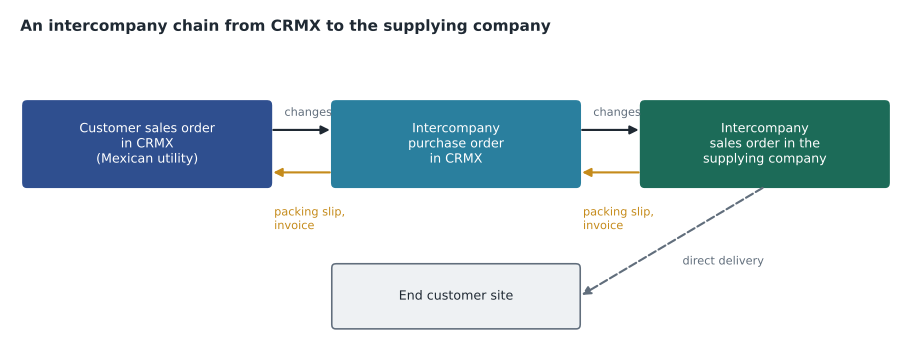
Intercompany trade links documents between legal entities in the same Dynamics 365 environment. When a sales order is entered in one company for goods that another company will supply, an intercompany purchase order is created in the selling company to buy from the supplying company, and an intercompany sales order is created in the supplying company to sell to the selling company. These three orders form an intercompany chain. Changes, confirmations, packing slips and invoices can flow along the chain automatically, so each company keeps its own books while only one person enters the original order.
The setup
Intercompany trade needs a few things in each company. The supplying company has a customer account for the buying company, and the buying company has a vendor account for the supplying company. Both accounts are linked to the same party as the companies themselves, which is how the system recognizes them as intercompany. On the customer and vendor accounts, an Intercompany setup page activates trading and defines the policies: which documents are created automatically, how prices are set, and which values are copied along the chain.
| In company | Account | For |
|---|---|---|
| CRCA | Customer IC-CRMX | Selling to CRMX |
| CRCA | Customer IC-CRUS | Selling to CRUS |
| CRUS | Customer IC-CRMX | Selling to CRMX |
| CRUS | Customer IC-CRCA | Selling to CRCA |
| CRMX | Vendor IC-CRCA | Buying from CRCA |
| CRMX | Vendor IC-CRUS | Buying from CRUS |
The intercompany customer and vendor accounts belong to the INTERCO customer and vendor groups from lessons 1 and 6, which post to the intercompany receivable and payable accounts. The financial management course reserved separate main accounts for intercompany balances, so eliminations at consolidation are straightforward.
Intercompany policies
The intercompany setup on the vendor account in the buying company, and on the customer account in the supplying company, decides how the chain behaves. The main options are on the purchase order policy and the sales order policy pages; the exact labels have changed over releases, so the table describes what each option does rather than quoting every field name.
| Policy setting | What it controls |
|---|---|
| Create intercompany orders automatically | Whether the intercompany sales order is created when the purchase order is created or confirmed |
| Use direct delivery | Whether the supplying company ships straight to the end customer |
| Post invoice automatically | Whether the purchase invoice in the buying company posts when the supplying company posts its sales invoice |
| Post packing slip and product receipt automatically | Whether a packing slip in the supplier creates the product receipt in the buyer |
| Price source | Whether the intercompany sales order price comes from the supplier's trade agreements or the buyer's purchase price |
| Value mapping | Which values, such as delivery terms or charges, are copied along the chain |
Pricing is a finance decision as much as a sales one, because the price between companies is a transfer price and is subject to tax rules in each country. Thandeka's team set transfer prices as sales trade agreements in CRCA and CRUS for the INTERCO customer group, at cost plus an agreed margin, reviewed annually with the tax advisors. The intercompany sales order takes its price from those agreements, and the intercompany purchase order in CRMX takes the same price, so both sides agree to the cent.
Direct delivery between companies
When the supplying company ships straight to the end customer, the chain uses intercompany direct delivery. The supplier's warehouse picks the goods and ships them to the customer's address, and the packing slip it posts creates, through the chain, a product receipt on the intercompany purchase order and a packing slip on the original customer order in the buying company. The goods never pass through the buyer's warehouse, but each company records its part of the sale. CRMX will use direct delivery for large pump orders, which ship from the plant straight to Mexican utilities, and normal intercompany orders for spares, which go to the Monterrey hub first.
| Step in the supplier | What happens in the buyer |
|---|---|
| Intercompany sales order confirmed | Purchase order shows the confirmed dates |
| Packing slip posted (direct delivery) | Product receipt on the purchase order and packing slip on the customer order |
| Sales invoice posted | Purchase invoice created and posted if the policy allows |
| Credit note posted | Purchase credit note created along the chain |
Changes along the chain
Changes made in the original sales order, such as a new quantity or delivery date, are passed down the chain to the intercompany purchase order and the intercompany sales order, unless those documents are already in a state that prevents changes. Changes made in the supplying company, such as a later confirmed date, are passed back up. Each company still has its own approval rules: the intercompany purchase order in CRMX follows the purchase order workflow, so the team configured a condition that skips approval for intercompany vendors, because the original sales order has already been approved by CRMX's own sales process.
Annelise warned against editing chain documents directly in the middle of the chain. If a clerk changes the intercompany purchase order by hand, the two ends can drift apart. Cobalt Ridge restricted editing of intercompany orders to the intercompany coordinator role and trained customer service to make changes on the original order.
Intercompany planning and stock transfers
Intercompany trade also matters for planning. Master planning can plan across companies: demand in CRMX can create planned intercompany purchase orders that become demand in the supplying company, so the plant sees Mexican demand without anyone emailing a forecast. This is covered in the master planning course. Simple stock moves between warehouses in the same company use transfer orders, from the product course; moves between companies always use intercompany orders, because ownership and accounting change.
Intercompany charges and taxes
Freight and handling charges can be passed along the chain. A charge on the intercompany sales order, such as freight from the plant to Monterrey, can be copied to the intercompany purchase order through value mapping, so CRMX records the freight cost it owes. Taxes are calculated in each company according to that company's own tax setup and the delivery address; cross-border sales also need customs documentation, which the chain does not produce by itself. Thandeka's team set up the export tax codes for CRCA and CRUS sales to CRMX, and the customs broker receives the commercial invoice from print management.
Reconciling intercompany balances
At month end, each company's intercompany receivable should equal the other company's intercompany payable. Because invoices flow along the chain, they usually do; differences come from timing, such as an invoice posted on the last day of the month in one company and the first day of the next in the other, and from currency revaluation. The financial management course set up monthly settlement of intercompany balances and eliminations in the consolidation company. Thandeka added a check to the month-end checklist: compare the intercompany balances by company pair before consolidating.
Tracking dimensions along the chain
Serial and batch numbers must survive the trip. When the plant ships MC-150 pumps to a Mexican utility by direct delivery, the serial numbers registered on the intercompany sales order's packing slip are passed to the product receipt on the intercompany purchase order and to the packing slip on CRMX's customer order. That keeps the traceability that the product course set up: if a seal batch fails again, Teodora can find which pumps went to which Mexican customer, even though the customer bought from CRMX. The same applies to batch numbers on seal kits shipped to the Monterrey hub, where they keep their shelf life dates and batch disposition codes.
For this to work, the item's tracking dimension group must be the same in both companies, which the product course ensured by releasing products with the same groups to every legal entity. Annelise mentioned a project where a serial-tracked item had been released to a second company without serial tracking, and every intercompany shipment had to be fixed by hand until the setup was corrected.
Intercompany returns
Returns follow the chain backwards. When a Mexican customer returns a pump to CRMX, the return order in CRMX can create an intercompany return chain: a purchase return to the supplying company and a return order there. The disposition decided in the company that receives the goods drives the credit along the chain, so CRMX credits its customer and receives a credit from the plant's company. For returns that physically go back to the plant, the return goes along the chain; for small items that CRMX scraps locally, the team agreed that CRMX would process a local return with a Credit only claim to the supplying company rather than shipping scrap across the border.
When intercompany is not the right tool
Not every relationship between the companies is a sale of goods. Engineering services provided by CRUS staff to CRMX, management fees, and shared IT costs are charged through intercompany journals or free text invoices, which the financial management course set up as monthly recharges in US dollars. Using sales orders for them would add steps without adding control. The rule the team wrote down: if goods move or inventory changes owner, use an intercompany order; if only money moves, use the finance tools.
Testing a chain
Intercompany chains touch three companies, two warehouses and several automatic postings, so they need careful testing. The team's UAT script for intercompany had the scenarios below, each run in the UAT sandbox with users signed in to the right company and role, and each checked against the expected postings in every company.
| Scenario | What to check |
|---|---|
| Spares from the distribution warehouse to the Monterrey hub | Prices match the transfer trade agreement; product receipt in CRMX; batches carried over |
| Pumps by direct delivery to a Mexican utility | Serials on all three documents; automatic product receipt and packing slip in CRMX |
| Quantity change on the original order after confirmation | Change reaches both intercompany orders |
| Supplier confirms a later date | Date appears on CRMX's order and customer confirmation |
| Invoice in the supplier at month end | Purchase invoice posts in CRMX in the same period |
| Return from a Mexican customer | Return chain created; credits in both companies |
Kiri Langford, the project manager, scheduled the intercompany scenarios for the first UAT round in January 2027, because CRMX starts trading that month and the first real chain would otherwise be the test. Security was part of the test too. The team tested which permissions CRMX customer service users need for the chain to be created and updated in the supplying company, kept those to the minimum the documentation and the tests required, and recorded the result in the security design, so nobody would later grant broad access to CRCA or CRUS just to make an order go through.
Owning the chains
Someone has to watch the chains. Cobalt Ridge created an intercompany coordinator role, held by one person in the distribution business and one in finance. The coordinator reviews chains with errors, such as an intercompany sales order that could not be created because an item had not been released to the supplying company, or a purchase invoice that failed to post automatically because the period was closed. Each morning the coordinator checks the intercompany workspace views for orders whose documents are out of step: shipped in the supplier but not received in the buyer, or invoiced in the supplier but not in the buyer. Most problems in the first weeks of any intercompany setup are master data: an item missing in one company, an intercompany account without the intercompany setup activated, or a missing trade agreement price. The coordinator's checklist puts those three checks first, before anyone edits an order.
Worked problem
A CRMX order for pumps and spares
In January 2027, a Monterrey utility orders 6 MC-150 pumps for delivery to its site and 20 seal kits for its stores, through CRMX.
Show solution
- Customer service in CRMX enters one sales order with both lines for the utility.
- For the pump line, CRMX creates an intercompany purchase order with direct delivery to CRUS, which creates an intercompany sales order at the transfer price.
- For the seal kits, CRMX ships from Monterrey stock, replenished by a separate intercompany purchase order.
- The plant ships the pumps to the utility; its packing slip creates the product receipt and customer packing slip in CRMX.
- The plant invoices CRMX; the purchase invoice posts automatically in CRMX, which then invoices the utility.
Answer: One order entered once in CRMX, with each company recording its part, and intercompany balances that match.
Common mistakes
MistakeCreating intercompany customers and vendors without linking them to the companies' parties.
InsteadLink the accounts to the correct parties so they are recognized as intercompany.
MistakeEditing documents in the middle of a chain by hand.
InsteadMake changes on the original order and let them flow along the chain.
MistakeSetting transfer prices without finance and tax review.
InsteadAgree transfer prices with finance and tax advisors and hold them in trade agreements.
MistakeUsing transfer orders to move stock between companies.
InsteadUse intercompany orders, because ownership and accounting change.
Summary and key terms
- Intercompany trade links a customer order, an intercompany purchase order and an intercompany sales order into one chain.
- Each company needs a customer or vendor account for the other, linked to the right party, with intercompany activated.
- Policies decide which documents are created and posted automatically and where prices come from.
- Intercompany direct delivery ships from the supplier to the end customer while each company records its part.
- Changes flow along the chain; month-end checks compare intercompany balances by company pair.
- Intercompany chain
- The linked customer order, intercompany purchase order and intercompany sales order.
- Transfer price
- The price at which one legal entity sells to another in the same group.
- Intercompany direct delivery
- Shipping from the supplying company straight to the end customer in an intercompany chain.
- Value mapping
- The intercompany setting that decides which values are copied along the chain.
- Intercompany policy
- Settings that control automatic creation and posting of intercompany documents.
Practice problems
Work each problem on paper first, then reveal the answer to check.
Which three orders make up an intercompany chain?
Show answer
The customer sales order, the intercompany purchase order and the intercompany sales order.
Why should intercompany moves not use transfer orders?
Show answer
Ownership and accounting change between companies; transfer orders are within one company.
Where did Cobalt Ridge hold its transfer prices?
Show answer
In sales trade agreements for the INTERCO customer group.
Lesson quiz · 5 questions
Score 60% or more to complete this lesson.
Create a free account to save your progress, take quizzes and earn a certificate.