
MSBA-331 · Lesson 8 of 12 · 19 min
Returns
▶ Video coming soon A video version of this lesson is on the way.
Three weeks into the sandbox tests, Teodora Brisebois brought the session a problem that was not a test. A utility had returned two MC-150 pumps under warranty with leaking seals, and the seal kits had come from batch SK-26-1187, the batch from the product course's traceability story. At the same time, a box of 40 O-rings from a seal supplier had failed incoming inspection and had to go back. "Two returns in one week," she said, "one from a customer and one to a vendor. Show me how the system handles both, and how I keep the bad parts away from the good ones."
Two directions of return
Returns flow in two directions. Customer returns, also called sales returns, bring goods back from customers, usually through a return material authorization (RMA), which in Supply Chain Management is the return order. Vendor returns send goods back to vendors, through a purchase order of type Returned order, usually with a return authorization number supplied by the vendor. Both appear in the MB-330 objectives: vendor returns under procurement and sales returns under sales and marketing.
| Customer return | Vendor return | |
|---|---|---|
| Document | Return order (RMA) | Purchase order of type Returned order |
| Quantity sign | Positive on the return order; received into inventory | Negative on the purchase order; issued from inventory |
| Key references | RMA number; original sales invoice | Vendor RMA number; original vendor invoice |
| Financial result | Credit note to the customer | Credit note from the vendor |
| Disposition | Disposition code decides what happens to the goods | Goods leave inventory; the vendor decides |
Return orders
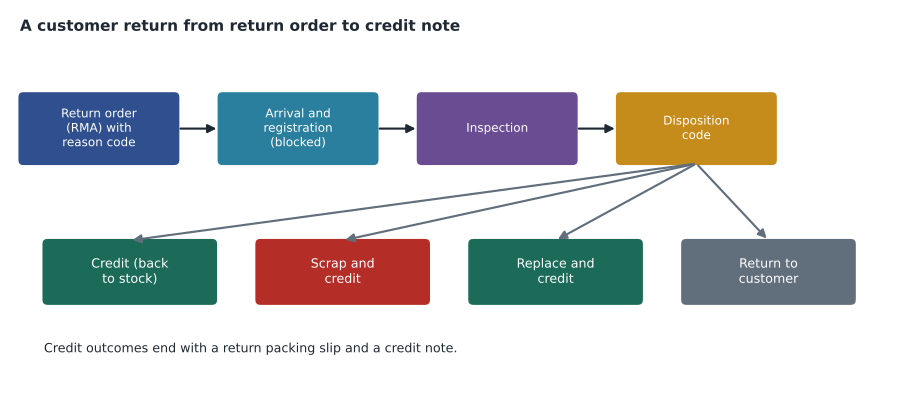
A return order is created in Accounts receivable or Sales and marketing. It names the customer, the return reason code, which explains why the goods are coming back, and an RMA number from a number sequence. Lines can be created by finding the original sales order or invoice with Find sales order, which copies the items, quantities, prices and, importantly, the original cost and dimensions, such as the serial numbers of the two pumps. Lines can also be entered manually when the original invoice cannot be found. The return order has a return deadline after which it can no longer be received, and a status that shows how far the return has progressed.
| Return order status | Meaning |
|---|---|
| Created | The RMA exists; nothing has arrived |
| Open | Some lines have been registered |
| Closed | All lines are processed or canceled |
| Canceled | The return was canceled before receipt |
Arrival, inspection and disposition codes
When the goods arrive, they are registered against the return order, usually through the arrival overview and an arrival journal, or on the mobile app in a warehouse management warehouse. Each line then needs a disposition code, which decides what happens to the returned goods and what the customer receives. Disposition codes have an action behind them, and the action is what the system acts on.
| Disposition action | What happens |
|---|---|
| Credit | Goods go back into inventory; the customer is credited |
| Credit only | The customer is credited; no goods are received into inventory |
| Scrap | Goods are received and scrapped; the customer is credited |
| Replace and credit | Goods are received, the customer is credited, and a replacement order is created |
| Replace and scrap | Goods are received and scrapped, and a replacement order is created |
| Return to customer | Goods are sent back to the customer; no credit |
Companies create their own disposition codes for each action, with names that fit their processes. Cobalt Ridge created RET-STOCK (credit, back to stock), RET-SCRAP (scrap and credit), RET-REPL (replace and credit), RET-WARR (replace and scrap, for warranty failures), RET-NOCR (return to customer) and CRED-ONLY (credit only, for small items customers keep). For the utility's two pumps, the code was RET-WARR: the pumps were received and scrapped for analysis, and a replacement order for two new pumps was created automatically.
Quality can be part of the flow. Returned items can be registered with an inventory status of blocked, and a quality order can be created by a quality association for the return event, so inspection happens before anyone chooses a disposition. Teodora's team inspects every returned pump. The two warranty pumps went to the quality lab with a quality order, and the nonconformance from the product course's setup recorded the seal failure against batch SK-26-1187.
Replacement orders
With a replace disposition, the system creates a replacement order linked to the return order. Replacement orders are ordinary sales orders with a reference back to the RMA. If the customer needs the replacement before the faulty goods come back, a replacement order can be created in advance from the return order header, with the price and terms the company chooses. Cobalt Ridge ships warranty replacements in advance for utilities, because a utility cannot wait for the return truck when a pump station is down.
Packing slips and credit notes for returns
When the disposition is set, the return is completed by posting a packing slip on the return order, which updates inventory for the received or scrapped goods, and then an invoice, which for a return is a credit note. The credit note reverses revenue and the receivable, posts tax on the credit, and, for goods back in stock, posts their cost back into inventory. Because the return line was created from the original invoice with Find sales order, the return is valued at the original cost and the credit is for the original price, which is why finding the original order matters.
Annelise raised a point about cost. If a returned item is not linked to the original sale, the system has to guess its cost, usually from the item's current cost, and the margin on the original sale is no longer reversed precisely. Thandeka wanted precise margins, so Cobalt Ridge made Find sales order mandatory for returns of items sold within the last two years, and allowed manual lines only with the credit manager's approval.
Return charges and restocking fees
Many companies charge customers for some returns. Charges can be added to return orders, either manually or by auto charges with a charge code such as a restocking fee, often as a percentage of the line amount. Charges can depend on the return reason: no fee when Cobalt Ridge shipped the wrong part, a 15 percent restocking fee when a distributor simply over-ordered. Return reason codes can be grouped, and the charge rules refer to the groups.
| Return reason group | Example reasons | Restocking fee |
|---|---|---|
| OUR-ERROR | Wrong item shipped, damaged in transit | None |
| WARRANTY | Failure within warranty | None |
| CUST-CHOICE | Over-ordered, no longer needed | 15 percent of line amount |
| CUST-ERROR | Ordered the wrong part | 10 percent of line amount |
Returns in a warehouse management warehouse
At the distribution warehouse, returns arrive at the same dock as purchase receipts and are received on the Warehouse Management mobile app. The worker scans the RMA number, the item and the quantity, and the app creates work that puts the returned goods in a returns location, not back on the shelf. A disposition can be captured on the device when the decision is obvious, such as an unopened seal kit returned because the distributor over-ordered, or left to a later inspection step. Henrik set up a separate location profile for returns with the blocked inventory status, so returned stock cannot be picked for another order until someone chooses a disposition that releases it.
Returns of batch-controlled seal kits needed one extra rule. A returned kit must be registered to its original batch, so the shelf life and the batch disposition code still apply. A kit returned from a batch that is now RESTRICT or REJECT, such as SK-26-1187, cannot go back to stock regardless of the disposition chosen on the return line, because the batch disposition code blocks it.
What a return posts
Finance wanted to see the postings. A return credited and put back to stock reverses the sale: revenue and tax are debited, the receivable is credited, and the item's cost moves from cost of goods sold back into inventory. A return that is scrapped credits the customer in the same way, but the cost goes to a scrap or warranty expense account instead of inventory. The accounts come from the inventory posting profile for the item group and the disposition, so the team mapped each disposition code to an outcome before testing.
| Disposition at Cobalt Ridge | Customer credit | Inventory effect | Cost goes to |
|---|---|---|---|
| RET-STOCK | Yes | Received to stock | Inventory |
| RET-SCRAP | Yes | Received and scrapped | Scrap expense |
| RET-REPL | Yes | Received to stock; replacement shipped | Inventory |
| RET-WARR | Yes | Received and scrapped; replacement shipped | Warranty expense |
| RET-NOCR | No | Shipped back to the customer | No change |
| CRED-ONLY | Yes | None | No inventory effect |
Ifeoma Ladipo-Ward, the cost accountant, asked for warranty costs to be visible by product line. Because the warranty expense posting carries the financial dimensions of the return line, which default from the original sale, the warranty cost of the two MC-150 pumps landed on the CENTRIF product line and the Municipal Water business unit, the dimensions set up in the financial management course.
Watching returns
Returns are a signal. A rise in returns for one item or one reason usually points to a quality, packaging or ordering problem. The team set up three measures, reported monthly: returns as a percentage of shipments by item group, returns by reason group, and the average days from RMA creation to credit note. Teodora reviews the warranty returns with engineering; Tadeusz reviews the customer choice and customer error returns with the distributor managers, because frequent over-ordering often means a distributor's own reorder points are wrong.
| Measure | Owner | Reviewed with |
|---|---|---|
| Returns percentage by item group | Quality | Engineering |
| Returns by reason group | Customer service | Distributor managers |
| Days from RMA to credit note | Customer service | Credit team |
| Vendor returns by vendor | Procurement | Quality, for vendor scores |
Vendor returns
The O-rings went the other way. A vendor return is a purchase order with the purchase type Returned order, or a return line with a negative quantity on an ordinary purchase order. The vendor's return authorization number goes into the RMA number field, which is required for returned orders. As with customer returns, the line can be linked to the original purchase so the return is valued at the original cost; the O-rings' line was created by finding the original receipt. Posting the packing slip on the returned order issues the goods from inventory; the vendor's credit note is then posted as a vendor invoice with negative quantities.
The rejected O-rings were already on HOLD with a quality order from the product course's setup, and their inventory status was blocked. The returned order picked them from the quarantine location, and the warehouse shipped them back with the vendor's RMA number on the packing slip. Marisol asked how vendor returns affect vendor scores. The quarterly evaluation from lesson 1 counts the returned quantity against each vendor, so the supplier's quality score dropped.
Returns that cross companies or skip the warehouse
Two kinds of return need extra thought. When goods were sold through an intercompany chain, which lesson 9 covers, a customer return in the selling company can create an intercompany return chain back to the company that holds the stock, so both companies' documents stay linked. When goods were shipped by direct delivery from a vendor, the customer may return them to the vendor directly; then the return order in Cobalt Ridge's system is linked to a vendor return, and the customer's credit and the vendor's credit are processed together, often with the disposition Credit only on the customer side because the goods never come back to Cobalt Ridge's warehouse.
Annelise suggested testing both cases before go-live, because they are rare enough that nobody will remember how they work when the first one happens. The team added two scenarios to the UAT script: a distributor returning seal kits that were bought intercompany from CRUS, and a distributor returning third-party seal kits that were shipped by direct delivery from the manufacturer. Both were scheduled for the January 2027 UAT round.
Worked problem
Processing the warranty return
A utility returns two MC-150 pumps, serials MC150-260931 and MC150-260944, with leaking seals. The utility needs replacements immediately.
Show solution
- Create a return order for the utility with reason code WARRANTY, and use Find sales order to copy the original invoice line with both serial numbers.
- From the return order, create a replacement order in advance for two pumps and ship it the same day.
- When the pumps arrive, register them with inventory status blocked; the quality association creates a quality order.
- After inspection confirms seal failure, set disposition code RET-WARR (replace and scrap) on the line.
- Post the return packing slip and the credit note; the nonconformance records the failure against batch SK-26-1187.
Answer: The utility has working pumps, is credited for the faulty ones, and the failure is traced to the seal batch.
Common mistakes
MistakeEntering return lines manually when the original invoice exists.
InsteadUse Find sales order so the return uses the original price, cost and dimensions.
MistakeChoosing a disposition before inspection for items that may be faulty.
InsteadRegister returns as blocked and inspect them first.
MistakeApplying the same restocking fee to every return.
InsteadBase charges on return reason groups so the company's own errors are not charged.
MistakePosting a vendor return without the vendor's RMA number.
InsteadRecord the vendor's return authorization in the RMA number field.
Summary and key terms
- Customer returns use return orders (RMAs); vendor returns use purchase orders of type Returned order.
- Return lines should be created from the original sale or purchase to keep price, cost and dimensions.
- Disposition codes, each with an action, decide whether goods are restocked, scrapped, replaced or returned and whether credit is given.
- Replacement orders can be created when goods arrive or in advance; returns end with a packing slip and a credit note.
- Charges such as restocking fees can depend on return reason groups.
- Return order
- A document that authorizes and records goods returned by a customer (RMA).
- Disposition code
- A code with an action that decides what happens to returned goods and the customer's credit.
- Return reason code
- A code that records why goods are returned.
- Replacement order
- A sales order created to replace returned goods, linked to the return order.
- Returned order
- The purchase type used to return goods to a vendor.
Practice problems
Work each problem on paper first, then reveal the answer to check.
Which disposition action credits the customer without receiving goods into inventory?
Show answer
Credit only.
What field must be filled for a purchase order of type Returned order?
Show answer
The RMA number from the vendor.
Why use Find sales order on a return?
Show answer
To copy the original price, cost and dimensions such as serial numbers.
Lesson quiz · 5 questions
Score 60% or more to complete this lesson.
Create a free account to save your progress, take quizzes and earn a certificate.