
MSBA-331 · Lesson 12 of 12 · 18 min
Case study: order-to-cash for a distributor
▶ Video coming soon A video version of this lesson is on the way.
For the last session, Annelise set the team a test. They would run one complete order-to-cash and procure-to-pay cycle for the distribution business in the CONFIG sandbox, using everything from the previous eleven lessons, with real people in their real roles: Tadeusz at customer service, Marisol as buyer, Henrik at the warehouse, Thandeka's team for invoices and rebates, and Teodora for quality. Piotr would watch the clock. The scenario was invented but built from real events: a new distributor, Hollowpine Supply, with branches in two provinces or states, placing its first order. Kiri Langford had written the script, and nobody had seen it beforehand.
The scenario
Hollowpine Supply is a regional distributor of water and wastewater equipment. It has agreed to carry Cobalt Ridge's DU-40 distributor units, MC-150 municipal pumps and spares from January 2027, under the standard distributor terms: price group DIST-B, discount group DIST, the distributor rebate agreement, free freight over 5,000, and a credit limit of 60,000. Its first order is for 3 DU-40 units, 2 MC-150 pumps (200 millimeter, 22 kilowatt, epoxy) and 30 SK-90H seal kits, delivered to its main branch in three weeks, plus 10 seal kits shipped directly to its second branch. Only 1 DU-40 is in stock; the rest must be bought or made.
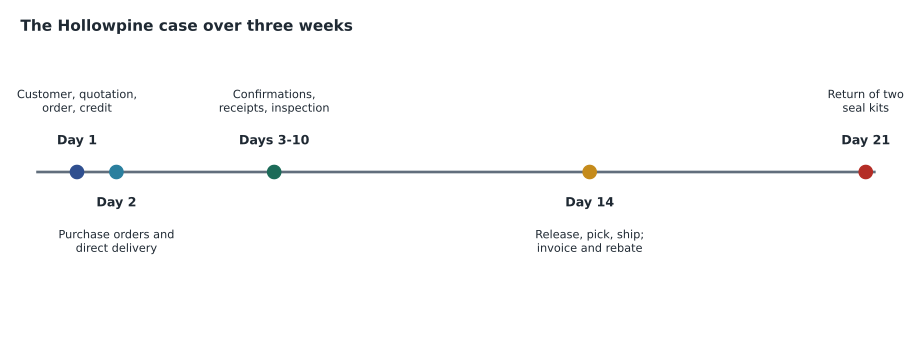
Step 1: the customer and the quotation
Tadeusz created Hollowpine as a customer in CRUS, in customer group DIST, with its two branch addresses as delivery addresses and the main office as the invoice address. He set price group DIST-B, discount group DIST, the sales group for the territory manager, the tax group and the credit limit. Because the order was Hollowpine's first and over 20,000, the company's rules required a quotation, so he created one with all four lines. Prices came from the trade agreements: the DU-40 at the DIST-B price, the pumps from the MC-150 price list by variant, and the seal kits with the 10 percent DIST discount on SEALS and the 5 percent multiline discount on seal kits.
| Line | Quantity | Price source | Net unit price |
|---|---|---|---|
| DU-40 distributor unit | 3 | DIST-B price group | 4,850 |
| MC-150 : 200 : 22 kW : Epoxy | 2 | MC-150 price list by variant, DIST-B | 9,400 |
| SK-90H seal kit (main branch) | 30 | DIST-B price, 10 percent DIST, 5 percent multiline | 205.20 |
| SK-90H seal kit (second branch, direct delivery) | 10 | Same as above | 205.20 |
The seal kit price shows the discounts working together. The DIST-B group price was 240. The 10 percent line discount brings it to 216, and the 5 percent multiline discount brings it to 205.20. The order has 40 seal kits, and the multiline discount applied because the sandbox's multiline trade agreement line for the DIST group had a From quantity of 40, not the 50 agreed in lesson 5. Tadeusz noticed it in the price details view, which he opened to check every step before sending the quotation. He kept the quotation as it was, because Hollowpine had been promised the discount during negotiation, and noted the difference for the debrief. Hollowpine accepted the quotation the next morning.
Step 2: order, credit and dates
Confirming the quotation created the sales order. The order total was 14,550 plus 18,800 plus 8,208, or 41,558 before tax, under the 60,000 limit, so credit management did not place a hold. ATP on the DU-40 showed one unit now and none for nine days, so Tadeusz used delivery date control to split the line: one unit with the rest of the order in three weeks was fine, since all three were needed by then. The two MC-150 pumps were available to promise from planned production in twelve days. The seal kits for the second branch were set up for direct delivery from the seal kit manufacturer, which creates a linked purchase order.
Step 3: buying what was missing
Master planning ran overnight in the sandbox and proposed planned purchase orders for the DU-40 components and a planned production order for the pumps; production is covered in a later course. Marisol firmed the planned purchase orders. Two went to Lakehead Forge, which is on vendor collaboration, and one to a small motor-controller vendor that only uses email. The direct delivery purchase order for the 10 seal kits went to the seal kit manufacturer with Hollowpine's second branch as the delivery address. All three orders went through the purchase order workflow; the two under 25,000 were approved without a step, and the third went to the buyer's lead.
Lakehead accepted one order and accepted the other with changes, proposing a two-day later date. Marisol checked with planning and accepted. The motor-controller vendor replied by email with a confirmation and a price increase of 3 percent. In the UAT pilot setup, the procurement agent extracted the confirmation and the price change and marked the change as having no impact on delivery, but Marisol rejected the price change, because the purchase agreement with that vendor fixed the price until June 2027, and sent a drafted reply that she edited to quote the agreement.
Step 4: receiving and inspection
The components arrived over the next week at the plant. Castings were registered by heat number, the quality association created quality orders, and Teodora's inspectors released them. One delivery of motor controllers was 4 percent short; the line allowed 5 percent under delivery, and the vendor said no more were coming, so the receiving clerk closed the line short. The freight charge from Lakehead came on the vendor invoice, was allocated by weight, and was posted to the items as FRT-IN, raising their cost.
| Receipt | What happened | Lesson |
|---|---|---|
| Castings from Lakehead Forge | Registered by heat, quality order, released | 3 |
| Motor controllers | Received 4 percent short and closed within tolerance | 3 |
| Lakehead freight | Charged to the items and allocated by weight | 10 |
| Seal kits by direct delivery | Vendor shipped to the second branch; receipt and packing slip posted together | 3 and 7 |
Step 5: shipping
On day 14, the DU-40 units and pumps were in the distribution warehouse. Henrik's team released the order to the warehouse. The consolidation policy combined it with a small order Hollowpine placed for gaskets the same morning, so both left on one shipment. The wave created pick work; the seal kits were picked first-expiry, first-out by batch, and the pumps' serial numbers were scanned. The load was ship confirmed in the afternoon, and the packing slip was emailed to Hollowpine with the seal kits' certificate of analysis. The order was over 5,000, so the freight auto charge was zero, and the absorbed freight was recorded for the margin report.
Step 6: invoice and rebate
The evening invoice batch posted one invoice for Hollowpine's shipment by summary update. Tax was calculated from the delivery address. The invoice created a rebate transaction under the distributor rebate agreement. Hollowpine's purchases so far were below the first tier of 250,000, so the accrual was zero, but the transaction recorded the invoiced amount toward the annual total. The territory manager's 2 percent commission was calculated on the net invoice amount. Thandeka checked the postings: revenue, receivable, tax, cost of goods sold including the freight added at receipt, and the commission accrual, each with the business unit and product line dimensions from the financial management course.
Step 7: a return
On day 21, Hollowpine reported that two seal kits had arrived with torn packaging. Tadeusz created a return order with reason code OUR-ERROR, using Find sales order to copy the original invoice line and batch. Because the reason group was OUR-ERROR, no restocking fee applied. The kits were registered as blocked at the distribution warehouse, inspected, and given the disposition RET-SCRAP; the credit note was posted, and the cost went to scrap expense. Teodora logged the packaging problem against the seal kit supplier for its quarterly score.
Step 8: the month-end view
Kiri's script ended with a month-end check, because a process that works on one order can still fail at period end. Thandeka's team ran the reports for the test month in the sandbox. The open purchase order lines report showed nothing left from the case except the closed short line, which correctly had no remaining quantity. The received-not-invoiced balance was zero after the vendor invoices were matched. The intercompany balances were untouched, since Hollowpine bought from one company. The rebate accrual report showed Hollowpine's invoiced total toward the first tier and a zero accrual, as expected. And the commission accrual for the territory manager matched 2 percent of the net invoice.
| Month-end check | Expected result | Result |
|---|---|---|
| Open purchase order lines | Only lines not yet due | As expected |
| Received not invoiced | Zero for the case | As expected |
| Rebate accrual for Hollowpine | Zero; total counted toward tier | As expected |
| Commission accrual | 2 percent of net invoice | As expected |
| Freight absorbed on orders over 5,000 | Visible in the margin report | Visible after a report filter fix |
What the case did not cover
Annelise was careful to say what the test left out, so nobody would assume it had been proven. It did not use intercompany trade, which has its own UAT scenarios from lesson 9. It did not use landed cost, which is phase 2. It did not test the customer rebate at a tier boundary, which the rebate tests in lesson 10 cover. It ran with the procurement agent in a pilot configuration with draft-only emails, not with automatic sending. And it did not test volumes: one order is not a thousand. The performance test planned for January 2027 will release 400 distributor orders in a wave and post their invoices in one batch, to check that the dock, the batch jobs and the people can keep up.
The team also noted what would make the next case harder and more useful: a distributor who disputes a price after the invoice, a vendor who ships the wrong variant of a pump component, and a credit hold that is released while the order is already picked. Kiri added all three to the second UAT round.
The debrief
The whole cycle took the team 2 hours and 40 minutes in the sandbox, compared with an estimate of more than a day of emails and phone calls in the old process. Piotr's list of findings went into the project log. Three were configuration fixes: the multiline discount threshold for Hollowpine's group had to be confirmed with sales, the consolidation policy needed a cut-off time, and the return reason OUR-ERROR needed a sub-reason for packaging. Two were training points: buyers should check purchase agreements before accepting price changes, and warehouse workers should scan seal kit batches rather than type them. One was a decision: the procurement agent pilot would go ahead with the 30 vendors agreed in lesson 11.
| Finding | Type | Owner |
|---|---|---|
| Confirm multiline threshold for DIST-B with sales | Configuration | Tadeusz |
| Add a release cut-off time to the consolidation policy | Configuration | Henrik |
| Add a packaging sub-reason under OUR-ERROR | Configuration | Annelise |
| Check purchase agreements before accepting price changes | Training | Marisol |
| Scan batches on the mobile app, never type them | Training | Henrik |
| Proceed with the procurement agent pilot for 30 vendors | Decision | Piotr |
Annelise closed the series by connecting it to what comes next. The warehouse management course will take Henrik's dock from this course's outline to a full setup of locations, work templates and the mobile app. The master planning course will explain the planned orders that appeared overnight. And the exam readiness course for MB-330 will review procurement and sales alongside product information, inventory, warehousing and planning, with the domain weights from the October 21, 2026 skills measured.
Worked problem
Checking the seal kit price
The DIST-B price for SK-90H is 240. The DIST line discount on SEALS is 10 percent, and in the sandbox the multiline discount is 5 percent for 40 or more seal kits on one order. Hollowpine orders 40. What is the net unit price, and what is the line amount for the 30 kits to the main branch?
Show solution
- Start from the group price: 240.
- Apply the 10 percent line discount: 240 less 24 is 216.
- Apply the 5 percent multiline discount to the discounted price: 216 less 10.80 is 205.20.
- Line amount for 30 kits: 30 times 205.20 is 6,156.
- Check the result against the price details view on the sales line.
Answer: The net unit price is 205.20 and the main-branch line is 6,156 before tax.
Common mistakes
MistakeTesting each process separately and never end to end.
InsteadRun a full cycle with the real roles so hand-offs and timing are tested.
MistakeAccepting vendor price changes without checking agreements.
InsteadCheck purchase agreements and trade agreements before accepting changes.
MistakeWriting scripts that the testers have already seen.
InsteadUse a fresh scenario so the test shows how people work without rehearsal.
MistakeLeaving debrief findings without owners.
InsteadGive every finding a type and an owner in the project log.
Summary and key terms
- An end-to-end case ties together customers, quotations, pricing, credit, delivery dates, purchasing, receiving, shipping, invoicing, rebates and returns.
- Trade agreements, multiline discounts and price details make pricing checkable on every line.
- Vendor collaboration and the procurement agent handle confirmations; buyers check agreements before accepting changes.
- Warehouse release, consolidation and ship confirm end in a packing slip; invoicing creates rebate and commission transactions.
- A debrief turns test results into configuration fixes, training points and decisions with owners.
- End-to-end test
- A test that runs a complete business cycle across processes and roles.
- Order-to-cash
- The cycle from customer order to payment.
- Procure-to-pay
- The cycle from need to vendor payment.
- Debrief
- A review of a test that records findings and owners.
- Price details
- The view showing which agreements and discounts produced a line's price.
Practice problems
Work each problem on paper first, then reveal the answer to check.
Why was no restocking fee charged on the seal kit return?
Show answer
The reason group was OUR-ERROR, which has no restocking fee.
Why did Marisol reject the motor-controller vendor's price change?
Show answer
A purchase agreement fixed the price until June 2027.
What did the invoice create besides revenue and receivable postings?
Show answer
A rebate transaction and a commission calculation.
Lesson quiz · 5 questions
Score 60% or more to complete this lesson.
Create a free account to save your progress, take quizzes and earn a certificate.