
MSBA-122 · Lesson 9 of 12 · 20 min
Scaling agents safely
▶ Video coming soon A video version of this lesson is on the way.
When Saoirse first counted the agents in Quillfield's tenant, a few weeks after Agent Builder was switched on, she found 23. Some were excellent. Several pointed at the same procedure documents. Two were grounded in a SharePoint site that held draft commission plans. One, built by an enthusiastic account executive, answered client questions with information from a price list that had been replaced in the spring. None of this was anyone's fault; the tools made building easy, and nobody had said what should happen next. By November there were more than forty agents, and the council needed a way to let good agents grow without letting the problems grow with them.
This lesson covers how to scale agents safely: knowing what agents exist, managing them through a lifecycle, choosing the right controls for their risk, and keeping costs predictable. It draws on the AB-731 guide's emphasis on governance, on impacts to data, security, privacy and cost, and on understanding pay-as-you-go billing for agents.
Why agents need their own governance
An agent is more than a saved prompt. It has instructions that shape its behavior, knowledge sources that decide what it can see, tools or actions that decide what it can do, and a set of users. Each of those is a decision with consequences. And because agents are cheap to create and easy to share, they multiply. Without governance an organization ends up with what IT teams sometimes call agent sprawl: many overlapping agents of unknown quality, some using data they should not, with nobody clearly responsible for them.
The answer is not to stop people building. Agents built close to the work are often the most useful, and Quillfield's best ones came from staff like Yusra who knew exactly which questions colleagues asked. The answer is to treat agents like any other business asset: know what you have, give each one an owner, and match controls to risk.
The agent lifecycle
The council adopted a simple lifecycle for every agent shared beyond its creator.
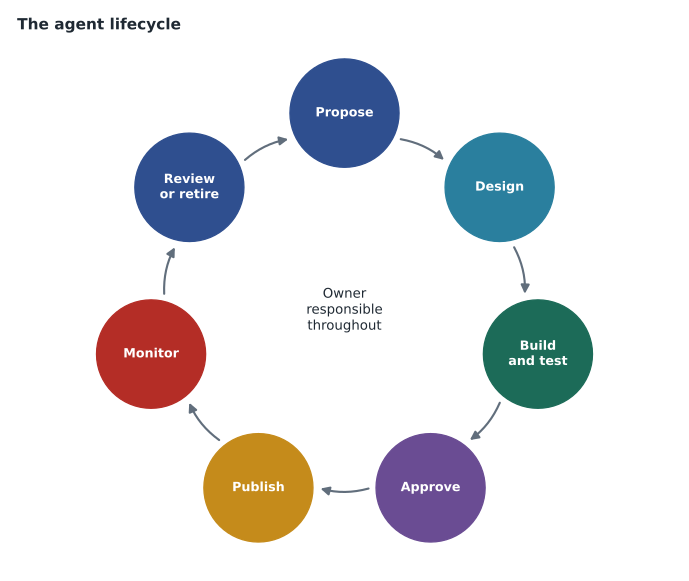
Propose. The maker fills in a short use case card: the problem, the users, the knowledge sources, the actions, the risk tier and the expected cost.
Design. The maker chooses knowledge sources that are current, accurate and correctly permissioned, decides what the agent may and may not do, and writes clear instructions.
Build and test. The maker tests the agent with realistic questions, including hard and unusual ones, and with questions it should refuse. For Tier 2 and Tier 3 agents, someone other than the maker also tests it.
Approve. Approval follows the council's decision rights: the team manager for small internal agents, the council for agents that use client data, reach many people or act on their own.
Publish. The agent is shared only with the audience it was designed for.
Monitor. The owner reviews usage, quality and cost each month.
Review or retire. Every six months, the owner confirms the agent is still needed and its knowledge is current. Agents that are no longer used, or whose owner has left, are retired.
Knowing what agents exist
An organization cannot govern agents it cannot see. Microsoft provides several places to find them. Administrators can see and manage agents in the Microsoft 365 admin center, including which agents are available, who can use them and whether they are approved. Microsoft Agent 365, generally available since May 2026 and licensed per user, adds an organization-wide registry of agents with governance, security and observability features across Microsoft and third-party agents. In Microsoft Entra, agent identities allow agents to be managed with the same identity controls as people and applications. Agents built in Copilot Studio live in Power Platform environments, where administrators can apply data policies and managed environment settings.
An AI Transformation Leader does not need to operate these tools, but should expect IT to answer four questions at any time: how many agents exist, which are shared widely, which use sensitive data, and which have no current owner.
Controls that match the risk
The responsible AI policy's risk tiers (Lesson 3) set the level of control for each agent. The council mapped them to specific requirements.
| Control | Tier 1 | Tier 2 | Tier 3 |
|---|---|---|---|
| Named owner | Creator | Required | Required, plus a deputy |
| Use case card | Not needed | Required | Required |
| Independent testing | Not needed | Recommended | Required, including fairness checks |
| Approval | None | Manager or council by threshold | Council |
| Human approval of outputs | User reviews own work | For anything sent to clients | For every consequential output |
| Monitoring | None | Monthly owner review | Monthly review plus quarterly audit |
| Review or retire | Creator's choice | Every six months | Every six months and after changes |
Two controls deserve emphasis. First, least privilege: an agent should have only the knowledge and actions it needs. An HR leave agent needs the leave policy and the ability to create a leave case for the person asking; it does not need the payroll site. Second, autonomy in steps: agents that act on their own start in drafts-only mode, with a person approving every action, and gain autonomy only after their results justify it. Quillfield's renewals-mailbox agent, which sorts incoming emails and drafts replies, will run drafts-only for at least six months before the council considers letting it send routine acknowledgments.
Worked problem
Reviewing an agent for wider release
Yusra's HR Leave Assistant has been live for all employees since late September. In its first full month it resolved about 74 percent of conversations without a person, users rated it 4.3 out of 5, it consumed about 2,410 billable Copilot Credits, and HR advisers estimated it saved them about 8 hours. Daria now asks for a similar agent for personal lines that would answer client questions on the public website. What should the council consider before approving it?
Show solution
- Audience: the HR agent serves employees; a website agent serves clients and the public, which raises the risk tier.
- Knowledge: client-facing answers must come from approved, current content, not internal procedures.
- Actions: the HR agent creates leave cases for the person asking; a client agent should not change policies or quote prices on its own.
- Transparency: clients must be told they are talking to an AI assistant and how to reach a person.
- Testing: hard and unusual client questions, including complaints and questions it should refuse.
- Cost: public traffic is less predictable, so a budget and alert are essential.
Answer: The client agent is a new Tier 2 or Tier 3 system, not an extension of the HR agent. Its success inside the company is encouraging, but the council should treat it as a separate proposal with its own testing, transparency and cost controls.
Keeping costs predictable
Agents used by people without Microsoft 365 Copilot licenses, and agents that run autonomously, are billed in Copilot Credits. Organizations can pay as they go through a linked Azure subscription, at one US cent per credit, buy capacity packs of 25,000 credits a month for 200 US dollars, or pre-purchase credits for a discount. The right option depends on how much and how steadily the organization uses agents.
Worked problem
Pay-as-you-go or a capacity pack
Quillfield's metered agents used about 9,000 credits in October. Saoirse expects that to rise to about 24,000 credits a month once the claims team gets its procedures agent. Compare the monthly cost of pay-as-you-go at one US cent per credit with one capacity pack of 25,000 credits at 200 US dollars a month.
Show solution
- Current, pay-as-you-go: 9,000 times 0.01 = 90 US dollars.
- Future, pay-as-you-go: 24,000 times 0.01 = 240 US dollars.
- Future, capacity pack: 200 US dollars for up to 25,000 credits.
- Break-even: 200 divided by 0.01 = 20,000 credits a month. Above that, the pack is cheaper.
Answer: Stay on pay-as-you-go while usage is about 9,000 credits; consider a capacity pack once usage settles above about 20,000 credits a month. At 24,000 credits the pack saves about 40 US dollars a month, but only if usage is steady, since unused capacity does not carry over.
Whatever the billing choice, the controls are the same: a budget for each agent or group of agents, alerts before the budget is reached, a named owner who reviews consumption monthly, and a council review when an agent's cost grows faster than its value.
Cleaning up sprawl
Saoirse's first agent review in October found that 9 of the 23 agents had not been used in a month, 4 duplicated others, and 2 used a site that should not have been shared. The council agreed a one-time clean-up: unused agents were retired after their creators were notified; duplicates were merged into the best version, with the other creators credited; and the two agents using the commission site were disabled until the site was fixed. The council also asked IT to report agents without an owner monthly, and set the target at zero.
| Finding | Count in October | Action |
|---|---|---|
| Unused for 30 days or more | 9 | Notified creators; retired after two weeks |
| Duplicates of another agent | 4 | Merged into the best version |
| Using overshared content | 2 | Disabled until the site was fixed |
| Using out-of-date knowledge | 1 | Owner updated the source; retested |
| Healthy and in use | 7 | Kept; owners confirmed |
The clean-up took about two weeks and removed most of the risk. More importantly, the lifecycle meant it would not have to be repeated on the same scale.
Agents across the organization
As agents spread, the council found it useful to group them into three classes, each with a default approach.
| Class | Examples | Default approach |
|---|---|---|
| Personal agents | A user's helper over their own files and notes | Allowed within the guardrails; no approval |
| Team and department agents | Procedure helpers, onboarding guides, policy explainers | Lifecycle with manager or council approval by threshold |
| Enterprise and client-facing agents | Website assistants, autonomous mailbox agents, agents in business processes | Full lifecycle with council approval, testing and audits |
The classes also helped with cost. Personal agents used by licensed users are generally covered by the Microsoft 365 Copilot license within fair use. Team agents used by unlicensed staff and enterprise agents are where Copilot Credits accumulate, so those classes got budgets.
The role of IT
Scaling agents safely depends on a partnership between the business and IT. The business decides what agents are for and owns their content and results. IT provides the platform: environments for development, testing and production in Copilot Studio; data policies that control which connectors agents may use; identity and access controls; monitoring; and the inventory. At Quillfield, Saoirse's team set up three Power Platform environments for agents, with makers building in development, testing in a test environment and publishing to production only after approval. That structure, borrowed from software development, meant that a change to a popular agent could be tested before it reached hundreds of people.
Retiring agents well
Retirement is the stage most often forgotten. An agent that is no longer maintained can give out-of-date answers for months before anyone notices. Quillfield's rule was that an agent whose owner left the company had thirty days to find a new owner or be retired, and that every agent unused for ninety days would be reviewed for retirement. Retiring an agent meant notifying its users, pointing them to any replacement and removing it from the catalog of available agents, rather than simply deleting it overnight.
Common mistakes
MistakeStopping staff from building agents to avoid sprawl.
InsteadLet people build, but require owners, a lifecycle and controls matched to risk.
MistakeGiving agents broad access in case they need it.
InsteadApply least privilege to knowledge and actions.
MistakeLetting autonomous agents act from day one.
InsteadStart drafts-only and expand autonomy as results justify it.
MistakeTreating a successful internal agent as approved for clients.
InsteadReview a client-facing version as a new, higher-risk proposal.
MistakeBuying a capacity pack before usage is steady.
InsteadUse pay-as-you-go until volumes are predictable, then compare against the break-even.
Summary and key terms
- Agents have instructions, knowledge, actions and users, and they multiply quickly; without governance, agent sprawl follows.
- A lifecycle of propose, design, build and test, approve, publish, monitor and review or retire keeps agents healthy.
- Microsoft 365 admin center, Agent 365, Entra agent identities and Power Platform environments help organizations see and control agents.
- Controls scale with risk tier: owners, testing, approval, human review, monitoring and regular review.
- Least privilege and autonomy in steps are the two most important controls.
- Choose pay-as-you-go, capacity packs or pre-purchase by volume and steadiness, and give every metered agent a budget, alert and owner.
- Agent sprawl
- The uncontrolled growth of overlapping agents of unknown quality and ownership.
- Agent lifecycle
- The stages an agent passes through from proposal to retirement.
- Least privilege
- Giving a system only the access it needs for its task.
- Autonomy in steps
- Expanding an agent's ability to act on its own gradually, as results justify it.
- Capacity pack
- A monthly prepaid allocation of Copilot Credits, such as 25,000 credits for 200 US dollars.
- Microsoft Agent 365
- A Microsoft product, generally available since May 2026, for registering, governing and observing agents across an organization.
Practice problems
Work each problem on paper first, then reveal the answer to check.
At what monthly volume does a 25,000-credit pack at 200 US dollars become cheaper than pay-as-you-go at one US cent per credit?
Show answer
Above 20,000 credits a month.
Name the seven stages of Quillfield's agent lifecycle.
Show answer
Propose, design, build and test, approve, publish, monitor, review or retire.
What four questions should IT be able to answer about agents at any time?
Show answer
How many exist, which are shared widely, which use sensitive data and which have no current owner.
Lesson quiz · 5 questions
Score 60% or more to complete this lesson.
Create a free account to save your progress, take quizzes and earn a certificate.