
MSBA-122 · Lesson 1 of 12 · 19 min
An AI strategy on one page
▶ Video coming soon A video version of this lesson is on the way.
By the middle of the autumn, Quillfield Insurance Brokers had more AI activity than anyone had planned. Every one of its 380 employees could use Microsoft 365 Copilot Chat with a work account. Sixty people in a pilot group had Microsoft 365 Copilot licenses. Yusra Kamaludin had built agents that people actually used, the contact center had a Coverage Explainer agent billed on a pay-as-you-go meter, and Bram Oosterhuis was sketching two projects in Microsoft Foundry. Hamish Quarrington's measurements showed pilot users saving a little over three hours a week on five common tasks. What Quillfield did not have was a single statement of what all this was for.
Celestine Nwachukwu-Hale, the chief operating officer and executive sponsor for AI, opened the first meeting of the new AI council with a blank page. "By the end of this series," she said, "I want one page that any manager in this company can read in three minutes and use to decide whether a new AI idea fits. If it does not fit on one page, we do not understand it yet."
This course follows the council as it turns Quillfield's experiments into a program. It covers the third domain of Exam AB-731, Microsoft Certified: AI Transformation Leader, which Microsoft titles "Identify an implementation and adoption strategy for Microsoft's AI apps and services" and weights at 20 to 25 percent of the exam. That domain has two parts: aligning an AI strategy with Microsoft's responsible AI policies, and planning for AI adoption across the organization. The companion courses on the business value of generative AI and on Microsoft's AI apps and services cover the other two domains.
Why a strategy at all
A company can get real value from AI without a written strategy, at least for a while. Enthusiastic people try tools, share what works and save time. The trouble starts when the experiments multiply. Without a shared view, each team buys or builds what suits it, the same documents end up behind five different agents, nobody can say what the program costs in total, and the risks are managed one incident at a time. Leaders also lose the ability to say no: if there is no stated purpose, every idea is as good as every other.
A strategy fixes these problems by making a small number of decisions explicit. It says what the organization is trying to achieve with AI, where it will focus first, what it will not do, how it will manage risk, how it will measure success and what it will invest. Everything else, such as which agent to build next or which team gets licenses, follows from those decisions.
The AB-731 study guide does not prescribe a format. Its emphasis is on the elements a strategy must connect: business value, responsible AI, governance, an AI council, an adoption team, champions, barriers, and the impacts on data, security, privacy and cost. A one-page strategy is a practical way to show that those elements fit together.
The seven parts of a one-page strategy
After two meetings the council settled on seven headings. They are a common shape for an AI strategy, and they map closely to the topics in this course.
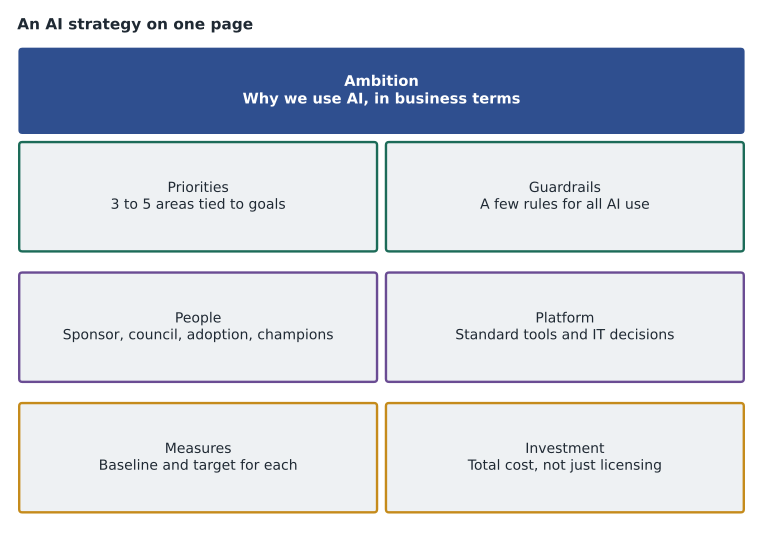
1. Ambition. One or two sentences that say why the organization is using AI, in terms of its own business. Quillfield's draft read: "We use AI to give our people more time with clients and fewer hours on paperwork, so that we grow without losing the personal service our clients choose us for." The ambition is not about technology. It names the outcome and the value the organization will protect.
2. Priorities. Three to five areas where AI will be applied first, each tied to a business result. Quillfield chose renewal preparation in commercial lines, faster answers in the contact center, and less administrative work for account executives. Priorities give managers a test: an idea that serves a priority goes to the front of the queue; an idea that serves none waits.
3. Guardrails. The few rules that apply to every AI use. Quillfield's were short: company and client data go only into work-account AI tools; a person reviews anything sent to a client; agents that act on their own start with drafts only; and every AI system has a named owner. Lesson 3 covers how guardrails grow into a responsible AI policy.
4. People. Who leads the program and how employees will be supported: the executive sponsor, the AI council, the adoption team, champions and training. Lessons 2, 6 and 7 cover these roles.
5. Platform. Which Microsoft products the organization will standardize on, and which decisions are reserved for IT. For Quillfield this meant Microsoft 365 Copilot and Copilot Chat as the everyday tools, Copilot Studio for agents, and Microsoft Foundry only for projects Bram's small team could support. Standardizing does not mean nothing else is allowed; it means the default is clear.
6. Measures. How the organization will know whether AI is working: a few adoption, impact and risk measures, each with a baseline and a target. Lesson 8 covers measurement in depth.
7. Investment. What the program will cost in the coming year: licenses, consumption, implementation, training and people's time, and where the money comes from. Lorne Macpherson-Ibe, the chief financial officer, insisted that this box show total cost, not only licenses, because in his experience licenses were rarely the largest item.
Writing the ambition
The ambition is the hardest sentence to write because it must be specific enough to guide choices and short enough to remember. The council tested drafts against three questions. Would an employee understand it without a glossary? Does it say what the business gains? Does it say what the business will protect? An ambition such as "Become an AI-first company" fails the first two tests. "Use AI to make every process 30 percent more efficient" fails the third, because it says nothing about clients or employees, and it invites people to read AI as a cost-cutting program.
That last point mattered at Quillfield. When Copilot Chat arrived in September, Daria Velikova, the head of personal lines, heard staff in her team asking whether AI meant fewer jobs. An ambition that talked only about efficiency would have confirmed their fear. An ambition that talked about more time with clients gave managers something honest and positive to say, and it was true to the measurements: the time saved in the pilot was mostly reinvested in client calls and in clearing backlogs.
| Draft ambition | Problem | Better version |
|---|---|---|
| Become an AI-first company | Vague; says nothing about value | Use AI to give our people more time with clients |
| Automate 30 percent of our work | Sounds like job cuts; ignores quality | Remove routine paperwork so we can grow without losing service |
| Deploy Copilot to everyone by June | A milestone, not an ambition | Belongs in Priorities or Measures, not the headline |
| Lead the industry in AI innovation | Not testable; invites hype | Name the clients and work that will improve |
Choosing priorities
Priorities should come from the business strategy, not from a list of AI features. The council started by listing Quillfield's three business goals for the next two years: grow commercial lines by winning more mid-sized clients, keep personal lines profitable as competitors moved online, and improve client retention in group benefits. For each goal, it asked where people spent time on work that did not need their judgment, and where faster or more consistent information would change an outcome.
That exercise produced about thirty ideas. Lesson 5 covers how the council scored them. For the one-page strategy, only the result appears: three priority areas, each with the business goal it serves and the first measure that will show progress. Keeping the list short is deliberate. A strategy with twelve priorities has none.
Worked problem
Turning a business goal into an AI priority
Quillfield's goal is to grow commercial lines by winning more mid-sized clients. Account executives spend, on average, about 6 hours a week preparing for renewals and new-business meetings: reading past correspondence, pulling policy details and drafting summaries. In the pilot, Microsoft 365 Copilot cut renewal summary time from 38 minutes to 17 minutes. How should this become a priority on the one-page strategy?
Show solution
- Name the area in business terms: "Meeting and renewal preparation for commercial lines account executives."
- Link it to the goal: time saved goes to prospect meetings, which drive new business.
- Choose a first measure people can check: prospect meetings per executive per month, alongside hours spent on preparation.
- State the tools in the Platform box, not in the priority: Microsoft 365 Copilot licenses for the account executives.
Answer: Priority 1: "Meeting and renewal preparation in commercial lines — more prospect meetings per account executive." The tool choice and the measure baseline sit in their own boxes, so the priority stays readable.
Guardrails versus a full policy
The guardrails on the one-page strategy are not the whole responsible AI policy. They are the four or five rules that everyone must know, written so that they fit in a sentence each. The full policy, which Wendell Pike-Amari, the compliance officer, maintains, contains the detail: definitions, risk tiers, review steps, exceptions and links to Quillfield's privacy and information security policies. The strategy points to the policy; it does not replace it.
This split helps adoption. Employees remember a few rules and know where to look for the rest. Managers can apply the guardrails without calling compliance for every question, and compliance can update the detailed policy without reissuing the strategy.
Connecting the strategy to Microsoft's products
An AI Transformation Leader does not configure products, but the strategy must make product decisions possible. The Platform box should say enough that IT and finance can act. For a Microsoft-centered organization, the main choices are these.
| Decision | Options to name in the strategy | Who decides the detail |
|---|---|---|
| Everyday AI for all staff | Microsoft 365 Copilot Chat, included with eligible Microsoft 365 subscriptions | IT, within the guardrails |
| Deep AI in daily work for selected roles | Microsoft 365 Copilot licenses (paid subscription) | AI council sets criteria; managers nominate |
| Agents for specific tasks | Agent Builder and Copilot Studio; agents billed on pay-as-you-go or capacity | Agent owners, with council approval above a threshold |
| Custom AI solutions | Microsoft Foundry and Foundry Tools, pay-as-you-go or commitment tiers | Solutions architect and IT, with a business case |
The study guide expects candidates to understand these licensing and billing options: chat included with eligible Microsoft 365 subscriptions, paid Microsoft 365 Copilot subscriptions, pay-as-you-go billing for agents, and the pay-as-you-go and commitment-tier models for Foundry Tools. The strategy does not need prices, but the Investment box does, and Lesson 4 returns to the cost impacts.
Testing the page
Before taking the draft to the leadership team, Celestine asked Hamish to test it with five managers who had not been on the council. Each manager read the page and then judged three real requests: Tomasz Rybak's idea for an agent that summarized complaint calls, a request from a branch manager for ten more Copilot licenses, and an account executive's wish to use a free AI transcription app on client calls. If the page worked, the managers would reach roughly the decisions the council would have reached.
Four of the five did. The complaint-summary agent fitted the contact center priority and went to the queue. The license request was referred to the criteria in the People box. The transcription app failed the first guardrail, because client conversations would go into a consumer tool. The fifth manager approved the transcription app, reasoning that it was "only notes"; that told the council its guardrail wording needed an example. The revised line read: "Company and client data, including recordings and notes of client conversations, go only into work-account AI tools."
Keeping the strategy alive
A one-page strategy is not written once. The council agreed to review it every quarter and to change it whenever a measure showed something unexpected or Microsoft changed a product enough to affect the Platform box. It also agreed to keep a short change log on the back of the page, so that people could see what had changed and why. A strategy that never changes is usually a strategy nobody is using.
Common mistakes
MistakeWriting the ambition in terms of technology, such as becoming AI-first.
InsteadState the business outcome and what the organization will protect.
MistakeListing every promising idea as a priority.
InsteadChoose three to five priorities tied to business goals; everything else waits.
MistakeCounting only licenses in the Investment box.
InsteadInclude consumption, implementation, training and people's time.
MistakePutting the whole responsible AI policy on the strategy page.
InsteadShow a few guardrails and point to the full policy.
MistakeTreating the strategy as finished once approved.
InsteadReview it quarterly and record changes.
Summary and key terms
- An AI strategy makes a few decisions explicit: purpose, focus, limits, risk, measures and investment.
- A one-page strategy has seven parts: ambition, priorities, guardrails, people, platform, measures and investment.
- The ambition names the business outcome and what the organization will protect, not a technology goal.
- Priorities come from business goals and stay few; guardrails are short rules that point to the full policy.
- The Platform box names the Microsoft options in enough detail for IT and finance to act on, including the licensing and billing models the AB-731 guide lists.
- Test the page by asking managers to make real decisions with it, and review it every quarter.
- AI strategy
- A short statement of what an organization aims to achieve with AI, where it will focus, how it will manage risk, how it will measure success and what it will invest.
- Ambition
- The opening statement of an AI strategy that names the business outcome and the values the organization will protect.
- Priority area
- A business area chosen for early AI investment because it serves a stated business goal.
- Guardrail
- A short rule that applies to all AI use, such as which tools may receive company data.
- Executive sponsor
- The senior leader accountable for an AI program and its results.
- AB-731
- The Microsoft exam for the AI Transformation Leader certification, covering business value, Microsoft AI apps and services, and implementation and adoption strategy.
Practice problems
Work each problem on paper first, then reveal the answer to check.
Name the seven parts of a one-page AI strategy.
Show answer
Ambition, priorities, guardrails, people, platform, measures and investment.
Why did the council add an example to its first guardrail?
Show answer
One manager in the test misread "company data" as excluding call notes and approved a consumer transcription app; the example made the rule clear.
What weight does the implementation and adoption strategy domain carry on AB-731?
Show answer
20 to 25 percent.
Lesson quiz · 5 questions
Score 60% or more to complete this lesson.
Create a free account to save your progress, take quizzes and earn a certificate.