
MSBA-122 · Lesson 6 of 12 · 18 min
Change management and champions
▶ Video coming soon A video version of this lesson is on the way.
Six weeks into the pilot, Hamish noticed a pattern in the usage reports. About a third of the 60 licensed users were using Microsoft 365 Copilot every day. Another third used it once or twice a week. The last third had tried it in the first week and barely touched it since. The licenses were the same, the training had been the same, and the tool worked. What differed was the people: their habits, their doubts, their managers and how much time they had to learn something new.
Technology is rarely the hardest part of an AI program. The hardest part is change: helping hundreds of people work differently, at their own pace, while doing their jobs. This lesson covers three skills from the AB-731 guide: establishing an adoption team, identifying common barriers to adoption and establishing an AI champions program.
Why AI adoption is a change problem
Most software rollouts change where people click. AI changes how people think about their work. Using Copilot well means deciding which parts of a task to hand over, describing what you want clearly, checking the result and trusting it enough to save time but not so much that you stop thinking. Those are new habits, and habits form slowly. People also bring feelings to AI that they do not bring to a new expense system: curiosity, fear for their jobs, skepticism, or a sense that using AI is somehow cheating.
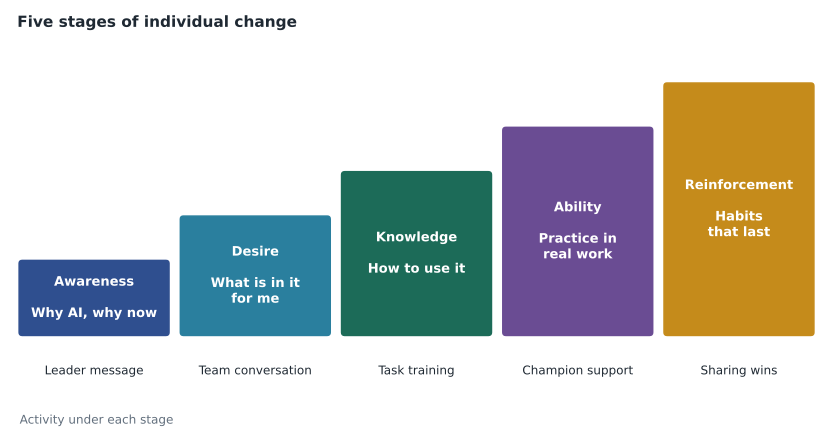
Change management gives leaders a structured way to handle this. Many organizations use established models, such as Prosci's ADKAR model, which says that individuals move through awareness of the need for change, desire to take part, knowledge of how to change, ability to do it and reinforcement to sustain it. Whatever the model, the lesson is the same: people need to know why, want to, know how, be able to and keep going. A program that only trains people, which covers knowledge, skips four of the five.
The adoption team
The adoption team is the group responsible for turning the strategy and council decisions into change on the ground. The AB-731 guide asks candidates to understand how to establish one. Its work usually covers five areas.
| Area | What the adoption team does | At Quillfield |
|---|---|---|
| Planning | Sequences rollout by group, sets readiness criteria, coordinates with IT | Hamish, with Saoirse's IT specialist |
| Communication | Explains the why, shares news and stories, answers worries | Communications adviser, one day a week |
| Training and support | Runs training, office hours and a help channel | Hamish, champions, the help desk |
| Champions | Recruits, equips and supports champions | Hamish |
| Measurement | Tracks adoption, impact and sentiment, reports to the council | Hamish |
Microsoft's Copilot Success Kit, published on the Microsoft Adoption site, gives adoption teams ready-made material: an implementation summary for leaders, a user enablement guide, a technical readiness guide, an adoption planning checklist, a stakeholder engagement worksheet, a license allocation guide and the Copilot scenario library. Separate success kits cover Copilot Chat and agents. Quillfield's adoption team used the planning checklist and scenario library heavily and adapted the user-facing templates to its own guardrails rather than writing everything from scratch.
The adoption team needs a direct line to the council, which is why its lead usually serves as council secretary. It also needs a budget, even a small one: time for champions, training sessions, and sometimes outside help for communications or large-group training.
Common barriers to adoption
The study guide asks candidates to identify common barriers. Hamish ran short interviews with ten people from the least active third of the pilot group. Their reasons matched what adoption teams commonly report.
| Barrier | What people said | What helps |
|---|---|---|
| No time to learn | "I am too busy to stop and figure it out." | Short training on one task at a time; protected practice time from managers |
| Unclear value | "I don't see what it does for my job." | Role-specific examples from colleagues; the scenario library |
| Distrust of accuracy | "I tried it once and it got something wrong." | Teach checking habits and which tasks suit AI; share honest results |
| Fear for jobs | "If it does my work, why keep me?" | Clear leadership message about how saved time will be used; honest answers |
| Data worries | "Am I allowed to use it with client files?" | Simple guardrails; a one-page policy summary; examples of what is allowed |
| Habit | "I just forget it's there." | Reminders in the flow of work; champions nudging; team rituals |
| Manager not engaged | "My manager never mentions it." | Brief managers first; ask managers to use it in team meetings |
| Uneven access | "Why does my colleague get it and I don't?" | Transparent license criteria; Copilot Chat for everyone |
Two barriers deserve special attention from leaders, because only leaders can remove them.
Fear for jobs. If people believe AI is a way to cut staff, many will avoid it or use it reluctantly. Leaders must be honest. At Quillfield, Celestine said in a staff meeting what the strategy said: the goal was to grow without hiring as fast and to spend more time with clients, and the company had no plan to replace roles with AI. She also said what she could not promise: that roles would not change. That honesty was more credible than a blanket reassurance would have been.
Manager engagement. Interviews showed that the strongest predictor of whether someone used Copilot regularly was whether their manager did. Managers who used Copilot in team meetings, asked for AI-prepared summaries and made time for practice had teams that adopted faster. The adoption team responded by briefing all managers before their teams, giving each manager three tasks to model, and adding a line on AI use to managers' monthly check-ins with their own leaders.
An AI champions program
A champion is an employee who volunteers to learn AI tools early, help colleagues use them, and pass feedback to the adoption team. Champions are not IT staff or trainers. Their value is that they do the same work as the people around them, speak the same language and are available at the moment someone gets stuck. The study guide names establishing an AI champions program as a core adoption skill.
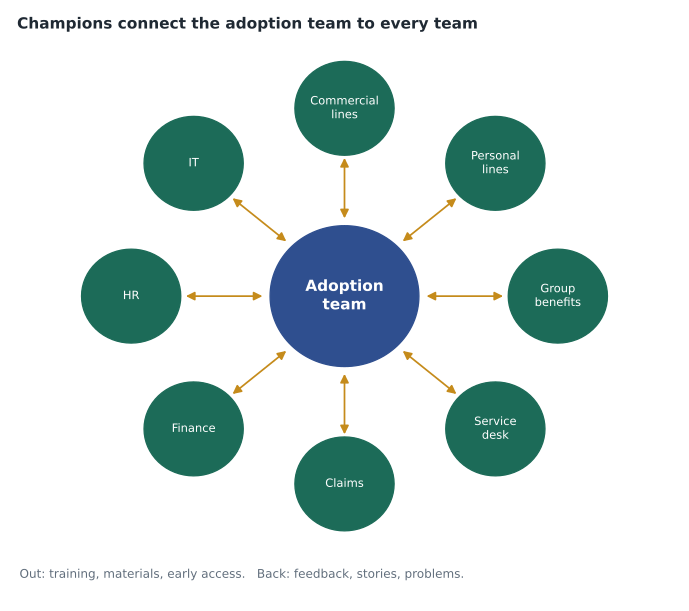
Quillfield's champions program had eight volunteers, one from each major team. Dolores Ventimiglia, the senior account executive who had begun as a skeptic, became the most effective, precisely because colleagues knew she would not oversell. The program followed a simple design.
Recruitment. Volunteers, not nominees, with their manager's agreement. The adoption team looked for people respected by their peers, curious and patient, not necessarily the most technical.
Time. Each champion had about two hours a week recognized as part of their job. Without protected time, champions burn out or quietly stop.
Equipment. Early access to new features, a monthly champions session with the adoption team, a shared channel for questions, and a small library of examples and prompts.
Role. Run a short "show and tell" in their team each fortnight, answer questions, notice what is not working and report it, and collect stories of real results.
Recognition. Champions were named in company communications, their contributions were noted in performance reviews, and the council heard from one champion at every meeting.
Worked problem
Sizing a champions network
Quillfield plans to expand Microsoft 365 Copilot to 120 licensed users next year, while all 380 staff keep Copilot Chat. The adoption team wants at least one champion for every 40 staff overall and at least one per team, with eight teams. Each champion gives about two hours a week. How many champions does it need, and how many hours a week does the program cost?
Show solution
- By headcount: 380 divided by 40 = 9.5, so at least 10 champions.
- By team: at least 8, one per team, which the headcount rule already exceeds.
- So 10 champions, with the two largest teams, commercial lines and the contact center, each getting a second champion.
- Time: 10 champions times 2 hours = 20 hours a week, about half of one full-time role.
Answer: Ten champions, costing about 20 hours a week. Leaders should treat that time as part of the program's investment, not as something champions do on top of their jobs.
Communicating the change
Good change communication answers people's real questions, in order. The first question is usually "Why are we doing this?", then "What does it mean for me?", then "How do I start?" and "Where do I get help?" Quillfield's adoption team planned communications in waves: a message from Celestine on the purpose, a conversation in each team led by the manager, training invitations with specific tasks, then regular sharing of short stories from colleagues. The stories proved most powerful. A two-paragraph account from a personal lines adviser about using Copilot to prepare for a difficult renewal call did more for adoption in her team than any announcement.
Sustaining the change
Adoption does not end when people have been trained. Usage often rises after launch and then dips as novelty fades. Reinforcement keeps it going: new tips and features introduced gradually, team rituals such as starting a weekly meeting with an AI-prepared summary, recognition of people who find useful new uses, and measurement that shows teams their own progress. Hamish also found that some people needed a second round of training after a few months, once they had enough experience to ask better questions.
By November, the least active third of the pilot had shrunk to about one in six. The biggest changes came not from more training but from managers modeling use, champions sitting with colleagues for twenty minutes on a real task, and the leadership message about jobs.
Resistance is information
Some people will resist AI, and adoption teams are tempted to treat them as obstacles. Experienced adoption leads treat resistance as information. When Gus Tremblay-Okoro, a claims advocate, said he would not use Copilot to draft letters to clients after a loss, he was not being difficult; he believed those letters needed a personal voice that AI would flatten. The adoption team agreed, and the claims guidance now says that Copilot may help with structure and facts, but the advocate writes the opening and closing in their own words. Listening to the objection produced a better rule and turned a skeptic into someone who used Copilot for the parts of the job where it helped.
The council also asked the adoption team to report not only usage but the reasons people gave for not using AI, so that it could see which barriers were growing or shrinking over time.
| Signal | Possible meaning | Response |
|---|---|---|
| A whole team uses AI far less than others | Manager not engaged, or tasks do not suit AI | Talk to the manager; review the team's three tasks |
| Usage drops after launch | Novelty faded; habits not formed | Reinforcement: new tips, rituals, champion check-ins |
| Many questions about the rules | Guardrails unclear | Add examples to the policy summary |
| Low satisfaction scores | Poor results on the tasks tried | Review prompts, knowledge sources or training |
Measuring adoption work itself
The adoption team measured its own activities as well as the results. It tracked how many people had attended task training in each team, how many had spoken with their champion, and how many managers had been briefed. Comparing these with usage showed which activities made the biggest difference. Champion conversations, in particular, were strongly associated with people moving from occasional to regular use, which persuaded the council to keep funding champions' time when the budget was reviewed.
Common mistakes
MistakeTreating adoption as a training problem only.
InsteadAddress awareness, desire, ability and reinforcement as well as knowledge.
MistakeReassuring staff that nothing will change.
InsteadBe honest about how saved time will be used and that roles may change.
MistakeExpecting champions to help on top of their full jobs.
InsteadRecognize protected time for champions as part of their role.
MistakeLaunching to staff before briefing managers.
InsteadBrief and equip managers first; their example drives adoption.
MistakeStopping effort once training is complete.
InsteadReinforce with stories, rituals, tips and measurement after launch.
Summary and key terms
- AI adoption is a change problem: people need awareness, desire, knowledge, ability and reinforcement.
- The adoption team plans rollout, communicates, trains and supports, runs champions and measures results.
- Microsoft's Copilot Success Kit provides planning checklists, enablement guides, a scenario library and templates.
- Common barriers include lack of time, unclear value, distrust, fear for jobs, data worries, habit, disengaged managers and uneven access.
- Leaders must address fear for jobs honestly and engage managers, because only leaders can remove those barriers.
- An AI champions program uses respected volunteers with protected time, equipment and recognition to support peers and feed back problems.
- Change management
- A structured approach to helping people adopt new ways of working.
- ADKAR
- A change model from Prosci: awareness, desire, knowledge, ability and reinforcement.
- Adoption team
- The group that turns AI strategy into rollout, communication, training, champions and measurement.
- Champion
- An employee who volunteers to learn AI early, help colleagues and pass feedback to the adoption team.
- Copilot Success Kit
- Microsoft's collection of adoption guides, checklists, templates and scenarios for Copilot.
- Reinforcement
- Activities that sustain a change after launch, such as recognition and team rituals.
Practice problems
Work each problem on paper first, then reveal the answer to check.
What was the strongest predictor of regular Copilot use in Quillfield's interviews?
Show answer
Whether the person's manager used it.
An organization of 600 staff wants one champion per 50 staff. How many champions is that?
Show answer
12.
Name three barriers that champions can help with and one that needs leaders.
Show answer
Champions help with lack of time, unclear value and habit; fear for jobs needs leaders.
Lesson quiz · 5 questions
Score 60% or more to complete this lesson.
Create a free account to save your progress, take quizzes and earn a certificate.