
MSAZ-309 · Lesson 12 of 12 · 20 min
Exam day and renewal
▶ Video coming soon A video version of this lesson is on the way.
The last lesson is practical. It covers choosing between a test center and an online exam, booking and identification, what happens on the day, what the score report shows, and how to keep the certification current afterwards. Hana has not yet booked; the plan is to book in early April for Friday, June 11, 2027, once phase 1 shows she is on track. Everything described about the day itself is therefore a plan.
Test center or online
DP-800 is delivered by Pearson VUE in two ways. At a test center, the room, computer and network are provided and supervised. Online, a candidate sits at home or in a private office, with a webcam and microphone, while a remote proctor watches. Online exams are convenient but have strict rules: a clean desk, no one else in the room, no second monitor, a system check beforehand and a check-in process that includes photos of the room. A dropped connection or a family member walking in can end the exam.
Hana chooses a test center in Des Moines. She has two children, an unreliable home network and no office that locks. The center removes all three risks. Walt Hadley made the same choice for DP-300. A candidate with a quiet, reliable space may prefer online, but should run Pearson VUE's system test on the same computer and network well before the day, and again on the day.
Booking, rescheduling and identification
Booking starts from the exam page on Microsoft Learn, signed in with the personal Microsoft account linked to the certification profile. The candidate chooses the delivery method, the location if in person, the language, and a date and time. The price for the candidate's country is shown before payment, and vouchers or discount codes are entered there. Harrow & Finch will provide a voucher.
Rescheduling and canceling are allowed up to a deadline before the appointment; Microsoft's exam policies give the current rules, and Hana will read them when she books rather than rely on memory. Missing the appointment or arriving too late normally forfeits the fee. The name on the booking must match the identification shown at check-in exactly. Pearson VUE requires valid, government-issued photo identification, and some locations ask for a second piece; the requirements for the country are listed during booking.
Accommodations such as extra time or assistive technology must be approved before booking. The 30 extra minutes for candidates whose preferred language is not offered is also requested in advance. Hana sits in English, her first language, so neither applies to her.
On the day
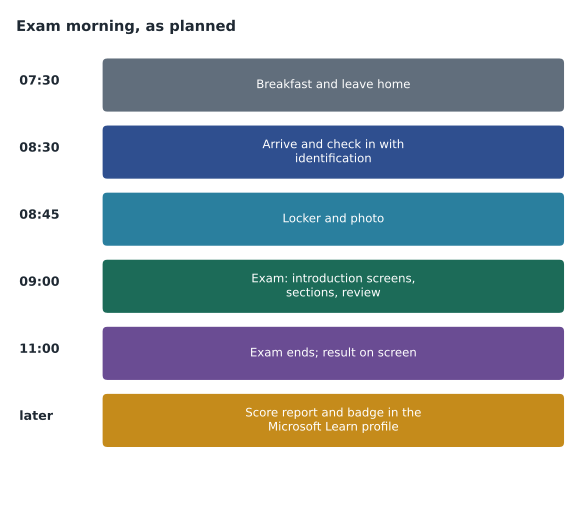
Hana's plan for the morning is simple and unhurried. She arrives at the center 30 minutes early, which Pearson VUE asks for in-person candidates. At check-in she shows her identification, has her photo taken, and puts everything else, including her phone, watch and water bottle, in a locker. She is given a whiteboard or erasable sheet and a marker. The exam starts with introduction screens and a short agreement before the timer begins in earnest.
Inside the exam, the timer, the question number and the section are always visible. Hana uses the pacing plan from lesson 11: recalculate on the first screen, answer every question, mark sparingly, and check the clock at questions 15, 30 and 45. Before leaving a case study or a yes or no series she makes sure every answer is filled in, because those parts lock. At the end she uses the review screen for marked questions only, then ends the exam.
During the exam the whiteboard is useful for two things: the pacing checkpoints, written at the start, and short notes for case study requirements, such as R1 to R9 with one word each. It is not useful for working through long calculations; DP-800 has few of those.
Results and the badge
The result appears on screen soon after the exam ends: pass or fail, with the scaled score. A score report follows, showing performance by skill group as bars, which say whether the candidate did relatively well or poorly in each group rather than giving exact counts. After a pass, the certification appears in the Microsoft Learn profile, and a digital badge is issued through Credly, which can be shared on a professional profile or a résumé. The badge links to a page that verifies the certification.
If the result is a fail, the score report is the starting point for the next attempt. The bars show which groups were weakest, and the error log shows the patterns. The retake rules from lesson 1 apply: 24 hours after a first failure, then 14 days between later attempts, at most five attempts in 12 months. Elena's advice is the same as for Walt: spend at least two weeks on the weak groups before trying again.
Renewal
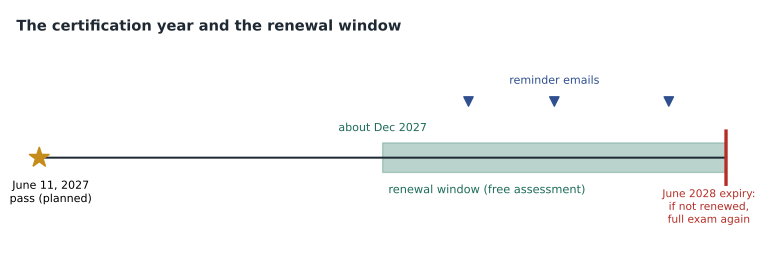
Associate certifications are valid for 12 months. Renewal is free and done online on Microsoft Learn by passing a renewal assessment, which opens in the six months before expiry. The assessment is unproctored, shorter than the exam, and focused on what has changed in the skills since the certification was earned. Microsoft sends reminder emails to the address on the profile, which is one more reason to use a personal account. If the first attempt fails, another can follow straight away; after that there is a 24-hour wait between attempts, with no limit on the number. If the certification expires before renewal, the full exam must be passed again.
For Hana, a pass on June 11, 2027 would mean a certification valid until June 2028 and a renewal window opening around December 2027. Because the AI features in the engine are changing fast, the renewal assessment for DP-800 is likely to include features that were previews when she studied. Elena suggests a short habit for the year after the exam: read the 'What's new' pages for SQL Server and Azure SQL once a month, and try one new feature in the Finch Rewards test database each quarter. That keeps her ready for renewal without a cram.
After the exam
The certification is a record, not an end point. Elena wants Hana to do three things in the weeks after June 11. First, write down what surprised her about the exam while it is fresh, without recording any actual questions, which the candidate agreement forbids. Those notes help the next person at Harrow & Finch who sits DP-800. Second, update the team wiki page on exam preparation with the plan and the resources that worked. Third, choose one item from the outline that she learned only for the exam, such as reciprocal rank fusion or SQL Database Project drift checks, and use it for real in the Finch Rewards work, so that it becomes skill rather than memory.
The exam agreement matters. Candidates agree not to share exam content. Describing which topics felt heavy, how long the case study took or what the interface looked like is fine; writing down or sharing actual questions or answers is not, and can lead to the certification being revoked. Practice materials that claim to contain real exam questions should be avoided for the same reason.
The day before and the morning
Hana's checklist for Thursday, June 10 is short. Confirm the appointment time and address in the Pearson VUE confirmation email. Put her identification in her bag the evening before. Check the route and parking near the test center, and allow for traffic. Eat a normal dinner and go to bed at the usual time. On Friday morning, eat breakfast, leave early, and do not open her notes in the car park. The last thing she reads before the exam should be the exam's own instructions.
For an online exam, the list would add running the system test on the same computer and network the day before, closing every other program, using a wired connection if possible, clearing the desk and walls near it, telling the household the room is off limits for the whole session, and starting check-in 30 minutes before the appointment, because the room photos and identification check take time.
If something goes wrong during the exam
Technical problems are rare but not unknown. At a test center, a frozen screen or a power cut is handled by the staff, who can pause the session and contact Pearson VUE. Online, a lost connection may let the candidate reconnect and continue, or may end the session. In either case the important step is to get a case number from Pearson VUE at the time. The retake waiting period can be waived for a technical failure only when there is a case on record. Hana writes the Pearson VUE support contact on her checklist so that she does not have to search for it in a stressful moment.
Problems with a question itself, such as a typo or an option that seems to have two right answers, can be reported through the comment option the exam provides. Comments do not change the score on the day, but they are reviewed. Elena's advice is to answer the question as best she can, leave a brief comment, and move on without spending more than a few seconds on it.
Handling nerves
Hana is calm in meetings and anxious in exams, which is common among capable professionals. Three habits help. Start by answering, not by reading everything; the first few answers settle the nerves. Treat a run of hard questions as normal; difficulty varies, and three hard questions in a row say nothing about the result. And use the reset from lesson 11 when needed: look away, breathe out slowly, read only the last sentence of the question.
A case study is a change of pace, and taking ten seconds to breathe before starting one is worth the time. So is a short pause at each pacing checkpoint, which doubles as a check on the clock.
If the result is a fail
A fail is information, not a verdict. Hana's plan if it happens is already written: read the group bars that evening, write down the topics she remembers struggling with, and book a retake about two weeks later after focused work on the weakest group. The policy allows a second attempt after 24 hours, but a rushed retake usually repeats the first result. Dana Whitcombe's budget covers one retake. Many people who pass associate exams did not pass the first time, and the second attempt starts from a better place because the format is no longer new.
Exam-day questions people ask
Can she take breaks? The clock keeps running during any break, and at a test center a break must be arranged with the staff; in a two-hour exam most candidates do not take one. Can she bring water? Not into the exam room at most centers; it stays in the locker. Can she write on the whiteboard before the timer starts? Rules vary, so the safe plan is to write the pacing checkpoints in the first minute after the exam begins. Each of these is small, and knowing the answers in advance removes one more source of surprise on the morning.
Worked problem
Dates for the certification year
If Hana passes on Friday, June 11, 2027, and her certification is valid for 12 months with a renewal window that opens six months before expiry, roughly when does the window open and when does the certification expire?
Show solution
- Validity is 12 months from the pass date: about June 11, 2028.
- The window opens six months before expiry: about December 11, 2027.
- Microsoft shows the exact dates in the certification profile, which is the authority.
Answer: The renewal window opens around December 11, 2027 and the certification expires around June 11, 2028. Hana should check the exact dates in her Microsoft Learn profile and renew early in the window.
Common mistakes
MistakeOnline delivery is always the easier choice.
InsteadOnline exams have strict room and network rules; a test center removes those risks.
MistakeAny photo identification is fine at check-in.
InsteadIt must be valid, government-issued, and match the booking name exactly.
MistakeThe score report shows exactly how many questions were right in each group.
InsteadIt shows relative performance by group as bars, not exact counts.
MistakeRenewal requires booking a proctored exam.
InsteadRenewal is a free, unproctored online assessment in the six months before expiry.
MistakeSharing the exact questions after the exam helps colleagues and is allowed.
InsteadThe candidate agreement forbids sharing exam content; share topics and approach only.
Summary and key terms
- Choose between a test center and online delivery by your space, network and risk; run the system test if online.
- Book from Microsoft Learn with the personal account; the booking name must match government-issued photo identification.
- Arrive early, use the whiteboard for pacing checkpoints and case study requirements, and fill in locked sections before leaving them.
- The result appears on screen; the score report shows group performance as bars; a Credly badge follows a pass.
- Renew free online in the six months before the 12-month expiry; an expired certification needs the full exam again.
- Do not share exam content; keep the skills current by trying new features after the exam.
- Proctor
- The person who supervises an exam, in person at a test center or remotely online.
- Score report
- The report after an exam showing the scaled score and relative performance by skill group.
- Credly badge
- A digital badge issued after a pass that links to a page verifying the certification.
- Candidate agreement
- The terms a candidate accepts at the start of the exam, including not sharing exam content.
Practice problems
Work each problem on paper first, then reveal the answer to check.
Why did Hana choose a test center?
Show answer
To avoid home network, noise and privacy risks that could end an online exam.
What must match exactly at check-in?
Show answer
The name on the booking and the name on the identification.
What does the score report show by skill group?
Show answer
Relative performance as bars, not exact counts.
When does the renewal window open?
Show answer
In the six months before the certification expires.
What may a candidate share after the exam?
Show answer
General impressions, such as topics that felt heavy and timing, but not actual questions or answers.
Lesson quiz · 5 questions
Score 60% or more to complete this lesson.
Create a free account to save your progress, take quizzes and earn a certificate.