
MSAZ-309 · Lesson 1 of 12 · 23 min
The SQL AI Developer certification
▶ Video coming soon A video version of this lesson is on the way.
On Monday, November 9, 2026, Hana Sato finished the last of her design sessions with Elena Brandt at Des Moines head office. Over five weeks the two of them had rebuilt the Finch Rewards database for Azure SQL Database: new tables, a points ledger, JSON preferences, a store finder and a points-expiry feature that will go live next year. At the end of that session Elena asked Hana a question she had been saving. Hana had said in October that she wanted to sit exam DP-800 in June 2027. Was that still the plan? It was. So, before leaving, Hana sat a 50-question diagnostic set that Elena had built from the published skills outline. She answered 33 correctly. This course starts from that result.
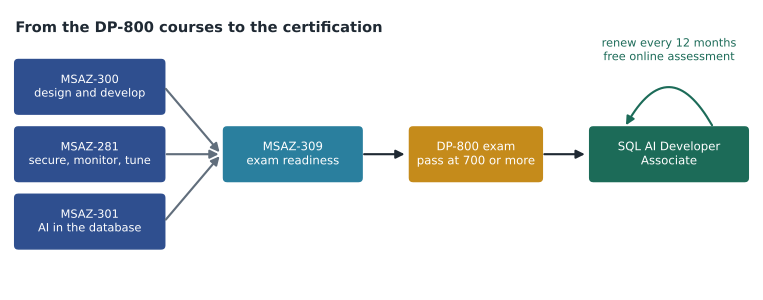
Hana is a developer, not a database administrator. She writes the Finch Rewards app and its API, and she has learned a great deal of T-SQL in the last year. Over the winter she will join the security and tuning clinic described in MSAZ-281 and the AI course, MSAZ-301, which covers vectors, embeddings and retrieval-augmented generation. This course comes last. It does not teach new technology. It teaches how the DP-800 exam is built, what each part of it asks for, and how to turn what she has learned into marks on a single day in June.
This first lesson explains what the certification is, who it is for, what the exam covers at the highest level and the rules around it: delivery, length, scoring, retakes and renewal. The later lessons go deeper into question types and case studies, the weights, each skill group, reading T-SQL, the distractors that catch people, a full practice scenario, a timed plan and exam day.
What the certification is
Passing exam DP-800, Developing AI-Enabled Database Solutions, earns the Microsoft Certified: SQL AI Developer Associate certification. Microsoft announced the certification in March 2026. It is one of Microsoft's role-based certifications, which come in levels. Fundamentals certifications check broad understanding of a product area. Associate certifications check that a person can do a job role. Expert certifications build on associates. DP-800 is an associate exam, so its questions assume hands-on experience. A fundamentals question might ask what a vector is. A DP-800 question is more likely to describe an app, a table of product reviews, a latency target and a security rule, and then ask which search method, index and permission meet all of them.
There is no formal prerequisite. Microsoft does not require DP-900, DP-300 or any other exam first. The study guide describes the candidate it has in mind: a developer who designs and builds AI-enabled database solutions across SQL Server, Azure SQL and SQL databases in Microsoft Fabric. That person is expected to be comfortable with T-SQL, to have worked with continuous integration and delivery in GitHub, to use AI-assisted development tools, and to understand AI ideas such as embeddings, vectors and models. Hana fits that description well. Her weakest area, as the diagnostic showed, is the AI part, which she has only read about so far. MSAZ-301 will close most of that gap before the readiness work begins.
The exam covers three platforms that share one engine: SQL Server 2025, Azure SQL (Azure SQL Database and Azure SQL Managed Instance), and SQL database in Fabric. Most features in the outline work on all of them, but not always in the same way or with the same release status. A feature may be generally available in Azure SQL Database and still in preview in SQL Server 2025, where preview features must be switched on for each database. Several questions turn on exactly that kind of difference. Lesson 4 and lesson 7 list the ones that matter most.
The three skill groups
Microsoft publishes a study guide for each exam with a list of skills measured. The DP-800 list is dated March 12, 2026, and it is the document that defines what can be asked. It has three skill groups, each with a weight range that says roughly how much of the exam comes from that group.
| Skill group | Weight (parts in 100) | Where it was taught |
|---|---|---|
| Design and develop database solutions | 35 to 40 | MSAZ-300 |
| Secure, optimize and deploy database solutions | 35 to 40 | MSAZ-281 and MSAZ-300 |
| Implement AI capabilities in database solutions | 25 to 30 | MSAZ-301 |
The first two groups are large. Each could be up to 40 parts in 100 of the exam, so together they make up between 70 and 80 parts. The AI group is smaller but still substantial at 25 to 30 parts. A candidate who knows the AI material very well and treats the rest as background will not pass, and neither will a strong T-SQL developer who skips the AI group. Lesson 3 turns the weights into study hours.
Each skill group is divided into areas, and each area lists specific skills. The design group covers database objects, programmability objects, advanced T-SQL and AI-assisted tools such as GitHub Copilot and Model Context Protocol servers. The secure, optimize and deploy group covers data security, performance, CI/CD with SQL Database Projects and integration with Azure services such as Data API builder. The AI group covers external models and embeddings, intelligent search and retrieval-augmented generation. The study guide names functions by name in several places, which is unusual and helpful: it tells a candidate exactly which JSON, regular expression, fuzzy matching and vector functions can appear.
The certification page also says the English version of the exam is scheduled for an update on October 19, 2026, while the study guide still lists skills measured as of March 12, 2026. Microsoft usually describes upcoming changes in a section of the study guide before they take effect, and the study guide page itself was revised in late October. Before booking, Hana will compare the two pages and read the change log in the study guide, so that she studies the outline that will apply on her exam day. That check takes five minutes and should be repeated a month before any exam.
Delivery, length and languages
The exam is proctored and scheduled through Pearson VUE. A candidate can sit at a test center or online, at home or in an office, with a webcam and a remote proctor. The certification page lists 120 minutes for the exam. Some preparation sites describe the time as 100 minutes of answering inside 120 minutes of seat time, which includes the introduction and any comments at the end; Microsoft's own pages are the authority, so Hana will check the time shown when she books. Microsoft does not state the number of questions, and it can vary from one sitting to another, so this course does not quote one. What matters for planning is the time, and lesson 11 builds a pacing plan around it.
The exam is offered in English, Japanese, Chinese (Simplified), Chinese (Traditional), Korean, German, French, Italian, Portuguese (Brazil) and Spanish. Localized versions are released about eight weeks after the English version is updated. A candidate whose preferred language is not offered can ask for 30 extra minutes. Other accommodations, such as extra time for a documented need or assistive devices, are requested before booking.
The price depends on the country or region where the exam is proctored, so no single figure is listed. Candidates see the price for their location when they schedule. Harrow & Finch is paying for Hana's exam, and Dana Whitcombe's training budget has a line for one sitting and one retake, the same plan it made for Walt Hadley's DP-300 exam.
The certification page also says the exam may have interactive components. Microsoft provides an exam sandbox that shows the question types and the interface. Elena wants Hana to try it in the spring, so that no screen on exam day is new. Lesson 2 goes through the formats and the case study layout.
Generally available and preview features
The study guide says that most questions cover features that are generally available, and that the exam may include preview features if they are commonly used. This matters more for DP-800 than for most exams, because many AI features in the SQL engine are new. Vector indexes and VECTOR_SEARCH, for example, are generally available in Azure SQL Database, SQL database in Fabric and Managed Instance with the always-up-to-date update policy, but in preview in SQL Server 2025, where the PREVIEW_FEATURES database-scoped configuration must be turned on. The fuzzy string functions are also a preview in SQL Server 2025. Change event streaming is a preview everywhere it is offered.
Elena's rule is simple. Learn the feature, learn where it is generally available, and learn the one setting that turns it on where it is a preview. If a question says a company runs SQL Server 2025 on its own hardware and wants approximate vector search today, a correct answer will mention the preview switch. If it says the company uses Azure SQL Database, it will not need one.
Scoring: what 700 means
Microsoft reports results on a scale from 1 to 1,000, and the passing score is 700 or greater. Many candidates assume 700 means 70 correct answers in every 100. It does not. The score is scaled to account for the difficulty of the particular set of questions a candidate received, so two candidates with the same number of correct answers could get different scaled scores. Some questions can be worth more than one point. Microsoft does not publish the conversion.
So a practice result of 70 in 100 is not a guarantee, and 65 in 100 is not a certain fail. Practice results are useful as trends and for finding weak areas. Elena's target for Hana is consistent practice results of 80 in 100 or better in all three groups, which leaves room for nerves and for unfamiliar wording.
There is no penalty for a wrong answer. A blank scores the same as a wrong answer, so every question should get an answer, even a guess. A guess between two options left after ruling out two is right half the time; a blank is never right.
Retakes
A candidate who fails a first attempt can retake the exam after 24 hours. After a second failure, and between each later attempt, the wait is 14 days. Nobody can take the same exam more than five times within 12 months of the first attempt. Each attempt is paid for unless a voucher or offer covers it. A candidate who has passed cannot retake the exam while the certification is current. The waiting period can be waived only when a technical problem, such as a lost connection or an equipment failure, interrupted the exam and a Pearson VUE case was opened at the time.
Elena tells Hana not to plan around a retake, but to know the rules so that a bad day does not feel final. If June 11 does not go well, a second attempt could be as early as the weekend, but Elena would rather she spend two weeks on the areas the score report shows as weak.
Keeping the certification current
Associate certifications expire every 12 months unless renewed. Renewal is free. It is done by passing an online renewal assessment on Microsoft Learn, which is unproctored, shorter than the exam and focused on recent changes. The renewal window opens in the six months before the expiry date. The assessment must be passed before the certification expires; an expired certification can only be regained by passing the full exam again.
For DP-800 the renewal assessment is likely to matter more than usual, because the AI features in the engine are changing quickly. A pass in June 2027 would mean an expiry date in June 2028 and a renewal window from about December 2027. Elena adds a calendar reminder now.
Registering the right account
Microsoft recommends that candidates register with a personal Microsoft account. The certification page warns that exam records tied to a work or school account will be lost if the person leaves that organization, and cannot be recovered. Hana creates a personal Microsoft account, links it to her Microsoft Learn profile and adds her work email only as a contact address. The name on the profile must match the name on the identification she will show at check-in, so she checks that before booking.
What the exam rewards
Associate exams reward judgment more than recall. Most DP-800 questions describe a situation and ask for the best choice under its constraints: the search method that finds paraphrased reviews without missing exact product codes, the permission that lets an API read through a view but not the base table, the change-handling method that refreshes embeddings within a minute without a polling job. Many wrong options would work somewhere else, or would work at higher cost, or would break a stated rule. A candidate who reads every requirement and tests each option against all of them does better than one who spots a familiar name and picks it.
Hana has an advantage here. She has just built a real database with real constraints, and every design session ended with a decision and a reason. The exam asks for the same thing, quickly and in someone else's company. Elena's job in this course is to make that habit fast and dependable.
Worked problem
Reading a diagnostic result
Hana's diagnostic set had 50 questions in proportion to the weights. Her results, as correct answers out of questions asked, were: design and develop 14 of 19, secure, optimize and deploy 12 of 19, AI capabilities 7 of 12. What share did she answer correctly overall, and which group most needs attention?
Show solution
- Total correct: 14 + 12 + 7 = 33.
- Total asked: 19 + 19 + 12 = 50.
- \[33 \div 50 = 0.66 \text{, or 66 in 100}\]
- By group: design 14 ÷ 19 ≈ 0.74, secure and deploy 12 ÷ 19 ≈ 0.63, AI 7 ÷ 12 ≈ 0.58.
- AI is lowest, but it is the smallest group; secure and deploy is almost as low and carries more weight.
Answer: She answered 66 in 100 correctly. AI capabilities is the weakest group at about 58 in 100, and MSAZ-301 will cover it first. Secure, optimize and deploy, at about 63 in 100 and weighted 35 to 40 parts, needs almost as much attention because it is larger. A diagnostic result is not a scaled score; it shows where to work.
Common mistakes
MistakeA passing score of 700 means answering 70 in 100 questions correctly.
InsteadThe score is scaled for question difficulty; 700 is the pass mark, not a fixed share.
MistakePreview features never appear on the exam.
InsteadMost questions cover generally available features, but commonly used preview features may appear.
MistakeDP-300 must be passed before DP-800.
InsteadDP-800 has no prerequisite exam.
MistakeThe exam only covers Azure SQL Database.
InsteadIt covers SQL Server 2025, Azure SQL Database, Azure SQL Managed Instance and SQL database in Fabric.
MistakeA work account is the safest place for certification records.
InsteadMicrosoft recommends a personal Microsoft account; records on a work account are lost when the person leaves.
Summary and key terms
- Passing DP-800 earns the Microsoft Certified: SQL AI Developer Associate certification; there is no prerequisite exam.
- The skills outline, dated March 12, 2026, has three groups: design and develop 35 to 40, secure, optimize and deploy 35 to 40, and AI capabilities 25 to 30 parts in 100.
- The exam is delivered by Pearson VUE at a test center or online, is listed at 120 minutes and is offered in ten languages; the price depends on the country.
- Most questions cover generally available features; commonly used preview features may appear, so know where each feature is a preview.
- Scores are scaled from 1 to 1,000 and 700 passes; there is no penalty for a wrong answer.
- Retakes: 24 hours after a first failure, then 14 days, at most five attempts in 12 months; renew free each year with an online assessment.
- SQL AI Developer Associate
- The Microsoft certification earned by passing exam DP-800, Developing AI-Enabled Database Solutions.
- Skills measured
- The published list of skill groups, areas and skills, with weights, that defines what an exam can cover.
- Preview feature
- A feature that is not yet generally available; in SQL Server 2025 many must be enabled with the PREVIEW_FEATURES setting.
- Scaled score
- A result placed on a 1-to-1,000 scale that accounts for the difficulty of the questions received.
- Renewal assessment
- A free, unproctored online assessment on Microsoft Learn that extends an associate certification for another year.
- Exam sandbox
- A Microsoft demonstration of exam question types and the interface, used for practice.
Practice problems
Work each problem on paper first, then reveal the answer to check.
What are the three DP-800 skill groups and their weights?
Show answer
Design and develop database solutions 35 to 40; secure, optimize and deploy database solutions 35 to 40; implement AI capabilities 25 to 30 parts in 100.
Which four platforms does the exam cover?
Show answer
SQL Server 2025, Azure SQL Database, Azure SQL Managed Instance and SQL database in Microsoft Fabric.
How long must a candidate wait after a second failed attempt?
Show answer
14 days.
Why does the general availability of a feature matter on this exam?
Show answer
Many AI features are generally available in Azure but a preview in SQL Server 2025, and questions can turn on that difference and the setting that enables previews.
Why should Hana check the study guide's change log before booking?
Show answer
The certification page announces an update to the English exam, so she must study the outline that applies on her exam day.
Lesson quiz · 5 questions
Score 60% or more to complete this lesson.
Create a free account to save your progress, take quizzes and earn a certificate.