
MSAZ-309 · Lesson 11 of 12 · 20 min
Timed practice plan
▶ Video coming soon A video version of this lesson is on the way.
Knowing the material is necessary but not enough. The exam is also a timed task, and many capable candidates lose marks to the clock: they spend eight minutes on one stubborn T-SQL question and then rush the last ten. Elena's plan for Hana has two parts. The first is a dated schedule from March 1 to the exam on Friday, June 11, 2027, that moves from focused review to mixed practice to full simulations. The second is a pacing plan for the 120 minutes of the exam itself, with checkpoints Hana can glance at as she goes.
Everything in this lesson after today, November 12, 2026, is a plan. The dates may move if work gets busy at Harrow & Finch, but the structure should stay.
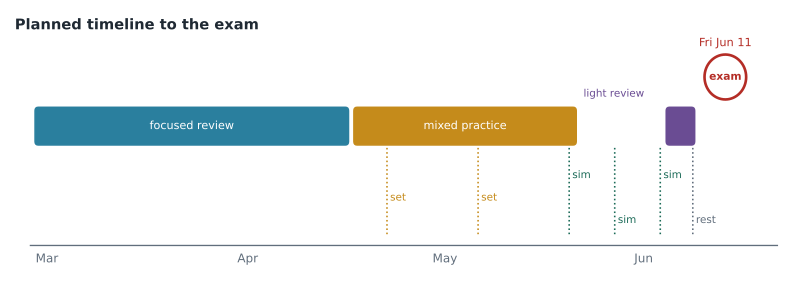
The shape of the plan
Phase 1, focused review, runs for seven weeks from Monday, March 1 to Sunday, April 18. Hana works through the areas in the study budget from lesson 3, one or two at a time, at about six hours a week: three evening sessions of an hour and a half and one longer Saturday morning. Each session ends with ten questions on that area only, so she can see whether the area has stuck. She starts with the areas furthest from her daily work: CI/CD with SQL Database Projects, Data API builder and intelligent search.
Phase 2, mixed practice, runs for five weeks from April 19 to May 23. The questions now come from every area at once, in random order, which is harder and closer to the exam. Two full practice sets of 50 questions are planned for Saturday, April 24 and Saturday, May 8. After each, Hana spends as long reviewing the answers as she spent taking the set, and moves hours toward the areas that are still weak.
Phase 3, simulations, uses three Saturday mornings: May 22, May 29 and June 5. Each is a full timed run in exam conditions: 120 minutes, no notes, phone in another room, a case study included, and the same start time as the real exam. The point is to practice pacing and stamina as much as knowledge. In the last week Hana does only light review of her error log, rests completely on Thursday, June 10, and sits the exam at 09:00 on Friday, June 11.
| Phase | Dates | Hours (about) | What success looks like |
|---|---|---|---|
| Focused review | March 1 to April 18 | 42 | Each area scores 8 of 10 in its end-of-session check |
| Mixed practice | April 19 to May 23 | 33 | Practice sets at 80 in 100 or better in every group |
| Simulations | May 22, May 29, June 5 | 11 | Finish with at least 10 minutes to spare |
| Light review and rest | June 6 to June 10 | 3 | Error log read twice; no new topics |
| Exam | Friday, June 11, 09:00 | 2 | Pass |
Practice sets and what they are for
Practice questions have three uses, and each use needs a different kind of set. Short area sets, of ten questions, check understanding of one topic right after studying it. Mixed sets, of about 50, check whether knowledge holds up when topics are shuffled, and show which groups need more time. Full simulations check timing and stamina. Using a full simulation in March, before the material is learned, mostly measures what Hana does not yet know, which she already has from the diagnostic.
Microsoft offers a free practice assessment for DP-800. The study guide says a newer version on AI Skills Navigator more closely matches the exam experience. Elena wants Hana to use it in phase 2 as one of the mixed sets, not in phase 1, so that its result means something. Other practice sources vary in quality. A good practice question explains why each wrong option is wrong; a poor one only gives the letter. Hana keeps an error log, a simple table with the question topic, her answer, the right answer and the reason she chose wrong, using the distractor patterns from lesson 9. By June the log is her most valuable revision document.
Pacing inside the exam
Microsoft lists 120 minutes for DP-800 and does not publish the number of questions. The first screen of the exam shows how many questions and sections there are, and the timer is always on screen. Elena's pacing plan is built so that Hana can adjust it in the first minute, once she sees the real numbers. To be safe, the plan assumes only 100 minutes of answering time, leaving the rest for the introduction screens, review and any surprise.
The plan treats a case study separately, using the 21 minutes measured in lesson 10 for an eight-question case study. It keeps 10 minutes at the end for reviewing marked questions. The rest of the time is shared evenly among the remaining questions, and checkpoints are set at every fifteenth question so Hana can see whether she is ahead or behind.
answer_minutes = 100     # cautious planning figure inside the 120 listed
review_minutes = 10
case_study_minutes = 21  # from the practice case study in lesson 10
other_questions = 45     # adjust to the count shown on the first screen

per_question = (answer_minutes - review_minutes - case_study_minutes) / other_questions
print(f"Minutes per question outside the case study: {per_question:.2f}")
for q in range(15, other_questions + 1, 15):
    print(f"After question {q:2d}: about {q * per_question:4.0f} minutes used")
print(f"Case study ends at about {other_questions * per_question + case_study_minutes:.0f} minutes")Minutes per question outside the case study: 1.53 After question 15: about 23 minutes used After question 30: about 46 minutes used After question 45: about 69 minutes used Case study ends at about 90 minutes
What this code does
The program takes the answering time Hana plans to use, takes away the time kept for review and for one case study, and shares what is left evenly among the other questions. It prints how long each question can take on average and how many minutes should have been used after every fifteenth question, so she can check during the exam whether she is on pace. The last line shows when the case study should be finished, which leaves the review time.
With 45 questions plus a case study, each ordinary question gets about a minute and a half, which is enough for most single-answer questions and tight for the long T-SQL ones. If the first screen shows a different count, Hana divides again: the rule is to share the time left after the case study and review equally. If there are two case studies, each gets its own allowance. The checkpoints are what matter during the exam: at question 15 she should have used no more than about 23 minutes, at question 30 about 46.
Habits that save time
Several small habits save more time than reading faster. Answer every question on first sight, even if unsure, and mark only those worth another look. Do not change an answer at review unless there is a clear reason, such as a requirement that was missed; first instincts are usually better than second-guesses made under pressure. When stuck between two options for more than a minute, choose the simpler, more current one, mark it and move on. For long code questions, use the reading order from lesson 8 and look first at the line where options differ.
Hana also practices a reset. If she notices she has read a question three times without taking it in, she looks away from the screen for five seconds, breathes out slowly, and reads only the last sentence. It sounds trivial, but in the second simulation it is what gets her through a run of three hard questions without losing her pace.
Adjusting the plan
Plans meet real life. If a work deadline takes a week out of phase 1, Elena's rule is to cut evenly from the strongest areas, not the weakest. If a practice set in phase 2 shows one group below 70 in 100, that group gets most of the next week. If the third simulation is still below 75 in 100, the right move may be to reschedule the exam by a few weeks rather than to sit it unready; Pearson VUE allows rescheduling, with the deadlines shown at booking. Moving an exam is cheaper than a retake and kinder on confidence.
The last week
The week before the exam is for consolidation, not new material. Hana's plan for Sunday, June 6 to Wednesday, June 9 is an hour each evening: read the error log once from start to finish, reread the summaries of lessons 4 to 7, and go through the near-synonym table from lesson 9 until each pair can be separated in one sentence. On Wednesday she confirms the appointment details, the route to the test center, and the identification she will bring. On Thursday she does not study at all.
Rest the day before is part of the plan, not a reward. Memory consolidates during sleep, and a tired candidate makes more reading errors, which lesson 9 showed were a real share of Hana's wrong answers. A late-night cram adds a little knowledge and removes a lot of attention. Elena puts it simply: the last hour of study before the exam is worth less than the first hour of sleep.
Practicing with a partner
Walt Hadley is preparing for DP-300 on a similar schedule, and the two exams share some ground: security features, performance tools and Query Store appear in both. Elena pairs them for one session a week in phase 2. Each brings five questions they wrote themselves, with wrong options built from the distractor patterns, and each explains the answers to the other. Explaining an answer aloud exposes gaps that reading hides. If Hana cannot say in one sentence why Dynamic Data Masking does not meet a requirement, she does not yet know it well enough.
The pairing has a second benefit. Walt is strong where Hana is weaker, in performance tuning and the DBA side of security, and Hana is strong in T-SQL features and CI/CD, where Walt has less experience. The weekly session is short, forty-five minutes, and it often finds the one detail that a week of solo study missed.
Keeping the plan honest
Every Sunday evening Hana spends ten minutes comparing what she planned for the week with what she did. The comparison is not for guilt. It shows whether the plan is realistic. If three weeks in a row show about four hours done instead of six, the plan needs changing, either by moving the exam or by cutting topics in a deliberate way rather than by accident. Elena checks the summary every two weeks and asks only one question: what is the weakest area now, and is it getting the most time?
Worked problem
Recalculating the pace
On exam day the first screen shows 52 questions, one of which is an eight-question case study counted separately. Using Elena's plan, with 100 minutes of answering time, 10 minutes for review and 21 minutes for the case study, how long can each of the other questions take, and where should she be after question 15?
Show solution
- Other questions: 52 − 8 = 44.
- \[100 - 10 - 21 = 69 \text{ minutes}\]
- \[69 \div 44 \approx 1.57 \text{ minutes per question}\]
- \[15 \times 1.57 \approx 24 \text{ minutes}\]
Answer: Each of the 44 other questions can take about 1.57 minutes, and after question 15 she should have used about 24 minutes. The plan stays the same; only the division changes.
Common mistakes
MistakeFull simulations are the best way to start studying.
InsteadUse short area sets first; save full simulations for the last weeks, when they measure timing and stamina.
MistakeThe practice assessment should be taken in the first week to see the level.
InsteadTake it during mixed practice, when its result shows readiness rather than material not yet studied.
MistakeAlways change an answer if a second reading feels different.
InsteadChange answers only for a clear reason, such as a missed requirement.
MistakeIf behind schedule, cut time from the weakest areas first.
InsteadCut from the strongest areas; weak areas need the time most.
MistakeA failed final simulation means the exam must go ahead anyway.
InsteadRescheduling a few weeks is often better than sitting unready.
Summary and key terms
- Plan in three phases: focused review, mixed practice and timed simulations, then rest the day before.
- Use short sets after each topic, 50-question mixed sets to find weak groups, and full simulations for timing.
- Use Microsoft's practice assessment during mixed practice, and keep an error log sorted by distractor pattern.
- Plan pacing on 100 minutes of answering inside the 120 listed, with time set aside for case studies and review.
- Recalculate the time per question from the count on the first screen and watch the checkpoints.
- Answer every question on first sight, change answers only for a reason, and reschedule rather than sit unready.
- Error log
- A record of wrong practice answers with the reason each was chosen, used for revision.
- Simulation
- A full practice exam taken under exam conditions to rehearse timing and stamina.
- Checkpoint
- A planned point in the exam, such as question 15, with a target time already used.
Practice problems
Work each problem on paper first, then reveal the answer to check.
What are the three phases of Hana's plan?
Show answer
Focused review, mixed practice and simulations.
When should Microsoft's practice assessment be used?
Show answer
During mixed practice, when the material has been studied.
Why does the pacing plan assume 100 minutes rather than 120?
Show answer
To leave margin for introduction screens, review and surprises.
What should Hana do if she is stuck between two options for more than a minute?
Show answer
Choose the simpler, more current option, mark it and move on.
If a work deadline takes time out of the plan, which areas should lose study time?
Show answer
The strongest areas.
Lesson quiz · 5 questions
Score 60% or more to complete this lesson.
Create a free account to save your progress, take quizzes and earn a certificate.