
MCAT-150 · Lesson 9 of 12 · 20 min
Mixed practice set 1: Chem/Phys and CARS
▶ Video coming soon A video version of this lesson is on the way.
The first of three mixed sets put the two morning sections side by side, the way they come on test day. Thandiwe wrote a Chem/Phys passage, three Chem/Phys independent questions and a CARS passage, thirteen questions in all, and set a time of 22 minutes: about 8 minutes for the science passage, 3 for the independent questions, a deliberate 30-second pause, then 10 minutes for CARS. 'The pause is the point,' she said. 'You have to switch from calculating to reading, and most people carry the calculator brain into the first CARS passage. Practice the switch.'
Take the set under timed conditions before reading the explanations. Use your pacing checkpoints, the reading method from lesson 3 for the science passage and the argument-mapping method from lesson 4 for CARS. Mark any answer you are unsure of, do a blind review before checking the key, and log your misses with the categories from lesson 6. All passages and questions are original, and all data are invented for this course.
Passage 1 (Chem/Phys): a gravity-fed infusion
In a gravity-fed intravenous infusion, a bag of saline hangs above the patient, and fluid flows through tubing and a catheter into a vein. The driving pressure is the hydrostatic pressure of the column of fluid, equal to the density of the fluid times the gravitational acceleration times the height of the fluid surface above the catheter. Flow is opposed by the pressure in the vein and by viscous resistance in the tubing and catheter. For steady, smooth flow through a narrow tube, the Hagen-Poiseuille relation gives the volume flow rate as proportional to the pressure difference across the tube and to the fourth power of the tube's radius, and inversely proportional to the tube's length and to the fluid's viscosity.
Students in a paramedic training lab measured flow through one catheter into a sealed chamber held at a constant pressure of 1,000 pascals above atmospheric pressure, to imitate venous pressure. They varied the height of the saline surface above the catheter and recorded the steady flow rate. Saline was at room temperature throughout. Assume the density of saline is 1,000 kilograms per cubic meter and g is 10 meters per second squared.
| Height of fluid surface above catheter (m) | Flow rate (mL per minute) |
|---|---|
| 0.25 | 1.5 |
| 0.50 | 4.0 |
| 1.00 | 9.0 |
| 1.50 | 14.0 |
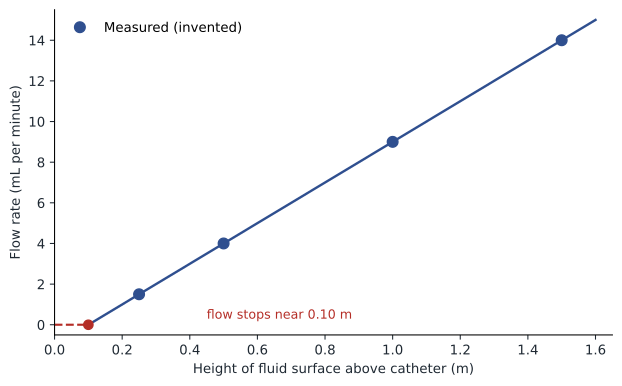
Questions 1 to 5 refer to passage 1.
1. What is the hydrostatic driving pressure at the catheter when the fluid surface is 1.00 meter above it? (A) 1.0 times 10 to the 2 pascals. (B) 1.0 times 10 to the 3 pascals. (C) 1.0 times 10 to the 4 pascals. (D) 1.0 times 10 to the 5 pascals.
2. Based on Table 1, at approximately what height of the fluid surface above the catheter would flow stop? (A) 0 meters. (B) 0.10 meters. (C) 0.25 meters. (D) 1.00 meter.
3. If the students replaced the catheter with one of twice the internal radius, and the catheter controlled the resistance, how would the flow rate at a given height change? (A) It would double. (B) It would increase about fourfold. (C) It would increase about sixteenfold. (D) It would decrease by half.
4. Warming the saline to body temperature lowers its viscosity slightly. What effect would this have on flow at a given height? (A) Flow would increase. (B) Flow would decrease. (C) Flow would not change, because viscosity does not appear in the relation. (D) Flow would stop, because warm fluid expands.
5. Fluid passes from the wider tubing into the narrower catheter. Compared with the fluid in the tubing, the average speed of the fluid in the catheter is: (A) lower, because the catheter has more resistance. (B) the same, because the flow rate is the same. (C) higher, because the same volume flow must pass through a smaller area. (D) zero, because the catheter is full.
Independent questions (Chem/Phys)
6. What is the pH of a 0.0010 molar solution of hydrochloric acid? (A) 1. (B) 2. (C) 3. (D) 11.
7. An object is placed beyond twice the focal length of a converging lens. The image is: (A) real, inverted and smaller than the object. (B) real, upright and larger than the object. (C) virtual, upright and larger than the object. (D) virtual, inverted and smaller than the object.
8. A radioactive sample has a half-life of 6 hours. What fraction of the original nuclei remains after 18 hours? (A) 1/3. (B) 1/6. (C) 1/8. (D) 1/18.
Passage 2 (CARS): on repairing old buildings
For much of the nineteenth century, the restoration of a medieval church meant returning it to a state it was imagined to have once possessed. Architects removed later additions, replaced weathered carvings with crisp copies and completed towers that had never been finished, all in the name of recovering an original design. The results were often handsome. They were also, in a sense, new buildings wearing old names.
The objection, raised by a few critics at the time and by many since, was not that such work was ugly but that it was untruthful. A building that has stood for six centuries carries the marks of its use: a doorway widened for processions, a window blocked after a fire, stones worn smooth by hands. To remove these is to erase evidence of the lives the building has held, and to replace a history with a guess. The restorer's "original" was often a design that had existed only in the restorer's imagination.
Modern conservation codes largely accepted this argument. They ask that repairs be minimal, that new material be distinguishable from old on close inspection, and that work be reversible where possible. A cracked beam is reinforced, not replaced; a missing stone is filled with a plain block rather than a carved imitation. The building is allowed to look its age.
Yet the conservation ideal has its own difficulties. A policy of minimal intervention can leave a building in a state that no one in its history would have recognized or wanted: patched, half-finished and visibly propped up. The medieval builders themselves were not conservators. They rebuilt, extended and replaced with confidence, adding a new choir in the fashion of their own day beside an old nave in the fashion of their grandparents'. If the history of a building includes centuries of bold change, it is not obvious why that history must end the moment the building becomes a monument.
None of this argues for a return to the confident fictions of the nineteenth century. It argues, rather, for humility in two directions. We should be slow to erase what time has added, but also slow to assume that our own caution is the only form of respect. A building that is still used, still loved and still changing may honor its past better than one preserved, perfectly and lifelessly, as evidence. (Passage written for this course.)
Questions 9 to 13 refer to passage 2.
9. The main purpose of the passage is to: (A) defend nineteenth-century restoration practices against their critics. (B) explain the technical rules of modern conservation codes. (C) argue that both nineteenth-century restoration and modern minimal conservation have limits. (D) show that medieval builders preferred minimal repairs.
10. In the second paragraph, the author mentions "a doorway widened for processions" primarily to: (A) illustrate the kind of historical evidence that restoration could erase. (B) criticize medieval builders for altering their designs. (C) explain why processions were important in medieval churches. (D) suggest that doorways should be returned to their original width.
11. The author's attitude toward modern conservation codes can best be described as: (A) wholly approving. (B) respectful but qualified. (C) dismissive. (D) indifferent.
12. Suppose a city proposes adding a modern glass entrance to a historic library that is still in daily use, designed so the old walls remain intact. Based on the passage, the author would most likely regard the proposal as: (A) unacceptable, because new material must never be added to a historic building. (B) acceptable only if the glass were replaced by a copy of medieval stonework. (C) potentially consistent with respect for the building, as part of its continuing history of change. (D) irrelevant to questions of conservation, because libraries are not churches.
13. Which statement, if true, would most weaken the author's claim about medieval builders in the fourth paragraph? (A) Medieval builders often left older work standing beside new additions. (B) Records show medieval builders usually rebuilt damaged parts in the style of the original, avoiding the fashions of their own day. (C) Some nineteenth-century architects studied medieval building records closely. (D) Modern conservation codes were written mainly by architects.
Answers and explanations: passage 1
1. C (skill 2). Pressure equals density times g times height: 1,000 times 10 times 1.00 is 10,000 pascals, or 1.0 times 10 to the 4 pascals.
2. B (skill 4). Flow rises by 1.0 milliliter per minute for every 0.1 meter of height, a straight line. Working back from 0.25 meters (1.5 milliliters per minute) by 1.5 steps of 0.1 meter gives zero flow at about 0.10 meters. Physically, that is where the hydrostatic pressure, 1,000 times 10 times 0.10 or 1,000 pascals, just equals the chamber pressure. Choice A ignores the opposing chamber pressure.
3. C (skill 2). The Hagen-Poiseuille relation makes flow proportional to the fourth power of the radius. Doubling the radius multiplies flow by 2 to the fourth, which is 16. Choice B treats flow as proportional to area.
4. A (skill 2). Flow is inversely proportional to viscosity, so lower viscosity means higher flow at the same pressure difference. Choice C contradicts the passage.
5. C (skill 1). By continuity, volume flow rate equals area times average speed. The same volume per second passes through both parts, so the smaller area of the catheter means a higher speed. Choice A confuses resistance with speed.
Answers and explanations: independent questions
6. C (skill 1). Hydrochloric acid is a strong acid and dissociates fully, so the hydrogen ion concentration is 1.0 times 10 to the minus 3 molar and the pH is 3.
7. A (skill 1). For a converging lens with the object beyond 2f, the image forms between f and 2f on the other side: real, inverted and smaller.
8. C (skill 2). Eighteen hours is three half-lives. One half, cubed, is one eighth.
Answers and explanations: passage 2
9. C. The passage criticizes nineteenth-century restoration (paragraphs 1 and 2), presents modern conservation (paragraph 3), raises difficulties with it (paragraph 4) and concludes with "humility in two directions" (paragraph 5). Choice A contradicts the last paragraph's first sentence; B is too narrow; D distorts paragraph 4.
10. A. The doorway is one of three examples of "marks of its use", offered as evidence that restoration erased. The author does not criticize the builders (B) or argue for restoring the original width (D).
11. B. The author says conservation codes accepted a sound argument and describes their rules without objection, then says the ideal "has its own difficulties". Respect with qualification fits; "wholly approving" ignores paragraph 4, and "dismissive" ignores paragraph 3.
12. C (Reasoning Beyond the Text). The author argues that a building's history includes "bold change" and that a used, changing building may honor its past. A modern addition that leaves old walls intact fits that view. Choice A states the strict conservation view in more absolute terms than the passage gives even for the codes; B contradicts the criticism of imitation; D ignores that the argument applies to historic buildings generally.
13. B (Reasoning Beyond the Text). The author's claim is that medieval builders "rebuilt, extended and replaced with confidence" in the fashion of their own day. Evidence that they usually rebuilt in the original style would undercut it. Choice A supports the author.
The debrief
Ezequiel finished the science passage in seven minutes and got all five right. He recognized the setup at once from his EMT training, where he had raised IV bags to speed up flow. 'I have lived question 2,' he said. 'If the bag is too low, nothing goes in.' He also recognized the fourth-power rule from the bench flow model in the physics capstone of MCAT-121, which was the point: a mixed set should feel like review. He missed question 11, choosing "wholly approving", because he read paragraph 3 closely and skimmed paragraph 4. On blind review he caught it.
Devika got question 2 wrong under time, choosing zero meters, then right on blind review once she wrote out the pressure balance. She logged it as reasoning, not content: she knew both ideas but had not combined them. Her other miss, question 12 in both rounds, came from choosing A; she had read the strict conservation rules of paragraph 3 as the author's own view. She also noticed something about the switch from Chem/Phys to CARS. 'For the first paragraph of the CARS passage I was looking for numbers. I literally scanned for a table.' The 30-second pause helped on the second try, when she used it to take two slow breaths and say "argument, not data" to herself.
Elliot finished first, in 19 minutes, and missed two: question 3 (he chose sixteenfold correctly on blind review, having first chosen fourfold by treating flow like area) and question 13, where he chose A. On review he saw that A supported the author rather than weakening the claim. 'I answered "related to the claim" instead of "weakens the claim".' He added a rule to his log: for every strengthen-or-weaken question, write "+" or "minus" next to each choice before choosing.
| Student | Timed score | After blind review | Main miss type |
|---|---|---|---|
| Ezequiel | 12 of 13 | 13 of 13 | Reading: skimmed the qualifying paragraph in CARS |
| Devika | 11 of 13 | 12 of 13 | Reasoning: did not combine two ideas in question 2 |
| Elliot | 11 of 13 | 12 of 13 | Reading: misread the task in a weaken question |
Thandiwe pointed out that all three students lost their points in ways that the earlier lessons had named: combining ideas, reading the whole argument and reading the task word in the stem. None of the misses was a content gap. 'At this stage, that is normal. You know the material. Now the points are in the habits.'
Common mistakes
MistakeFlow through a tube is proportional to its cross-sectional area.
InsteadUnder the Hagen-Poiseuille relation, flow is proportional to the fourth power of the radius.
MistakeA graph of flow against height must pass through the origin.
InsteadAn opposing pressure shifts the line; flow begins only when the driving pressure exceeds it.
MistakeA CARS author who praises one approach must fully approve of it.
InsteadRead the whole argument; a later paragraph often qualifies earlier praise.
MistakeIn a weaken question, any choice related to the claim is a good answer.
InsteadThe answer must push against the claim; mark each choice as strengthening, weakening or neutral.
MistakeYou can move straight from science to CARS without a pause.
InsteadUse the break or a few seconds to switch from calculating to reading for argument.
Summary and key terms
- Hydrostatic pressure equals density times g times height; 1 meter of water gives about 1.0 times 10 to the 4 pascals.
- Flow begins only when driving pressure exceeds opposing pressure; a linear graph that misses the origin shows that offset.
- Under the Hagen-Poiseuille relation, flow scales with the fourth power of radius and inversely with viscosity and length; by continuity, speed rises where area falls.
- The CARS passage argued for "humility in two directions"; questions turned on reading the qualifying fourth paragraph and the strength of claims.
- Strengthen-or-weaken questions require marking each choice as plus, minus or neutral before choosing.
- Practice the switch from Chem/Phys to CARS, because calculation habits carry over into reading.
- Hydrostatic pressure
- The pressure exerted by a fluid at rest because of the weight of the fluid above.
- Hagen-Poiseuille relation
- For smooth flow in a narrow tube, flow is proportional to the pressure difference and the fourth power of radius, and inversely proportional to length and viscosity.
- Continuity equation
- For an incompressible fluid, area times average speed is constant along a tube.
- Viscosity
- A fluid's resistance to flow.
- Weaken question
- A CARS question asking which new information would most undermine a claim in the passage.
Practice problems
Work each problem on paper first, then reveal the answer to check.
Using Table 1, predict the flow rate at a height of 2.0 meters.
Show answer
Driving pressure 20,000 pascals minus 1,000 is 19,000; at 0.001 milliliters per minute per pascal, about 19 milliliters per minute.
If the chamber pressure were raised to 2,000 pascals, how would the line in Figure 1 change?
Show answer
It would shift to the right with the same slope; flow would begin at about 0.20 meters.
In passage 2, what is the function of the fourth paragraph in the argument?
Show answer
It raises difficulties with the modern conservation ideal, qualifying the approval in paragraph 3 and preparing the conclusion.
Which choice in question 13 would strengthen the author's claim, and why?
Show answer
Choice A, because evidence that builders left old work beside new additions supports the picture of confident change alongside the old.
Lesson quiz · 5 questions
Score 60% or more to complete this lesson.
Create a free account to save your progress, take quizzes and earn a certificate.