
MCAT-150 · Lesson 1 of 12 · 25 min
Taking a full-length test: endurance and the practice schedule
▶ Video coming soon A video version of this lesson is on the way.
The Sunday Session that opened the full-length block began with a number on the shared screen: 7 hours and 30 minutes. 'That is roughly how long you will be in the test center,' Thandiwe said. 'Six hours and fifteen minutes of it is testing. Everything we have done since September was content and method. From now on we also train the thing that runs all of it: your attention, for a whole day.' Elliot, who had booked January 21, would start weekly full-length tests in mid-December. Ezequiel's full-length phase would begin in late February. Devika, aiming for mid-May, would start in the spring. Each of them needed a schedule built backward from test day.
This lesson explains why full-length practice tests matter, how many to take and when, how to make practice conditions match the real test, and how to fit full-length tests, review and targeted practice into a weekly rhythm without burning out. It is the first of the strategy lessons in this course; lessons 9 to 12 then give you original mixed practice sets to use the methods on.
What a full-length test measures that nothing else does
Section practice and question banks measure whether you can do a kind of question. A full-length test measures whether you can do 230 of them in a row, in a fixed order, under fixed time limits, after hours of sustained concentration. The MCAT has four sections in the same order every time: Chemical and Physical Foundations of Biological Systems (Chem/Phys), Critical Analysis and Reasoning Skills (CARS), Biological and Biochemical Foundations of Living Systems (Bio/Biochem) and Psychological, Social, and Biological Foundations of Behavior (Psych/Soc). The three science sections each have 59 questions in 95 minutes: ten passage sets of four to six questions and fifteen independent questions. CARS has 53 questions in 90 minutes, over nine passages.
| Part of the day | Length | Questions |
|---|---|---|
| Check-in, certification and tutorial (optional) | About 30 to 40 minutes | None |
| Chem/Phys | 95 minutes | 59 (10 passage sets, 15 independent) |
| Optional break | Up to 10 minutes | None |
| CARS | 90 minutes | 53 (9 passages) |
| Optional break (the long one) | Up to 30 minutes | None |
| Bio/Biochem | 95 minutes | 59 (10 passage sets, 15 independent) |
| Optional break | Up to 10 minutes | None |
| Psych/Soc | 95 minutes | 59 (10 passage sets, 15 independent) |
| Void question and satisfaction survey | About 8 minutes | None |
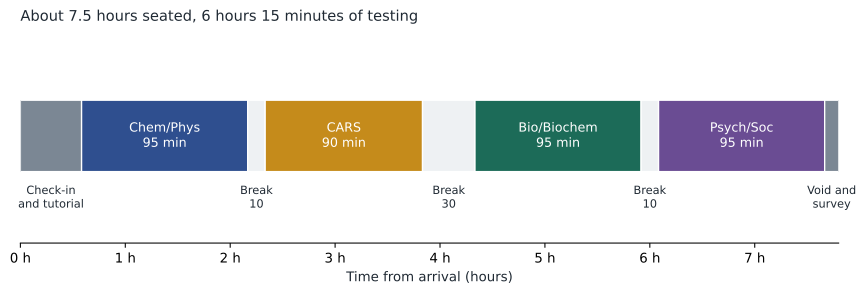
Three things show up only on a full-length test. The first is fatigue. Many students who score well on Psych/Soc in isolation lose two or three points when it comes last, after more than five hours of testing. The second is carry-over. A hard Chem/Phys section can leave you rattled for CARS, and a long break that runs over can leave you rushed at the start of Bio/Biochem. The third is the pattern of your scores across the day. If your accuracy drops in the second half of every section, or in the last section of every test, you have a stamina problem rather than a content problem, and the fix is different.
A full-length test is also the best estimate of your likely score that you can get before test day. One practice score is noisy: a single test samples a small part of a very large content outline. But a series of full-length tests, taken under the same conditions and reviewed carefully, gives you a trend. Lesson 7 shows how to read that trend and when it should change your plans.
The official materials and why they come last
The AAMC, which writes the MCAT, sells and gives away practice materials written by the same people who write the test. In the 2027 testing year, its official prep includes a free, scored Practice Exam 1, a free Unscored Sample Test, and further full-length practice exams sold at low cost, each with 230 questions in the real format. It also sells question packs and section banks. Students in the AAMC Fee Assistance Program receive the online official prep products as part of the program; Ezequiel received the Online-Only Bundle that way. MCAT-101 covered the full list and the fee rules.
Commercial test companies also sell full-length tests. They are useful for building stamina and practicing timing, and many students take several. But their scoring scales are estimates made by each company, and their passages can differ from the AAMC's style. Official full-length tests are the closest you can get to the real thing, so most coaches suggest spreading them across your full-length phase and keeping at least two for the last three or four weeks, when you most need an accurate reading.
| Material | What it is good for | When to use it |
|---|---|---|
| AAMC Practice Exam 1 (free, scored) | A realistic diagnostic and a first look at the format | Early, as a diagnostic (the group used it in September) |
| AAMC Unscored Sample Test (free) | Format practice; question review without a score | During the content phase or as an early full-length |
| Further AAMC practice exams (low cost, scored) | The most accurate estimates of your score | Spread across the full-length phase; keep at least two for the final month |
| AAMC section banks and question packs | Hard, test-like practice by section | Between full-length tests, aimed at weak areas |
| Commercial full-length tests | Stamina and timing practice; extra volume | Early in the full-length phase, or between official tests |
How many, and when
There is no official number of full-length tests to take, and good scores have come from many different plans. A common pattern is six to ten full-length tests over the last six to ten weeks, starting once most of the content review is done. Fewer than four rarely gives you enough data to see a trend or enough practice to build stamina. More than about twelve tends to crowd out review, and review is where the learning happens. Thandiwe's line is the one on the group's whiteboard: 'Practice tests measure; review teaches.'
The usual rhythm is one full-length test a week. In the final three or four weeks some students move to two a week, but only if they still have time to review both properly. Each test takes a full day and a careful review takes at least as long again, so two tests a week leaves little room for anything else.
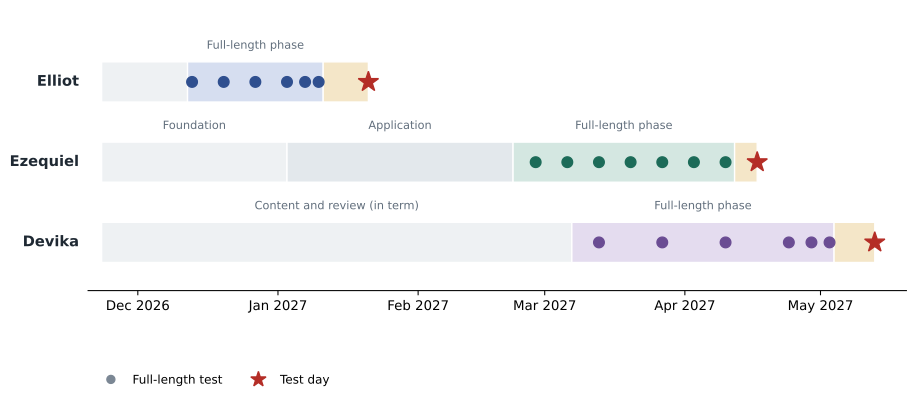
The three members of the Sunday Session have different timelines, and their full-length plans show how one approach adapts. Elliot tests on January 21, 2027. He planned weekly full-length tests from mid-December, with his last one about ten days before test day, giving him five or six. Ezequiel tests on April 17. His plan has a foundation phase through early January, an application phase to late February, a full-length phase from February 22 to April 11 with seven tests, and a taper week from April 12 to 16. Devika is aiming for May 13. Her university finals end in late April, so she will take three full-length tests on weekends in March and April while still in classes, then three more in the two and a half weeks after finals, when her study hours rise from about 15 to about 25 a week.
Building endurance gradually
Most people cannot jump from hour-long study sessions to a seven-and-a-half-hour test without paying for it. Endurance builds like any other kind of fitness: in steps, with recovery. A sensible progression in the weeks before your first full-length test runs like this. First, do single sections at full length and with real timing: one 95-minute science section, or one 90-minute CARS section, with no pauses. Next, do two sections back to back with a 10-minute break between them. Then do a half-length test (two sections and a break) at the same time of day as your test appointment. Finally, sit a full-length test.
Ezequiel had good reason to take this seriously. He sat the MCAT once before, in June 2025, without ever having taken a full-length practice test. His section scores fell across the day, and he remembers that by Psych/Soc he was reading sentences twice to take them in. In his foundation phase he began doing one full-length section every Saturday morning, timed, with his phone in another room. By early January he planned to be doing two sections back to back. 'In 2025 my body was there for seven hours and my brain left after three,' he said.
The goal of endurance training is not to feel fresh at the end of the day. Nobody does. The goal is for your accuracy late in the day to stay close to your accuracy early in the day. You can measure this: compare your percentage correct in the first and second halves of each section, and across the four sections of each full-length test. Lesson 5 shows how to use those numbers.
Making practice conditions match the real test
A practice score is only as useful as the conditions it was earned under. A full-length test taken with pauses, at the kitchen table with a phone nearby, and with extra break time does not tell you much about test day. Thandiwe asked each student to write down their test-day conditions and copy them as closely as possible every time.
- Start time: the standard appointment starts at 8:00 a.m. local time, and check-in begins earlier. Start your practice tests at the same time, so your best hours line up with the test's.
- Breaks: take the three optional breaks at their real lengths, 10, 30 and 10 minutes, and use them the way you plan to on test day. Do not skip them in practice and then take them on test day, or the other way round.
- Materials: on test day you work on a laminated noteboard booklet with a fine-point marker, not on loose paper. Practice with something similar, such as a sheet protector over graph paper and a fine dry-erase marker.
- Interruptions: none. Phone off and in another room, no music unless you will have it on test day (you will not), no snacks during sections.
- Environment: a quiet room away from your usual study desk, ideally somewhere you do not normally work. Some students take a practice test at a public library to get used to strangers nearby.
- Food and drink: eat what you plan to eat on test day, at the same times, so that test day holds no surprises.
Devika found the start time hardest. Her pharmacy shifts on Thursday evenings and her late study nights meant she was rarely sharp before 10 a.m. Thandiwe suggested shifting her sleep gradually in the two weeks before her first full-length test, moving her wake-up time 15 to 20 minutes earlier every few days until 6:30 a.m. felt normal. 'Your brain does not care what time the test is,' she said. 'It cares what time it thinks it is.'
A worked example: planning a full-length phase
Worked problem
Building a full-length schedule backward from test day
A student tests on a Saturday in mid-May. Her last university exam is three and a half weeks before test day, and she can study about 15 hours a week before that and about 30 hours a week after. She has five official AAMC full-length tests left and access to three commercial tests. How should she lay out her full-length phase?
Show solution
- Start at test day and work backward. Leave the last three or four days for light review and rest, with no full-length test in the final week.
- Place the last official test about 8 to 10 days before test day, so there is time to review it and act on what it shows.
- In the three weeks after finals, when she has the most time, place three official tests one week apart, with review the day after each test.
- Check the window: three and a half weeks after finals, minus the final rest week, leaves room for only three tests at one a week. So two of the five official tests must come before finals.
- Before finals, when time is short, place one test every other weekend for ten weeks: the three commercial tests first, to build stamina, then the two earliest official tests in the last month before finals.
- Finally, check the load each week: a test day, a review day or two, targeted practice on the weaknesses the review showed, and a rest day.
Answer: Eight full-length tests in all: three commercial tests and two official tests on alternate weekends before finals, then three official tests one week apart after finals, the last about 9 days before test day, with no full-length test in the final week.
The arithmetic is not complicated, but it is easy to get wrong if you plan forward from today instead of backward from test day. Students who plan forward often end up with three full-length tests crammed into the last ten days, with no time to learn from any of them.
The weekly rhythm
Once the full-length phase starts, most weeks follow the same pattern. Day one is the test itself, taken in the morning under real conditions. The rest of that day is for rest: a walk, a meal with friends, nothing to do with the MCAT. Day two and sometimes day three are for review, which lesson 6 covers in detail; a careful review of a full-length test takes most students six to ten hours, often split over two days. The remaining days are for targeted practice on the weaknesses the review turned up: content review, section bank passages, timed CARS passages, flashcards. One day a week is a rest day, and it is not optional.
| Day | Elliot (December and January) | Ezequiel (late February to early April) |
|---|---|---|
| Saturday | Clinic volunteering, then light flashcards | Full-length test, 8:00 a.m. start |
| Sunday | Full-length test, 8:00 a.m. start; Sunday Session in the afternoon on alternate weeks | Rest; Sunday Session |
| Monday | Review the test, first half | Review the test, sections 1 and 2 |
| Tuesday | Review the test, second half | Evening course; review sections 3 and 4 before class |
| Wednesday | Targeted practice: two timed CARS passages a day, plus weakest science topic | Targeted practice: organic chemistry and section bank passages |
| Thursday | Targeted practice; section bank passages | Evening course; CARS passages |
| Friday | Rest day | Targeted practice; light review of error log |
Elliot's Sunday tests sometimes clashed with the group sessions. Thandiwe told him to take the test anyway and join the next week. 'The test is the workout. The session is the coaching. You can miss a coaching session.'
Sleep, food and the body
Test performance depends on things that have nothing to do with chemistry. Sleep matters most. Memory consolidation happens during sleep, and a short night before a practice test lowers scores, which is one more reason to treat practice tests as rehearsals of test day. Aim for a regular bedtime and wake time across the whole full-length phase, not just the night before.
For food, the rule is boring and familiar: eat a breakfast you have eaten before practice tests, bring snacks and water for the breaks, and avoid trying anything new on test day. Caffeine is fine if you normally use it; test day is not the day to start or stop. Ezequiel, used to twelve-hour EMT shifts, packed his break snacks the same way he once packed a shift bag: protein, something salty, a piece of fruit and a full water bottle.
Exercise helps too. Several studies link regular aerobic exercise with better attention and mood, and a short walk on the long break is one of the best ways to reset. You cannot leave the test center during breaks, but you can stretch and walk in the corridors or common area. Practice that too.
When a full-length test goes badly
Some full-length tests go badly, and how you respond matters more than the score. A drop of three or four points from one test to the next is common and usually reflects the test, the day or the topics sampled, not a real decline. The right response is to review the test the same way you would review a good one, look for causes and adjust. Panic and an extra test the next day are the wrong responses. Lesson 7 explains how to tell a real trend from noise, and lesson 8 covers the emotional side of a bad practice test.
Thandiwe told the group about a former student whose third full-length score fell five points below her second. The review showed that nearly all the lost points came from the last two Psych/Soc passages, which she had rushed after a long break ran over. The content was fine; the fix was a watch habit for the long break. Her next test recovered the five points and more.
Common mistakes
MistakeMore full-length tests always means a higher score.
InsteadLearning comes from review; past about eight to ten tests, extra tests often crowd out review and targeted practice.
MistakePractice tests can be taken in pieces or with pauses to save time.
InsteadOnly uninterrupted tests under real timing measure endurance and give a score you can trust.
MistakeSave every official test for the final two weeks.
InsteadSpread official tests across the full-length phase, keeping at least two for the final month, so you have a trend.
MistakeSkipping breaks in practice builds extra stamina.
InsteadPractice the breaks exactly as you will take them on test day, so the day holds no surprises.
MistakePlan the full-length phase forward from today.
InsteadPlan backward from test day so the last tests land with time left to review and act on them.
Summary and key terms
- The MCAT day is about 7.5 hours seated with 6 hours 15 minutes of testing: Chem/Phys, CARS, Bio/Biochem and Psych/Soc, with optional breaks of 10, 30 and 10 minutes.
- Full-length tests measure endurance, carry-over between sections and late-day accuracy, which section practice cannot.
- A common plan is six to ten full-length tests over the last six to ten weeks, about one a week, with official AAMC tests spread through and at least two kept for the final month.
- Build endurance in steps: full single sections, then two sections back to back, then half-length tests, then full-length tests.
- Match test-day conditions: 8:00 a.m. start, real break lengths, a noteboard-style surface, no phone and no pauses.
- Each week combines one test, one to two days of review, targeted practice on weaknesses and a rest day.
- Full-length practice test
- A practice MCAT of 230 questions in the real section order and timing, taken in one sitting.
- Endurance
- The ability to keep accuracy steady across a long testing day.
- Full-length phase
- The last weeks of preparation, organized around regular full-length tests and their review.
- Taper
- A short period before test day with light review and no full-length tests, to arrive rested.
- Noteboard booklet
- The laminated booklet and fine-point marker provided for scratch work on test day.
- Official prep
- Practice materials written and sold by the AAMC, the organization that writes the MCAT.
Practice problems
Work each problem on paper first, then reveal the answer to check.
How many questions are on a full-length MCAT, and how long is the testing time without breaks?
Show answer
230 questions (59 + 53 + 59 + 59) in 6 hours 15 minutes (95 + 90 + 95 + 95 minutes).
A student scores well on Psych/Soc in section practice but loses points on it in every full-length test. What is the most likely issue, and what is one way to check?
Show answer
Fatigue late in the day. Compare accuracy in the first and second halves of Psych/Soc, and compare Psych/Soc accuracy in full-length tests with section practice.
Why keep at least two official AAMC full-length tests for the final month?
Show answer
They give the most accurate estimate of the likely score at the point when a decision about test day may be needed.
Ezequiel tests on April 17 and plans his last full-length test for April 11. Why not take one on April 15?
Show answer
It would leave too little time to review it and act on it, and it would cost rest just before test day.
Lesson quiz · 5 questions
Score 60% or more to complete this lesson.
Create a free account to save your progress, take quizzes and earn a certificate.