
MCAT-150 · Lesson 7 of 12 · 20 min
Score trends: reading practice scores, postponing and voiding
▶ Video coming soon A video version of this lesson is on the way.
Elliot asked the question everyone in the group had been thinking about. 'Suppose my practice scores in January are not where I want them. How do I know whether to take the test on the 21st or move it?' Thandiwe said she would not answer it with a feeling. 'We will answer it with numbers you decide on now, while you are calm. Then in January you just read the numbers.'
This lesson explains how to read your practice scores: why one score is noisy, how to see a trend, how practice scores relate to the real test, and what scores mean in percentile terms. It then covers the two big decisions the scores feed: whether to postpone the test and, on test day itself, whether to void. Both decisions have rules and costs, and both are easier when you decide your criteria in advance.
Why a single score is noisy
An MCAT score is an estimate. The test samples a small part of a very large content outline, and on a different form with different passages you would score a little differently. The AAMC reports that a score is best thought of as a band: roughly plus or minus 1 point on each section and about plus or minus 2 points on the total. Practice tests behave the same way. Two practice tests a week apart can differ by three or four points with no real change in your ability, just because one sampled your weak topics and the other your strong ones, or because you slept badly before one of them.
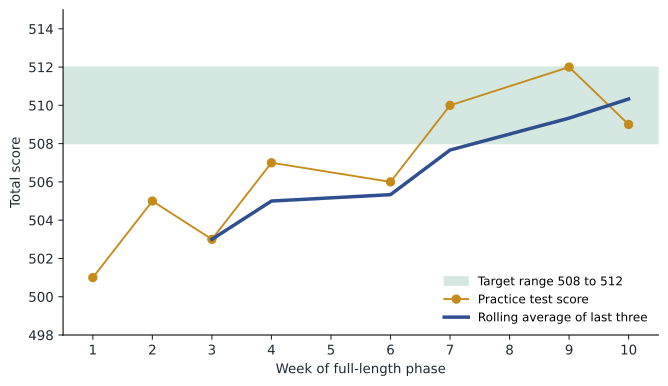
This means that a single practice score, good or bad, should not change your plans much. A run of three or more scores taken under the same conditions tells you far more. A simple tool is the rolling average: the average of your last three full-length scores. It smooths out single-test noise and shows the direction you are heading.
Practice scores and the real test
Official AAMC practice tests are written by the people who write the MCAT and are scaled the same way, so they are the best single predictor of your real score, though no practice test predicts it exactly. Many students find their real score close to the average of their last two or three official practice tests. Commercial tests use their own scales, which may run higher or lower than the real test; treat them as tools for practice and timing rather than as predictions, and compare a commercial test mainly with other tests from the same company.
Conditions matter as much as the test. A score from a test taken in two sittings, at night, or with long pauses is not comparable with one taken in a single morning under real timing. When you look at your trend, look only at tests taken under test-day conditions.
What scores mean
Each section is scored from 118 to 132, with a midpoint of 125, and the total ranges from 472 to 528, with a midpoint of 500. The AAMC publishes percentile ranks each year, based on recent examinees. In the table in effect from May 1, 2026, a total of about 500 sat near the 48th percentile, about 505 near the 64th, about 510 near the 79th and about 515 near the 91st. Percentiles help you compare yourself with other test-takers, but medical schools look at scores in the context of their own admitted students and of the whole application, and their expectations differ widely.
| Total score | Approximate percentile (2026 to 2027 table) |
|---|---|
| 495 | About 33rd |
| 500 | About 48th |
| 505 | About 64th |
| 508 | About 74th |
| 510 | About 79th |
| 512 | About 84th |
| 515 | About 91st |
| 520 | About 97th |
Set your target from the schools you plan to apply to. The AAMC's Medical School Admission Requirements database lists median scores for admitted students at US and Canadian MD programs, and MCAT-101 described how several Canadian schools use the MCAT, some with section minimums and some not at all. A target range, rather than a single number, is more useful: for example, "508 to 512 total, with no section below 126".
Deciding in advance: your postponement rule
The decision to postpone is hard to make well in the last weeks, when you are tired and anxious. So make the rule first. Thandiwe asked each member of the group to write a rule with three parts: a date by which the decision will be made, a measure (usually the rolling average of official practice tests) and a threshold.
The date must come before the AAMC's change deadlines. For the 2027 testing year, rescheduling at 30 to 59 days before the test costs 110 US dollars, at 10 to 29 days 210 dollars, and no changes are possible within 10 days. A decision date about 3 to 4 weeks before the test keeps the cost moderate and leaves time for a new plan. Rescheduling also depends on seat availability: popular dates and centers fill up, so check what is open before you decide.
The measure should be the average of your last two or three official practice tests under real conditions. The threshold should reflect your target range. A common rule is: "If, on the decision date, my average is more than 3 or 4 points below the bottom of my target range and has not been rising, I will move the test; otherwise I will take it." The rule should also include what you would do with the extra time, because postponing without a new plan usually produces the same scores later.
Worked problem
Elliot's postponement rule
Elliot tests on January 21, 2027. His target is 512 or higher with CARS at least 126. His last day to reschedule at the 10-to-29-day fee is January 11, and he wants to decide by January 3. What rule might he write, and how would it apply to two possible sets of results?
Show solution
- Measure: the average of his last three full-length tests, at least two of them official, taken under test-day conditions.
- Threshold: if the average is below 508 on January 3, or his CARS average is below 124, he moves the test; if it is 508 or higher with CARS 124 or higher, he takes it.
- Plan if he moves: book the next available date that still lets him apply early in the AMCAS cycle, and spend the extra weeks mainly on CARS, his weakest section.
- Scenario A: scores of 509, 511 and 510, with CARS at 125, 124 and 126. Average 510, CARS about 125. He takes the test.
- Scenario B: scores of 503, 506 and 505, with CARS at 122, 123 and 123. Average about 505, CARS about 123. He moves the test.
Answer: A rule with a date, a measure and a threshold, written in November, turns January's decision into reading numbers: take the test in scenario A, move it in scenario B.
The threshold in Elliot's rule is below his target. That is deliberate. A practice average a little below target, with a rising trend, often converts to a score in the target range, and postponing has its own costs: weeks of extra study, the risk of burnout, and possible delays in his application. Thandiwe suggested he set the threshold where he would be genuinely unhappy with the likely result, not where he would be merely disappointed.
Reasons to postpone, and reasons not to
Good reasons to postpone include a clear and lasting gap between practice scores and your target, a major life event (illness, a family emergency, a sudden change at work) that has cost you weeks of preparation, and a content area you have not yet reviewed at all. Weaker reasons include one bad practice test, general anxiety, and a wish to feel "ready", since most people never feel fully ready.
Consider the application timeline as well. If you are applying through AMCAS in the current cycle, a later test date means later scores, which may delay when schools can complete your file. For Ontario schools through OMSAS, there is a deadline by which scores must be released to count for the cycle, covered in MCAT-101. Moving the test can push you into the next application year, which may be the right choice but is a large one.
Attempt limits and score reporting
The AAMC limits how often you can test: three times in a single testing year, four times over two consecutive years and seven times in a lifetime. Voids and no-shows count toward these limits. For applicants through AMCAS, all MCAT scores from April 2003 onward are reported to schools, so schools see every scored attempt, not only the best one. Schools differ in how they use multiple scores: some consider the most recent, some the highest, some all of them.
This is why Ezequiel thinks differently from a first-time tester. His June 2025 score of 499 will appear in his AMCAS application next to whatever he earns in April. A strong improvement is a good story, but a second score close to the first is not. Thandiwe asked him to set a slightly more conservative threshold, so that he tests in April only if his practice scores give him a real chance of a clear improvement.
The void decision on test day
At the end of the test you are asked once whether to score or void the exam. If you void, no score is produced and schools will not know you took the test, but it still counts as an attempt. If you do not answer, the test is scored. The decision is final.
Most coaches advise voiding only for a clear and serious problem that you can name: you were ill and could not concentrate for a section or more, you had to leave the room for a long time, a technical problem cost you a large part of a section, or you could not finish a whole section for any reason. Feeling that the test was hard is not a reason to void. Nearly everyone leaves the MCAT feeling that it went badly, because the test is designed to be hard for everyone, and these feelings are poor predictors of actual scores. Students who void because the test "felt bad" often learn later, from their practice data, that they had probably scored within their usual range.
| Situation at the end of the test | Score or void? | Why |
|---|---|---|
| The test felt hard; no specific problem | Score | Nearly everyone feels this; practice data are a better guide than feelings |
| One passage went very badly | Score | One passage rarely moves a section score much |
| Ill for most of a section; could not concentrate | Consider voiding | A named problem that cost a large part of the test |
| A technical failure, reported to staff, cost much of a section | Consider voiding | Report it to staff during the test and to the AAMC afterward |
| Could not finish a whole section for any reason | Consider voiding | A missing section will pull the score well below your ability |
Write your void rule before test day and put it in your test-day plan from lesson 2. Then, at the end of the test, read the rule rather than deciding afresh. Devika's rule: "Score it unless I was sick, missed a section or had a technical failure that the staff recorded." Ezequiel's was similar, with one addition: "If I void, I already know my next date."
After scores arrive
When your score is released, compare it with your practice average, not with your hopes. If it falls within or near your target range, the preparation worked. If it falls well below your practice average, review what happened on test day; sometimes there was an obvious cause, such as sleep or illness. If you decide to retake, give yourself enough time to change something real, usually two to three months, and build a new plan on what your score report and your error log show. A retake with the same preparation tends to give the same score.
Common mistakes
MistakeOne bad practice test means you should postpone.
InsteadSingle scores vary by several points; base decisions on a rolling average of several tests under real conditions.
MistakeCommercial practice scores predict the real score as well as official ones.
InsteadCommercial tests use their own scales; official AAMC tests are the best predictor.
MistakeDecide whether to postpone when you see how you feel in the last week.
InsteadSet a rule with a date, a measure and a threshold in advance, and decide before the change deadlines.
MistakeIf the test felt hard, it is safer to void.
InsteadVoid only for a named, serious problem; feelings at the end of the test are poor predictors of scores.
MistakeSchools see only your best MCAT score.
InsteadThrough AMCAS, all scored attempts since April 2003 are reported; voided tests are not reported but still count as attempts.
Summary and key terms
- A score is a band of about plus or minus 1 point per section and 2 on the total; single practice scores vary by several points.
- Use a rolling average of your last three tests under real conditions, and rely mainly on official AAMC practice tests.
- Scores run from 118 to 132 per section and 472 to 528 total; in the 2026 to 2027 table, about 500 was near the 48th percentile and about 510 near the 79th.
- Write a postponement rule in advance with a decision date before the change deadlines, a measure and a threshold, plus a plan for extra time.
- Attempt limits are three per testing year, four over two years and seven in a lifetime; voids and no-shows count, and AMCAS reports all scored attempts.
- Void only for a named, serious problem, following a rule written before test day.
- Score band
- The range around a reported score within which a test-taker's true score most likely falls.
- Rolling average
- The average of a fixed number of the most recent scores, used to smooth out noise.
- Percentile rank
- The percentage of recent examinees who scored at or below a given score.
- Postponement rule
- A decision rule, set in advance, that says when you will move your test date.
- Attempt limit
- The AAMC's cap on how many times a person may take the MCAT in a year, two years and a lifetime.
Practice problems
Work each problem on paper first, then reveal the answer to check.
A student's last three official practice scores are 506, 511 and 508. What is the rolling average, and what does the 511 tell you on its own?
Show answer
The average is about 508. The 511 alone says little, because single scores vary by several points.
A student tests on May 13 and wants to decide about postponing without paying the highest change fee. When should she decide?
Show answer
At least 30 days before, by about April 13, to pay the 30-to-59-day fee rather than the 10-to-29-day fee; no changes are possible after May 3.
During the test, a student has a migraine and cannot read for most of Bio/Biochem. Is voiding reasonable?
Show answer
Yes; a named, serious problem that cost most of a section is the kind of reason a void rule should cover.
Why did Thandiwe suggest a more conservative threshold for Ezequiel?
Show answer
His earlier score is visible to schools, so a second attempt is most valuable if it shows a clear improvement.
Lesson quiz · 5 questions
Score 60% or more to complete this lesson.
Create a free account to save your progress, take quizzes and earn a certificate.