
MCAT-150 · Lesson 10 of 12 · 18 min
Mixed practice set 2: Bio/Biochem and Psych/Soc
▶ Video coming soon A video version of this lesson is on the way.
The second mixed set covered the afternoon of test day: Bio/Biochem and Psych/Soc. Thandiwe scheduled it for the end of a long Sunday session, after ninety minutes of review, on purpose. 'You will never take these two sections fresh,' she said. 'They come after CARS and a long break, and Psych/Soc comes after five hours. So you take them tired.' The set has a Bio/Biochem passage with five questions, a Psych/Soc passage with five questions and three independent questions, thirteen in all, with 21 minutes allowed.
Take it timed, ideally after another study session so you are not fresh. Use the science reading method from lesson 3 for both passages, paying attention in the Psych/Soc passage to the design, and use the precision-with-terms habit from lesson 4 for the independent questions. Then blind-review, check and log your misses. All passages, questions and data are original and invented for this course.
Passage 1 (Bio/Biochem): two inhibitors of a bacterial enzyme
Researchers studied a bacterial enzyme, here called enzyme R, that catalyzes an early step in cell wall synthesis and is absent from human cells. They tested two candidate drugs, compounds P and Q, as inhibitors. In each experiment they measured the initial rate of product formation at several substrate concentrations, with no inhibitor, with 10 micromolar compound P or with 10 micromolar compound Q, and estimated the maximum rate (Vmax) and the Michaelis constant (Km) for each condition.
| Condition | Vmax (micromoles per minute per milligram) | Km (millimolar) |
|---|---|---|
| No inhibitor | 50 | 0.20 |
| Compound P, 10 micromolar | 50 | 0.60 |
| Compound Q, 10 micromolar | 25 | 0.20 |
In a second experiment, the researchers preincubated enzyme R with each compound, then passed the mixture through a small column that separates proteins from small molecules, and measured activity again. Activity recovered fully after removal of compound P and after removal of compound Q. In a third experiment, they grew the bacteria with each compound and found that both slowed growth, but compound P had little effect when the growth medium contained a high concentration of the enzyme's natural substrate.
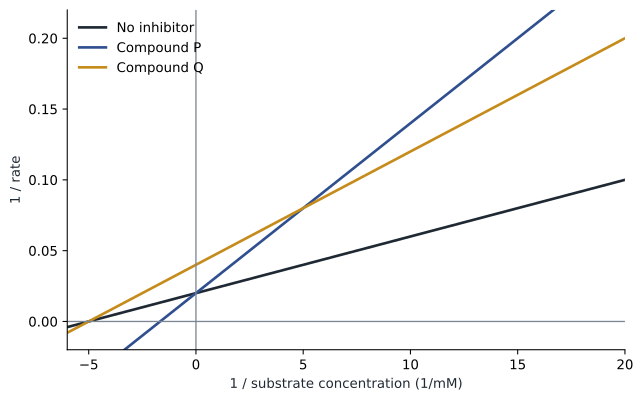
Questions 1 to 5 refer to passage 1.
1. Based on Table 1, compound P is best described as: (A) a competitive inhibitor. (B) a noncompetitive inhibitor. (C) an uncompetitive inhibitor. (D) an allosteric activator.
2. Based on Table 1, compound Q most likely: (A) binds the active site and competes with the substrate. (B) binds the enzyme at a site other than the active site, reducing the rate at all substrate concentrations. (C) increases the enzyme's affinity for its substrate. (D) binds only to the enzyme-substrate complex, lowering both Km and Vmax.
3. What does the second experiment show about both compounds? (A) They bind the enzyme covalently and irreversibly. (B) They inhibit the enzyme reversibly. (C) They destroy the enzyme. (D) They are not inhibitors.
4. Why did compound P have little effect on bacterial growth in medium with high substrate? (A) High substrate outcompetes a competitive inhibitor at the active site. (B) High substrate destroys compound P. (C) Compound P is a noncompetitive inhibitor, which substrate cannot overcome. (D) The bacteria stop making enzyme R in rich medium.
5. The researchers want to argue that compound Q is a promising antibiotic with few side effects in humans. Which fact from the passage best supports that argument? (A) Compound Q lowers Vmax. (B) Enzyme R is absent from human cells. (C) Compound Q is reversible. (D) Compound Q was tested at 10 micromolar.
Passage 2 (Psych/Soc): responding to a request for help in a group chat
Researchers studied whether the number of people in an online group affects how quickly members respond to a request for help. They recruited 240 undergraduate volunteers and randomly assigned each to a group chat of 2, 6 or 12 members. Unknown to participants, all other "members" were scripted accounts run by the researchers. Twenty minutes into an unrelated discussion task, a scripted member posted that she was locked out of the shared task file and asked whether anyone could send it to her. The researchers recorded whether each real participant responded within five minutes.
| Group size | Participants | Responded within 5 minutes |
|---|---|---|
| 2 | 80 | 64 (80 percent) |
| 6 | 80 | 40 (50 percent) |
| 12 | 80 | 24 (30 percent) |
In a follow-up condition with 12-member groups, the scripted member addressed the request to the participant by name. In this condition, 70 percent of participants responded within five minutes.
Questions 6 to 10 refer to passage 2.
6. Which phenomenon do the results in Table 2 most directly illustrate? (A) Social facilitation. (B) The bystander effect. (C) Group polarization. (D) The foot-in-the-door technique.
7. What is the independent variable in the main study? (A) Whether participants responded. (B) The time each participant took to respond. (C) The number of members in the group chat. (D) The content of the discussion task.
8. The follow-up condition, in which the request named the participant, best supports which explanation of the main finding? (A) Participants in large groups did not see the message. (B) Diffusion of responsibility: in large groups, each person feels less personally responsible. (C) Participants in large groups were less skilled at sending files. (D) Larger groups produced more conformity to an explicit group norm.
9. Why does random assignment strengthen the researchers' conclusion? (A) It guarantees that the results apply to all internet users. (B) It makes groups similar on average in characteristics such as helpfulness, so group size can be treated as the cause. (C) It ensures participants knew the other members were scripted. (D) It increases the number of participants in each group.
10. A critic argues that the findings may not apply to workplace chats, where members know one another and have defined roles. This criticism concerns the study's: (A) internal validity. (B) reliability. (C) external validity. (D) operational definition of group size.
Independent questions
11. A person is dehydrated. Which change in hormone release, and its effect on the kidney, would be expected? (A) More antidiuretic hormone, increasing water reabsorption in the collecting ducts. (B) Less antidiuretic hormone, increasing urine volume. (C) More aldosterone, decreasing sodium reabsorption. (D) Less renin, raising blood pressure.
12. A dog salivates when it hears a can opener because the sound has often come before food. In classical conditioning terms, the sound of the can opener is the: (A) unconditioned stimulus. (B) unconditioned response. (C) conditioned stimulus. (D) conditioned response.
13. A resident physician finds that the demands of being both a careful diagnostician and a fast-moving member of an emergency team conflict within her single job. This is best described as: (A) role conflict. (B) role strain. (C) role exit. (D) ascribed status.
Answers and explanations: passage 1
1. A (skill 4). Compound P raises Km (0.20 to 0.60 millimolar) without changing Vmax (50). That is the signature of competitive inhibition: the inhibitor competes with substrate, so more substrate is needed for half-maximal rate, but at very high substrate the full rate is reached.
2. B (skill 2). Compound Q halves Vmax without changing Km, the pattern of pure noncompetitive inhibition: binding at another site lowers the amount of active enzyme without affecting substrate binding. Choice D describes uncompetitive inhibition, which lowers both constants.
3. B (skill 3). Activity recovered fully once each compound was removed, so neither inhibition is permanent. Covalent, irreversible inhibitors would leave activity low after the column.
4. A (skill 2). Competitive inhibition is overcome by high substrate concentrations, which is consistent with compound P's unchanged Vmax. Choice C describes compound Q, not P.
5. B (skill 3). Selective toxicity depends on the target being absent or different in human cells. The passage states that enzyme R is absent from human cells, which is the strongest support for few side effects. Choices A, C and D describe the inhibitor's action, not its selectivity.
Answers and explanations: passage 2
6. B (skill 1). The bystander effect is the tendency for people to be less likely to help when others are present, and less likely the more others there are. Response fell from 80 to 50 to 30 percent as group size rose. Social facilitation (A) concerns performance in front of others; group polarization (C) concerns attitudes becoming more extreme after discussion.
7. C (skill 3). The researchers manipulated group size by random assignment. Responding (A) was the dependent variable.
8. B (skill 3). Naming the participant restored a high response rate even in 12-member groups. That points to responsibility, not visibility or skill: once the request was personal, responsibility could not be diffused. Choice A is weakened because the message was visible in all conditions.
9. B (skill 3). Random assignment spreads individual differences evenly across conditions on average, so differences between groups can be attributed to the manipulation. It does not by itself make results generalize to other populations (A).
10. C (skill 3). External validity is about whether results generalize to other settings, people and situations. The critic questions generalization to workplaces, not the logic within the study (internal validity).
Answers and explanations: independent questions
11. A (skill 1). Dehydration raises plasma osmolality, which triggers the posterior pituitary to release more antidiuretic hormone; it inserts water channels in the collecting ducts and increases water reabsorption, producing concentrated urine. Aldosterone (C) increases, not decreases, sodium reabsorption.
12. C (skill 1). The sound was neutral until paired with food; it now elicits salivation, so it is the conditioned stimulus. Salivation to the sound is the conditioned response (D).
13. B (skill 1). Role strain is tension between demands within a single role. Role conflict (A) is tension between two or more different roles, such as physician and parent.
The debrief
Thandiwe had expected tiredness to cost points, and it did. Devika scored 10 of 13 timed and 12 after blind review. Her two blind-review recoveries were questions 9 and 10, both research-design questions she had rushed. Her remaining miss was question 2: she chose D, uncompetitive inhibition, because she remembered "Q lowers Vmax" and forgot to check Km. 'I knew I was tired, and I stopped looking at the second column.'
Elliot scored 12 timed and 13 after blind review. He missed question 13 under time, choosing role conflict, then fixed it on blind review by asking "one role or two?". Ezequiel scored 11 timed and 12 after review. He was fastest on the Psych/Soc passage; the named-request condition reminded him of the rule he had learned as an EMT, to point at one person and say "you, call 911". Even so, he missed question 8 in both rounds, choosing D, conformity. 'I saw "large groups" and thought of norms.' Thandiwe asked what in the passage mentioned a norm. Nothing did. He wrote in his log: "If my answer uses a word the passage never used, check it twice."
| Student | Timed | After blind review | Pattern |
|---|---|---|---|
| Devika | 10 of 13 | 12 of 13 | Rushed design questions when tired; read only one column of a table |
| Elliot | 12 of 13 | 13 of 13 | Term confusion fixed by asking a distinguishing question |
| Ezequiel | 11 of 13 | 12 of 13 | Brought in an idea (conformity) the passage did not support |
Thandiwe compared the results with each student's results on similar questions taken fresh earlier in the autumn. All three had lost about one question more than usual on research design. 'That is the cost of the afternoon,' she said. 'The fix is not more content. It is the same method, applied deliberately when you are tired: read every column, name the design, check the word.'
What this set practices
This set combined the two sections that share the most reasoning skills. Both passages were experiments, and six of the ten passage questions turned on research design or data (skills 3 and 4). That is typical of the afternoon sections. Bio/Biochem questions on kinetics, inhibitors and controls depend on reading tables carefully. Psych/Soc questions on variables, random assignment and validity depend on naming the design correctly. In both, the passage governs: a term or idea that the passage does not support, however familiar, is a trap.
Common mistakes
MistakeAny inhibitor that lowers Vmax is noncompetitive.
InsteadCheck Km as well: noncompetitive leaves Km unchanged; uncompetitive lowers both Km and Vmax.
MistakeA competitive inhibitor lowers the maximum rate.
InsteadCompetitive inhibition raises Km but leaves Vmax unchanged, because high substrate overcomes it.
MistakeRandom assignment makes findings apply to everyone.
InsteadRandom assignment supports causal conclusions within the study (internal validity), not generalization (external validity).
MistakeRole conflict and role strain mean the same thing.
InsteadRole strain is within one role; role conflict is between different roles.
MistakeIf an answer uses a familiar term, it is probably right.
InsteadCheck that the passage supports the idea; familiar terms the passage never mentions are common traps.
Summary and key terms
- Competitive inhibitors raise Km without changing Vmax and are overcome by high substrate; noncompetitive inhibitors lower Vmax without changing Km.
- Recovery of activity after removing an inhibitor shows reversible inhibition; selective toxicity depends on a target absent or different in human cells.
- The bystander effect is reduced helping as group size grows; naming a person reduces diffusion of responsibility.
- The independent variable is what researchers manipulate; random assignment supports causal conclusions; external validity concerns generalization.
- Role strain is within one role; role conflict is between roles; a conditioned stimulus is a once-neutral stimulus that now elicits a response.
- Fatigue in the afternoon sections costs points mainly on design and data questions; apply the method deliberately when tired.
- Competitive inhibitor
- An inhibitor that competes with substrate for the active site, raising Km without changing Vmax.
- Noncompetitive inhibitor
- An inhibitor that binds at another site, lowering Vmax without changing Km.
- Bystander effect
- The tendency to be less likely to help when other people are present.
- Diffusion of responsibility
- The sense that responsibility is shared among those present, so each person feels less responsible.
- External validity
- The extent to which findings generalize beyond the study's setting and participants.
- Role strain
- Tension between competing demands within a single social role.
Practice problems
Work each problem on paper first, then reveal the answer to check.
In Figure 1, where do the no-inhibitor and compound P lines meet, and why?
Show answer
On the vertical axis, because the two conditions share the same Vmax and the intercept is one over Vmax.
What result in the second experiment would have suggested that compound Q is an irreversible inhibitor?
Show answer
Activity remaining low after the compound was removed by the column.
Suggest one change to the Psych/Soc study that would improve its external validity for workplaces.
Show answer
Run it in real or simulated workplace chats with colleagues who know one another and have defined roles.
A student who is both a varsity athlete and a pre-medical student cannot attend practice and a required chemistry lab at the same time. Role conflict or role strain?
Show answer
Role conflict, because the demands come from two different roles.
Lesson quiz · 5 questions
Score 60% or more to complete this lesson.
Create a free account to save your progress, take quizzes and earn a certificate.