
MCAT-130 · Lesson 7 of 12 · 21 min
Psychological disorders
▶ Video coming soon A video version of this lesson is on the way.
Before the session on psychological disorders, Thandiwe set two ground rules. 'First, we describe disorders the way a textbook and the MCAT do: as clusters of symptoms that cause distress or impairment, not as labels for people. We say a person with schizophrenia, not a schizophrenic. Second, if any of this touches something in your own life, you can step away from the screen at any time.' Ezequiel said that as an EMT he had transported many people during mental health crises, and that the most useful thing he had learned was to slow down and listen. 'Good,' Thandiwe said. 'Today we learn the categories. The listening you already have.'
Psychological disorders are part of content category 7A, "Individual influences on behavior". The MCAT tests the major categories of the Diagnostic and Statistical Manual of Mental Disorders (DSM), their key features, approaches to explaining them and the biological findings associated with some of them. Questions ask you to classify a described pattern, to reason about a study of a disorder or to identify a biological correlate. You will not be asked to diagnose a real patient, and you should not need detailed criteria such as exact symptom counts.
Defining and classifying disorders
A psychological disorder is commonly defined as a pattern of thoughts, feelings or behaviors that is deviant (unusual in its cultural context), distressing to the person and dysfunctional (interfering with daily life), sometimes with danger to self or others. Cultural context matters: behavior that is expected in one setting may be unusual in another, and the DSM includes discussion of cultural concepts of distress.
The DSM, published by the American Psychiatric Association, is the main classification system in North America. The current version is the DSM-5-TR, a text revision of the fifth edition published in 2022. The International Classification of Diseases (ICD), published by the World Health Organization, is used worldwide; its current edition is ICD-11. The DSM uses categorical diagnoses but includes some dimensional elements, such as severity ratings.
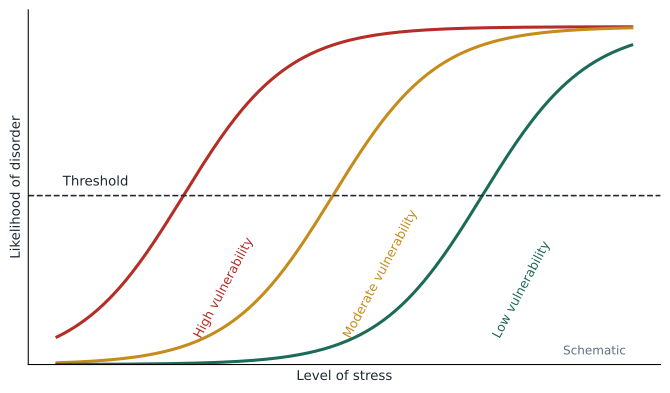
Three broad approaches explain disorders. The biomedical approach emphasizes biological causes, such as genes, brain structure and neurotransmitters, and biological treatments. The psychological approach emphasizes thoughts, learning and emotion. The biopsychosocial model, widely accepted in medicine, holds that disorders result from interactions among biological, psychological and social factors. The diathesis-stress model is a specific version: a person has a predisposition (diathesis), which may be genetic or psychological, and a disorder develops when stress interacts with that vulnerability.
Stigma, discussed in lesson 6, affects whether people seek help. Labels can help clinicians communicate and plan treatment, but they can also lead to stereotyping. David Rosenhan's 1973 study, in which healthy people were admitted to psychiatric hospitals after reporting hearing voices, was used to argue that labels bias how staff interpret behavior. Later investigations have raised serious questions about the study's methods and reporting, so it is best treated as a historically influential but contested study.
Major categories
| Category | Examples | Core features |
|---|---|---|
| Anxiety disorders | Generalized anxiety disorder, panic disorder, specific phobia, social anxiety disorder, agoraphobia | Excessive fear or worry with avoidance and physiological arousal |
| Obsessive-compulsive and related disorders | Obsessive-compulsive disorder, body dysmorphic disorder, hoarding disorder | Intrusive thoughts (obsessions) and repetitive behaviors (compulsions) |
| Trauma- and stressor-related disorders | Post-traumatic stress disorder, acute stress disorder, adjustment disorder | Symptoms following exposure to trauma or stress |
| Depressive disorders | Major depressive disorder, persistent depressive disorder | Persistent low mood or loss of interest |
| Bipolar and related disorders | Bipolar I, bipolar II, cyclothymic disorder | Episodes of mania or hypomania, often with depression |
| Schizophrenia spectrum and other psychotic disorders | Schizophrenia, delusional disorder | Delusions, hallucinations, disorganized thinking, negative symptoms |
| Dissociative disorders | Dissociative identity disorder, dissociative amnesia, depersonalization/derealization disorder | Disruption of memory, identity or awareness |
| Somatic symptom and related disorders | Somatic symptom disorder, illness anxiety disorder, conversion disorder | Physical symptoms or health worry causing distress |
| Personality disorders | Clusters A, B and C | Enduring, inflexible patterns that cause impairment |
| Neurodevelopmental and neurocognitive disorders | Autism spectrum disorder, ADHD; major neurocognitive disorder | Developmental differences; acquired cognitive decline |
Anxiety, obsessive-compulsive and trauma-related disorders
Generalized anxiety disorder involves persistent, excessive worry about many areas of life, with symptoms such as restlessness, fatigue and muscle tension. Panic disorder involves recurrent, unexpected panic attacks, sudden surges of intense fear with racing heart, shortness of breath and fear of dying or losing control, and worry about future attacks. Specific phobias are intense fears of particular objects or situations; social anxiety disorder is fear of social situations in which one may be judged; agoraphobia is fear of places where escape might be difficult. Learning theories explain some phobias through classical conditioning and their persistence through negative reinforcement: avoiding the feared object removes anxiety, which strengthens avoidance.
Obsessive-compulsive disorder involves obsessions, intrusive and unwanted thoughts that cause anxiety, and compulsions, repetitive behaviors or mental acts performed to reduce that anxiety. Hoarding disorder and body dysmorphic disorder are in the same group. Post-traumatic stress disorder (PTSD) follows exposure to actual or threatened death, serious injury or sexual violence and involves intrusive memories, avoidance, negative changes in thoughts and mood, and changes in arousal and reactivity such as hypervigilance and an exaggerated startle response, lasting more than a month. PTSD is classified separately from anxiety disorders in the current DSM.
Mood disorders
Major depressive disorder involves at least one major depressive episode: two weeks or more of depressed mood or loss of interest or pleasure (anhedonia), with other symptoms such as changes in sleep and appetite, fatigue, feelings of worthlessness, difficulty concentrating and thoughts of death. Persistent depressive disorder is a chronic depressed mood lasting at least two years in adults. Seasonal patterns of depression are recognized as a specifier.
Bipolar I disorder requires at least one manic episode: a distinct period of abnormally elevated or irritable mood and increased energy, with symptoms such as inflated self-esteem, decreased need for sleep, racing thoughts, distractibility and risky behavior, severe enough to impair functioning. Bipolar II involves hypomanic episodes (milder, without severe impairment) and major depressive episodes. Cyclothymic disorder involves many periods of hypomanic and depressive symptoms that do not meet full criteria, lasting at least two years.
Biological correlates of depression include reduced activity of monoamine neurotransmitters (serotonin, norepinephrine and dopamine) in older models, changes in HPA axis activity with high cortisol, and reduced hippocampal volume in some studies. The monoamine hypothesis is now considered incomplete, because antidepressants change neurotransmitter levels within hours but mood improves over weeks. Cognitive theories emphasize negative thought patterns, such as Aaron Beck's cognitive triad of negative views of the self, the world and the future. The learned helplessness model from lesson 4 also contributes. Bipolar disorder has a strong genetic component, and lithium is a long-standing treatment.
Schizophrenia
Schizophrenia involves a combination of positive symptoms, which add experiences not normally present, and negative symptoms, which remove normal functions.
- Positive symptoms: delusions (fixed false beliefs, such as persecution or grandeur), hallucinations (most often auditory), disorganized speech (loose associations, word salad) and grossly disorganized or catatonic behavior.
- Negative symptoms: reduced emotional expression (flat affect), avolition (lack of motivation), alogia (reduced speech), anhedonia and social withdrawal.
- Cognitive symptoms: problems with attention, working memory and executive function are common and often affect daily functioning most.
The dopamine hypothesis proposes that excess dopamine activity in certain pathways contributes to positive symptoms; many antipsychotic medications block dopamine D2 receptors, and drugs that increase dopamine, such as amphetamines, can produce psychotic symptoms. Other neurotransmitters, notably glutamate, are also implicated. Schizophrenia is highly heritable: the risk for an identical twin of a person with schizophrenia is far higher than for the general population, though not certain, which points to environmental contributions as well. Brain imaging often shows enlarged ventricles and reduced gray matter in some regions. Environmental risk factors include prenatal complications, heavy cannabis use in adolescence and urban upbringing, and onset is typically in late adolescence or early adulthood.
Dissociative and somatic symptom disorders
Dissociative disorders involve disruption of consciousness, memory or identity. Dissociative amnesia is an inability to recall important personal information, usually about a traumatic or stressful event, beyond ordinary forgetting. Depersonalization/derealization disorder involves persistent feelings of detachment from oneself or from one's surroundings. Dissociative identity disorder involves two or more distinct personality states; its causes and how often it occurs are debated.
Somatic symptom disorder involves distressing physical symptoms with excessive thoughts, feelings or behaviors about them. Illness anxiety disorder is preoccupation with having or developing a serious illness despite few or no symptoms. Conversion disorder (functional neurological symptom disorder) involves neurological symptoms, such as weakness or paralysis, that are inconsistent with recognized neurological conditions.
Personality disorders
Personality disorders are enduring, inflexible patterns of inner experience and behavior that deviate from cultural expectations, begin by adolescence or early adulthood and cause distress or impairment. They are often ego-syntonic, experienced by the person as part of who they are rather than as unwanted symptoms, unlike most other disorders, which are ego-dystonic. The DSM groups them in three clusters.
| Cluster | Description | Disorders |
|---|---|---|
| A (odd or eccentric) | Unusual thinking and social detachment | Paranoid, schizoid, schizotypal |
| B (dramatic, emotional or erratic) | Unstable emotions and relationships; impulsivity | Antisocial, borderline, histrionic, narcissistic |
| C (anxious or fearful) | Anxiety and avoidance | Avoidant, dependent, obsessive-compulsive personality disorder |
Obsessive-compulsive personality disorder (a preoccupation with orderliness, perfectionism and control) differs from obsessive-compulsive disorder: the personality disorder usually lacks true obsessions and compulsions and is ego-syntonic. Antisocial personality disorder involves a persistent disregard for the rights of others and requires the person to be at least 18, with evidence of conduct problems before age 15. Borderline personality disorder involves instability in relationships, self-image and emotions, with marked impulsivity.
Neurodevelopmental and neurocognitive disorders
Neurodevelopmental disorders begin in the developmental period. Autism spectrum disorder involves persistent differences in social communication and interaction, together with restricted, repetitive patterns of behavior, interests or activities. Attention-deficit/hyperactivity disorder (ADHD) involves persistent inattention, hyperactivity and impulsivity, or both, that interfere with functioning. Neurocognitive disorders involve acquired decline in cognition. Major neurocognitive disorder, previously called dementia, has many causes, the most common being Alzheimer disease. Parkinson disease, which involves loss of dopamine neurons in the substantia nigra, causes movement symptoms and can lead to cognitive decline. Delirium is an acute, fluctuating disturbance of attention and awareness, often caused by medical illness, medication or withdrawal, and is usually reversible when the cause is treated.
Treatment approaches
The MCAT expects only an overview. Psychodynamic therapies explore unconscious conflicts and past experiences. Humanistic therapies, such as Rogers's client-centered therapy, provide empathy, genuineness and unconditional positive regard. Behavioral therapies apply learning principles: exposure therapy and systematic desensitization for anxiety, and reinforcement-based programs. Cognitive therapies challenge distorted thoughts; cognitive behavioral therapy (CBT) combines both and has strong evidence for depression and anxiety disorders. Biomedical treatments include medications (antidepressants such as selective serotonin reuptake inhibitors, antipsychotics, mood stabilizers such as lithium, and anxiolytics), electroconvulsive therapy for severe depression, and newer neuromodulation methods such as transcranial magnetic stimulation. Many people benefit most from a combination of approaches.
Thandiwe stopped the session with ten minutes left and returned to her opening point. 'Every one of these categories describes people, and some of those people will be your patients. On the MCAT you will classify symptoms. In clinic you will remember that the person in front of you is more than the category.'
Worked problem
Reading a twin study of a disorder
A study reports that among identical twins of people with a disorder, 45 percent also have the disorder; among fraternal twins, 15 percent; in the general population, 1 percent. (Data invented for this course.) What do the data suggest, and what do they not show?
Show solution
- Compare identical and fraternal twins: the higher rate in identical twins suggests a genetic contribution.
- Compare fraternal twins with the population: the elevated rate also suggests shared genes and possibly shared environment.
- Note that the identical-twin rate is well below 100 percent: genes alone do not determine the disorder, so environment matters.
- Recognize the limits: twin studies assume that identical and fraternal twins share environments equally, which may not be true, and the data do not identify specific genes or mechanisms.
Answer: There is a substantial genetic contribution with an important environmental role, consistent with a diathesis-stress model; the study does not identify specific genes or prove a particular environmental cause.
Common mistakes
MistakeSchizophrenia means having multiple personalities.
InsteadSchizophrenia involves psychosis, negative symptoms and cognitive problems; multiple identity states describe dissociative identity disorder.
MistakeHallucinations are a negative symptom.
InsteadHallucinations and delusions are positive symptoms; flat affect and avolition are negative symptoms.
MistakeBipolar II is a milder form of depression.
InsteadBipolar II involves hypomanic episodes and major depressive episodes.
MistakeObsessive-compulsive personality disorder and obsessive-compulsive disorder are the same.
InsteadThe personality disorder involves perfectionism and control and is usually ego-syntonic; OCD involves true obsessions and compulsions.
MistakeIf identical twins do not always share a disorder, genes play no role.
InsteadHigher concordance in identical than fraternal twins shows a genetic contribution; less than full concordance shows environmental influence too.
Summary and key terms
- Disorders are patterns that are deviant, distressing and dysfunctional in their cultural context; the DSM-5-TR and ICD-11 classify them.
- The biopsychosocial and diathesis-stress models explain disorders as interactions of vulnerability and stress.
- Anxiety, obsessive-compulsive and trauma-related disorders involve fear, worry, intrusive thoughts and post-trauma symptoms.
- Depressive and bipolar disorders are distinguished by the presence of manic or hypomanic episodes; biological and cognitive factors contribute.
- Schizophrenia involves positive, negative and cognitive symptoms and is linked to dopamine, genetics and environmental risks.
- Personality disorders form three clusters and are usually ego-syntonic; treatments include psychotherapies and biomedical approaches, often combined.
- Biopsychosocial model
- The view that biological, psychological and social factors interact to produce health and illness.
- Diathesis-stress model
- The view that disorders arise when stress acts on a pre-existing vulnerability.
- Anhedonia
- Loss of interest or pleasure in activities.
- Manic episode
- A period of abnormally elevated or irritable mood and increased energy with impaired functioning.
- Positive symptoms
- Symptoms that add experiences, such as delusions and hallucinations.
- Negative symptoms
- Symptoms that reduce normal functions, such as flat affect and avolition.
- Ego-syntonic
- Experienced as consistent with one's self-image, as personality disorders often are.
- Dopamine hypothesis
- The proposal that excess dopamine activity contributes to the positive symptoms of schizophrenia.
Practice problems
Work each problem on paper first, then reveal the answer to check.
A person has experienced several sudden episodes of intense fear with a pounding heart and now avoids leaving home in case another occurs. Which disorders are suggested?
Show answer
Panic disorder, possibly with agoraphobia.
A patient talks rapidly, has barely slept for a week, has spent his savings on an unrealistic business and believes he cannot fail. Which episode is described?
Show answer
A manic episode, as in bipolar I disorder.
Which class of medication is most associated with blocking dopamine D2 receptors?
Show answer
Antipsychotics.
A person checks the stove dozens of times each night to relieve intrusive fears of fire. What is the checking called?
Show answer
A compulsion, part of obsessive-compulsive disorder.
Which personality disorder cluster includes avoidant and dependent personality disorders?
Show answer
Cluster C, the anxious or fearful cluster.
Lesson quiz · 5 questions
Score 60% or more to complete this lesson.
Create a free account to save your progress, take quizzes and earn a certificate.