
MCAT-130 · Lesson 2 of 12 · 24 min
The brain, attention and consciousness
▶ Video coming soon A video version of this lesson is on the way.
Thandiwe opened the second Psych/Soc session by asking each member to describe the last time they drove, walked or took transit somewhere and remembered almost nothing of the trip. Devika described her bus ride to the pharmacy; Ezequiel described night drives home after twelve-hour EMT shifts. 'Your brain was making hundreds of decisions,' Thandiwe said, 'and almost none of them reached awareness. Today is about what reaches awareness, what does not, and the hardware that decides.'
This lesson combines two parts of the AAMC outline. The biological bases of behavior, in content category 7A, cover the nervous system, neurotransmitters, the endocrine system and the influence of genes and environment on behavior. Attention and consciousness, including sleep, dreaming and psychoactive drugs, belong to content category 6B. The biology here is introductory: you need the major brain regions and what they do, the main neurotransmitters and how researchers study the brain, not the detailed cellular physiology covered in Bio/Biochem.
Organization of the nervous system
The central nervous system is the brain and spinal cord. The peripheral nervous system carries information to and from it and has two branches. The somatic nervous system controls voluntary movement and carries sensory information from skin and muscles. The autonomic nervous system regulates involuntary functions such as heart rate, digestion and gland activity, and has two divisions that generally act in opposition. The sympathetic division prepares the body for action: heart rate and blood pressure rise, pupils dilate, digestion slows and glucose is released. The parasympathetic division supports rest and digestion: heart rate slows, digestion resumes and energy is conserved.
Reflexes show that not all behavior needs the brain. In a spinal reflex arc, a sensory neuron carries a signal to the spinal cord, an interneuron relays it and a motor neuron triggers a muscle response, all before the brain registers the stimulus. The withdrawal of a hand from a hot surface is the classic example. The brain is informed afterward, which is why you feel the pain just after you have already moved.
Major brain regions
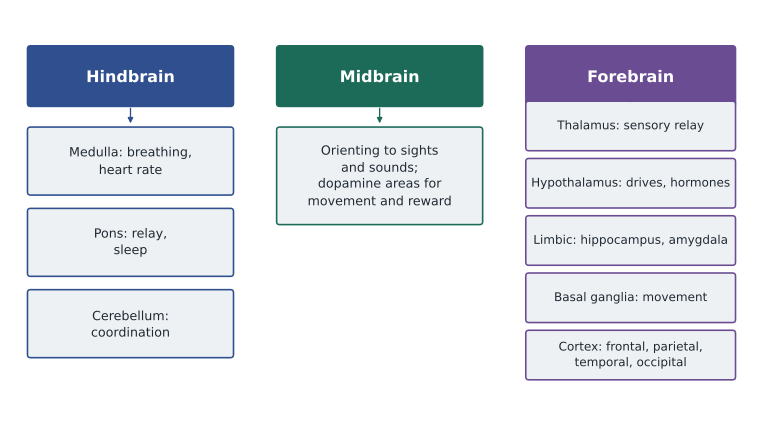
The brain is often described in three developmental divisions. The hindbrain includes the medulla oblongata (breathing, heart rate, blood pressure), the pons (relays signals and helps regulate sleep and breathing) and the cerebellum (coordination, balance and motor learning). The midbrain contains structures for orienting to visual and auditory stimuli and dopamine-producing areas involved in movement and reward. The forebrain includes the thalamus, hypothalamus, limbic system and cerebral cortex.
| Structure | Main functions | What damage or stimulation can show |
|---|---|---|
| Thalamus | Relays sensory information (except smell) to the cortex | Disrupted sensory processing |
| Hypothalamus | Hunger, thirst, temperature, sexual behavior; controls the pituitary | Changes in eating, body temperature or hormone release |
| Amygdala | Fear, threat detection and emotional memory | Reduced fear responses (as in Kluver-Bucy syndrome) |
| Hippocampus | Forming new explicit memories; spatial memory | Inability to form new long-term explicit memories (anterograde amnesia) |
| Basal ganglia | Smooth movement and habit formation | Movement disorders such as Parkinson disease |
| Frontal lobe | Planning, decision making, impulse control; motor cortex; Broca area | Personality change, poor judgment, expressive aphasia |
| Parietal lobe | Somatosensory cortex; spatial attention | Neglect of one side of space |
| Temporal lobe | Auditory cortex; Wernicke area; object and face recognition | Receptive aphasia; prosopagnosia |
| Occipital lobe | Primary visual cortex | Visual field loss or cortical blindness |
The limbic system, usually described as the hippocampus, amygdala, hypothalamus and nearby structures such as the cingulate cortex, links emotion, motivation and memory. The prefrontal cortex, at the front of the frontal lobe, is central to executive functions: working memory, planning, inhibiting impulses and shifting strategies. The case of Phineas Gage, a railway foreman whose frontal lobe was damaged by an iron rod in 1848, is often cited for the change in personality and impulse control that followed. Accounts of his case have been embellished over time, and historians now think he recovered some function, which makes it a useful reminder to treat single cases with caution.
Lateralization
The two cerebral hemispheres are connected by the corpus callosum and differ somewhat in specialization. In most people, the left hemisphere is dominant for language, including Broca's area in the frontal lobe (speech production) and Wernicke's area in the temporal lobe (language comprehension). The right hemisphere contributes more to spatial reasoning, face recognition and some aspects of emotional expression and prosody. Each hemisphere controls movement and receives touch from the opposite side of the body.
Split-brain studies by Roger Sperry and Michael Gazzaniga examined patients whose corpus callosum had been cut to treat severe epilepsy. When an image was flashed to the right visual field (left hemisphere), patients could name it. When it was flashed to the left visual field (right hemisphere), they could not name it but could select the object with the left hand. These studies show lateralization, but popular claims that people are 'left-brained' or 'right-brained' are not supported: both hemispheres work together in nearly every task.
Damage to Broca's area produces expressive (Broca) aphasia: speech is slow, effortful and telegraphic, but comprehension is relatively preserved. Damage to Wernicke's area produces receptive (Wernicke) aphasia: speech is fluent but often meaningless, and comprehension is poor. Damage to the arcuate fasciculus, which connects the two areas, produces conduction aphasia, in which comprehension and fluent speech are relatively intact but repetition is impaired.
Neurotransmitters
| Neurotransmitter | Major roles | Links you may see in passages |
|---|---|---|
| Acetylcholine | Muscle contraction; parasympathetic signaling; attention and memory | Loss of cholinergic neurons in Alzheimer disease |
| Dopamine | Reward, motivation, movement | Loss in Parkinson disease; excess activity linked to positive symptoms of schizophrenia |
| Serotonin | Mood, sleep, appetite | Many antidepressants increase serotonin signaling |
| Norepinephrine | Arousal, alertness, sympathetic response | Stress responses; some antidepressants act on it |
| GABA | Main inhibitory neurotransmitter in the brain | Alcohol and benzodiazepines enhance GABA effects |
| Glutamate | Main excitatory neurotransmitter; learning | Long-term potentiation in memory formation |
| Endorphins | Natural pain relief and pleasure | Opioid drugs act on the same receptors |
Drugs that mimic or enhance a neurotransmitter's action are agonists; drugs that block it are antagonists. A passage might describe a drug that blocks dopamine receptors and ask about its effects on movement or on psychotic symptoms; reason from the table rather than memorizing drug names.
The endocrine system and behavior
Hormones are slower-acting chemical messengers released into the blood. The hypothalamus controls the pituitary gland, which in turn regulates many other glands. In the stress response, the hypothalamic-pituitary-adrenal (HPA) axis releases corticotropin-releasing hormone, then adrenocorticotropic hormone, and finally cortisol from the adrenal cortex. Cortisol raises blood glucose and suppresses some immune functions. The adrenal medulla releases epinephrine and norepinephrine as part of the fast sympathetic response. Testosterone and estrogen influence sexual development and some aspects of behavior, and oxytocin is associated with social bonding, childbirth and lactation.
Genes, environment and behavior
Behavior genetics asks how much of the variation in a trait within a population is associated with genetic variation. Heritability is the proportion of variation in a trait within a particular population that can be attributed to genetic differences. It is a population statistic: a heritability of 0.5 for height does not mean that half of one person's height comes from genes. Heritability can also change when the environment changes. If everyone in a population had excellent nutrition, more of the remaining variation in height would be due to genes and heritability would rise.
Researchers estimate heritability with twin studies, comparing identical (monozygotic) twins, who share almost all of their genes, with fraternal (dizygotic) twins, who share about half on average. If identical twins are more similar on a trait than fraternal twins, genes probably contribute. Adoption studies compare adopted children with their biological and adoptive parents. Family studies show whether a trait clusters in families but cannot separate shared genes from shared environment. Gene-environment interaction means the effect of genes depends on the environment, and epigenetic changes, such as DNA methylation, can alter gene expression in response to experience without changing DNA sequence.
Two related ideas appear in passages. Adaptive value is the extent to which a trait helps an organism survive and reproduce. Regulatory genes and developmental timing matter too: human infants show reflexes such as rooting, sucking, the Moro (startle) reflex and the Babinski reflex, which fade as the nervous system matures, and motor milestones follow a regular sequence across cultures even when their exact timing varies.
Methods for studying the brain
- Lesion studies, including case studies of brain damage and experimental lesions in animals, link regions to functions but cannot easily separate the role of a region from that of fibers passing through it.
- Electroencephalography (EEG) records electrical activity from the scalp. It has excellent temporal resolution (milliseconds) but poor spatial resolution, and it is widely used in sleep research.
- Functional magnetic resonance imaging (fMRI) measures changes in blood oxygenation (the BOLD signal) linked to neural activity. It has good spatial resolution but poorer temporal resolution, because blood flow changes over seconds.
- Positron emission tomography (PET) uses radioactive tracers to measure metabolic activity or neurotransmitter binding.
- Computed tomography (CT) and structural MRI show anatomy but not activity.
- Transcranial magnetic stimulation (TMS) temporarily stimulates or disrupts a cortical area, allowing causal tests in healthy volunteers.
Methods questions often ask which technique fits a research goal. If the question is when something happens, choose EEG. If it is where activity occurs, choose fMRI. If it is whether a region is necessary, choose a lesion study or TMS. Correlational imaging data cannot show that a region causes a behavior; that requires manipulation.
Attention
Attention is the selection of some information for further processing. Selective attention focuses on one stimulus while ignoring others. The cocktail party effect describes being able to follow one conversation in a noisy room while still noticing when someone says your name, evidence that unattended information is processed to some degree. Broadbent's early filter model proposed that unattended information is blocked early, based on physical features; Treisman's attenuation model proposed that it is turned down rather than blocked, which explains why meaningful words can break through.
Divided attention is attending to more than one task at once. Performance usually suffers when tasks compete for the same resources, especially when both are new or demanding. With practice, some tasks become automatic and require little attention, which is why an experienced driver can hold a conversation on a familiar road but stops talking in heavy traffic. Inattentional blindness is the failure to notice an unexpected object in plain view when attention is focused elsewhere, as in the well-known experiment in which many viewers counting basketball passes failed to notice a person in a gorilla suit. Change blindness is the failure to notice changes in a scene.
Consciousness and sleep
Consciousness is awareness of oneself and one's environment. Alertness ranges from full wakefulness through drowsiness, sleep, and altered states produced by hypnosis, meditation or drugs. Hypnosis is a state of focused attention and heightened suggestibility; it can reduce pain perception in some people, but there is little evidence that it improves the accuracy of memory, and it can increase confidence in false memories. Meditation practices that train attention have been linked in studies to changes in EEG patterns and to reduced stress.
Sleep is regulated by two processes: a circadian rhythm of about 24 hours, controlled by the suprachiasmatic nucleus of the hypothalamus, which responds to light and regulates melatonin release from the pineal gland; and sleep pressure, which builds the longer one is awake. A night of sleep cycles through stages roughly every 90 minutes.
| Stage | EEG pattern | Features |
|---|---|---|
| Awake, alert | Beta waves (high frequency, low amplitude) | Active thinking |
| Awake, relaxed | Alpha waves | Eyes closed, calm |
| N1 (light sleep) | Theta waves | Transition; hypnagogic sensations, sudden jerks |
| N2 | Theta with sleep spindles and K complexes | Most of total sleep time |
| N3 (slow-wave sleep) | Delta waves (low frequency, high amplitude) | Deepest sleep; growth hormone release; sleepwalking and night terrors |
| REM sleep | Beta-like, wake-like activity | Rapid eye movements, vivid dreams, muscle paralysis (atonia) |
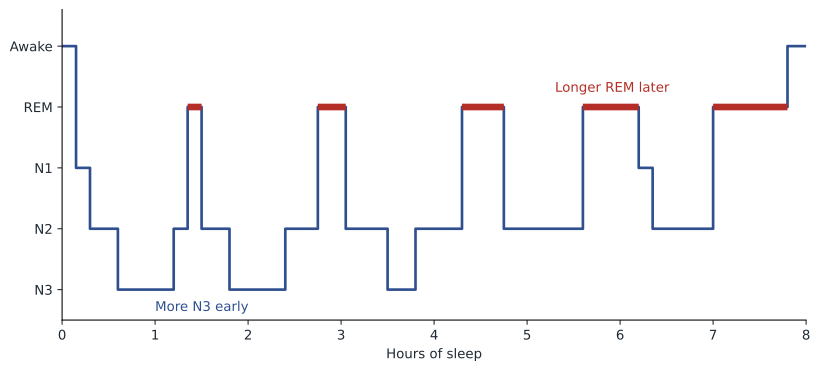
REM sleep is called paradoxical sleep because the brain is highly active while the voluntary muscles are paralyzed. People woken from REM usually report vivid dreams. Theories of dreaming include the activation-synthesis hypothesis (dreams are the brain's attempt to make sense of random activity from the brainstem), the information-processing or memory consolidation view, and the older psychoanalytic view of dreams as disguised wishes, which has little empirical support. Sleep, including both slow-wave and REM sleep, appears to support memory consolidation.
Sleep disorders are divided into dyssomnias, which affect the amount or timing of sleep, and parasomnias, which involve abnormal behavior during sleep. Insomnia is persistent difficulty falling or staying asleep. Narcolepsy involves sudden, uncontrollable sleep episodes and sometimes cataplexy (sudden loss of muscle tone triggered by emotion), with REM intrusions into wakefulness. Sleep apnea involves repeated pauses in breathing during sleep. Sleepwalking and night terrors occur in slow-wave sleep and are more common in children.
Psychoactive drugs and addiction
| Class | Examples | Main effects |
|---|---|---|
| Depressants | Alcohol, benzodiazepines, barbiturates | Slow central nervous system activity, often by enhancing GABA; reduced anxiety and coordination |
| Stimulants | Caffeine, nicotine, amphetamines, cocaine | Increase arousal; many raise dopamine or norepinephrine activity |
| Opioids | Morphine, heroin, fentanyl | Pain relief and euphoria via opioid receptors; respiratory depression in overdose |
| Hallucinogens | LSD, psilocybin | Altered perception; many act on serotonin receptors |
| Cannabis | THC-containing products | Altered perception and mood; acts on cannabinoid receptors |
Many drugs with addictive potential increase dopamine release in the mesolimbic reward pathway, which runs from the ventral tegmental area in the midbrain to the nucleus accumbens and on to the prefrontal cortex. Tolerance is the need for more of a drug to achieve the same effect; withdrawal is the set of symptoms that appears when use stops. Substance use disorders are diagnosed by a pattern of use that causes significant impairment, including loss of control, continued use despite harm and, often, tolerance and withdrawal. Treatment approaches include medications, behavioral therapies and harm reduction.
Ezequiel connected this to his EMT years. 'We gave naloxone for suspected opioid overdoses,' he said. 'It worked in seconds because it pushes the opioid off the receptor.' Thandiwe asked him to put that in MCAT words. 'Naloxone is an opioid receptor antagonist,' he said. 'Good,' she replied. 'And respiratory depression is why opioid overdose kills: the medulla stops driving breathing.'
A passage-style example
Worked problem
An attention and imaging study
Researchers asked 24 participants to count the number of times a target letter appeared in a stream of letters while a voice spoke in their ear. In some trials the voice said the participant's own name. Participants detected their own name on 35 percent of trials and other names on 5 percent. fMRI showed greater activity in the prefrontal cortex during name trials. (Data invented for this course.) Which conclusion is best supported?
Show solution
- Identify the attention task: participants attended to letters, so the voice was unattended.
- Detecting one's own name more often shows that unattended information was processed for meaning, consistent with attenuation, not an early filter that blocks all unattended input.
- Check the imaging claim: fMRI shows correlated activity, not that the prefrontal cortex causes name detection.
- Choose the answer that matches the behavioral result and does not overstate the imaging result.
Answer: Unattended speech was partly processed for meaning, supporting an attenuation model; the imaging data show an association, not a causal role.
Common mistakes
MistakeThe sympathetic nervous system is part of the somatic nervous system.
InsteadIt is a division of the autonomic nervous system, which controls involuntary functions.
MistakeA heritability of 0.6 means 60 percent of each person's trait comes from genes.
InsteadHeritability describes variation within a population, not the cause of one person's trait.
MistakeEEG has excellent spatial resolution.
InsteadEEG has excellent temporal resolution but poor spatial resolution; fMRI is the reverse.
MistakeSleepwalking happens during REM sleep.
InsteadSleepwalking and night terrors occur during slow-wave (N3) sleep; REM sleep features muscle paralysis.
MistakeWernicke aphasia produces slow, effortful speech.
InsteadWernicke aphasia produces fluent but meaningless speech with poor comprehension; Broca aphasia produces effortful speech.
Summary and key terms
- The nervous system divides into central and peripheral parts; the autonomic system has opposing sympathetic and parasympathetic divisions.
- Hindbrain, midbrain and forebrain structures have characteristic functions; the limbic system links emotion and memory, and the prefrontal cortex supports executive function.
- Language is usually lateralized to the left hemisphere, with Broca and Wernicke areas producing distinct aphasias when damaged.
- Neurotransmitters, hormones, genes and environment all shape behavior; heritability is a population statistic.
- Attention is selective and limited; unattended information can still be processed for meaning.
- Sleep cycles through N1, N2, N3 and REM about every 90 minutes; drugs alter consciousness by acting on neurotransmitter systems, and many act on the reward pathway.
- Autonomic nervous system
- The part of the peripheral nervous system that controls involuntary functions through sympathetic and parasympathetic divisions.
- Prefrontal cortex
- The front region of the frontal lobe responsible for planning, impulse control and other executive functions.
- Lateralization
- The specialization of each cerebral hemisphere for certain functions.
- Heritability
- The proportion of variation in a trait within a population attributed to genetic differences.
- Selective attention
- Focusing on one stimulus while ignoring others.
- REM sleep
- Sleep with rapid eye movements, wake-like EEG activity, vivid dreams and muscle paralysis.
- Circadian rhythm
- A roughly 24-hour biological cycle regulated by the suprachiasmatic nucleus.
- Tolerance
- The need for increasing doses of a drug to achieve the same effect.
Practice problems
Work each problem on paper first, then reveal the answer to check.
A patient can understand speech but speaks slowly in short, effortful phrases. Where is the damage most likely?
Show answer
Broca's area in the left frontal lobe.
Identical twins correlate 0.80 on a trait and fraternal twins 0.40. What does this suggest?
Show answer
A substantial genetic contribution to variation in the trait in that population, since the more genetically similar pairs are more alike.
Which sleep stage dominates the first half of the night?
Show answer
Slow-wave sleep (N3); REM periods become longer later in the night.
A drug blocks dopamine receptors. Which side effect on movement would you predict?
Show answer
Parkinson-like movement problems such as stiffness and tremor, because dopamine in the basal ganglia supports smooth movement.
Why might a researcher choose EEG over fMRI to study the moment a person recognizes a word?
Show answer
EEG measures activity within milliseconds, so it captures timing better than fMRI.
Lesson quiz · 5 questions
Score 60% or more to complete this lesson.
Create a free account to save your progress, take quizzes and earn a certificate.