
MCAT-130 · Lesson 4 of 12 · 23 min
Learning and behavior change
▶ Video coming soon A video version of this lesson is on the way.
Thandiwe began the learning session with a confession. 'When I was studying for my own qualifying exams, I kept my phone on the desk. Every time I solved a problem I checked it. Sometimes there was a message, sometimes not.' She paused. 'Which reinforcement schedule was I on, and why could I not stop?' Elliot answered first: 'Variable ratio. Unpredictable rewards.' 'Right,' she said, 'and that is the schedule that slot machines use. By the end of today you should be able to explain why your study habits respond to the same rules.'
This lesson covers content category 7C, "Attitude and behavior change": habituation and dishabituation, classical and operant conditioning, observational learning and theories of attitude change. It also draws on the parts of 7B that describe how others influence behavior. Learning questions are some of the most predictable on the Psych/Soc section, but the answer choices are designed to test precise distinctions, such as negative reinforcement versus punishment. Slow down on those words.
Non-associative learning
The simplest forms of learning involve a single stimulus. Habituation is a decrease in response to a repeated, harmless stimulus: you stop noticing the hum of a refrigerator. Dishabituation is the recovery of a habituated response when a new stimulus appears, or when the original stimulus changes. If the refrigerator suddenly clicks off, you notice the silence, and you may again notice sounds you had tuned out. Sensitization is the opposite of habituation: an increase in response after a strong or noxious stimulus. After a loud bang, you jump at smaller noises.
Habituation is learning, not fatigue or sensory adaptation, because the receptors still work. Researchers often show this by changing the stimulus slightly: if the response returns, the system was not simply exhausted. Infant researchers use habituation to study perception. Babies look less at a repeated image; if they look longer at a new image, they must be able to tell the two apart.
Classical conditioning
Ivan Pavlov, studying digestion in dogs, noticed that the animals began to salivate before food arrived, in response to signals that predicted feeding. Classical conditioning is learning to associate a neutral stimulus with a stimulus that naturally produces a response.
- Unconditioned stimulus (US): a stimulus that naturally triggers a response, such as food.
- Unconditioned response (UR): the natural response to the US, such as salivation to food.
- Neutral stimulus: a stimulus that initially produces no relevant response, such as a tone.
- Conditioned stimulus (CS): the formerly neutral stimulus after it has been paired with the US.
- Conditioned response (CR): the learned response to the CS, such as salivation to the tone.
The UR and CR are often the same behavior; what differs is the stimulus that produces it. If a question asks you to label the response, ask what triggered it. Salivation to food is a UR; salivation to the tone is a CR.
Several processes shape conditioned responses. Acquisition is the initial learning; it is fastest when the CS comes shortly before the US (delayed or forward conditioning) and weak when the CS follows the US (backward conditioning). Extinction is the weakening of the CR when the CS is repeatedly presented without the US. Spontaneous recovery is the reappearance of an extinguished CR after a rest, showing that extinction suppresses rather than erases learning. Generalization is responding to stimuli similar to the CS; discrimination is learning to respond only to the CS and not to similar stimuli. Higher-order (second-order) conditioning occurs when a well-established CS is used to condition a new neutral stimulus.
Robert Rescorla showed that conditioning depends on contingency: the CS must predict the US, not merely occur alongside it. If the US is just as likely without the CS, little learning occurs. Leon Kamin's blocking effect makes a related point: if one stimulus already predicts the US, a second stimulus added later is not learned, because it adds no new information.
Biological preparedness limits what is easily conditioned. John Garcia found that rats readily learned to avoid a taste paired with nausea even when illness came hours later, after a single pairing, but did not easily learn to associate the same taste with an electric shock. Taste aversion is therefore an exception to the usual rule that the CS must closely precede the US. People who become sick after a meal may avoid that food for years even when they know the food was not the cause.
Classical conditioning has practical applications. John Watson and Rosalie Rayner's 'Little Albert' study, which conditioned fear of a white rat in an infant, is now cited as an example of unethical research. Fear responses can be reduced through systematic desensitization, which pairs gradual exposure to a feared stimulus with relaxation, and through exposure therapy. Ezequiel described a patient he had transported who began shaking at the sound of an ambulance siren years after a serious crash. 'Conditioned stimulus,' he said. 'The siren predicted the worst day of her life.'
Operant conditioning
Operant conditioning is learning in which behavior is shaped by its consequences. Edward Thorndike's law of effect stated that behaviors followed by satisfying outcomes become more likely. B.F. Skinner developed the approach systematically, using operant chambers (Skinner boxes) in which animals pressed levers for food.
The vocabulary is precise. Reinforcement always increases the likelihood of a behavior; punishment always decreases it. Positive means something is added; negative means something is removed.
| Stimulus added | Stimulus removed | |
|---|---|---|
| Behavior increases | Positive reinforcement: praise after studying | Negative reinforcement: taking a pain reliever removes a headache |
| Behavior decreases | Positive punishment: a fine for speeding | Negative punishment: losing phone privileges for missing curfew |
Negative reinforcement is the most commonly misidentified term. It is not punishment. If removing something unpleasant makes a behavior more likely, the behavior has been negatively reinforced. Escape learning is behavior that ends an aversive stimulus (leaving a room when a fire alarm sounds), and avoidance learning is behavior that prevents it from occurring (leaving before the alarm is tested). Both are maintained by negative reinforcement.
Reinforcers can be primary (satisfying biological needs, such as food and water) or secondary, also called conditioned reinforcers, which gain value through association with primary reinforcers (money, grades, praise). Token economies, used in some schools and clinical settings, give tokens for desired behavior that can be exchanged for rewards.
Schedules of reinforcement
Continuous reinforcement, reinforcing every response, produces fast learning but fast extinction. Partial (intermittent) reinforcement produces slower learning but more persistent behavior.
| Schedule | Rule | Typical pattern | Example |
|---|---|---|---|
| Fixed ratio | Reinforce after a set number of responses | High rate with a pause after each reinforcement | Paid for every 10 items made |
| Variable ratio | Reinforce after an unpredictable number of responses | Highest, steady rate; most resistant to extinction | Slot machines; checking for messages |
| Fixed interval | Reinforce the first response after a set time | Scalloped pattern: responding rises as the time approaches | Studying harder just before a scheduled exam |
| Variable interval | Reinforce the first response after an unpredictable time | Slow, steady rate | Checking for a delivery that may come at any time |
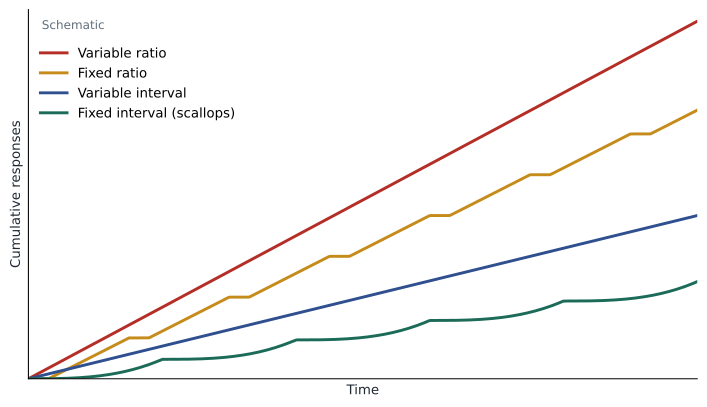
Two memory aids help. Ratio schedules depend on the number of responses, so they produce higher rates: more responding means more reinforcement. Variable schedules produce steadier responding and greater resistance to extinction, because the learner cannot tell when reinforcement has stopped.
Shaping reinforces successive approximations of a target behavior. A trainer teaching a dog to ring a bell might reinforce looking at the bell, then approaching it, then touching it, then ringing it. Chaining links a sequence of behaviors, each serving as a cue for the next. Superstitious behavior can develop when reinforcement happens to follow a behavior by chance, as Skinner suggested in pigeons that developed odd rituals while receiving food at fixed times.
Cognitive and biological limits on conditioning
Learning is not purely mechanical. Edward Tolman showed that rats allowed to explore a maze without reward later ran it quickly once food was introduced, demonstrating latent learning: learning that occurs without reinforcement and becomes visible only when there is a reason to show it. Tolman described the rats as forming cognitive maps. Wolfgang Köhler's chimpanzees solved problems through insight, such as stacking boxes to reach bananas. Instinctive drift is the tendency of trained animals to revert to instinctive behaviors, as when raccoons trained to drop coins into a box began rubbing the coins together instead.
Learned helplessness, described by Martin Seligman, occurs when repeated exposure to uncontrollable aversive events leads to a failure to try to escape later, even when escape is possible. Dogs that had received unavoidable shocks did not later jump a barrier to avoid shock. Learned helplessness has been proposed as a model for some aspects of depression, and the idea of control returns in lessons 5 and 7.
Observational learning
Albert Bandura showed that people learn by watching others. In his Bobo doll studies, children who watched an adult hit an inflatable doll were more likely to imitate the aggression than children who did not. Children who saw the adult rewarded imitated more, and those who saw the adult punished imitated less, an effect called vicarious reinforcement or punishment. Yet children who had seen the model punished could reproduce the aggressive acts when offered a reward, showing that learning had occurred even when performance was suppressed.
Bandura described four processes needed for modeling: attention (noticing the model), retention (remembering the behavior), reproduction (being able to perform it) and motivation (having a reason to do it). Mirror neurons, first described in monkeys, fire both when an animal performs an action and when it observes the same action; their role in human imitation and empathy is an active research topic and some claims about them have been overstated. Observational learning helps explain how media and peers can influence behavior, including both prosocial behavior and aggression.
Attitudes and how they change
An attitude is an evaluation of a person, object or idea, with affective (feelings), behavioral (actions or intentions) and cognitive (beliefs) components, the ABC model. Attitudes and behavior influence each other in both directions.
Attitudes predict behavior better when they are strong, specific to the behavior, accessible and when outside pressures are weak. The theory of planned behavior states that intentions, and therefore behavior, depend on attitudes toward the behavior, subjective norms (what important others think) and perceived behavioral control. Behavior also shapes attitudes. The foot-in-the-door phenomenon is the tendency to agree to a large request after agreeing to a small one. Role-playing can shape attitudes too; in Philip Zimbardo's 1971 Stanford prison study, participants assigned to be guards were described as quickly adopting harsh behavior, although later critiques have questioned how much guards were coached and how the study was run.
Cognitive dissonance theory, proposed by Leon Festinger, states that people feel discomfort when their attitudes and behaviors conflict, and they reduce it by changing an attitude, changing the behavior or adding justifications. In Festinger and Carlsmith's 1959 study, participants paid only one dollar to tell another person a boring task was interesting later rated the task as more enjoyable than those paid twenty dollars. The small payment was not enough to justify the lie, so participants adjusted their attitude instead.
The elaboration likelihood model of persuasion, proposed by Richard Petty and John Cacioppo, describes two routes. The central route involves careful evaluation of arguments and is used when people are motivated and able to think about the message; attitude change through this route tends to be lasting. The peripheral route relies on cues such as the attractiveness or expertise of the speaker, the number of arguments or emotional appeals, and it produces less durable change. Factors in persuasion include the message (one-sided or two-sided, emotional or rational), the source (credibility, attractiveness) and the target (mood, knowledge, need for cognition).
Social cognitive theory, Bandura's broader framework, adds reciprocal determinism: behavior, personal factors (beliefs, expectations, self-efficacy) and the environment all influence one another. Self-efficacy, belief in one's ability to succeed at a task, predicts persistence and is a target in many health behavior programs.
Applying learning to behavior change
Health and study behavior change draw on all of these principles. Thandiwe pointed out that the group's error log used them. Spaced re-tests are a fixed-interval schedule of retrieval; the weekly session is a commitment device; the group chat provides social reinforcement and modeling. Devika described how she had started rewarding herself with a walk after each completed passage set. 'Positive reinforcement,' Thandiwe said, 'and it is better on a fixed ratio than on a vague promise to yourself for the end of the week.'
Elliot asked about his phone. 'Remove the cue,' Thandiwe said. 'Put it in another room, so checking takes effort. You are interrupting a variable-ratio habit, and extinction will be slow at first. Expect an extinction burst, a short-term increase in checking urges before they fade.'
Worked problem
Classifying a consequence
A hospital introduces a policy: nurses who complete hand-hygiene audits with no errors for a month no longer have to attend a weekly hand-hygiene training session, which most find tedious. Audit performance improves. (Scenario invented for this course.) What kind of consequence is the policy?
Show solution
- Ask whether the behavior (careful hand hygiene) increased or decreased. It increased, so the consequence is reinforcement.
- Ask whether something was added or removed. The required training session was removed.
- Removal of an unpleasant stimulus that increases behavior is negative reinforcement.
- Reject punishment: nothing is being made less likely, and the session is removed, not imposed.
Answer: Negative reinforcement: removing an aversive requirement increased the target behavior.
Common mistakes
MistakeNegative reinforcement is a type of punishment.
InsteadNegative reinforcement removes an aversive stimulus and increases behavior; punishment decreases behavior.
MistakeExtinction erases a conditioned response.
InsteadSpontaneous recovery shows that extinction suppresses the response; the original learning remains.
MistakeContinuous reinforcement produces the most persistent behavior.
InsteadPartial reinforcement, especially variable ratio, is more resistant to extinction.
MistakeClassical conditioning requires that the CS and US always occur within seconds.
InsteadTaste aversion can form with a delay of hours, showing biological preparedness.
MistakeIn the Bobo doll study, children who saw the model punished did not learn the behavior.
InsteadThey learned it but performed it less; they reproduced it when offered a reward.
Summary and key terms
- Habituation, dishabituation and sensitization are forms of non-associative learning.
- Classical conditioning pairs a neutral stimulus with an unconditioned stimulus; acquisition, extinction, spontaneous recovery, generalization and discrimination shape the response, and contingency matters.
- Operant conditioning changes behavior through reinforcement (which increases it) and punishment (which decreases it), each positive or negative.
- Partial reinforcement schedules produce characteristic response patterns; variable ratio is the most resistant to extinction.
- Latent learning, insight, instinctive drift and learned helplessness show cognitive and biological limits on conditioning; observational learning requires attention, retention, reproduction and motivation.
- Attitudes and behavior influence each other through cognitive dissonance, the foot-in-the-door effect and persuasion via central and peripheral routes.
- Habituation
- A decrease in response to a repeated, harmless stimulus.
- Conditioned stimulus
- A formerly neutral stimulus that triggers a learned response after pairing with an unconditioned stimulus.
- Spontaneous recovery
- The reappearance of an extinguished conditioned response after a rest period.
- Negative reinforcement
- Removing an aversive stimulus to increase a behavior.
- Variable-ratio schedule
- Reinforcement after an unpredictable number of responses.
- Latent learning
- Learning that occurs without reinforcement and appears only when there is an incentive.
- Cognitive dissonance
- Discomfort from conflicting attitudes and behaviors, which motivates a change to reduce it.
- Elaboration likelihood model
- A model of persuasion with a central route (careful thought) and a peripheral route (cues).
Practice problems
Work each problem on paper first, then reveal the answer to check.
A child is scolded each time she leaves toys on the stairs, and she does so less often. What type of consequence is the scolding?
Show answer
Positive punishment: something unpleasant is added and the behavior decreases.
A dog conditioned to salivate to a 1,000-hertz tone also salivates to a 1,100-hertz tone. What is this called?
Show answer
Stimulus generalization.
A worker is paid after every 20 boxes packed. What schedule is this, and what pattern of responding would you expect?
Show answer
Fixed ratio; a high rate of responding with brief pauses after each payment.
A person who believes smoking is harmful keeps smoking and starts saying the risks are exaggerated. Which theory explains this?
Show answer
Cognitive dissonance: the attitude shifts to fit the behavior.
A famous athlete endorses a sports drink without giving any evidence. Which route of persuasion is targeted?
Show answer
The peripheral route, relying on source cues rather than arguments.
Lesson quiz · 5 questions
Score 60% or more to complete this lesson.
Create a free account to save your progress, take quizzes and earn a certificate.