
MCAT-130 · Lesson 6 of 12 · 21 min
Identity, personality and socialization
▶ Video coming soon A video version of this lesson is on the way.
For the identity session, Thandiwe asked each member to write five answers to the question 'Who am I?' and then share whichever they were comfortable with. Devika wrote 'daughter', 'pharmacy assistant', 'Trinidadian Canadian', 'reader' and 'future doctor, I hope'. Ezequiel wrote 'former EMT', 'first in my family to try this', 'New Mexican', 'brother' and 'stubborn'. Elliot wrote 'neuroscience student', 'clinic volunteer', 'Japanese American', 'runner' and 'overthinker'. 'Look at the mix,' Thandiwe said. 'Roles, groups, traits, hopes. Psychologists study each of those separately, and sociologists ask where they came from. That is today.'
This lesson covers content category 8A, "Self-identity", the personality part of category 7A and the socialization part of category 7B. The theories are numerous, and the MCAT expects you to recognize each by its central claim and to apply it to a short scenario. Lists of names are less important than knowing what each theory would predict.
Self-concept, self-esteem and self-efficacy
Self-concept is the overall set of beliefs a person holds about who they are. It includes personal identities (traits, abilities, roles) and social identities (memberships in groups defined by gender, ethnicity, religion, nationality, occupation and so on). William James distinguished the self as knower (the I) from the self as known (the me). Carl Rogers distinguished the actual self (who one is), the ideal self (who one would like to be) and, in other accounts, the ought self (who one thinks one should be). Discrepancies between these selves are linked to emotions: a gap between the actual and ideal self is associated with disappointment or sadness, and a gap between the actual and ought self with anxiety or guilt, in E. Tory Higgins's self-discrepancy theory.
Self-esteem is one's overall evaluation of one's worth. Self-efficacy, a term from Bandura, is belief in one's ability to succeed at a particular task. The two are related but different: a person can have high self-esteem and low self-efficacy for organic chemistry. Locus of control, described by Julian Rotter, is the extent to which people believe outcomes are controlled by their own actions (internal) or by luck, fate or powerful others (external). An internal locus of control is generally associated with greater persistence and better health behaviors, though context matters.
Social identity theory, developed by Henri Tajfel and John Turner, holds that part of our self-concept comes from group memberships and that we are motivated to see our groups positively. This helps explain in-group favoritism, discussed in lesson 8. Intersectionality is the idea that a person's multiple social identities, such as race, gender and class, combine to shape experiences in ways that cannot be understood by considering each identity alone.
Theories of identity development
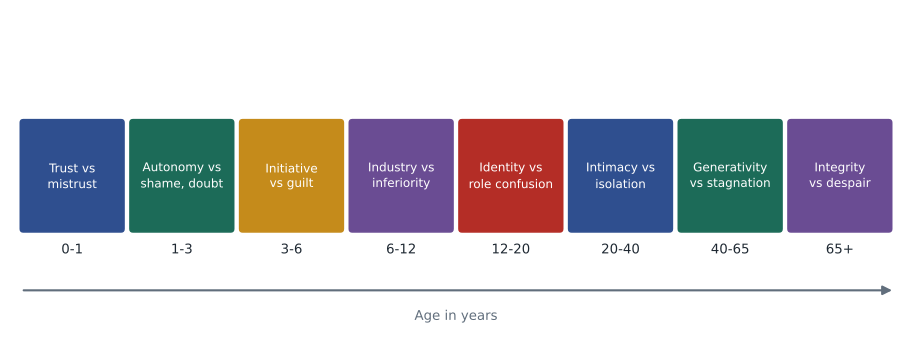
Several stage theories describe how identity and related abilities develop. The MCAT tests them by asking which stage or which theorist fits a description.
| Stage (approximate age) | Conflict | Favorable outcome |
|---|---|---|
| Infancy (0 to 1) | Trust versus mistrust | Trust that needs will be met |
| Early childhood (1 to 3) | Autonomy versus shame and doubt | Sense of independence |
| Preschool (3 to 6) | Initiative versus guilt | Purpose and initiative |
| School age (6 to 12) | Industry versus inferiority | Competence |
| Adolescence (12 to 20) | Identity versus role confusion | A coherent sense of self |
| Young adulthood (20 to 40) | Intimacy versus isolation | Close relationships |
| Middle adulthood (40 to 65) | Generativity versus stagnation | Contribution to the next generation |
| Late adulthood (65 and up) | Integrity versus despair | Acceptance of one's life |
James Marcia extended Erikson's adolescent stage by describing four identity statuses based on whether a person has explored options (crisis) and made commitments. Identity diffusion is no exploration and no commitment. Foreclosure is commitment without exploration, often adopting parents' values. Moratorium is active exploration without commitment. Identity achievement is commitment after exploration.
Sigmund Freud proposed psychosexual stages (oral, anal, phallic, latency and genital), in which conflicts at each stage could lead to fixations that shape adult personality. These ideas are historically important but have little empirical support. Lawrence Kohlberg described the development of moral reasoning in three levels, each with two stages: preconventional (avoiding punishment and gaining rewards), conventional (following social rules and seeking approval or maintaining order) and postconventional (reasoning from social contracts and universal ethical principles). Carol Gilligan criticized Kohlberg's work for being based mainly on male participants and argued for an ethic of care that emphasizes relationships and responsibility. Kohlberg's levels are a common source of questions: decide whether the reasoning in the scenario is about consequences to the self, about rules and approval, or about principles.
George Herbert Mead described the development of the social self through interaction. Children move from imitation, to play in which they take on specific roles (pretending to be a parent), to games in which they understand the roles of many others at once. The 'generalized other' is the internalized set of expectations of society. Mead distinguished the 'I' (the spontaneous, acting self) from the 'me' (the socialized self that reflects others' expectations). Charles Horton Cooley's looking-glass self holds that we form our self-image from how we imagine others see us.
Personality
Personality is a person's characteristic pattern of thinking, feeling and behaving. Major perspectives differ in what they emphasize.
| Perspective | Key figures | Central claim |
|---|---|---|
| Psychoanalytic and psychodynamic | Freud, Jung, Adler, Horney | Unconscious drives and early experiences shape personality |
| Humanistic | Rogers, Maslow | People strive for growth and self-actualization; conscious experience matters |
| Trait | Allport, Eysenck, Costa and McCrae | Personality consists of stable, measurable dispositions |
| Social cognitive | Bandura, Mischel | Personality arises from interaction between person, behavior and environment |
| Behaviorist | Skinner | Personality is a pattern of learned behaviors shaped by reinforcement |
| Biological | Eysenck and others | Genes and physiology underlie differences in temperament and traits |
Freud's structural model divides the mind into the id (primitive drives seeking immediate gratification, governed by the pleasure principle), the ego (which mediates between the id, reality and the superego, governed by the reality principle) and the superego (internalized moral standards). When these conflict, anxiety arises, and defense mechanisms reduce it unconsciously.
| Defense mechanism | Description | Example |
|---|---|---|
| Repression | Pushing threatening thoughts out of awareness | Not remembering a frightening event |
| Denial | Refusing to accept reality | Insisting a serious diagnosis is wrong |
| Projection | Attributing one's own unacceptable feelings to others | Accusing a partner of jealousy when one is jealous |
| Displacement | Redirecting feelings to a safer target | Shouting at a sibling after a bad day at work |
| Reaction formation | Acting in a way opposite to one's feelings | Being overly friendly to someone one dislikes |
| Rationalization | Creating acceptable excuses | Saying a failed exam did not matter anyway |
| Regression | Returning to earlier behavior | An older child bedwetting after a sibling is born |
| Sublimation | Directing impulses into acceptable activities | Turning aggression into competitive sport |
Carl Jung added the collective unconscious, shared archetypes and the introversion-extraversion dimension. Alfred Adler emphasized striving for superiority and feelings of inferiority. Karen Horney emphasized social and cultural influences and challenged Freud's views of women.
Humanistic theorists emphasized conscious experience and growth. Rogers argued that people need unconditional positive regard, acceptance regardless of behavior, to develop a congruent self-concept; conditions of worth, acceptance only when meeting others' standards, can lead to incongruence between the actual and ideal selves.
Trait theories are the most widely used in research. Gordon Allport distinguished cardinal, central and secondary traits. Hans Eysenck proposed dimensions of extraversion, neuroticism and psychoticism and linked them to biological arousal. The Big Five (five-factor) model, associated with Paul Costa and Robert McCrae, describes openness to experience, conscientiousness, extraversion, agreeableness and neuroticism, remembered as OCEAN. Big Five traits are moderately heritable, fairly stable in adulthood and predict outcomes such as job performance (conscientiousness) and well-being.
The person-situation debate began when Walter Mischel argued that behavior varies more across situations than trait theories predict. The resolution is interactionist: traits predict average behavior across many situations, while particular situations strongly influence behavior in the moment. Strong situations, with clear norms, reduce the effect of personality; weak situations allow it to show. Bandura's reciprocal determinism, introduced in lesson 4, is the social cognitive version of this idea.
Socialization
Socialization is the lifelong process by which people learn the norms, values, beliefs and behaviors of their society. Primary socialization occurs in childhood, mainly within the family. Secondary socialization occurs later, in schools, workplaces and other institutions. Anticipatory socialization is preparing for a future role, such as premedical students learning the language and norms of medicine. Resocialization is learning new norms after a major change, sometimes in a total institution such as the military or a prison, where life is highly controlled.
Agents of socialization include the family, peers, schools, the mass media and social media, religion, workplaces and the state. Each can transmit both formal knowledge and the hidden curriculum, the unwritten norms and expectations taught indirectly. Gender socialization is the learning of norms and expectations associated with gender, from toys and clothing to expectations about careers. Sociologists distinguish sex (biological characteristics) from gender (the social roles, behaviors and identities associated with being a woman, man or another gender) and from gender identity (a person's internal sense of their own gender).
Devika described how her parents had always framed medicine as the safest path, and how working in a pharmacy had shown her what the job involved. 'Family as agent of socialization, then anticipatory socialization at work,' Thandiwe said. Ezequiel added that his EMT training had felt like resocialization: 'They taught us a new way to walk into a room.'
Norms, sanctions and deviance
Norms are rules and expectations that guide behavior. Folkways are informal norms for everyday behavior, such as holding a door. Mores are norms with moral significance, such as prohibitions on lying to a patient. Taboos are norms so strong that violating them causes disgust. Laws are norms formally codified and enforced by the state. Sanctions are rewards and punishments that enforce norms; they can be formal (a fine) or informal (a disapproving look), positive or negative.
Deviance is behavior that violates norms, and what counts as deviant varies across cultures and over time. Several theories explain deviance. Robert Merton's strain theory proposes that deviance arises when people lack legitimate means to reach culturally approved goals; responses include conformity, innovation (accepting goals but using illegitimate means), ritualism, retreatism and rebellion. Edwin Sutherland's differential association theory holds that deviance is learned through interaction with others who model and reward it. Labeling theory proposes that deviance is partly a consequence of being labeled deviant: primary deviance is the initial act, and secondary deviance follows when a person accepts the label and acts accordingly. Stigma is the extreme disapproval attached to a characteristic or behavior, described by Erving Goffman as a 'spoiled identity', and it can apply to illness, disability, addiction and other conditions.
Collective behavior covers relatively spontaneous, short-lived group behavior, including fads, mass hysteria and riots. Conformity and obedience, which are not always deviant and often enforce norms, are discussed in lesson 8.
Worked problem
Applying identity theories
A 19-year-old says she has always planned to become an accountant like her parents and has never seriously considered other options. Her 20-year-old friend has changed majors three times, has taken courses in four departments and has not yet decided. (Scenario invented for this course.) Classify each using Marcia's identity statuses, and name the Erikson stage both are in.
Show solution
- Identify the two dimensions: exploration and commitment.
- The first person is committed but has not explored: foreclosure.
- The second is exploring actively without commitment: moratorium.
- Both are at the identity versus role confusion stage that Erikson placed in adolescence and early adulthood.
Answer: The first is in identity foreclosure; the second is in moratorium. Both are working through Erikson's identity versus role confusion stage.
Common mistakes
MistakeSelf-esteem and self-efficacy are the same thing.
InsteadSelf-esteem is overall self-worth; self-efficacy is confidence in succeeding at a specific task.
MistakeForeclosure means a person has explored and then committed.
InsteadForeclosure is commitment without exploration; identity achievement follows exploration.
MistakeProjection is redirecting feelings to a safer target.
InsteadProjection attributes one's own feelings to someone else; redirecting feelings is displacement.
MistakeMischel showed that personality traits do not exist.
InsteadHe showed that situations strongly influence behavior; traits still predict behavior averaged across situations.
MistakeLabeling theory explains the causes of all initial deviant acts.
InsteadLabeling theory focuses on how being labeled leads to secondary deviance and a deviant identity.
Summary and key terms
- Self-concept includes personal and social identities; self-esteem, self-efficacy and locus of control describe how people evaluate themselves and their control over outcomes.
- Erikson's psychosocial stages, Marcia's identity statuses, Kohlberg's moral reasoning levels and Mead's and Cooley's ideas describe identity development.
- Personality perspectives include psychodynamic, humanistic, trait (Big Five), social cognitive, behaviorist and biological views.
- Behavior reflects both traits and situations; strong situations reduce the influence of personality.
- Socialization occurs through family, peers, schools, media and institutions, including anticipatory socialization and resocialization.
- Norms are enforced by sanctions; strain, differential association and labeling theories explain deviance, and stigma shapes how deviance is treated.
- Self-efficacy
- Belief in one's ability to succeed at a specific task.
- Locus of control
- The degree to which people believe they control outcomes (internal) or outside forces do (external).
- Identity foreclosure
- Commitment to an identity without exploring alternatives.
- Big Five
- The five-factor trait model: openness, conscientiousness, extraversion, agreeableness and neuroticism.
- Defense mechanism
- An unconscious strategy, in psychodynamic theory, for reducing anxiety.
- Looking-glass self
- Cooley's idea that self-image is formed from how we imagine others see us.
- Anticipatory socialization
- Learning the norms of a role before entering it.
- Labeling theory
- The view that being labeled deviant can lead to further deviance and a deviant identity.
Practice problems
Work each problem on paper first, then reveal the answer to check.
A 45-year-old begins mentoring young nurses and says he wants to leave something useful behind. Which Erikson stage does this reflect?
Show answer
Generativity versus stagnation.
A man who is angry at his boss comes home and yells at his dog. Which defense mechanism is this?
Show answer
Displacement.
A person who is organized, dependable and careful scores high on which Big Five trait?
Show answer
Conscientiousness.
A teenager in a low-income neighborhood wants financial success but sees no legitimate route to it and turns to theft. Which theory explains this best?
Show answer
Merton's strain theory (the innovation response).
A child says stealing is wrong because you might get caught. Which Kohlberg level is this?
Show answer
Preconventional morality, focused on punishment.
Lesson quiz · 5 questions
Score 60% or more to complete this lesson.
Create a free account to save your progress, take quizzes and earn a certificate.