
MCAT-110 · Lesson 6 of 12 · 21 min
Lipids and membranes
▶ Video coming soon A video version of this lesson is on the way.
Elliot came to this session with a question from his clinic shift. A patient had asked him why olive oil is liquid and butter is solid, and he had given a vague answer about "different fats". Thandiwe smiled. 'That is an MCAT question in disguise. The answer is in the shape of the fatty acid chains, and the same shape explains why membranes stay fluid in the cold.'
Lipids are a structurally diverse group defined by a shared property: they dissolve poorly in water and well in nonpolar solvents. The AAMC outline places their structure in category 5D and their role in membranes in category 2A, and fatty acid metabolism in category 1D, covered in lesson 11. This lesson covers fatty acids, triacylglycerols, membrane lipids, steroids, terpenes, eicosanoids and fat-soluble vitamins, and then the structure and fluidity of biological membranes and how molecules cross them.
Fatty acids
A fatty acid is a long hydrocarbon chain ending in a carboxylic acid group. Most natural fatty acids have an even number of carbons, typically 16 to 20, because they are built two carbons at a time. Saturated fatty acids have only single bonds in the chain and are "saturated" with hydrogen. Unsaturated fatty acids have one double bond (monounsaturated) or more (polyunsaturated). In natural fatty acids, double bonds are almost always cis, which puts a rigid kink in the chain.
The kink is the key to physical properties. Straight saturated chains pack tightly together and interact through many van der Waals forces, so they have high melting points and are solid at room temperature. Kinked cis chains cannot pack as tightly, so they melt at lower temperatures. Longer chains have more contact and melt at higher temperatures. That is the answer to the clinic patient's question: butter is rich in saturated fatty acids, olive oil in the monounsaturated oleic acid.
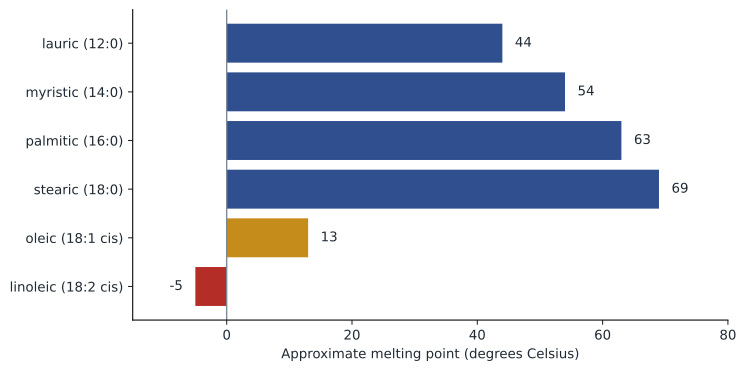
Trans fats, made industrially by partial hydrogenation of vegetable oils, have straight chains despite their double bonds and pack much like saturated fats. They raise LDL cholesterol, and many countries, including Canada and the United States, have banned the main industrial source, partially hydrogenated oils, from foods.
Fatty acids are named in two ways. A shorthand such as 18:1 gives the number of carbons and double bonds. The omega system counts from the methyl end, so an omega-3 fatty acid has its first double bond three carbons from that end. Humans cannot make double bonds beyond carbon 9 counting from the carboxyl end, so two polyunsaturated fatty acids, linoleic acid (an omega-6) and alpha-linolenic acid (an omega-3), are essential fatty acids that must come from the diet.
Triacylglycerols: stored energy
Triacylglycerols, also called triglycerides, consist of a glycerol backbone with three fatty acids attached by ester bonds. They are the body's main energy store, kept in the droplets of adipose cells. They store energy efficiently for two reasons. Their carbons are highly reduced, so their complete oxidation releases about 9 kilocalories per gram, compared with about 4 for carbohydrates and proteins. And because they are nonpolar, they are stored without water, whereas glycogen holds about twice its weight in water.
Hydrolysis of the ester bonds releases glycerol and free fatty acids. In the body, lipases do this. In the lab or soap factory, a strong base does it in a reaction called saponification, which produces glycerol and the salts of fatty acids, soaps. A soap molecule is amphipathic: it has a charged, hydrophilic carboxylate head and a long hydrophobic tail. In water, soaps form micelles, spheres with tails inside and heads outside, which trap grease in their core.
Membrane lipids
Membrane lipids are amphipathic, with a polar head and nonpolar tails, which makes them assemble spontaneously into bilayers in water. Three main classes appear on the test.
| Class | Backbone and structure | Examples and roles |
|---|---|---|
| Glycerophospholipids (phosphoglycerides) | Glycerol with two fatty acids and a phosphate linked to a head group | Phosphatidylcholine and phosphatidylethanolamine are major membrane lipids; phosphatidylserine is kept on the inner leaflet, and its exposure on the outside signals a cell for removal; phosphatidylinositol is a source of second messengers |
| Sphingolipids | Sphingosine, an amino alcohol, linked to one fatty acid and a head group | Sphingomyelin insulates nerve axons in myelin; glycosphingolipids such as cerebrosides and gangliosides carry sugar heads used in cell recognition |
| Sterols | Four fused rings with a hydroxyl group | Cholesterol in animal membranes; it moderates fluidity |
Several inherited diseases result from failure to break down sphingolipids in lysosomes. In Tay-Sachs disease, for example, a missing enzyme lets a ganglioside accumulate in neurons. You do not need to memorize these disorders, but passages use them to test the idea that a missing enzyme causes its substrate to build up.
Steroids, terpenes, eicosanoids and fat-soluble vitamins
Steroids share a structure of four fused carbon rings: three six-membered and one five-membered. Cholesterol is the parent steroid in animals. It is a membrane component and the starting material for steroid hormones, including cortisol, aldosterone, testosterone and estradiol, and for bile acids, which help digest fats. Steroid hormones are nonpolar, so they cross membranes and bind receptors inside cells, often acting directly on gene expression, whereas peptide hormones bind receptors on the cell surface.
Terpenes are built from five-carbon isoprene units. Cholesterol itself is made from isoprene units, and so are many plant compounds and vitamin A. Eicosanoids are signaling molecules made from 20-carbon fatty acids, especially arachidonic acid, released from membrane phospholipids. They include prostaglandins, which promote inflammation, pain and fever, and thromboxanes, which promote platelet aggregation. Aspirin and other nonsteroidal anti-inflammatory drugs reduce these effects by inhibiting cyclooxygenase, the enzyme that begins prostaglandin synthesis.
| Vitamin | Main function | Effect of deficiency |
|---|---|---|
| A (retinol) | Forms retinal, the light-absorbing pigment in vision; regulates gene expression in epithelia | Night blindness; dry eyes and skin |
| D (calciferol) | Converted in the liver and kidney to calcitriol, which raises calcium absorption from the gut | Rickets in children; osteomalacia in adults |
| E (tocopherol) | Antioxidant that protects membrane lipids from oxidation | Damage to nerves and red blood cells (rare) |
| K | Needed to modify clotting factors so they can bind calcium | Bleeding; newborns receive vitamin K at birth |
The structure of membranes
Biological membranes are described by the fluid mosaic model: a bilayer of phospholipids, with cholesterol and proteins embedded in it, in which most components can move sideways within their own layer. The hydrophobic tails face each other in the middle, and the polar heads face the water on either side. Integral proteins pass partly or fully through the bilayer; transmembrane proteins have stretches of hydrophobic amino acids, often alpha helices, that sit within the core. Peripheral proteins attach loosely to the surface, often to integral proteins or to lipid heads.
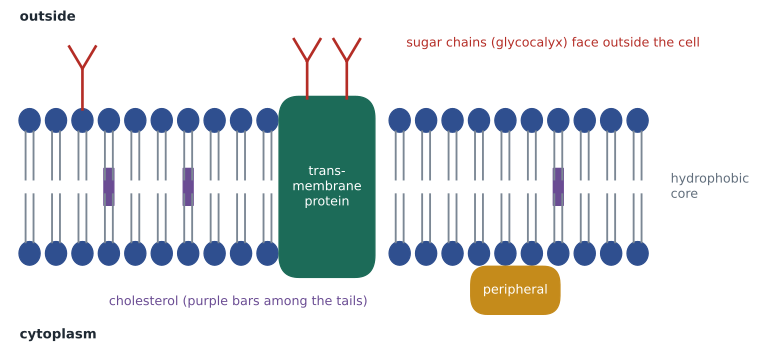
Lipids move sideways within a leaflet rapidly, but rarely flip from one leaflet to the other on their own, because the polar head would have to pass through the hydrophobic core. Enzymes called flippases, floppases and scramblases move them between leaflets, which allows cells to keep the two leaflets different. Proteins also move laterally, though more slowly and sometimes anchored to the cytoskeleton. Some regions, called lipid rafts, are enriched in cholesterol and sphingolipids and gather particular proteins.
Membrane fluidity must stay within a working range. Higher temperature increases fluidity. More unsaturated fatty acids and shorter chains also increase fluidity, for the same packing reasons that lower melting points. Cholesterol acts as a buffer: at high temperatures, its rigid rings restrain the movement of phospholipid tails and reduce fluidity; at low temperatures, it gets between the tails and prevents them from packing into a solid gel. Organisms that live in the cold, from bacteria to fish, adjust by making more unsaturated fatty acids, a process called homeoviscous adaptation.
Crossing the membrane
The hydrophobic core of the bilayer is a barrier to charged and polar molecules. Small nonpolar molecules, such as oxygen, carbon dioxide and steroid hormones, cross by simple diffusion down their concentration gradients. Water crosses slowly through the bilayer and quickly through aquaporin channels. Ions, glucose and amino acids need protein help.
| Mechanism | Energy needed? | Direction relative to gradient | Example |
|---|---|---|---|
| Simple diffusion | No | Down the gradient | Oxygen and carbon dioxide |
| Facilitated diffusion | No | Down the gradient, through a channel or carrier | Glucose through GLUT transporters |
| Primary active transport | Yes, directly from ATP | Against the gradient | Sodium-potassium pump |
| Secondary active transport | Yes, from another ion's gradient | Against the gradient, coupled to an ion moving down its own | Sodium-glucose cotransporter in the gut and kidney (symport); sodium-calcium exchanger (antiport) |
| Endocytosis and exocytosis | Yes | Bulk movement in vesicles | Receptor-mediated uptake of LDL; release of neurotransmitters |
Facilitated diffusion and active transport both use proteins, so they show saturation kinetics, like enzymes: the rate levels off when all carriers are busy. Simple diffusion does not saturate; its rate rises in proportion to the concentration difference. A passage graph in which uptake rate levels off as concentration rises points to carrier-mediated transport.
Osmosis is the diffusion of water across a semipermeable membrane toward the side with the higher concentration of solute particles. A cell placed in a hypotonic solution, with lower solute concentration than the cell, takes in water and swells, and a red blood cell may burst. In a hypertonic solution, it loses water and shrinks. In an isotonic solution, there is no net movement. Osmotic pressure depends on the number of dissolved particles, not their identity, so one mole of sodium chloride, which dissociates into two ions, has about twice the osmotic effect of one mole of glucose.
Worked problem
Predicting membrane fluidity
A bacterium is moved from 37 degrees Celsius to 15 degrees Celsius. Predict two changes in its membrane lipids over the next several hours and explain why each helps.
Show solution
- Lower temperature reduces fluidity; the membrane risks becoming gel-like, which impairs transporters and enzymes.
- The cell can increase the proportion of unsaturated fatty acids, whose cis kinks prevent tight packing.
- It can also shorten the average fatty acid chain length, which reduces van der Waals contact between tails.
- Both changes lower the temperature at which the membrane would solidify, restoring fluidity.
Answer: More unsaturated and shorter fatty acid chains. Bacteria lack cholesterol, so they rely on changes in fatty acid composition.
Passage-style practice
Passage. Researchers measured the uptake of two compounds, X and Y, into cultured cells at increasing external concentrations, with intracellular concentrations near zero at the start. Uptake of X rose in proportion to concentration across the whole range. Uptake of Y rose steeply at low concentrations and leveled off at about 50 nanomoles per minute per milligram of protein above 10 millimolar. Adding ouabain, which inhibits the sodium-potassium pump, reduced uptake of Y by about 90 percent and did not affect X. Data invented for this course.
Practice problems
Work each problem on paper first, then reveal the answer to check.
How does X most likely enter the cells? (Skill 2: scientific reasoning)
Show answer
By simple diffusion: uptake is proportional to concentration and does not saturate.
What does the leveling off of Y's uptake suggest? (Skill 4: data-based reasoning)
Show answer
A carrier protein that becomes saturated, so transport has a maximum rate.
Why would ouabain reduce uptake of Y? (Skill 2)
Show answer
Y is probably taken up by secondary active transport coupled to sodium. Blocking the pump collapses the sodium gradient that drives the cotransporter.
What property would you predict for compound X? (Skill 1: concepts)
Show answer
It is small and nonpolar, able to pass through the hydrophobic core of the bilayer.
Which control would best show that ouabain does not damage the cells in a way that blocks all transport? (Skill 3: research design)
Show answer
Show that uptake of X, or of a substance known to enter by sodium-independent facilitated diffusion, is unchanged with ouabain, and that cell viability is normal.
Micelles, bilayers and liposomes
Amphipathic molecules assemble into different structures depending on their shape. Molecules with one tail and a large head, such as soaps and detergents, are roughly cone-shaped and pack into spherical micelles with no water inside. Molecules with two tails, such as phospholipids, are roughly cylindrical and pack into flat bilayers, which close on themselves to avoid exposed edges, forming vesicles. Artificial vesicles made from phospholipids are called liposomes. Because their interior holds water and their membrane holds nonpolar molecules, liposomes can carry both water-soluble and fat-soluble drugs, and several medicines and vaccines are delivered in lipid particles built on this principle. Detergents in the lab exploit the same chemistry in reverse: they insert into membranes and break them into small mixed micelles, which is how membrane proteins are extracted for study.
Common mistakes
MistakeUnsaturated fatty acids have higher melting points because double bonds are stronger.
InsteadCis double bonds kink the chain and prevent tight packing, lowering the melting point.
MistakeCholesterol always makes membranes more rigid.
InsteadCholesterol reduces fluidity at high temperatures and prevents solidification at low temperatures; it buffers fluidity.
MistakePhospholipids flip freely between leaflets.
InsteadSideways movement is fast, but flipping is rare without enzymes, so the two leaflets can differ.
MistakeSteroid hormones bind receptors on the cell surface.
InsteadNonpolar steroid hormones cross the membrane and usually bind receptors inside the cell.
MistakeFacilitated diffusion can move a molecule against its gradient.
InsteadFacilitated diffusion is passive and moves molecules only down their gradients; moving against a gradient requires active transport.
Summary and key terms
- Fatty acids are carboxylic acids with long hydrocarbon chains; saturation and length raise melting point, and cis double bonds lower it.
- Triacylglycerols store about 9 kilocalories per gram without water; saponification produces soaps that form micelles.
- Glycerophospholipids, sphingolipids and cholesterol make up membranes; steroids, terpenes, eicosanoids and fat-soluble vitamins have signaling and other roles.
- Membranes follow the fluid mosaic model; lipids move sideways freely but rarely flip between leaflets.
- Temperature, unsaturation and chain length affect fluidity, and cholesterol buffers it.
- Molecules cross membranes by simple diffusion, facilitated diffusion, primary or secondary active transport, or vesicles; carrier-mediated transport saturates.
- Amphipathic
- Having both a hydrophilic part and a hydrophobic part.
- Triacylglycerol
- Glycerol esterified to three fatty acids; the main form of stored fat.
- Saponification
- Base-driven hydrolysis of ester bonds in fats, producing glycerol and soaps.
- Sphingolipid
- A membrane lipid built on sphingosine rather than glycerol.
- Fluid mosaic model
- The model of membranes as a fluid lipid bilayer containing mobile proteins.
- Secondary active transport
- Transport against a gradient driven by another ion moving down its gradient.
- Osmosis
- Diffusion of water across a semipermeable membrane toward higher solute concentration.
Lesson quiz · 5 questions
Score 60% or more to complete this lesson.
Create a free account to save your progress, take quizzes and earn a certificate.