
MCAT-110 · Lesson 12 of 12 · 20 min
Capstone: metabolic regulation and a passage set
▶ Video coming soon A video version of this lesson is on the way.
For the last biochemistry session, Thandiwe did two things. First, she drew one big diagram on the shared screen showing what the liver, muscle, fat tissue and brain do after a meal and during a fast, and asked the group to explain each arrow. Then she gave them a timed set: two passages and four independent questions, fourteen questions in twenty-two minutes, about the pace of the real Bio/Biochem section. 'Integration is what the test rewards,' she said. 'A passage about a knockout mouse is really asking whether you can connect the pathways you have learned to the hormones that control them.'
This lesson follows the same plan. The first part covers hormonal regulation and the integration of metabolism, the last topic in AAMC content category 1D: the roles of insulin, glucagon, epinephrine and cortisol, the metabolic states from the fed state to starvation, and the fuel preferences of major tissues. The second part is a timed passage set with an answer key and the group's debrief.
The hormones that run metabolism
Four hormones do most of the work. Insulin and glucagon, both made by the pancreatic islets, act in opposition and respond minute by minute to blood glucose. Epinephrine responds to stress and exercise. Cortisol acts over hours to days.
| Hormone | Source and trigger | Main targets | Main metabolic effects |
|---|---|---|---|
| Insulin | Beta cells, when blood glucose rises after a meal | Liver, muscle, adipose tissue | Increases glucose uptake (GLUT4 in muscle and fat), glycolysis, glycogen synthesis, fatty acid and protein synthesis; inhibits gluconeogenesis, glycogen breakdown and lipolysis |
| Glucagon | Alpha cells, when blood glucose falls | Mainly liver | Increases glycogen breakdown, gluconeogenesis and ketone body production; inhibits glycolysis and glycogen synthesis in the liver |
| Epinephrine | Adrenal medulla, in stress and exercise | Liver, muscle, adipose tissue | Increases glycogen breakdown in liver and muscle and lipolysis in fat; raises blood glucose and fatty acids quickly |
| Cortisol | Adrenal cortex, in prolonged stress and fasting | Liver, muscle, adipose tissue | Increases gluconeogenesis and the enzymes that support it, protein breakdown in muscle and lipolysis; raises blood glucose over hours |
Insulin acts through a receptor tyrosine kinase, and its effects spread through a cascade that, among other things, activates phosphatases. Glucagon and epinephrine act through G protein-coupled receptors that raise cyclic AMP and activate protein kinase A, which phosphorylates key enzymes. This explains the pattern you saw in lessons 9 and 11: phosphorylation tends to switch on the pathways that release fuel (glycogen breakdown, gluconeogenesis, lipolysis) and switch off the pathways that store it (glycogen synthesis, fatty acid synthesis), and insulin reverses those switches. Cortisol, a steroid, acts on gene expression, so its effects build up more slowly and last longer.
Inside cells, an energy sensor called AMP-activated protein kinase responds to rising AMP, a sign that ATP is being used up. It switches on ATP-producing pathways, such as fatty acid oxidation and glucose uptake, and switches off ATP-consuming ones, such as fatty acid and cholesterol synthesis. Exercise activates it in muscle.
Metabolic states
The body moves through a predictable sequence of states as time passes after a meal.
| State | Approximate timing | Hormones | Main sources of blood glucose and fuel |
|---|---|---|---|
| Fed (absorptive) | Up to about 4 hours after a meal | Insulin high, glucagon low | Glucose from the diet; tissues store glycogen and fat |
| Postabsorptive (early fasting) | About 4 to 24 hours | Insulin falling, glucagon rising | Liver glycogen breakdown first, then increasing gluconeogenesis; fatty acids increasingly used by muscle |
| Fasting | About 1 to 3 days | Glucagon and cortisol high, insulin low | Gluconeogenesis from amino acids, lactate and glycerol; fatty acids and rising ketone bodies |
| Prolonged starvation | Beyond several days | Glucagon and cortisol high, insulin very low | Ketone bodies supply much of the brain's energy; protein breakdown slows; fat stores are the main fuel |
Tissues differ in what they can burn, and those differences shape the whole system. The brain uses glucose almost exclusively under normal conditions, because fatty acids do not cross the blood-brain barrier well; it switches partly to ketone bodies in prolonged fasting. Red blood cells have no mitochondria and depend entirely on glycolysis, producing lactate. Resting skeletal muscle uses mostly fatty acids, and working muscle uses glycogen and blood glucose as well; heart muscle prefers fatty acids and also uses ketone bodies and lactate. Adipose tissue stores fat after meals and releases fatty acids and glycerol between them. The liver acts as the body's glucose buffer, storing glucose after meals and releasing it during fasting, and it is the only tissue that makes significant amounts of ketone bodies.
Diabetes mellitus shows what happens when the system breaks. In type 1 diabetes, the immune system destroys beta cells, so insulin is absent. Even when blood glucose is high, the body behaves as if it were fasting: muscle and fat take up little glucose, the liver keeps making glucose, fat tissue releases fatty acids freely, and the liver makes ketone bodies, risking ketoacidosis. In type 2 diabetes, tissues respond poorly to insulin, a state called insulin resistance, and beta cells eventually cannot make enough to compensate. Blood glucose rises, but some insulin is present, so ketoacidosis is less common.
The passage set
Set a timer for 22 minutes and answer all 14 questions before reading the answer key. Mark any question you guessed on, so you can blind review it afterward, as lesson 11 of MCAT-101 described. All passages and data were written for this course.
Passage 1 (5 questions)
Passage 1. Glucose 6-phosphatase, located in the endoplasmic reticulum of liver cells, catalyzes the final step of both gluconeogenesis and glycogen breakdown in the liver. Researchers studied mice in which the gene for this enzyme was deleted only in the liver (liver knockout mice) and compared them with control mice. After an overnight fast, they measured blood glucose, blood lactate and liver glycogen. In a second experiment, they injected glucagon into fasted mice and measured blood glucose 30 minutes later.
| Measurement after overnight fast | Control mice | Liver knockout mice |
|---|---|---|
| Blood glucose (millimolar) | 5.2 | 2.1 |
| Blood lactate (millimolar) | 1.4 | 4.8 |
| Liver glycogen (milligrams per gram) | 12 | 78 |
| Blood glucose 30 minutes after glucagon (millimolar) | 8.9 | 2.3 |
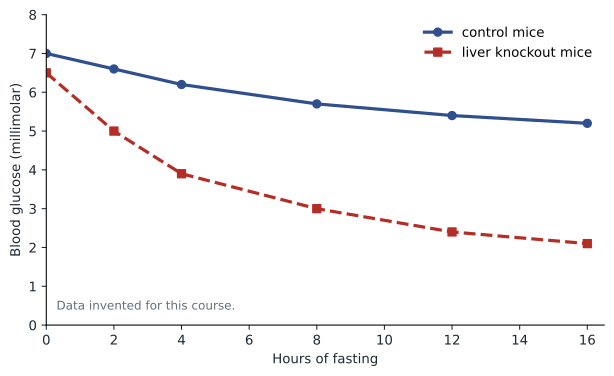
Q1. Which finding best explains the knockout mice's high liver glycogen? (A) Glycogen synthase is overactive because insulin is high; (B) glucose 6-phosphate produced by glycogen breakdown cannot leave the liver as glucose and is redirected into glycogen; (C) glucagon cannot bind liver cells; (D) muscle releases its glycogen into the liver.
Q2. The knockout mice's blood glucose barely rises after glucagon. The best explanation is that: (A) glucagon receptors are absent in the knockout liver; (B) glucagon activates glycogen breakdown, but the final step that releases free glucose is missing; (C) glucagon inhibits glycogen phosphorylase; (D) blood glucose was already at its maximum.
Q3. Why might blood lactate be elevated in the knockout mice? (A) Excess glucose 6-phosphate in the liver feeds glycolysis, producing more pyruvate and lactate; (B) lactate dehydrogenase is absent; (C) muscle stops producing lactate; (D) the kidneys stop excreting lactate.
Q4. Which treatment would most directly prevent the knockout mice's fasting hypoglycemia? (A) Frequent feeding with a slowly digested starch; (B) an injection of glucagon before the fast; (C) a drug that inhibits glycogen synthase; (D) a high-fat diet with no carbohydrate.
Q5. Blood glucose in the knockout mice falls to 2.1 millimolar rather than to zero. Which source most likely supplies the remaining glucose? (A) Muscle glycogen released directly into the blood; (B) gluconeogenesis in the kidney, which also expresses glucose 6-phosphatase; (C) fatty acids converted to glucose in adipose tissue; (D) red blood cells.
Passage 2 (5 questions)
Passage 2. Compound M is an experimental drug that carries protons across the inner mitochondrial membrane and accumulates mainly in liver cells. Researchers gave compound M or a placebo to mice fed a high-fat diet for 8 weeks and measured whole-body oxygen consumption, body temperature, liver fat and the ratio of ATP to ADP in liver cells.
| Measurement | Placebo | Compound M |
|---|---|---|
| Oxygen consumption (milliliters per kilogram per minute) | 45 | 54 |
| Body temperature (degrees Celsius) | 36.9 | 37.3 |
| Liver triacylglycerol (milligrams per gram) | 62 | 28 |
| Liver ATP to ADP ratio | 6.0 | 4.1 |
Q6. Compound M is best described as: (A) an inhibitor of complex IV; (B) an inhibitor of ATP synthase; (C) an uncoupler of oxidative phosphorylation; (D) an activator of glycolysis.
Q7. Why does oxygen consumption rise with compound M? (A) The proton gradient is dissipated, so electron transport runs faster; (B) ATP synthase runs faster because more ADP is available; (C) compound M is itself oxidized by oxygen; (D) muscle becomes anaerobic.
Q8. The fall in liver triacylglycerol is best explained by: (A) increased fatty acid synthesis; (B) increased fatty acid oxidation to meet the demand for electrons when ATP production per oxygen falls; (C) decreased beta-oxidation; (D) increased conversion of fatty acids to glucose.
Q9. The lower ATP to ADP ratio in the liver would be expected to: (A) inhibit AMP-activated protein kinase; (B) activate AMP-activated protein kinase, which inhibits acetyl-CoA carboxylase; (C) activate fatty acid synthase; (D) activate glycogen synthase.
Q10. Which observation would most raise concern about the safety of compound M? (A) A small decrease in liver fat; (B) a dose-dependent rise in body temperature at higher doses; (C) a modest rise in oxygen consumption; (D) no change in blood glucose.
Independent questions (4 questions)
Q11. An enzyme follows Michaelis-Menten kinetics with a Km of 4 millimolar. At what substrate concentration does it work at one-third of Vmax? (A) 1 millimolar; (B) 2 millimolar; (C) 4 millimolar; (D) 8 millimolar.
Q12. A protein with a pI of 9.2 is placed in a buffer at pH 7.0 and subjected to electrophoresis without SDS. Toward which electrode does it move? (A) The positive electrode; (B) the negative electrode; (C) it does not move; (D) it moves to the pH 9.2 region of the buffer.
Q13. Which disaccharide gives a negative Benedict's test? (A) Maltose; (B) lactose; (C) sucrose; (D) cellobiose.
Q14. Which change would increase the fluidity of a membrane at 20 degrees Celsius? (A) Replacing oleic acid chains with stearic acid chains; (B) lengthening the fatty acid chains; (C) increasing the proportion of polyunsaturated fatty acids; (D) lowering the temperature to 10 degrees Celsius.
Answer key
| Question | Answer | Why |
|---|---|---|
| Q1 | B | Glycogen breakdown produces glucose 6-phosphate, which cannot become free glucose without the enzyme; it accumulates and is stored again as glycogen. (Skill 2) |
| Q2 | B | Glucagon signals normally and activates glycogen phosphorylase, but the last step to free glucose is missing. (Skill 2) |
| Q3 | A | Glucose 6-phosphate that cannot leave is pushed through glycolysis, increasing pyruvate and lactate. (Skill 2) |
| Q4 | A | Frequent feeding with slowly digested starch supplies glucose from the diet, bypassing the liver's inability to release it. Glucagon does not work, and inhibiting glycogen synthase does not restore glucose release. (Skill 3) |
| Q5 | B | The kidney carries out gluconeogenesis and has its own glucose 6-phosphatase. Muscle lacks the enzyme; even-chain fatty acids cannot make glucose. (Skill 1) |
| Q6 | C | Carrying protons across the inner membrane dissipates the gradient, which defines an uncoupler. (Skill 1) |
| Q7 | A | With the gradient relieved, the electron transport chain is no longer held back, so oxygen use rises. (Skill 2) |
| Q8 | B | Uncoupling lowers ATP made per electron, so liver cells oxidize more fuel, including stored fatty acids. (Skill 2) |
| Q9 | B | A falling ATP to ADP ratio raises AMP, activating AMP-activated protein kinase, which phosphorylates and inhibits acetyl-CoA carboxylase. (Skill 2) |
| Q10 | B | Uncouplers release energy as heat; a dose-dependent rise in temperature suggests a risk of dangerous overheating. (Skill 3) |
| Q11 | B | One-third of Vmax: S divided by (4 plus S) equals one-third, so 3S equals 4 plus S, and S equals 2 millimolar. (Skill 4) |
| Q12 | B | Below its pI, the protein is positively charged and moves toward the negative electrode. (Skill 1) |
| Q13 | C | Sucrose has no free anomeric carbon. (Skill 1) |
| Q14 | C | Cis double bonds in polyunsaturated chains disrupt packing; the other changes reduce fluidity. (Skill 1) |
The group's debrief
The three members scored differently on the timed set and improved in blind review, as they had on the mini diagnostic. Their scores below are out of 14.
| Member | Passage 1 (of 5) | Passage 2 (of 5) | Independent (of 4) | Timed total | After blind review |
|---|---|---|---|---|---|
| Devika | 4 | 4 | 4 | 12 | 13 |
| Elliot | 5 | 4 | 3 | 12 | 14 |
| Ezequiel | 4 | 3 | 4 | 11 | 13 |
Devika's one timed miss in passage 1 was Q5. She had chosen muscle glycogen, then caught her own error in blind review: 'Muscle has no glucose 6-phosphatase. That was the whole point of Elliot's question in lesson 9.' Her kinetics question, Q11, was correct this time; she had set up the equation on her scratch paper instead of guessing from the graph. In passage 2 she missed Q9, because she had not connected the ATP to ADP ratio to AMP-activated protein kinase. Thandiwe pointed out that the passage never mentioned the enzyme; the question expected her to bring it in from outside knowledge, which the Bio/Biochem section does often.
Elliot made both of his independent-question errors in the last three minutes. 'I knew the electrophoresis one,' he said about Q12. 'I just read pI 9.2 and pH 7 and moved it the wrong way.' His timing log showed that he had spent nine minutes on passage 1, which he found easy, rereading the table twice. Thandiwe's note for him: trust the first careful read of a table, and bank the time for the independent questions, which are faster per point.
Ezequiel's misses in passage 2 were Q6 and Q8. He had read "carries protons across the inner mitochondrial membrane" and thought of ATP synthase, then followed that idea through the rest of the passage. In blind review, he went back to lesson 10's table and saw the distinction: ATP synthase uses the proton flow to make ATP, while an uncoupler lets protons through without making ATP, and the passage's rise in oxygen consumption and body temperature only fits the second. 'One wrong idea at the start cost me two questions,' he said. Thandiwe agreed, and added a line to his error log: when a passage describes a mechanism, name it in the margin before reading the questions.
Thandiwe closed by asking each member to update the content tags in their error logs. Over the course, each had built a list of biochemistry topics that still caused misses: Devika had bioenergetics calculations and enzyme regulation; Elliot had careless reading under time pressure; Ezequiel had oxidative phosphorylation and organic structures of sugars. Those lists would set the first weeks of each person's review in the next course.
Common mistakes
MistakeGlucagon acts on muscle to release glucose into the blood.
InsteadGlucagon acts mainly on the liver; muscle lacks glucagon receptors and glucose 6-phosphatase.
MistakeThe brain uses fatty acids during fasting.
InsteadFatty acids cross the blood-brain barrier poorly; the brain uses glucose and, in prolonged fasting, ketone bodies.
MistakeInsulin inhibits glucose uptake into muscle.
InsteadInsulin moves GLUT4 to the membrane and increases glucose uptake into muscle and fat.
MistakeIn type 1 diabetes, high blood glucose shuts off fat breakdown.
InsteadWithout insulin, lipolysis and ketone production run unchecked despite high glucose.
MistakeAn uncoupler is the same as an ATP synthase inhibitor.
InsteadBoth stop ATP synthesis, but an uncoupler increases oxygen use and heat, while an ATP synthase inhibitor decreases oxygen use.
Summary and key terms
- Insulin promotes fuel storage; glucagon, epinephrine and cortisol promote fuel release, mainly through cyclic AMP and phosphorylation or, for cortisol, gene expression.
- AMP-activated protein kinase senses low energy and shifts cells toward ATP production.
- The body moves from the fed state through early fasting and fasting to starvation, relying first on liver glycogen, then gluconeogenesis, then fat and ketone bodies.
- The brain relies on glucose and, in prolonged fasting, ketone bodies; red blood cells rely on glycolysis; muscle and heart use fatty acids; the liver buffers blood glucose.
- Diabetes mellitus disrupts this system, causing a fasting-like state in type 1 diabetes and insulin resistance in type 2 diabetes.
- Integration questions ask you to connect a defect or drug to pathways, hormones and tissue roles; name the mechanism before answering.
- Insulin
- A pancreatic hormone released after meals that promotes glucose uptake and fuel storage.
- Glucagon
- A pancreatic hormone released during fasting that promotes glucose release from the liver.
- Cortisol
- An adrenal steroid hormone that promotes gluconeogenesis and protein breakdown over hours to days.
- AMP-activated protein kinase
- An enzyme that senses rising AMP and shifts metabolism toward ATP production.
- Postabsorptive state
- The period after a meal has been absorbed, when liver glycogen maintains blood glucose.
- Insulin resistance
- Reduced response of tissues to insulin, a feature of type 2 diabetes.
Practice problems
Work each problem on paper first, then reveal the answer to check.
During a 10-kilometer run, which hormone most rapidly increases glycogen breakdown in muscle?
Show answer
Epinephrine, acting through cyclic AMP; muscle does not respond to glucagon.
Why do red blood cells depend on blood glucose at all times?
Show answer
They lack mitochondria, so they cannot use fatty acids or ketone bodies and rely on glycolysis.
After three days of fasting, which two sources of carbon contribute most to gluconeogenesis?
Show answer
Amino acids from muscle protein, especially alanine, and glycerol from fat breakdown, with lactate recycled by the Cori cycle.
A person with type 1 diabetes misses insulin doses. Which blood measurement would rise most sharply over the next day?
Show answer
Ketone bodies, such as beta-hydroxybutyrate, along with glucose.
Lesson quiz · 5 questions
Score 60% or more to complete this lesson.
Create a free account to save your progress, take quizzes and earn a certificate.