
MCAT-110 · Lesson 5 of 12 · 21 min
Carbohydrates: structure and chemistry
▶ Video coming soon A video version of this lesson is on the way.
Ezequiel's first MCAT, in June 2025, had included a question about whether a sugar was "reducing". He remembered staring at a ring structure and guessing. 'Organic chemistry was always my weak spot,' he said, 'and carbohydrates felt like organic chemistry wearing a disguise.' Thandiwe agreed that the disguise was thin. 'Sugars are aldehydes and ketones with a lot of alcohols attached. Once you see that, the ring, the anomers and the reducing test all follow from reactions you already know.'
Carbohydrates appear in the AAMC outline twice: in category 5D, under the structure of biologically relevant molecules, where the emphasis is on organic chemistry, and in category 1D, where they are fuel molecules. This lesson covers the structure, classification and stereochemistry of monosaccharides, ring formation and anomers, the chemical reactions of sugars, glycosidic bonds and disaccharides, and the major polysaccharides. Lesson 9 covers how cells break carbohydrates down and build them up.
Monosaccharides and their classification
Monosaccharides, or simple sugars, have the general formula of carbon, hydrogen and oxygen in a 1 to 2 to 1 ratio, written as Cn(H2O)n, which gave carbohydrates their name: "hydrates of carbon". Every carbon except one carries a hydroxyl group, and the remaining carbon is part of a carbonyl group. If the carbonyl is at the end of the chain, an aldehyde, the sugar is an aldose; if it is inside the chain, usually at carbon 2, a ketone, the sugar is a ketose. Sugars are also named by the number of carbons: trioses have three, tetroses four, pentoses five and hexoses six. Glucose is an aldohexose, fructose a ketohexose and ribose an aldopentose.
| Sugar | Type | Where it matters |
|---|---|---|
| Glyceraldehyde | Aldotriose | Reference compound for D and L; its phosphate is an intermediate in glycolysis |
| Dihydroxyacetone | Ketotriose | Its phosphate is an intermediate in glycolysis |
| Ribose and deoxyribose | Aldopentoses | The sugars of RNA and DNA |
| Glucose | Aldohexose | The main fuel in blood; the building block of starch, glycogen and cellulose |
| Galactose | Aldohexose | Part of lactose; converted to glucose in the liver |
| Fructose | Ketohexose | Part of sucrose; enters glycolysis in the liver |
Stereochemistry of sugars
Sugars have several chiral carbons, and their stereochemistry is described in two ways. The D and L labels refer to the chiral carbon farthest from the carbonyl, the highest-numbered chiral carbon. In a Fischer projection, if its hydroxyl points to the right, the sugar is D; if to the left, it is L. The labels compare the sugar with D- and L-glyceraldehyde; they do not describe the direction in which the sugar rotates polarized light, which must be measured. Almost all naturally occurring sugars in human metabolism are D sugars.
A molecule with n chiral centers can have up to 2 to the power n stereoisomers. An aldohexose such as glucose has four chiral carbons in its open-chain form, so there are 16 aldohexoses: eight D and eight L. The relationships among these isomers are tested often.
| Term | Meaning | Example |
|---|---|---|
| Enantiomers | Non-superimposable mirror images; every chiral center is inverted | D-glucose and L-glucose |
| Diastereomers | Stereoisomers that are not mirror images; some but not all centers differ | D-glucose and D-galactose |
| Epimers | Diastereomers that differ at exactly one chiral center | D-glucose and D-galactose (carbon 4); D-glucose and D-mannose (carbon 2) |
| Anomers | Epimers that differ only at the anomeric carbon formed when the ring closes | Alpha-D-glucose and beta-D-glucose |
Ring formation and anomers
Sugars with five or more carbons exist mainly as rings in water. The ring forms when a hydroxyl group on the same molecule attacks the carbonyl carbon, the same reaction by which an alcohol and an aldehyde form a hemiacetal. In glucose, the hydroxyl on carbon 5 attacks carbon 1, forming a six-membered ring called a pyranose. In fructose, the hydroxyl on carbon 5 attacks carbon 2, forming a five-membered ring called a furanose. Glucose forms a hemiacetal, and fructose, a ketone, forms a hemiketal.
Ring closure creates a new chiral center at the former carbonyl carbon, called the anomeric carbon: carbon 1 in glucose. Its new hydroxyl can point in either of two directions, giving two anomers. In a Haworth projection of a D sugar, the alpha anomer has the anomeric hydroxyl on the opposite side of the ring from the carbon 6 group (pointing down), and the beta anomer has it on the same side (pointing up).
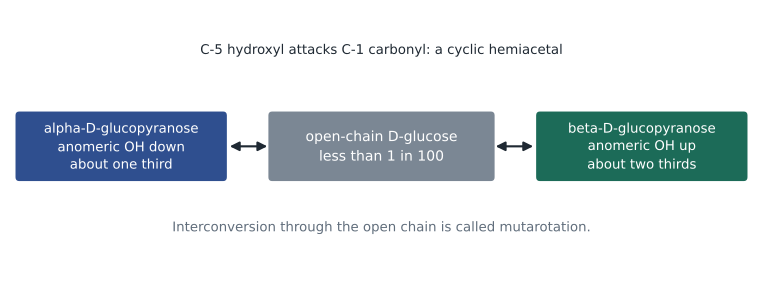
In solution, the two anomers interconvert through the open-chain form, a process called mutarotation. At equilibrium, D-glucose is about one-third alpha and two-thirds beta, with a tiny fraction as the open chain. Beta is favored because in the chair form of the ring, all of beta-D-glucose's bulky groups, including the anomeric hydroxyl, sit in the more spacious equatorial positions.
Reactions of sugars
Because sugars contain alcohols and a carbonyl, they undergo the reactions of those groups. Four are tested most often.
| Reaction | What happens | Why it matters |
|---|---|---|
| Oxidation | The aldehyde of an aldose (in the open chain) is oxidized to a carboxylic acid, forming an aldonic acid | The basis of tests for reducing sugars, such as Benedict's and Tollens' tests |
| Reduction | The carbonyl is reduced to an alcohol, forming a sugar alcohol (alditol), such as sorbitol from glucose | Sorbitol buildup contributes to complications of diabetes in some tissues |
| Esterification and phosphorylation | Hydroxyl groups form esters, including phosphate esters | Glucose is phosphorylated to glucose 6-phosphate on entering cells, which traps it inside |
| Glycoside formation | The anomeric hydroxyl reacts with another alcohol to form an acetal, a glycosidic bond | Links sugars into disaccharides and polysaccharides; locks the anomer in place |
A reducing sugar is one that can be oxidized, which requires a free anomeric carbon able to open into the aldehyde form. All monosaccharides are reducing sugars, including ketoses such as fructose, which can isomerize to an aldose in the basic conditions of the tests. In a reducing sugar, the sugar is oxidized and the reagent is reduced: in Tollens' test, silver ions are reduced to a silver mirror, and in Benedict's test, copper(II) ions are reduced to a red precipitate of copper(I) oxide. A disaccharide is reducing if at least one of its anomeric carbons is not tied up in the glycosidic bond.
Glycosidic bonds and disaccharides
When the anomeric carbon of one sugar reacts with a hydroxyl group of another, they form a glycosidic bond and release water, another condensation reaction. The bond is named by the anomer of the first sugar and the two carbons joined. Hydrolysis by acid or by specific enzymes breaks it.
| Disaccharide | Components and bond | Reducing? | Enzyme that hydrolyzes it |
|---|---|---|---|
| Maltose | Glucose alpha(1 to 4) glucose | Yes | Maltase |
| Lactose | Galactose beta(1 to 4) glucose | Yes | Lactase |
| Sucrose | Glucose alpha(1 to 2) beta fructose; both anomeric carbons are in the bond | No | Sucrase |
| Cellobiose | Glucose beta(1 to 4) glucose | Yes | Not digested by human enzymes |
Sucrose is the classic non-reducing sugar, because its glycosidic bond joins the anomeric carbon of glucose to the anomeric carbon of fructose, leaving neither free. Lactose intolerance results when the small intestine makes too little lactase after childhood; undigested lactose passes to the colon, where bacteria ferment it, producing gas and drawing water in.
Polysaccharides
Polysaccharides are long chains of monosaccharides. The type of glycosidic bond determines their shape and function, and enzymes are highly specific for one bond type.
| Polysaccharide | Monomer and bonds | Structure | Role |
|---|---|---|---|
| Amylose (starch) | Glucose, alpha(1 to 4) | Unbranched, coiled into a helix | Energy storage in plants |
| Amylopectin (starch) | Glucose, alpha(1 to 4) with alpha(1 to 6) branches roughly every 24 to 30 residues | Branched | Energy storage in plants |
| Glycogen | Glucose, alpha(1 to 4) with alpha(1 to 6) branches roughly every 8 to 12 residues | Highly branched | Energy storage in animals, mainly liver and muscle |
| Cellulose | Glucose, beta(1 to 4) | Straight chains that stack and hydrogen bond into strong fibers | Plant cell walls; dietary fiber for humans |
| Chitin | N-acetylglucosamine, beta(1 to 4) | Straight, strong chains | Exoskeletons of arthropods; fungal cell walls |
Glycogen's heavy branching serves a purpose. Enzymes add and remove glucose at the nonreducing ends of the chains, and each branch adds another end. A highly branched molecule can therefore release many glucose units at once when blood glucose falls or a muscle starts working. Branching also makes glycogen more soluble.
The difference between starch and cellulose shows how much a single bond matters. Both are polymers of glucose, but the alpha bonds of starch produce a coiled chain that human amylases can digest, while the beta bonds of cellulose produce straight chains that pack into fibers that no human enzyme can break. Cattle and termites digest cellulose only because microbes in their guts make the enzyme cellulase.
Carbohydrates also attach to proteins and lipids. Glycoproteins and glycolipids on the outer surface of the plasma membrane form a sugar coat, the glycocalyx, that takes part in cell recognition. The ABO blood groups, for example, are defined by different sugars attached to glycoproteins and glycolipids on red blood cells.
Worked problem
Deciding whether a sugar is reducing
Trehalose, a disaccharide found in insects and fungi, consists of two glucose units joined by an alpha(1 to 1) bond. Is it a reducing sugar, and would it give a positive Benedict's test?
Show solution
- Identify the anomeric carbons: carbon 1 of each glucose.
- An alpha(1 to 1) bond joins carbon 1 of the first glucose to carbon 1 of the second, so both anomeric carbons are in the bond.
- With no free anomeric carbon, neither ring can open to an aldehyde.
- A sugar that cannot open to an aldehyde cannot reduce copper(II).
Answer: Trehalose is non-reducing and gives a negative Benedict's test, like sucrose. Hydrolyzing it to two glucose molecules would make the test positive.
Passage-style practice
Passage. A student tested four unknown carbohydrate solutions with Benedict's reagent before and after heating each with dilute acid, and with iodine solution, which turns blue-black with the helical chains of amylose. Data invented for this course.
| Sample | Benedict's before acid | Benedict's after acid | Iodine |
|---|---|---|---|
| A | Positive | Positive | No color change |
| B | Negative | Positive | No color change |
| C | Negative | Positive | Blue-black |
| D | Negative | Negative | No color change |
Practice problems
Work each problem on paper first, then reveal the answer to check.
Which sample could be sucrose? (Skill 2: scientific reasoning)
Show answer
Sample B: it is non-reducing until acid hydrolyzes it into glucose and fructose, and it gives no iodine color.
Which sample most likely contains starch? (Skill 2)
Show answer
Sample C: the blue-black iodine result indicates amylose, and acid hydrolysis releases reducing glucose.
Sample A could be glucose or lactose. Which additional test would distinguish them? (Skill 3: research design)
Show answer
Treat with lactase, or hydrolyze and use a method that identifies galactose, such as chromatography against standards; glucose alone would give no galactose.
Sample D gives negative results in every test. What might it be? (Skill 2)
Show answer
A non-carbohydrate, or a carbohydrate resistant to this dilute acid treatment, such as cellulose in suspension; more tests would be needed.
Why must the student neutralize the acid before the second Benedict's test? (Skill 3)
Show answer
Benedict's test works in basic conditions; leftover acid could give a false negative.
Sugar chemistry in the clinic
The same reaction that makes glucose a reducing sugar has a medical use. The open-chain aldehyde of glucose can react slowly, without any enzyme, with free amino groups on proteins, a process called glycation. Hemoglobin in red blood cells is glycated in proportion to the average blood glucose over the cell's lifetime of about 120 days. Measuring the glycated fraction, called hemoglobin A1c, therefore gives a picture of blood glucose over the previous two to three months, rather than at a single moment, and it is used to diagnose and monitor diabetes. Long-term glycation of other proteins, such as collagen and proteins in the lens of the eye and in blood vessel walls, contributes to the complications of poorly controlled diabetes.
Cells also attach sugars to proteins on purpose, using enzymes. In N-linked glycosylation, a branched sugar chain is attached to the side-chain nitrogen of asparagine, beginning in the endoplasmic reticulum and trimmed in the Golgi apparatus. In O-linked glycosylation, sugars are attached to the hydroxyl oxygen of serine or threonine. These sugar chains help proteins fold, mark them for delivery to the right compartment, and form the surface markers used in cell recognition, such as the ABO blood group antigens. A passage that describes a protein running as a fuzzy, larger-than-expected band on a gel, which sharpens after treatment with an enzyme that removes sugars, is describing glycosylation.
Common mistakes
MistakeD and L tell you which way a sugar rotates polarized light.
InsteadD and L describe the configuration of the highest-numbered chiral carbon; the direction of rotation must be measured.
MistakeAlpha and beta anomers cannot interconvert.
InsteadFree anomers interconvert in water by mutarotation; only a glycosidic bond locks the anomer.
MistakeKetoses such as fructose are not reducing sugars.
InsteadFructose gives positive tests because it isomerizes to an aldose in the basic test conditions.
MistakeSucrose is a reducing sugar because it contains glucose.
InsteadBoth anomeric carbons are in its glycosidic bond, so it is non-reducing.
MistakeStarch and cellulose differ in their monomers.
InsteadBoth are glucose; they differ in the alpha versus beta glycosidic bond.
Summary and key terms
- Monosaccharides are aldoses or ketoses with three to seven carbons; glucose is an aldohexose, fructose a ketohexose and ribose an aldopentose.
- D and L refer to the highest-numbered chiral carbon; epimers differ at one center, and anomers differ at the anomeric carbon.
- Sugars cyclize by forming hemiacetals or hemiketals; glucose forms a pyranose ring, and its alpha and beta anomers interconvert by mutarotation.
- Reducing sugars have a free anomeric carbon and give positive Tollens' and Benedict's tests; sucrose and trehalose are non-reducing.
- Glycosidic bonds link sugars; maltose, lactose and sucrose are the key disaccharides.
- Starch and glycogen use alpha bonds and branch at alpha(1 to 6) links; cellulose uses beta(1 to 4) bonds that humans cannot digest.
- Aldose
- A sugar whose carbonyl group is an aldehyde.
- Ketose
- A sugar whose carbonyl group is a ketone.
- Anomeric carbon
- The carbon that was the carbonyl carbon before ring closure; it carries the alpha or beta hydroxyl.
- Epimers
- Stereoisomers that differ at only one chiral center.
- Mutarotation
- Interconversion of the alpha and beta anomers in solution through the open-chain form.
- Reducing sugar
- A sugar with a free anomeric carbon that can be oxidized.
- Glycosidic bond
- The acetal linkage formed between the anomeric carbon of one sugar and a hydroxyl of another molecule.
Lesson quiz · 5 questions
Score 60% or more to complete this lesson.
Create a free account to save your progress, take quizzes and earn a certificate.