
MBA-603 · Lesson 7 of 12 · 21 min
Automation and the future of work
Daniel Osei starts the seventh session with a photograph from Northfield's plant floor. Two years ago, the company installed two robotic welding cells for its highest-volume brackets. Each cell does the work that used to take three welders across two shifts. Northfield did not lay anyone off: the welders moved to lower-volume, more complex assemblies that the robots cannot do economically, two became robot technicians after training, and the company has since hired more people in total because it won new work that the robots made affordable. But Daniel also remembers the six months after installation, when output fell, scrap rose and supervisors spent their days fixing problems no one had anticipated. Automation, he says, worked, but not in the way the vendor's slide deck said it would.
Dr. Marchetti uses his story to frame the lesson. Every wave of automation, from mechanized looms to spreadsheets to industrial robots to software that processes invoices, has prompted predictions of mass unemployment, and every wave so far has eliminated some jobs, changed most others and created new ones. Generative AI is different in one important respect: it reaches into cognitive and creative work that earlier automation barely touched. This lesson examines how to think about automation at the level of tasks rather than jobs, how to decide what to automate and what to augment, how to estimate the effects on an organization's roles, and how to manage the transition for people.
Tasks, not jobs
The most useful idea in the economics of automation is that technology automates tasks, not jobs. David Autor, Frank Levy and Richard Murnane, in a 2003 paper, showed that computers substituted for routine tasks, those that follow explicit rules, such as calculating, filing and repetitive assembly, and complemented non-routine tasks requiring problem solving, judgment, interpersonal skill or physical adaptability. The result over the following decades was a hollowing out of many middle-skill routine jobs, such as clerical and production work, while both high-skill and many low-skill service jobs grew. Autor's 2015 essay Why Are There Still So Many Jobs? argued that automation tends to raise the value of the tasks that machines cannot do, and that occupations usually survive by shifting their mix of tasks.
Daron Acemoglu and Pascual Restrepo extended the framework by distinguishing two forces. The displacement effect occurs when machines take over tasks that people used to do, reducing the demand for labor in those tasks. The reinstatement effect occurs when technology creates new tasks in which people have an advantage, such as programming, data analysis and robot maintenance. Productivity gains also raise incomes and demand, which creates jobs elsewhere. Whether workers as a whole gain depends on the balance, and Acemoglu has argued that some recent automation has been so-so: good enough to displace workers but not productive enough to generate large gains elsewhere.
Generative AI changes which tasks are exposed. A 2023 study by Tyna Eloundou and colleagues at OpenAI and the University of Pennsylvania estimated that around four fifths of US workers had at least a tenth of their tasks exposed to language models and related tools, and about a fifth had at least half their tasks exposed, with exposure highest in higher-wage, information-heavy occupations. Exposure is not the same as replacement. A task may be exposed because AI can do part of it faster with a person checking the result, which is augmentation, or because AI can do it entirely, which is automation. Which happens depends on the quality needed, the cost of errors, regulation and how the firm chooses to redesign the work.
Measuring exposure in an organization
Dr. Marchetti asks the cohort to break three Cedarline roles into their main tasks, estimate the hours spent on each in a typical week, and judge how much of each task current AI and automation could do. The estimates are rough, made in a workshop with people who know the roles, but they show where change is likely and what it means for each role.
# Task-level exposure: hours per week, and how much of each task current AI and automation could do
# (0 = none, 1 = all). Augmentation means a person still does the task, faster.
roles = {
    "Care team agent": [("answer order and policy questions", 14, 0.7), ("diagnose damage from photos", 8, 0.4),
                        ("arrange repair logistics", 6, 0.5), ("calm upset customers", 7, 0.1), ("log and tag cases", 5, 0.8)],
    "Store associate": [("advise on fit and use", 16, 0.1), ("check stock and order online", 6, 0.6),
                        ("receive and price stock", 8, 0.3), ("take repair drop-offs", 5, 0.2), ("tidy and set displays", 5, 0.0)],
    "Merchandise planner": [("build sales forecasts", 12, 0.6), ("set size and store allocations", 9, 0.5),
                            ("negotiate with factories", 8, 0.1), ("write weekly trading reports", 6, 0.8), ("review new designs", 5, 0.1)],
}
for role, tasks in roles.items():
    hours = sum(h for _, h, _ in tasks)
    exposed = sum(h * e for _, h, e in tasks)
    top = max(tasks, key=lambda t: t[1] * t[2])
print(f"{role:19s} {hours:2d} h/week, exposed {exposed:4.1f} h ({exposed / hours:.0%}); most exposed task: {top[0]}")Care team agent 40 h/week, exposed 20.7 h (52%); most exposed task: answer order and policy questions Store associate 40 h/week, exposed 8.6 h (22%); most exposed task: check stock and order online Merchandise planner 40 h/week, exposed 17.8 h (44%); most exposed task: build sales forecasts
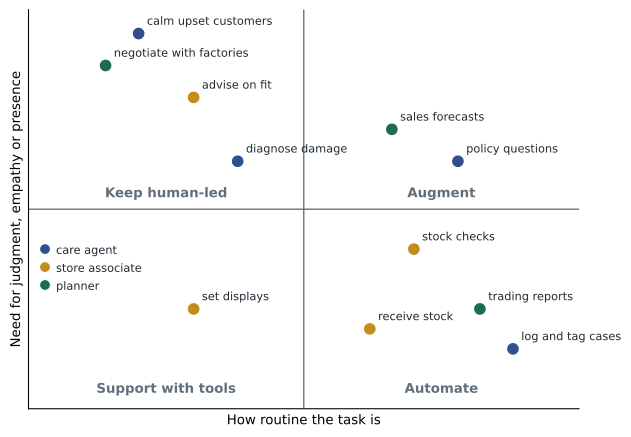
About half of a care agent's time and 44 percent of a planner's time is exposed, against about a fifth of a store associate's. The figures do not mean that half the care agents will lose their jobs. Cedarline's strategy expects repair and care contacts to grow quickly as the membership launches, so automation of routine questions could let the same team handle much more volume and spend more of its time on diagnosis and difficult conversations, which customers value and which require judgment. For planners, the forecasting and reporting work that AI can absorb is the least valuable part of the job; the valuable parts, negotiating with factories and judging new designs, remain. For store associates, the most exposed task, checking stock and ordering online for customers, is one the single inventory view in the roadmap will make faster, freeing time for advice, the reason customers come to a specialist store.
The exercise also shows why job-level forecasts mislead. Few roles fall entirely in one quadrant of the task matrix. The same agent who answers routine questions also calms upset customers, a task with very low exposure. Redesigning roles around the tasks that remain is usually more realistic than eliminating roles.
Deciding what to automate
Automation decisions should be made on economics and risk, not on technical possibility. Dr. Marchetti offers five questions. How much volume does the task have and how standardized is it? High-volume, rule-based work, such as matching invoices to purchase orders, is the classic target for robotic process automation, software that mimics the clicks and keystrokes a person makes across systems. How costly are errors, and can they be caught? A wrong product description can be fixed; a wrong dose in a hospital cannot. How stable is the process? Automating a process that changes every month creates constant maintenance. Is the problem the task, or the process around it? Automating a bad process makes the bad process faster; it is often better to simplify or eliminate the work first. And what happens to the people and the time freed?
Robotic process automation illustrates the trap. Many firms adopted it in the late 2010s to connect old systems without rebuilding them, and it often paid back quickly. But software robots that depend on the exact layout of a screen break when the screen changes, and firms with hundreds of them found that maintaining them became a burden. Dr. Marchetti's rule of thumb is to use such tools as a bridge while the underlying systems are replaced or integrated properly, not as a permanent architecture.
Physical automation follows similar logic. Northfield's welding robots paid off because the bracket volumes were high and stable, the work was repetitive and hard on people, and quality improved with consistency. Collaborative robots, smaller machines designed to work safely beside people, have made automation economical for lower volumes. In retail warehouses, automated storage and picking systems can cut labor per order sharply, but they are costly, inflexible once installed and economical only at high and predictable volumes. Cedarline's strategy of deferring a second distribution facility makes heavy warehouse automation premature; better slotting, scanning and software come first.
Augmentation and job redesign
The more promising path for most knowledge work is augmentation: using technology to make people better at their jobs rather than to replace them. Hana Kowalski's ambient documentation pilot is an example. Physicians in Lakeview's clinics spend a large share of their day on documentation, much of it after hours, and the tool drafts notes from the conversation for the physician to edit and sign. Early results suggest physicians spend noticeably less time writing notes and report less after-hours work. But the value depends on how the time is used. Lakeview could book more appointments, reduce burnout and turnover, or give each patient more attention, and these choices have different financial and human consequences. Hana's team has decided not to increase appointment volume during the pilot, so that it can measure effects on quality and burnout first.
Augmentation also changes skills. When AI drafts the first version, the human role shifts toward specifying what is needed, judging quality and catching errors. That requires expertise, which raises a long-term concern: if junior staff no longer do the routine work through which people traditionally learned a profession, how will they develop the judgment to supervise AI later? Firms that rely on AI-generated first drafts need deliberate training paths for juniors, such as reviewing AI output with experienced colleagues and doing some work without assistance.
Managing the transition for people
The human side of automation decides whether it succeeds. People who fear for their jobs resist change, hide problems and leave, often the best of them first. Dr. Marchetti recommends that leaders say clearly what will and will not happen to jobs, commit where they can to redeploying rather than dismissing people whose tasks are automated, and back the commitment with training. Where staff are unionized, collective agreements may contain provisions on technological change, and under federal labor law an employer generally must bargain over the effects of such decisions on represented employees. Large layoffs can also trigger advance notice requirements under the federal WARN Act and similar state laws. Early, honest consultation with unions usually works better than presenting finished plans.
Workforce planning connects automation to hiring. If Cedarline's care contacts double over three years while automation absorbs a third of current work, the care team may need to grow only modestly rather than double, and the plan can rely on normal turnover rather than layoffs. Reskilling programs work best when they are tied to specific roles the organization needs, such as repair technicians, data analysts or care specialists, rather than generic courses, and when they pay people during the training. Amazon, AT&T and others have run large reskilling programs with mixed but instructive results: participation and completion depend heavily on whether employees see a real job at the end.
Productivity measurement deserves a final word. Robert Solow remarked in 1987 that computers could be seen everywhere except in the productivity statistics, and the debate about whether information technology raised productivity lasted until the late 1990s, when gains finally appeared. Something similar may be happening with AI: individual tasks get faster, but organizations capture the gains only when they redesign processes and decide how to use the time. The firms that benefit most will not be those that deploy AI fastest, but those that change the work around it.
Worked problem
Planning automation in the care team
Cedarline's care team has 24 agents handling 38,000 contacts a month. The membership is expected to raise contacts to 60,000 a month within two years. The AI assistant from lesson 6 is expected to resolve 25 percent of contacts and save 1.5 minutes on the rest. Annual agent turnover is about 25 percent. How many agents will Cedarline need in two years, and how should it manage the change?
Show solution
- Estimate workload today: 38,000 contacts at 7.5 minutes is 285,000 minutes, about 11,900 minutes per agent a month across 24 agents.
- Estimate workload in two years with the assistant: 60,000 contacts, 75 percent handled by agents at 6 minutes each, is 270,000 minutes, slightly below today's workload.
- Translate into people: at today's productivity per agent, about 23 agents would be needed, roughly the current team, instead of the 38 that 60,000 contacts would need without the assistant.
- Plan the transition: with 25 percent turnover, about six agents leave each year, so Cedarline can hold the team steady by hiring mainly to replace departures, while training several agents as repair diagnosis specialists for the growing membership.
Answer: Cedarline can handle the growth with roughly its current team of about 24 agents, avoiding the hiring of about 14 more, without layoffs. It should tell the team this plainly, invest in diagnosis and repair skills, and measure whether resolution and satisfaction hold as the assistant takes on more work.
Common mistakes
MistakeAutomation eliminates jobs one for one.
InsteadTechnology automates tasks; jobs usually change their mix of tasks, and new tasks appear.
MistakeHigh exposure to AI means a job will disappear.
InsteadExposure can lead to augmentation rather than automation, depending on error costs, quality needs and redesign choices.
MistakeAutomate the existing process.
InsteadSimplify or eliminate unnecessary work first; automating a bad process makes it faster but not better.
MistakeSaved time automatically raises productivity.
InsteadGains appear only when the organization decides how to use the time and redesigns the work.
Summary and key terms
- Automation acts on tasks; routine tasks are substituted while non-routine tasks are often complemented.
- Displacement and reinstatement effects together determine automation's effect on labor demand.
- Generative AI exposes many cognitive tasks, especially in information-heavy, higher-wage occupations, but exposure is not replacement.
- Task-level analysis shows where change will come and why job-level forecasts mislead.
- Automation decisions should weigh volume, standardization, error costs, process stability and what happens to freed time.
- Successful transitions rely on honest communication, redeployment, role-specific reskilling and workforce plans that use natural turnover.
- Routine task
- A task that follows explicit rules and can be specified as a procedure.
- Displacement effect
- The reduction in labor demand when machines take over tasks people did.
- Reinstatement effect
- The increase in labor demand when technology creates new tasks in which people have an advantage.
- Robotic process automation
- Software that mimics a person's clicks and keystrokes to carry out rule-based tasks across systems.
- Augmentation
- Using technology to make people more productive in a task they still perform.
- Task exposure
- The share of a task or job that a technology could perform or speed up significantly.
Practice problems
Work each problem on paper first, then reveal the answer to check.
Distinguish the displacement and reinstatement effects.
Show answer
Displacement is machines taking over tasks people did; reinstatement is technology creating new tasks for people.
Why might a care agent with half her tasks exposed keep her job?
Show answer
Volume is growing, and the remaining tasks, diagnosis and difficult conversations, are valuable and need judgment.
What is a risk of relying heavily on robotic process automation?
Show answer
Software robots break when screens or processes change, creating a growing maintenance burden.
How can AI drafting threaten the development of junior staff?
Show answer
Juniors may no longer do the routine work through which they learned the judgment needed to supervise AI.
Lesson quiz · 5 questions
Score 60% or more to complete this lesson.
Create a free account to save your progress, take quizzes and earn a certificate.