
MBA-603 · Lesson 1 of 12 · 23 min
What digital transformation is: technology, strategy and organization
The second year of the executive MBA at the Lakeshore School of Business in Chicago opens in September, and the first Friday session of Digital Transformation begins with a question on the screen: what did your organization spend on technology last year, and what changed because of it? Dr. Elena Marchetti, who spent twelve years building data and payment systems at a large bank and five more as chief digital officer of a home-improvement retailer, gives the cohort five minutes. Most can answer the first half from a budget they have seen. Almost nobody can answer the second half with anything more specific than a new system went live.
That gap, she says, is the subject of the course. Organizations do not lack technology. They buy enterprise software, move systems to the cloud, hire data scientists and now license generative AI tools by the thousand seats. What they often lack is a clear link between that spending and a change in how they create and capture value. Digital transformation, as the term is used in this course, means changing an organization's strategy, operating model, processes and culture so that it can use digital technology to serve customers differently and to run itself differently. The technology is necessary but it is the easy part. The hard parts are deciding what to change, rebuilding the processes and data that the technology depends on, and getting thousands of people to work in new ways.
The cohort knows Dr. Marchetti's starting point from the strategy course they finished in the winter. A strategy is a coherent set of choices about where to play and how to win, and a digital initiative is worth doing only if it strengthens that position or opens a better one. Cedarline Outdoor, the case company they have followed since their first accounting course, chose in MBA-514 a focused strategy of durable gear repaired for life, with fewer styles, less wholesale, more of its own stores and online sales, and a new service unit called Cedarline Care. This course asks what technology that strategy needs, in what order, and how Cedarline should organize to deliver it. By the capstone in lesson 12 the cohort will present a three-year digital roadmap to Cedarline's board.
Digitization, digitalization and transformation
Three words are often used interchangeably, and separating them clarifies what a project is trying to do. Digitization is converting information from analog to digital form: scanning paper repair tickets, recording sales in a point-of-sale system instead of a ledger, or putting a barcode on every jacket. Digitalization is using digital information to change a process: routing a repair ticket automatically to the workshop with the right skills, or reordering stock when the point-of-sale system shows a size running low. Digital transformation is changing the business itself: offering repair as a membership service, selling used gear through an online marketplace, or letting a customer buy online and collect in a store within two hours because every unit of inventory is visible in one system.
Most organizations have done a great deal of the first, a fair amount of the second and much less of the third. The distinction matters because each level requires different things. Digitization needs equipment and data entry discipline. Digitalization needs process redesign, integration between systems and people who understand both the process and the software. Transformation needs leadership decisions about the business model, new capabilities, often new roles and incentives, and the patience to keep investing while the benefits arrive slowly.
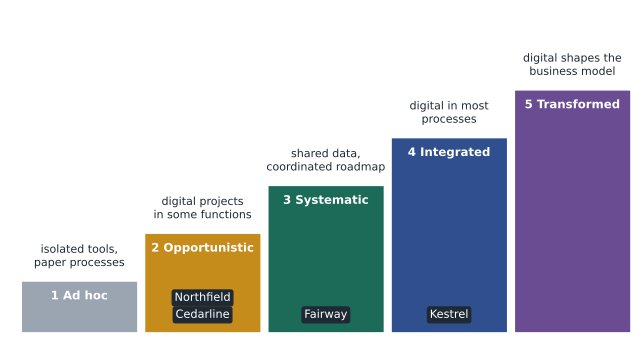
Why transformation is hard
Dr. Marchetti puts up a chart she has used for years. Surveys of executives by consulting firms have repeatedly found that a large share of digital transformation programs fall short of their objectives; figures of about 70 percent are often quoted, though the definitions of failure vary and the surveys rely on what managers say rather than on audited results. She does not dwell on the number. The useful question is why so many programs disappoint, and the research and her own experience point to a consistent set of reasons.
The first is starting with technology rather than with a business problem. A company buys a customer data platform because competitors have one, and two years later the platform holds data that nobody uses for any decision. The second is treating transformation as a project with an end date rather than a change in capabilities. A new system goes live, the program team is disbanded, and the processes, data quality and skills that the system needs to deliver value are left to decay. The third is underestimating the complementary investments. Economists who study productivity, including Erik Brynjolfsson and his colleagues, have argued that the returns to information technology depend on organizational changes such as new processes, decision rights and training, and that these intangible investments can cost several times as much as the hardware and software. When firms make the technology investment without the complementary ones, measured productivity can fall at first, a pattern they called the productivity J-curve.
The fourth reason is the legacy estate. Established firms run hundreds of systems, many of them old, customized and poorly documented, and every new initiative has to connect to them. A retailer that wants to show store inventory online discovers that its store systems update stock counts once a night, that a fifth of the counts are wrong, and that the product codes in the stores differ from those on the website. None of this is visible in a vendor demonstration. The fifth is culture and incentives. Store managers rewarded on store sales have little reason to help customers buy online. A merchandising team that has always trusted its instincts does not automatically trust a forecasting model. Lesson 11 returns to these problems in detail.
Four domains of change
Dr. Marchetti organizes the course around four domains in which digital technology changes a business. The first is the customer: how customers find, buy, use and get help with the product, which lessons 2, 3 and 9 address. The second is operations: how the firm plans, makes, moves and services things, which lessons 5, 6 and 7 address through analytics, artificial intelligence and automation. The third is the business model: what the firm sells, to whom and how it earns money, including platforms, subscriptions and services, which lessons 2 and 3 address. The fourth is the organization itself: the data, technology foundations, security, investment processes, skills and culture that make the other three possible, which lessons 4, 8, 10 and 11 address.
A useful test for any proposed initiative is to ask which domain it changes and how the change will show up in the measures the firm already uses. A ship-from-store capability changes operations and the customer experience, and it should show up in online conversion, delivery times, full-price sell-through and markdowns. A repair membership changes the business model, and it should show up in recurring revenue, customer retention and lifetime value. A data platform changes the organization's foundations; it does not show up directly in any customer measure, which is why it is the hardest kind of investment to justify and the easiest to cut, and why lesson 12 will treat it as an enabler whose value comes through the initiatives that depend on it.
Assessing digital maturity
Before deciding where to go, an organization needs an honest view of where it is. Maturity models, which consulting firms, research groups and standards bodies have published in many forms, score an organization on a set of dimensions and place it on a scale of stages. The details differ, but most cover strategy and leadership, customer experience, operations, data, technology and people. The scores are judgments, and their value lies less in the number than in the conversation they force: managers from different functions often disagree sharply about how mature their organization is, and the disagreement reveals where the problems are.
Dr. Marchetti asks four members of the cohort to score their organizations on six dimensions from 1 to 5, using a simple rubric, and to agree on Cedarline's scores as a group. Grace Mwangi, a category manager at Fairway Grocers, a regional supermarket chain, scores Fairway fairly high on customers because of its loyalty program and online grocery service. Daniel Osei, plant controller at Northfield Components, a maker of metal stampings for vehicle and equipment manufacturers, scores Northfield highest on operations, where it has invested in machine monitoring, and lowest on customers. Leo Brandt, co-founder and chief financial officer of Kestrel Analytics, a venture-funded software company that sells inventory forecasting to retailers, scores Kestrel high on almost everything, which prompts some teasing.
# Digital maturity scores (1 = ad hoc, 5 = leading) for six dimensions
weights = {"strategy": 0.20, "customer": 0.20, "operations": 0.15,
           "data": 0.20, "technology": 0.10, "people and culture": 0.15}
orgs = {
    "Cedarline":   {"strategy": 2, "customer": 3, "operations": 2, "data": 1.5, "technology": 2, "people and culture": 2},
    "Fairway":     {"strategy": 3, "customer": 3.5, "operations": 3, "data": 3, "technology": 3, "people and culture": 2.5},
    "Northfield":  {"strategy": 2, "customer": 1.5, "operations": 3.5, "data": 2, "technology": 2.5, "people and culture": 2},
    "Kestrel":     {"strategy": 4, "customer": 4, "operations": 3.5, "data": 4, "technology": 4.5, "people and culture": 3.5},
}
stages = [(1.5, "1 ad hoc"), (2.5, "2 opportunistic"), (3.5, "3 systematic"), (4.5, "4 integrated"), (9, "5 transformed")]
for name, s in orgs.items():
    score = sum(weights[d] * s[d] for d in weights)
    stage = next(label for limit, label in stages if score < limit)
    weakest = min(s, key=s.get)
    print(f"{name:10s} index {score:.2f}  stage {stage:16s} weakest: {weakest}")
gap = {d: 3 - orgs["Cedarline"][d] for d in weights}
print("Cedarline gaps to a stage-3 target:", {d: g for d, g in gap.items() if g > 0})Cedarline index 2.10 stage 2 opportunistic weakest: data
Fairway index 3.03 stage 3 systematic weakest: people and culture
Northfield index 2.18 stage 2 opportunistic weakest: customer
Kestrel index 3.90 stage 4 integrated weakest: operations
Cedarline gaps to a stage-3 target: {'strategy': 1, 'operations': 1, 'data': 1.5, 'technology': 1, 'people and culture': 1}Cedarline scores 2.10 on the weighted index, in the opportunistic stage, with data as its weakest dimension. Its customer score of 3 reflects a decent website and an online share of sales that has doubled to about a quarter of revenue in four years. But the cohort's discussion of the data score is revealing. Cedarline has separate customer records in its store tills, its web shop and its repair desk, with no common customer identifier; its product codes differ between the design system and the stores; and its store stock counts are updated overnight and are often wrong. Every initiative the strategy calls for, from ship-from-store to a repair membership to a resale marketplace, depends on data the company does not yet have in usable form. Fairway sits in the systematic stage with people and culture as its weakest dimension, and Northfield, like Cedarline, is opportunistic, with strong operations data that never reaches its customers.
The weighting is a choice, and Dr. Marchetti points out that a different weighting would change the ranks only slightly but could change the conversation a great deal. The more important output is the last line: to reach a systematic stage, Cedarline must improve on five of the six dimensions, and the biggest gap is in data. That is an early clue to the shape of the roadmap the cohort will build in lesson 12.
Who leads a transformation
Responsibility for digital work has moved around in most organizations. In the traditional model, a chief information officer runs infrastructure and enterprise systems as a service function, measured on uptime and cost. In the 2010s many companies added a chief digital officer to lead customer-facing initiatives, often with a separate team and budget, sometimes in tension with the information technology organization. Later still came chief data officers, chief data and analytics officers and, more recently, chief AI officers. The proliferation of titles reflects a real problem: digital capability cuts across every function, and no single executive owns all the levers.
Research by Stephanie Woerner and Peter Weill at the MIT Center for Information Systems Research, among others, suggests that what matters is less the title than a few arrangements: a clear owner for the transformation agenda who reports to the chief executive, business leaders who are accountable for the value of the initiatives in their areas, a shared technology and data platform rather than a separate stack for each unit, and funding that follows outcomes rather than projects. Dr. Marchetti's own view, from her years as a chief digital officer, is that a separate digital unit is useful for a few years to build skills and prove the model, but that it becomes a problem if it is still separate after five, because the rest of the business learns that digital is someone else's job.
Hana Kowalski, director of operations at Lakeview Health, a not-for-profit network of clinics and a community hospital, describes Lakeview's arrangement. The chief information officer runs the electronic health record and infrastructure; a small digital health team under the chief operating officer runs the patient portal and virtual care; and a new clinical AI committee reviews every proposal to use AI in care. The arrangement works for routine projects but struggles with anything that crosses lines, such as using portal data to reduce missed appointments, which needs the portal team, the record system, the clinics and the privacy office to act together.
Measuring progress
Because transformation is a change in capabilities rather than a single project, it needs measures at three levels. Activity measures track what the organization is doing: systems launched, staff trained, data sources connected. They are easy to collect and easy to game. Capability measures track what the organization can now do: the share of inventory visible in real time, the share of decisions supported by a shared data set, the time from idea to a released software change, the share of customers with a single identifier. Outcome measures track what the business gets: revenue from digital channels and services, conversion, retention, cost to serve, markdowns, inventory turns and return on invested capital.
The cohort will build a short scorecard of each kind for Cedarline in the capstone, linked to the balanced scorecard they designed in MBA-514. Dr. Marchetti's rule is that every activity measure should be traceable to a capability measure, and every capability measure to an outcome. If a measure cannot be traced, the organization is probably counting effort rather than progress.
Worked problem
Diagnosing a stalled transformation
A specialty retailer launched a digital program three years ago with a separate digital unit of 60 people. It rebuilt the website, launched an app and bought a customer data platform. Online sales have grown, but total profit has not improved, the app has 4 percent of customers as monthly users, and store managers say online orders steal their sales. Using the ideas in this lesson, diagnose the main problems and suggest three changes.
Show solution
- Identify what kind of change was made: the program digitized and digitalized the online channel but did not transform how the business works across channels, so the gains in online sales partly came from stores.
- Look for missing complementary investments: no shared inventory view, no change to store incentives, and a data platform with no decisions attached to it.
- Look at the organization: a separate digital unit after three years suggests the rest of the business has not taken ownership of digital outcomes.
- Check the measures: the program reports activity (features launched, app downloads) rather than capability and outcome measures such as inventory accuracy, cross-channel customer value and margin.
Answer: The retailer should credit stores for online sales in their area and for pickups, so incentives reward the customer rather than the channel; tie the customer data platform to two or three specific decisions, such as targeting lapsed customers and personalizing email offers, with measured outcomes; and begin folding the digital unit into the business by making merchandising and store leaders jointly accountable for cross-channel targets.
Common mistakes
MistakeDigital transformation means buying new technology.
InsteadIt means changing strategy, processes, data and culture so that technology changes how the firm creates and captures value.
MistakeA digital program ends when the systems go live.
InsteadValue depends on continuing investment in processes, data quality and skills; transformation is a change in capabilities, not a project.
MistakeMaturity scores are objective measurements.
InsteadThey are structured judgments; their main value is the disagreement and discussion they bring out.
MistakeA separate digital unit should run digital initiatives permanently.
InsteadA separate unit can build skills early, but lasting change requires business leaders to own digital outcomes.
Summary and key terms
- Digitization converts information to digital form, digitalization uses it to change processes, and digital transformation changes the business model and operating model.
- Transformation programs often disappoint because they start from technology, end too early, skip complementary investments, run into legacy systems and ignore incentives.
- Technology returns depend on complementary organizational investments, which can cost more than the technology itself and can cause a productivity J-curve.
- Digital change touches four domains: the customer, operations, the business model and the organization.
- Maturity models help an organization see where it stands, and the weakest dimension often shapes the roadmap.
- Progress needs activity, capability and outcome measures, each traceable to the next.
- Digitization
- Converting analog information into digital form.
- Digitalization
- Using digital information and tools to change a business process.
- Digital transformation
- Changing an organization's strategy, operating model, processes and culture so that digital technology changes how it creates and captures value.
- Complementary investment
- Spending on processes, skills, data and organization that is needed for a technology investment to pay off.
- Productivity J-curve
- The pattern in which measured productivity falls before it rises after a major technology investment, because intangible complementary investments are not counted as output.
- Maturity model
- A framework that scores an organization on several dimensions and places it on a scale of stages.
Practice problems
Work each problem on paper first, then reveal the answer to check.
Classify each as digitization, digitalization or transformation: scanning repair tickets; routing repair tickets automatically to the right workshop; selling repair as an annual membership.
Show answer
Digitization, digitalization and transformation respectively.
Why might productivity fall in the first year after a large system launch?
Show answer
Staff are learning new processes, data are being cleaned and processes redesigned, and these intangible investments consume effort without yet being counted as output.
Give one activity, one capability and one outcome measure for a ship-from-store program.
Show answer
Activity: stores enabled for ship-from-store. Capability: share of store inventory with accurate real-time counts. Outcome: full-price sell-through or online conversion.
A firm scores 4 on technology but 1.5 on data. What does that suggest?
Show answer
It has bought capable systems but lacks the shared, accurate data and governance to use them, so data should be an early priority.
Lesson quiz · 5 questions
Score 60% or more to complete this lesson.
Create a free account to save your progress, take quizzes and earn a certificate.