
MBA-603 · Lesson 12 of 12 · 23 min
Capstone: Cedarline's digital roadmap
The final session of Digital Transformation is a board meeting. Cedarline's chief executive has agreed to let the cohort present a three-year digital roadmap to a panel playing the board, made up of Dr. Marchetti, a former retail chief information officer and a director who chairs a public company's audit and risk committee. The cohort has 30 minutes to present and 30 minutes for questions. Dr. Marchetti has given them one rule: every initiative must trace back to the strategy Cedarline chose in MBA-514, durable gear repaired for life, and forward to measures the board can check.
This lesson walks through the cohort's work: the diagnosis, the guiding policy, the portfolio of initiatives and its economics, the sequence and dependencies, the organization and governance, the risks, and the measures. It draws on every earlier lesson and on the cohort's earlier courses.
Diagnosis
The cohort opens with three facts. First, Cedarline's strategy depends on capabilities it does not have. A repair-for-life promise, a repair membership, a resale marketplace and a single view of inventory across stores and online all require knowing each customer and each product reliably, and the maturity assessment in lesson 1 rated data as Cedarline's weakest dimension. Customer records are split across tills, the web shop, the repair desk and the loyalty program, product codes differ between systems, and store stock counts are updated overnight and are often wrong. Second, the economics of the strategy's channel shift depend on these capabilities. Pickup in store and ship-from-store earn more per order than warehouse shipping, but only when inventory records are accurate, as lesson 9 showed. Third, Cedarline's digital spending has been opportunistic: a website rebuild, a loyalty program and an app for store staff, each sound on its own, without shared data or a sequence.
The critical challenge, in the language of Richard Rumelt that the cohort learned in the strategy course, is that Cedarline's chosen position requires it to know every product and every customer over a long life, and its systems were built to record transactions, not relationships.
Guiding policy
The cohort's guiding policy has three parts. Build the foundations first: shared data on customers and products, accurate inventory and security, because every later initiative depends on them. Put digital to work for the durability position: services that track, repair and resell Cedarline products are the distinctive part of the roadmap and should be designed and owned by Cedarline. Buy or rent everything else, adopting standard processes where differences do not matter to customers, and stage uncertain bets so that Cedarline can stop those that do not work.
The policy also rules things out, which the cohort says plainly. Cedarline will not build a general marketplace for other brands' used gear, which would pit it against larger platforms. It will not invest in heavy warehouse automation while it defers a second distribution facility. It will not launch personalization at scale before its customer data are reliable. And it will not create a separate digital unit; each initiative will have a business owner.
The portfolio and its economics
The roadmap contains eight initiatives in three phases. Phase 1, in the first year, builds the foundations: a data platform with a single customer identity and product record; a single inventory view with item-level tags in stores, an order management system and pickup and ship-from-store; and the security program from lesson 8. Phase 2, mainly in the second year, delivers the distinctive services and operational gains: the Cedarline Care app with product passports, a code on each product linking it to its record of ownership, repairs and resale; the Cedarline Renewed resale marketplace; demand forecasting and allocation for the planners; and the AI assistant for the care team from lesson 6. Phase 3 starts a pilot of a personalization engine, with a rollout only if the pilot succeeds, as lesson 10 recommended.
The cohort estimates each initiative's one-off costs, running costs and benefits at full speed, drawing on the analyses in earlier lessons and on references from other retailers. The benefits from the single inventory view combine more pickup and ship-from-store orders, fewer lost sales and lower markdowns. The security program's benefit is the reduction in expected loss from lesson 8. The data platform has small direct benefits; its value lies in the initiatives it enables.
# Cedarline's three-year digital roadmap (millions of dollars; FY2027 = year 1)
rate, horizon = 0.09, 7
initiatives = [  # name, phase, one-off cost by year, annual run cost, annual benefit at full speed, first benefit year, ramp years
    ("Data platform and customer identity", 1, {1: 2.6, 2: 0.8}, 0.45, 1.2, 2, 1),
    ("Single inventory view, ship from store, pickup", 1, {1: 3.1, 2: 1.0}, 0.40, 3.6, 2, 2),
    ("Security program", 1, {1: 1.2, 2: 0.4}, 0.62, 1.0, 1, 1),
    ("Cedarline Care app and product passports", 2, {2: 2.2, 3: 0.6}, 0.35, 2.4, 3, 2),
    ("Renewed resale marketplace", 2, {2: 1.4, 3: 0.5}, 0.30, 1.6, 3, 2),
    ("Demand forecasting and allocation", 2, {2: 1.5, 3: 0.4}, 0.25, 2.2, 3, 2),
    ("AI assistant for the care team", 2, {2: 0.45}, 0.12, 0.9, 3, 1),
    ("Personalization engine (pilot first)", 3, {3: 0.8}, 0.10, 0.0, 4, 1),
]
def flows(item):
    name, phase, capex, run, benefit, start, ramp = item
    out = []
    for t in range(1, horizon + 1):
        level = 0 if t < start else min(1.0, (t - start + 1) / ramp)
        out.append(benefit * level - (run if t >= start else 0) - capex.get(t, 0))
    return out
def npv(f): return sum(x / (1 + rate) ** t for t, x in enumerate(f, start=1))
total = [0.0] * horizon
for item in initiatives:
    f = flows(item); total = [a + b for a, b in zip(total, f)]
    print(f"phase {item[1]}  {item[0]:47s} NPV {npv(f):5.2f}")
spend = {t: sum(i[2].get(t, 0) for i in initiatives) for t in (1, 2, 3)}
print("one-off spending by year:", {f"year {t}": round(v, 2) for t, v in spend.items()})
print("portfolio cash flow by year:", [round(x, 2) for x in total])
print(f"portfolio NPV {npv(total):.2f}; cumulative cash turns positive in year",
next(t for t in range(1, horizon + 1) if sum(total[:t]) > 0))phase 1 Data platform and customer identity NPV 0.03
phase 1 Single inventory view, ship from store, pickup NPV 7.97
phase 1 Security program NPV 0.47
phase 2 Cedarline Care app and product passports NPV 3.47
phase 2 Renewed resale marketplace NPV 2.07
phase 2 Demand forecasting and allocation NPV 3.96
phase 2 AI assistant for the care team NPV 2.17
phase 3 Personalization engine (pilot first) NPV -0.87
one-off spending by year: {'year 1': 6.9, 'year 2': 7.75, 'year 3': 2.3}
portfolio cash flow by year: [-6.52, -5.22, 5.01, 10.31, 10.31, 10.31, 10.31]
portfolio NPV 19.29; cumulative cash turns positive in year 4Over seven years at Cedarline's 9 percent cost of capital, the portfolio has a net present value of about 19.3 million dollars. One-off spending is 6.9 million in the first year, 7.75 million in the second and 2.3 million in the third, about 17 million in total, or roughly 1.2 percent of revenue a year on top of current technology spending. Cash flow is negative in the first two years and positive from the third, and cumulative cash turns positive in the fourth year. By the fourth year, the initiatives deliver net benefits of about 10.3 million a year.
The individual results tell the story the cohort wants the board to hear. The single inventory view is the largest single source of value, at about 8 million dollars. The data platform's own net present value is close to zero, about 30,000 dollars, because its direct benefits only just cover its costs, yet the Care app, the marketplace, forecasting and personalization all depend on it; cutting it would destroy most of the portfolio's value. The security program is modestly positive on expected loss alone, before counting what a major incident would do to the brand. The personalization pilot shows a negative value of about 0.9 million on its own because it includes only the pilot's cost; it is the price of the option the cohort valued at about 1.5 million in lesson 10.
The cohort checks for double counting. The strategy projections in MBA-514 already assumed higher margins from fewer promotions, more own-channel sales and better full-price sell-through, and some of those gains depend on the initiatives in this roadmap. The board should therefore see the roadmap as the means of delivering the strategy's projected returns, not as an additional 10 million a year on top of them. The cohort shows the board which strategy assumptions depend on which initiatives, so that a delay in an initiative becomes a visible risk to the strategy's numbers.
Sequence and dependencies
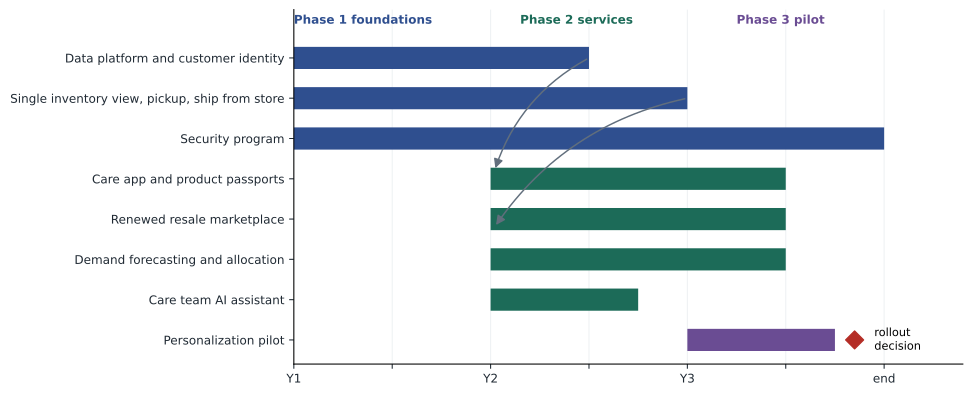
The sequence follows the dependencies. Product codes must be consistent before inventory can be reconciled across systems and before product passports can be issued; customer identity must be resolved before the Care membership can launch, because the membership needs to know who owns what. Item-level tags go first to the stores with the largest assortments, where inventory errors cost most. Pickup in store launches before ship-from-store, because it is more valuable and less demanding. Ship-from-store is enabled store by store as each passes an accuracy threshold of 95 percent. The security program runs from the first month, because every new system and data set increases what Cedarline must protect.
Within each initiative, delivery follows the practices of lesson 10. Each initiative has a stable product team with a business owner, works in short cycles and releases early versions to a few stores, regions or customer groups before scaling. The Care membership is tested in two regions with a comparison group before national launch, so that its effect on retention and spending can be measured rather than assumed, as lesson 2 recommended. The resale marketplace starts on a specialist resale platform in two product categories.
Organization, people and governance
The cohort proposes that the chief executive own the roadmap, with a small transformation office reporting to the chief executive and a monthly steering group of the executive team. Each initiative has a business owner: the chief operating officer for the inventory view and forecasting, the head of Cedarline Care for the app, the marketplace and the AI assistant, the chief marketing officer for customer identity and personalization, and the head of technology for the data platform and security. A new head of data, reporting to the head of technology, leads data governance with data owners in each domain, as lesson 4 described.
The people plan draws on lessons 7 and 11. The care team stays at about its current size while contacts grow, with agents trained as repair diagnosis specialists. Store managers' measures change to credit online sales in their areas, pickups and repair drop-offs, before ship-from-store launches. A network of champions in each store supports the store app and later the Care app. Cedarline hires about a dozen specialists over three years, including data engineers, a product manager for each phase 2 product and security staff, and rents other skills from partners. A digital academy offers short programs for store managers, planners and the care team, tied to the initiatives they will use.
AI governance follows lesson 6: an inventory of AI uses, risk tiers, approved tools for staff with clear data rules, human review of customer-facing outputs until measured quality justifies more automation, and a quarterly report to the board's audit and risk committee alongside the security report.
Risks and how the roadmap manages them
The cohort lists the main risks with the response to each. Delivery risk on the order management system, the largest implementation, is reduced by choosing a proven retail vendor, adopting its standard processes, phasing the rollout and setting a decision point after the first stores. Data risk, the possibility that customer and product data prove harder to clean than expected, is reduced by starting with product codes, fixing capture at the tills and measuring quality monthly. Adoption risk, the possibility that stores or planners do not use the new tools, is addressed by changing incentives before launch and by champions. Security risk grows as data are consolidated and is addressed by the security program and by designing access controls into the data platform. Benefit risk, the possibility that the Care membership or marketplace earns less than expected, is limited by regional tests with comparison groups and by stage gates.
Regulatory risk is real but manageable. Customer data will be handled to meet the strictest of the state privacy laws in the states where Cedarline sells, including consent records, purpose limits and data protection assessments for the Care app and personalization, with the opt-outs those laws require for targeted advertising. AI uses that affect customers will be disclosed, and the roadmap avoids AI decisions about individuals in areas such as credit or employment that state laws treat as high risk. Product passports are designed with an eye on emerging rules elsewhere: the European Union has adopted a regulation that will phase in digital product passports for many product groups, with textiles among the priorities, which matters if Cedarline expands its sales there.
Measures
The cohort proposes a short scorecard in three levels, as lesson 1 recommended, linked to the balanced scorecard the cohort designed for Cedarline in MBA-514. Capability measures: inventory record accuracy in stores, the share of customers with a single identity, the share of products sold with a passport, and the four software delivery measures for each product team. Outcome measures: pickup and ship-from-store share of online orders, full-price sell-through and markdowns, Care membership numbers and renewal rate, resale volumes and the share of resale buyers who later buy new gear, forecast error, care contacts resolved per agent hour, and customer retention across channels. Financial measures: the portfolio's spending against plan, net benefits by initiative and the strategy's return on invested capital and economic profit.
The board receives the scorecard quarterly. Each phase has a stage gate at which the board decides whether to proceed, based on predefined thresholds: for example, the Care membership launches nationally only if the regional test shows renewal above 70 percent and incremental spending at least half the level the business case assumed.
The digital statement
Dr. Marchetti asks every group to end with a statement short enough to fit on an index card, echoing the strategy course. The cohort's version reads: Cedarline will know every product and every customer for life, so that it can sell, repair and resell durable gear wherever customers choose; it will build the foundations first, own what makes it different and rent the rest. It has 38 words. A board member asks what would make the cohort abandon the roadmap. The answer, agreed in advance, is that if inventory accuracy in the first stores cannot be brought above 95 percent within a year, the economics of the channel shift fail, and the board should revisit the strategy's channel targets before spending on phase 2. Dr. Marchetti says that answer is the best part of the presentation, because it shows the cohort knows which assumption everything rests on.
Worked problem
Responding to a board challenge
During questions, the audit committee chair says the roadmap spends almost 17 million dollars over three years, while a competitor has announced a much larger AI program. She asks whether Cedarline is moving too slowly and should accelerate personalization and AI. How should the cohort respond?
Show solution
- Return to the strategy: Cedarline competes on durability and repair, not on being the most personalized retailer, so its digital spending should strengthen that position.
- Point to dependencies: personalization and most AI uses depend on reliable customer and product data, which phase 1 builds; accelerating them before then would waste money.
- Use the economics: the personalization engine has negative expected value if committed now and positive value if staged, as lesson 10 showed.
- Show where AI is used already: forecasting and the care assistant are in phase 2, where data and value are clear, and staff have approved AI tools now under governance.
Answer: The cohort should answer that the roadmap is sequenced for value, not for headlines: it uses AI where Cedarline's data and strategy support it, stages personalization behind a pilot, and could accelerate phase 2 if phase 1 milestones are met early. Spending more before the foundations are ready would raise risk without raising value.
Common mistakes
MistakeA digital roadmap is a list of attractive technologies.
InsteadIt is a sequenced set of initiatives that serve the strategy, with dependencies, owners, economics and measures.
MistakeEvery initiative should have a positive NPV on its own.
InsteadEnablers such as a data platform and pilots that buy options can be worth funding for the value they unlock.
MistakeDigital benefits add to the strategy's projections.
InsteadMany are the means of achieving the strategy's projected returns and must not be double counted.
MistakeA roadmap, once approved, should be followed to the end.
InsteadStage gates and predefined thresholds let the board stop, change or accelerate initiatives as evidence arrives.
Summary and key terms
- A digital roadmap begins with a diagnosis of the capabilities the strategy needs and the firm lacks.
- Cedarline's guiding policy is to build data, inventory and security foundations first, own the services that make it different, and rent the rest.
- The eight-initiative portfolio has an NPV of about 19 million dollars on one-off spending of about 17 million over three years, with cumulative cash positive in year 4.
- Enablers and pilots may have little value alone but are essential to the portfolio, and benefits must be checked for double counting against the strategy.
- Sequence follows dependencies, delivery follows product and agile practices, and each initiative has a business owner.
- Risks are managed through vendor choice, data quality, incentives, security, staged tests and a quarterly scorecard with stage gates.
- Digital roadmap
- A sequenced plan of digital initiatives tied to a strategy, with dependencies, owners, economics and measures.
- Enabler
- An investment whose value comes mainly from the other initiatives it makes possible.
- Product passport
- A digital record linked to a physical product that follows its ownership, repairs and resale.
- Stage gate
- A planned decision point at which leaders decide whether to continue an initiative based on predefined criteria.
- Transformation office
- A small team that tracks a transformation's roadmap, dependencies, benefits and risks for the executive team.
- Double counting
- Counting the same benefit twice, for example in both a strategy projection and a digital business case.
Practice problems
Work each problem on paper first, then reveal the answer to check.
Why is the data platform's own NPV close to zero, and why fund it anyway?
Show answer
Its direct benefits only just cover its costs, but most of the portfolio's value depends on it.
In which year does the roadmap's cumulative cash turn positive?
Show answer
Year 4.
What condition did the cohort set for abandoning the roadmap?
Show answer
If store inventory accuracy cannot be brought above 95 percent within a year, the board should revisit the channel targets before spending on phase 2.
Give two measures from the cohort's capability level.
Show answer
Any two of: store inventory record accuracy, share of customers with a single identity, share of products with a passport and software delivery measures.
Lesson quiz · 5 questions
Score 60% or more to complete this lesson.
Create a free account to save your progress, take quizzes and earn a certificate.