
MBA-511 · Lesson 9 of 12 · 19 min
Capital structure: Modigliani–Miller, taxes and distress
Northfield Components' founding family has asked Daniel to join a meeting with the company's bank. The family wants to take a special distribution of 20 million dollars, funded by a new term loan, to diversify their personal wealth. The bank is willing, but the loan would take Northfield's ratio of debt to EBITDA from about 2.0 to about 3.0 times, close to the covenant limit of 3.5. The family's adviser argues that debt is cheaper than equity, so borrowing more will lower the company's cost of capital and raise its value. The plant managers worry that a downturn could leave the company unable to invest. Dr. Varga says that both views contain part of the truth, and that the theory of capital structure exists to say how much of each.
The Modigliani–Miller benchmark
In 1958 Franco Modigliani and Merton Miller proved a surprising result. In a world with no taxes, no costs of bankruptcy, no transaction costs and the same information for everyone, the value of a firm does not depend on how it is financed. Its value is set by the cash flows its assets generate, and dividing those cash flows between lenders and shareholders, like slicing a pizza differently, does not change the size of the pizza. This is Modigliani and Miller's first proposition.
The argument is one of arbitrage. If a levered firm were worth more than an identical unlevered one, investors could sell the levered firm's shares, buy the unlevered firm's shares and borrow on their own account to recreate the same cash flows, pocketing the difference. Because investors can create or undo leverage themselves, they will not pay a firm to do it for them.
Their second proposition addresses the adviser's argument directly. Debt is cheaper than equity because lenders are paid first and bear less risk. But as a firm borrows more, its shareholders bear more risk, since their claim on the same operating cash flows now comes after a larger fixed obligation, and so they require a higher return. The cost of equity rises in exactly the proportion needed to keep the weighted average unchanged.
Here the return on assets is the cost of capital of the unlevered firm. Replacing expensive equity with cheap debt does not lower the WACC, because the remaining equity becomes more expensive. The MM propositions are not a description of the real world; they are a benchmark that tells us where to look for the effects of financing. If capital structure matters, it must be because of taxes, the costs of financial distress, information or incentives, the very things the theory assumes away.
Taxes and the interest tax shield
The first and largest departure from the benchmark is tax. Interest is deductible against corporate income, while dividends are not. Every dollar of interest a firm pays therefore reduces its tax bill by the tax rate, and the government in effect pays part of the cost of debt. Modigliani and Miller showed in 1963 that, with corporate taxes, the value of a levered firm equals the value of the same firm with no debt plus the present value of its interest tax shields. If debt is permanent and the shields are as risky as the debt, that present value is the tax rate times the amount of debt.
With taxes alone, the theory would say that firms should be financed almost entirely with debt. In practice, few firms do this. Two reasons are that personal taxes on interest income are often higher than on equity income, which reduces the net advantage of debt, and that tax rules limit the deduction.
The United States limits business interest deductions under section 163(j) of the Internal Revenue Code to 30 percent of adjusted taxable income, with an exemption for smaller businesses whose average gross receipts are below an inflation-indexed threshold of about 31 million dollars. From 2022 through 2024 adjusted taxable income was measured after depreciation, similar to EBIT, which tightened the limit; the 2025 budget reconciliation law restored the EBITDA-based measure for tax years beginning after 2024. Disallowed interest can be carried forward. For a firm like Northfield, the rule rarely binds, but for highly levered buyouts it can sharply reduce the value of the tax shield.
The costs of financial distress
The second departure is that borrowing too much is costly. A firm that cannot meet its debt payments faces bankruptcy or a costly restructuring, with legal and advisory fees that studies put at a few percent of firm value for large companies and more for small ones. Those are the direct costs. The indirect costs are usually larger and begin long before default. Customers hesitate to buy products that need long-term support from a supplier that may not survive. Suppliers demand cash on delivery. Key employees leave. Managers cut research, maintenance and marketing to conserve cash, and pass up positive-NPV projects because the benefits would go mainly to creditors, a problem economists call debt overhang. Competitors take advantage of the weakness.
Distress costs are highest for firms whose value depends on intangible assets, growth opportunities and ongoing relationships, such as software, pharmaceutical and fashion companies, and lowest for those with tangible, easily resold assets and stable cash flows, such as real estate, utilities and pipelines. This pattern matches what we observe: utilities and real estate trusts borrow heavily, while technology firms often hold more cash than debt.
The trade-off theory
Putting the two effects together gives the static trade-off theory. As a firm borrows more, it gains tax shields but raises the expected costs of financial distress. At low levels of debt, the probability of distress is small and the tax benefit dominates, so firm value rises. At high levels, distress becomes likely and its expected costs grow faster than the tax benefit, so value falls. The optimal capital structure is where the marginal benefit equals the marginal cost, and the WACC is at its lowest.
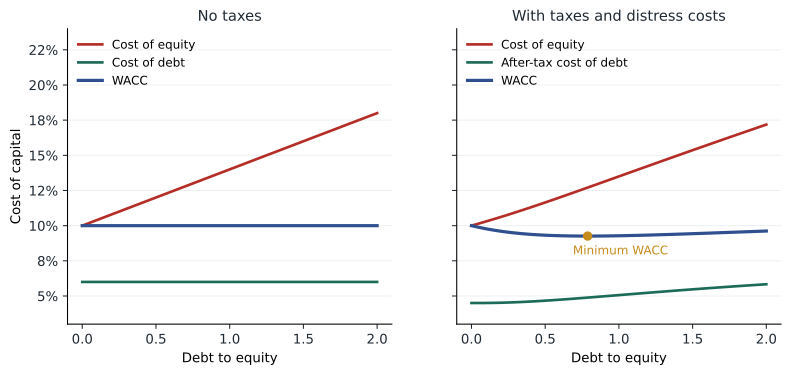
The theory does not give a precise number, but it explains a great deal about which firms borrow and which do not. It also has an awkward fact to explain: many highly profitable firms, which would gain most from tax shields and are least likely to face distress, borrow very little. That observation motivates two further theories.
Information, incentives and the pecking order
Stewart Myers and Nicholas Majluf argued in 1984 that managers know more about their firm's prospects than outside investors do. A firm that issues new shares signals that management thinks the shares are fully valued, or overvalued, so share prices typically fall when issues are announced. To avoid that cost, firms follow a pecking order: they fund investment first from retained earnings, then from debt, and only as a last resort from new equity. The pecking order explains why profitable firms borrow little: they do not need to. It also explains why Kestrel, a young firm with no profits and few assets to pledge, relies on venture equity, the one source available to it.
Incentives also matter. Debt can discipline managers by committing them to pay out cash, reducing the free cash flow they might otherwise waste, an argument made by Michael Jensen in 1986 that helps explain leveraged buyouts. But as lesson 1 showed, debt also creates conflicts between shareholders and lenders that lenders protect against with covenants and higher rates. In practice, managers also care about financial flexibility: keeping enough borrowing capacity in reserve to act quickly when opportunities or crises arise. Surveys of chief financial officers consistently rank flexibility and the firm's credit rating as the most important influences on their borrowing.
Levering and unlevering beta
Because leverage raises the risk borne by shareholders, it raises equity beta. Robert Hamada's formula, which assumes the firm keeps a constant amount of debt and that debt has a beta of zero, links the equity beta to the asset beta. It is the tool used in lesson 8 to adjust comparable companies' betas to a project's capital structure.
Adjusted present value
When a project's financing changes over time, or comes with special features such as a subsidized loan, a convenient alternative to the WACC is the adjusted present value. APV values the project as if it were financed entirely with equity, discounting its cash flows at the unlevered cost of capital, and then adds the present value of financing side effects: interest tax shields, subsidies, issue costs and, if they can be estimated, the expected costs of distress. APV makes each source of value visible, which is useful in leveraged buyouts and in project finance, where debt is paid down on a schedule.
# Capital structure tools: MM with taxes, Hamada betas and an APV (millions)
tax, rf, erp = 0.25, 0.04, 0.05
beta_asset = 0.9
r_asset = rf + beta_asset * erp
for de in (0.0, 0.25, 0.5, 1.0):
    beta_e = beta_asset * (1 + (1 - tax) * de)
    print(f"D/E {de:4.2f}: equity beta {beta_e:.2f}, cost of equity {rf + beta_e * erp:.2%}")

# Northfield: unlevered value and the effect of 20m of extra permanent debt
fcff, g = 9.0, 0.02
v_unlevered = fcff * (1 + g) / (r_asset - g)
print(f"unlevered value at {r_asset:.1%}: {v_unlevered:.1f}")
print(f"PV of tax shield on 20m of permanent debt: {tax * 20:.1f}")

# APV of a project with a 5-year loan repaid in equal parts
cash = [-30.0, 8.0, 8.0, 8.0, 8.0, 8.0]
base = sum(cf / (1 + r_asset) ** t for t, cf in enumerate(cash))
loan, rd = 20.0, 0.065
shield, balance = 0.0, loan
for t in range(1, 6):
    shield += balance * rd * tax / (1 + rd) ** t
    balance -= loan / 5
issue_costs = 0.4
print(f"base NPV {base:.2f} + tax shields {shield:.2f} - issue costs {issue_costs:.2f} = APV {base + shield - issue_costs:.2f}")D/E 0.00: equity beta 0.90, cost of equity 8.50% D/E 0.25: equity beta 1.07, cost of equity 9.34% D/E 0.50: equity beta 1.24, cost of equity 10.19% D/E 1.00: equity beta 1.57, cost of equity 11.88% unlevered value at 8.5%: 141.2 PV of tax shield on 20m of permanent debt: 5.0 base NPV 1.53 + tax shields 0.84 - issue costs 0.40 = APV 1.97
Worked problem
Should Northfield borrow for the family's distribution?
The new 20 million dollar loan would be permanent, at 6.5 percent, and Northfield's tax rate is 25 percent. Daniel estimates that the extra debt raises the chance of financial distress in the next ten years from 5 to 12 percent, and that distress would cost about 25 percent of Northfield's enterprise value of roughly 150 million dollars. Does the recapitalization add value?
Show solution
- Tax benefit: the present value of the interest tax shield on permanent debt is about 0.25 times 20 = 5 million dollars, before any interest limitation.
- Extra expected distress cost: the probability rises by 7 points, times 25 percent of 150 million = 0.07 times 37.5 = about 2.6 million dollars, before discounting.
- Net effect: roughly 5.0 minus 2.6 = about 2.4 million dollars of value added, if the estimates are right.
- Consider flexibility: the loan uses most of the remaining room under the 3.5 times covenant, limiting Northfield's ability to fund the press line from lesson 5.
Answer: On these estimates, the recapitalization adds a modest amount of value through tax savings, but the margin is thin, the distress estimate is uncertain and the loss of flexibility is real. Daniel can reasonably recommend a smaller distribution, perhaps 10 million dollars, that captures part of the tax benefit while leaving room to fund the press line and absorb a downturn.
Common mistakes
MistakeDebt is cheaper than equity, so more debt always lowers the WACC.
InsteadLeverage raises the cost of equity; the WACC falls only because of tax shields and rises once distress costs dominate.
MistakeThe tax shield makes all-debt financing optimal.
InsteadDistress costs, interest limits, personal taxes and lost flexibility offset the benefit.
MistakeFinancial distress costs start only at bankruptcy.
InsteadIndirect costs, such as lost customers and forgone investment, begin well before default.
MistakeEquity beta is unaffected by leverage.
InsteadHigher leverage raises equity beta, as the Hamada formula shows.
Summary and key terms
- Without taxes or frictions, financing does not change firm value; the cost of equity rises with leverage to keep the WACC constant.
- Interest tax shields add value, approximately the tax rate times permanent debt, subject to interest limitation rules.
- Direct and indirect costs of financial distress offset the tax benefit at high leverage.
- The trade-off theory sets debt where marginal tax benefits equal marginal distress costs; the pecking order explains why profitable firms borrow little.
- Hamada's formula relevers betas, and APV values financing side effects separately.
- Modigliani–Miller propositions
- Results showing that, without taxes and frictions, capital structure does not affect firm value.
- Interest tax shield
- The tax saved because interest is deductible.
- Financial distress
- Difficulty meeting obligations to creditors, with direct and indirect costs.
- Debt overhang
- The tendency of a highly indebted firm to pass up good projects because the gains would go to creditors.
- Pecking order
- A preference for internal funds, then debt, then new equity, because of information costs.
- Adjusted present value
- The all-equity value of a project plus the present value of its financing side effects.
Practice problems
Work each problem on paper first, then reveal the answer to check.
A firm has an asset cost of capital of 10 percent, debt costing 6 percent and a debt-to-equity ratio of 0.5. With no taxes, what is its cost of equity?
Show answer
10 + 0.5 times (10 minus 6) = 12 percent.
An unlevered firm worth 500 million dollars issues 200 million of permanent debt and buys back shares. With a 25 percent tax rate and no distress costs, what is the levered firm worth?
Show answer
500 + 0.25 times 200 = 550 million dollars.
An asset beta is 0.8, the tax rate 25 percent and the target debt-to-equity ratio 0.6. What is the equity beta?
Show answer
0.8 times (1 + 0.75 times 0.6) = 0.8 times 1.45 = 1.16.
Why might a software company with high profits choose to have no debt?
Show answer
Its value lies mainly in intangible assets and growth opportunities, so distress costs would be high; it can fund investment from profits, and it values flexibility.
Lesson quiz · 5 questions
Score 60% or more to complete this lesson.
Create a free account to save your progress, take quizzes and earn a certificate.