
MBA-511 · Lesson 2 of 12 · 19 min
Time value of money and valuing cash flows
Hana Kowalski arrives at the second session with a real decision. Lakeview Health needs a new MRI scanner. The manufacturer will sell it for 3.2 million dollars today, or lease it for 62,000 dollars a month for five years, after which Lakeview can return it. A leasing company has offered a third option: pay nothing for the first year, then 75,000 dollars a month for four years. Lakeview's board wants to know which offer is cheapest. Adding up the payments gives 3.72 million dollars for the first lease and 3.6 million for the second, both more than the purchase price, but Hana suspects that comparison is wrong because the payments are spread over time. Dr. Varga agrees and uses her problem to introduce the most important idea in finance: a dollar today is worth more than a dollar in the future.
Why money has a time value
There are three reasons a dollar today is worth more than a promised dollar later. A dollar today can be invested to earn interest, so it will grow to more than a dollar. Prices tend to rise, so a future dollar will usually buy less. And a promise to pay in future carries some risk that it will not be kept. In this lesson the focus is on the first reason, the opportunity to earn a return, with the discount rate standing in for what the money could earn elsewhere at similar risk. Lessons 7 and 8 explain how risk enters the discount rate.
Two operations connect money at different dates. Compounding moves money forward: an amount invested today at a rate r per period grows to the present value times one plus r for each period. Discounting moves money back: an amount to be received in future is worth that amount divided by one plus r for each period. Discounting is simply compounding in reverse.
At 6 percent a year, one million dollars grows to 1.06 million after a year, 1.1236 million after two years and about 1.79 million after ten years, because interest is earned on past interest. The same arithmetic says that 1.79 million dollars promised in ten years is worth one million today at 6 percent. A useful shortcut, the rule of 72, says that money doubles in roughly 72 divided by the interest rate in percent years: about twelve years at 6 percent and about eight years at 9 percent.
Drawing the timeline
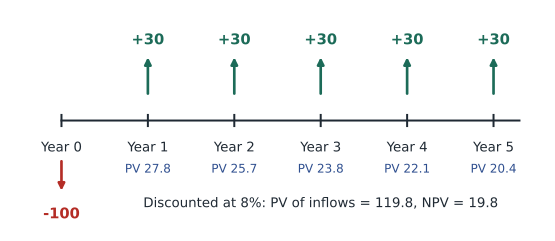
Dr. Varga insists that every problem start with a timeline. Time 0 is today. Each later point is the end of a period, usually a year or a month. Cash paid out is shown as negative, cash received as positive. Once the cash flows are on the timeline, the value of the whole stream at any date is the sum of the values of the individual flows moved to that date. This principle, value additivity, means that complex streams can always be broken into simple pieces.
Two conventions cause many errors. First, a cash flow at the end of year one is discounted by one period, not zero; payments made at the beginning of each period, such as rent paid in advance, form an annuity due and need one fewer period of discounting. Second, the rate and the period must match: a monthly payment stream must be discounted at a monthly rate.
Annuities and perpetuities
Many cash-flow streams repeat. An annuity is a series of equal payments at regular intervals for a fixed number of periods, such as loan payments or a lease. A perpetuity is a series of equal payments that continues forever, such as some preferred shares or a rough model of a mature business. Their present values have closed-form formulas that save adding up hundreds of terms.
The perpetuity formula is easy to remember: a perpetuity paying C a year is worth C divided by r, because investing C divided by r at rate r would produce C a year forever. The annuity formula follows from it: an annuity for n years equals a perpetuity starting now minus a perpetuity starting in n years. If the payments grow at a constant rate g that is less than r, the growing perpetuity formula is C divided by r minus g, where C is the first payment, one period from now. That formula reappears in lesson 4 as the Gordon growth model for valuing shares, and in lesson 11 as the terminal value in a company valuation.
Interest rate conventions
Interest rates are quoted in many ways, and comparing offers requires converting them to a common basis. A nominal annual rate quoted with compounding m times a year means a rate of the nominal rate divided by m is applied each period. The effective annual rate, the rate that would give the same result with annual compounding, is higher whenever compounding is more frequent than once a year.
US borrowers usually see rates quoted as an annual percentage rate. For a mortgage or car loan, the stated rate is normally an annual rate compounded monthly, so a 6.0 percent mortgage rate means 0.5 percent a month and an effective annual rate of about 6.17 percent. The APR disclosed under the Truth in Lending Act also folds in certain fees and points, so it can differ from the note rate, and credit cards quote an APR that is applied daily to the balance. When comparing a mortgage, a car loan and a business line of credit, convert each to an effective annual rate first, and check which fees are included.
A second distinction is between nominal and real rates. A nominal rate is quoted in money; a real rate is quoted in purchasing power. If a bank pays 4 percent while prices rise 2.5 percent a year, the real rate is about 1.5 percent; more precisely, one plus the real rate equals one plus the nominal rate divided by one plus inflation. The rule for valuation is consistency: discount nominal cash flows at a nominal rate and real cash flows at a real rate. Mixing them, for example by projecting flat costs in today's dollars and discounting at a nominal rate, understates value and is one of the most common errors in capital budgeting.
# Present value tools: annuity, perpetuity and growing perpetuity
def pv_annuity(c, r, n, due=False):
    v = c / r * (1 - (1 + r) ** -n)
    return v * (1 + r) if due else v
def pv_perpetuity(c, r):
    return c / r
def pv_growing(c1, r, g):
    assert g < r
    return c1 / (r - g)
def ear(apr, m):
    return (1 + apr / m) ** m - 1

print(f"FV of 1.0m at 6% for 10 years: {1.0 * 1.06 ** 10:.3f}m")
print(f"PV of 50k a year for 20 years at 7%: {pv_annuity(50, 0.07, 20):.1f}k")
print(f"PV of 50k a year forever at 7%: {pv_perpetuity(50, 0.07):.1f}k")
print(f"PV of 50k growing 2% a year forever at 7%: {pv_growing(50, 0.07, 0.02):.1f}k")
print(f"EAR of 6% compounded monthly: {ear(0.06, 12):.4%}")
print(f"EAR of 5% compounded semi-annually: {ear(0.05, 2):.4%}")FV of 1.0m at 6% for 10 years: 1.791m PV of 50k a year for 20 years at 7%: 529.7k PV of 50k a year forever at 7%: 714.3k PV of 50k growing 2% a year forever at 7%: 1000.0k EAR of 6% compounded monthly: 6.1678% EAR of 5% compounded semi-annually: 5.0625%
Valuing Hana's three offers
Lakeview borrows through tax-exempt health-system bonds and can borrow for five years at about 4.8 percent a year. Because the lease payments are contractual obligations similar to debt, that borrowing rate is the right discount rate for comparing them: leasing is a form of borrowing, and the question is which form of financing is cheapest. Converting 4.8 percent to a monthly effective rate gives about 0.391 percent per month.
# Lakeview's MRI: buy, lease, or deferred lease (payments at month end)
annual = 0.048
m = (1 + annual) ** (1 / 12) - 1          # monthly rate with the same effective annual rate
def pv_annuity(c, r, n):
    return c / r * (1 - (1 + r) ** -n)
buy = 3_200_000
lease = pv_annuity(62_000, m, 60)
deferred = pv_annuity(75_000, m, 48) / (1 + m) ** 12   # starts after 12 months
print(f"monthly rate {m:.4%}")
print(f"buy now          {buy:>12,.0f}")
print(f"lease 60 months  {lease:>12,.0f}")
print(f"deferred lease {deferred:>12,.0f}")monthly rate 0.3915% buy now 3,200,000 lease 60 months 3,309,672 deferred lease 3,126,124
Once the payments are discounted, the ranking changes. The level lease has a present value of about 3.31 million dollars, a little more than the purchase price, and the deferred lease about 3.13 million, the cheapest of the three. The deferred lease is cheaper partly because Lakeview pays nothing for a year, so its money stays invested longer. Before signing, Hana must check what each option includes: if the purchase comes with a resale value at the end of five years, or the lease includes maintenance worth 15,000 dollars a month, the comparison changes. Value additivity makes those adjustments easy: discount each extra cash flow and add it to the option it belongs to.
Dr. Varga adds that the discount rate in a time value problem is always an opportunity cost: the return the money could earn in its next best use at similar risk. For Lakeview, comparing ways of paying for a scanner, that is the rate at which it could borrow. For a business evaluating a risky new product, it is the return investors could earn on other investments of similar risk, which is usually much higher. Choosing the rate is a judgment about risk, and lessons 7 and 8 show how to make it.
Worked problem
How much can Northfield borrow?
Northfield's bank will lend for seven years at 6.6 percent a year compounded monthly, with equal monthly payments. Daniel estimates that the new press line will free up 420,000 dollars a month that can go to loan payments. What is the largest loan those payments can support?
Show solution
- Find the monthly rate: 6.6 percent divided by 12 = 0.55 percent.
- Count the payments: 7 years times 12 = 84 months.
- Apply the annuity formula: PV = 420,000 / 0.0055 times (1 minus 1.0055 to the power of minus 84).
- 1.0055 to the power of 84 is about 1.585, so the bracket is 1 minus 0.631 = 0.369, and PV = 76.36 million times 0.369 = about 28.2 million dollars.
Answer: The payments can support a loan of about 28.2 million dollars. Daniel should also check that the extra debt keeps Northfield within its covenant of 3.5 times debt to EBITDA.
Thinking in present values
Dr. Varga ends with a list of the everyday decisions that are really time value problems in disguise: whether to take an early-payment discount from a supplier, which is often worth an annual return of 30 percent or more; whether to prepay a loan; how much to save each year to fund a pension promise; whether to pay a signing bonus or a higher salary; how much a customer who stays for years is worth. Leo realizes that his customer lifetime value calculation at Kestrel adds up five years of subscription margin without discounting, and that at Kestrel's high cost of capital the discounted figure is about a quarter lower. The lesson is not that the arithmetic is hard; it is that leaving it out leads to systematically wrong decisions.
Common mistakes
MistakeAdding cash flows from different years gives their total value.
InsteadCash flows at different dates must be moved to the same date before they are added.
MistakeA monthly payment can be discounted at the annual rate.
InsteadThe rate must match the period; convert to a monthly rate.
MistakeA quoted rate of 6 percent compounded monthly is an effective rate of 6 percent.
InsteadThe effective annual rate is higher, about 6.17 percent.
MistakeReal cash flows can be discounted at a nominal rate.
InsteadDiscount nominal flows at nominal rates and real flows at real rates.
Summary and key terms
- A dollar today is worth more than a dollar later because it can earn a return, because of inflation and because future promises carry risk.
- Compounding moves money forward and discounting moves it back; values at the same date can be added.
- Annuities, perpetuities and growing perpetuities have closed-form present values.
- Convert quoted rates to effective annual rates before comparing them, and match rates to periods.
- Be consistent: nominal cash flows with nominal rates, real with real.
- Present value
- The value today of a future cash flow or stream, found by discounting.
- Annuity
- A series of equal payments at regular intervals for a fixed number of periods.
- Perpetuity
- A series of equal payments that continues forever.
- Effective annual rate
- The annual rate that, compounded once a year, gives the same result as a quoted rate with more frequent compounding.
- Real interest rate
- An interest rate measured in purchasing power, approximately the nominal rate minus inflation.
Practice problems
Work each problem on paper first, then reveal the answer to check.
What is the present value of 2 million dollars to be received in 8 years at 7 percent?
Show answer
2 / 1.07 to the power of 8 = 2 / 1.718 = about 1.164 million dollars.
A preferred share pays 1.50 dollars a year forever. Investors require 6 percent. What is it worth?
Show answer
1.50 / 0.06 = 25 dollars.
A supplier offers 2 percent off for payment in 10 days instead of 30. What effective annual rate is the buyer earning by taking the discount?
Show answer
Paying 98 instead of 100 twenty days early earns 2 / 98 = 2.04 percent for 20 days. There are about 18.25 such periods in a year, so the effective rate is 1.0204 to the power of 18.25 minus 1 = about 44.6 percent.
A lottery offers 10 million dollars now or 600,000 dollars a year for 25 years starting in a year. At 5 percent, which is worth more?
Show answer
The annuity is worth 600,000 / 0.05 times (1 minus 1.05 to the power of minus 25) = 12 million times 0.705 = about 8.46 million dollars, so the lump sum is worth more.
Lesson quiz · 5 questions
Score 60% or more to complete this lesson.
Create a free account to save your progress, take quizzes and earn a certificate.