
MATH-441 · Lesson 7 of 12 · 22 min
Integrable functions, Fatou’s lemma and dominated convergence
Lesson 6 integrated nonnegative functions. We now extend the integral to functions of both signs and prove the two remaining convergence theorems. Fatou's lemma gives an inequality for arbitrary sequences of nonnegative functions; it is the workhorse behind almost every limit argument in the subject. Lebesgue's dominated convergence theorem, derived from it, gives the condition under which pointwise convergence implies convergence of integrals: the existence of a single integrable function above all the \(|f_n|\). This is the theorem that most often justifies exchanging a limit with an integral in practice, from differentiating under the integral sign to computing expectations in probability. Throughout, \((X, \mathcal{A}, \mu)\) is a measure space.
Integrable functions
Definition 7.1. A measurable function \(f : X \to \overline{\mathbb{R}}\) is integrable if \(\int |f| \, d\mu < \infty\). Its integral is \[\int f \, d\mu = \int f^+ \, d\mu - \int f^- \, d\mu,\] where \(f^+ = \max(f, 0)\) and \(f^- = \max(-f, 0)\). The set of integrable functions is denoted \(L^1(\mu)\), or \(L^1(X)\), or \(L^1\). For complex-valued \(f\), integrability means \(\int |f| < \infty\) and \(\int f = \int \operatorname{Re} f + i \int \operatorname{Im} f\).
Since \(f^+ \le |f|\) and \(f^- \le |f|\), both integrals on the right are finite and the difference makes sense. By Corollary 6.6 an integrable function is finite almost everywhere, so we may redefine it to be zero on the null set where it is infinite without changing any integral, and we usually regard elements of \(L^1\) as real-valued. The definition is absolute: a function is integrable only if its absolute value is. This rules out conditionally convergent integrals. For instance \(\frac{\sin x}{x}\) has a convergent improper Riemann integral on \([1, \infty)\), but \(\int_1^\infty \frac{|\sin x|}{x} \, dx = \infty\), so it is not Lebesgue integrable there. Absolute integrability is the price of having robust convergence theorems, much as absolute convergence is the condition under which series can be rearranged.
Theorem 7.2. \(L^1\) is a vector space, the integral is a linear map on it, and \(\big|\int f\big| \le \int |f|\) for every \(f \in L^1\). If \(f \le g\) almost everywhere, then \(\int f \le \int g\).
Proof. Closure under sums follows from \(|f + g| \le |f| + |g|\) and additivity of the integral for nonnegative functions. For linearity, let \(h = f + g\). Then \(h^+ - h^- = f^+ - f^- + g^+ - g^-\), so \(h^+ + f^- + g^- = h^- + f^+ + g^+\). Both sides are nonnegative, and Corollary 6.8 gives \(\int h^+ + \int f^- + \int g^- = \int h^- + \int f^+ + \int g^+\). All terms are finite, so rearranging gives \(\int h = \int f + \int g\). Scalar multiples are handled by cases on the sign of the scalar. For the inequality, \(\big|\int f\big| = \big|\int f^+ - \int f^-\big| \le \int f^+ + \int f^- = \int |f|\). Monotonicity follows from linearity applied to \(g - f \ge 0\) a.e. \(\blacksquare\)
Fatou's lemma
Theorem 7.3 (Fatou's lemma, 1906). If \(f_n \ge 0\) are measurable, then \[\int \liminf_{n \to \infty} f_n \, d\mu \le \liminf_{n \to \infty} \int f_n \, d\mu.\]
Proof. Let \(g_k = \inf_{n \ge k} f_n\). These functions are measurable, nonnegative, and increase with \(k\) to \(\liminf_n f_n\). By monotone convergence, \(\int \liminf f_n = \lim_k \int g_k\). For every \(n \ge k\), \(g_k \le f_n\), so \(\int g_k \le \inf_{n \ge k} \int f_n\). Letting \(k \to \infty\), \[\int \liminf_n f_n = \lim_k \int g_k \le \lim_k \inf_{n \ge k} \int f_n = \liminf_n \int f_n. \qquad \blacksquare\]
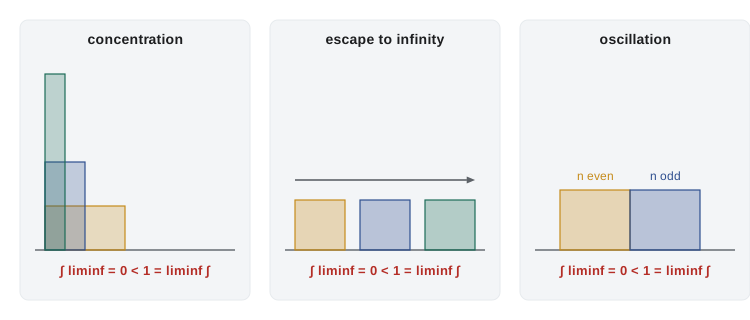
The inequality can be strict, and the examples from lesson 1 show how. For \(f_n = n\mathbf{1}_{(0, 1/n)}\) on \([0, 1]\), and for \(f_n = \mathbf{1}_{[n, n+1]}\) on \(\mathbb{R}\), the liminf is \(0\) everywhere, so the left side is \(0\), while every \(\int f_n = 1\). In both cases mass escapes, and Fatou's lemma says that this is the only thing that can go wrong: in the limit, mass can be lost but never created. A third example, \(f_n = \mathbf{1}_{[0, 1]}\) for even \(n\) and \(\mathbf{1}_{[1, 2]}\) for odd \(n\), has \(\liminf f_n = \mathbf{1}_{\{1\}}\), with integral \(0\), while every \(\int f_n = 1\): oscillation also loses mass.
The hypothesis \(f_n \ge 0\) matters. With \(f_n = -n\mathbf{1}_{(0, 1/n)}\), \(\liminf f_n = 0\) has integral \(0\), but \(\liminf \int f_n = -1\). More generally, the lemma holds whenever \(f_n \ge -g\) for some integrable \(g\), by applying it to \(f_n + g\).
The dominated convergence theorem
Theorem 7.4 (Lebesgue's dominated convergence theorem). Let \(f_n\) be measurable functions with \(f_n \to f\) almost everywhere. Suppose there is an integrable function \(g\) with \(|f_n| \le g\) almost everywhere, for every \(n\). Then \(f\) is integrable and \[\lim_{n \to \infty} \int |f_n - f| \, d\mu = 0, \qquad \text{in particular} \qquad \lim_{n \to \infty} \int f_n \, d\mu = \int f \, d\mu.\]
Proof. After discarding a null set we may assume convergence and domination hold everywhere. Then \(|f| \le g\), so \(f\) is integrable. The functions \(h_n = 2g - |f_n - f|\) are nonnegative, because \(|f_n - f| \le |f_n| + |f| \le 2g\), and \(h_n \to 2g\) pointwise. By Fatou's lemma, \[\int 2g = \int \liminf_n h_n \le \liminf_n \int h_n = \int 2g - \limsup_n \int |f_n - f|.\] Since \(\int 2g\) is finite, we may subtract it, obtaining \(\limsup_n \int |f_n - f| \le 0\). Hence \(\int |f_n - f| \to 0\), and \(\big|\int f_n - \int f\big| \le \int |f_n - f| \to 0\). \(\blacksquare\)
The conclusion \(\int |f_n - f| \to 0\) is stronger than convergence of the integrals: it says \(f_n \to f\) in the \(L^1\) distance studied in lesson 11. In the escaping-mass examples, any dominating function would have to lie above all the rectangles, and its integral would be infinite: for \(n\mathbf{1}_{(0, 1/n)}\) the smallest candidate, \(\sup_n f_n\), is about \(\frac{1}{x}\) near zero, which is not integrable on \((0, 1)\), and for \(\mathbf{1}_{[n, n+1]}\) it is \(\mathbf{1}_{[1, \infty)}\).
Corollary 7.5 (bounded convergence theorem). If \(\mu(X) < \infty\), \(|f_n| \le M\) for all \(n\), and \(f_n \to f\) almost everywhere, then \(\int f_n \to \int f\). Proof: the constant \(M\) is integrable on a finite measure space. \(\blacksquare\) On \([0, 1]\) with Lebesgue measure this resolves the example \(x^n\) from lesson 1 at once, and in probability it says that bounded random variables converging almost surely have converging expectations.
Series and the integral
Corollary 7.6. Let \(f_k\) be measurable functions with \(\sum_k \int |f_k| < \infty\). Then \(\sum_k f_k(x)\) converges absolutely for almost every \(x\), its sum is integrable, and \(\int \sum_k f_k = \sum_k \int f_k\).
Proof. By Corollary 6.9, \(G = \sum_k |f_k|\) has \(\int G = \sum_k \int |f_k| < \infty\), so \(G < \infty\) a.e. Where \(G\) is finite the series converges absolutely, and its partial sums are dominated by \(G\). Dominated convergence finishes the proof. \(\blacksquare\)
For example, \(\int_0^1 \frac{\ln x}{1 - x} \, dx\) can be found by expanding \(\frac{1}{1-x} = \sum_{k \ge 0} x^k\): since \(\int_0^1 |x^k \ln x| \, dx = \frac{1}{(k+1)^2}\) has finite sum, term-by-term integration is justified, giving \(-\sum_{k \ge 1} \frac{1}{k^2} = -\frac{\pi^2}{6}\).
Integrals depending on a parameter
Theorem 7.7. Let \(f : X \times (a, b) \to \mathbb{R}\) be such that \(f(\cdot, t)\) is integrable for each \(t\), and let \(F(t) = \int f(x, t) \, d\mu(x)\). (a) If \(t \mapsto f(x, t)\) is continuous for every \(x\) and \(|f(x, t)| \le g(x)\) with \(g\) integrable, then \(F\) is continuous. (b) If \(\frac{\partial f}{\partial t}\) exists everywhere and \(\big|\frac{\partial f}{\partial t}(x, t)\big| \le g(x)\) with \(g\) integrable, then \(F\) is differentiable and \(F^\prime(t) = \int \frac{\partial f}{\partial t}(x, t) \, d\mu(x)\).
Proof. (a) If \(t_n \to t\), then \(f(x, t_n) \to f(x, t)\) for every \(x\), dominated by \(g\), so \(F(t_n) \to F(t)\). (b) Fix \(t\) and \(h_n \to 0\). The difference quotients \(\frac{f(x, t + h_n) - f(x, t)}{h_n}\) converge to \(\frac{\partial f}{\partial t}(x, t)\), and by the mean value theorem each equals \(\frac{\partial f}{\partial t}(x, \tau)\) for some \(\tau\) between \(t\) and \(t + h_n\), so it is bounded by \(g(x)\). Dominated convergence gives \(\frac{F(t + h_n) - F(t)}{h_n} \to \int \frac{\partial f}{\partial t}(x, t) \, d\mu\). \(\blacksquare\)
Worked problem
A Gaussian integral by differentiation
Compute \(F(t) = \int_{\mathbb{R}} e^{-x^2} \cos(tx) \, dx\) given \(F(0) = \sqrt{\pi}\).
Show solution
- The integrand is dominated by \(e^{-x^2}\), and its \(t\)-derivative \(-x e^{-x^2} \sin(tx)\) is dominated by \(|x|e^{-x^2}\); both are integrable. By Theorem 7.7, \(F^\prime(t) = -\int x e^{-x^2} \sin(tx) \, dx\).
- Integrate by parts on \([-R, R]\), with \(u = \sin(tx)\) and \(dv = -xe^{-x^2} dx\), so \(v = \frac{1}{2}e^{-x^2}\), and let \(R \to \infty\) (the boundary terms vanish, and the limit of the integrals is justified by dominated convergence): \(F^\prime(t) = -\frac{t}{2} \int e^{-x^2} \cos(tx) \, dx = -\frac{t}{2}F(t)\).
- The solution of \(F^\prime = -\frac{t}{2}F\) with \(F(0) = \sqrt{\pi}\) is \(F(t) = \sqrt{\pi} e^{-t^2/4}\).
Answer: \(\int_{\mathbb{R}} e^{-x^2} \cos(tx) \, dx = \sqrt{\pi} \, e^{-t^2/4}\). Up to scaling, this says the Fourier transform of a Gaussian is a Gaussian.
# Dominated convergence holding and failing, and differentiation under the integral sign.
import math

def integrate(g, a, b, n=100000):
    h = (b - a) / n
    return h * sum(g(a + (i + 0.5) * h) for i in range(n))

print("dominated by 1 on [0, 1]:   integral of x^n ->",
      [round(integrate(lambda x, n=n: x ** n, 0, 1), 5) for n in (1, 10, 100, 1000)])
print("no integrable dominator:    integral of n 1_(0,1/n) ->",
      [round(integrate(lambda x, n=n: n if x < 1 / n else 0.0, 0, 1), 4) for n in (10, 100, 1000)])
print("dominated by 1/(1+x^2):     integral over [0, 60] of n sin(x/n)/(x (1 + x^2)) ->",
      [round(integrate(lambda x, n=n: n * math.sin(x / n) / (x * (1 + x * x)), 0, 60), 5) for n in (1, 10, 100)],
      " limit:", round(integrate(lambda x: 1 / (1 + x * x), 0, 60), 5))

F = lambda t: integrate(lambda x: math.exp(-x * x) * math.cos(t * x), -8, 8)
for t in (0.0, 1.0, 2.0):
print(f"t = {t}: F(t) = {F(t):.6f} sqrt(pi) exp(-t^2/4) = {math.sqrt(math.pi) * math.exp(-t * t / 4):.6f}")dominated by 1 on [0, 1]: integral of x^n -> [0.5, 0.09091, 0.0099, 0.001] no integrable dominator: integral of n 1_(0,1/n) -> [1.0, 1.0, 1.0] dominated by 1/(1+x^2): integral over [0, 60] of n sin(x/n)/(x (1 + x^2)) -> [0.99294, 1.4945, 1.55316] limit: 1.55413 t = 0.0: F(t) = 1.772454 sqrt(pi) exp(-t^2/4) = 1.772454 t = 1.0: F(t) = 1.380388 sqrt(pi) exp(-t^2/4) = 1.380388 t = 2.0: F(t) = 0.652049 sqrt(pi) exp(-t^2/4) = 0.652049
The middle example shows the theorem applied to an integrand that is not monotone in \(n\). Since \(|\sin u| \le |u|\), we have \(\big|\frac{n \sin(x/n)}{x(1 + x^2)}\big| \le \frac{1}{1 + x^2}\), which is integrable on \([0, \infty)\), and pointwise \(n\sin(\frac{x}{n}) \to x\). Dominated convergence gives the limit \(\int_0^\infty \frac{dx}{1 + x^2} = \frac{\pi}{2}\); the code truncates at 60, losing about \(\frac{1}{60}\).
Absolute continuity of the integral
Proposition 7.8. If \(f \in L^1(\mu)\), then for every \(\varepsilon > 0\) there is \(\delta > 0\) such that \(\int_E |f| \, d\mu < \varepsilon\) whenever \(\mu(E) < \delta\).
Proof. Let \(f_n = \min(|f|, n)\). By monotone convergence \(\int (|f| - f_n) \to 0\), so choose \(n\) with \(\int (|f| - f_n) < \frac{\varepsilon}{2}\), and let \(\delta = \frac{\varepsilon}{2n}\). If \(\mu(E) < \delta\), then \(\int_E |f| \le \int (|f| - f_n) + \int_E f_n < \frac{\varepsilon}{2} + n\delta = \varepsilon\). \(\blacksquare\) This uniform smallness of the integral over small sets is the property that, for \(f\) on an interval, makes the indefinite integral \(\int_a^x f\) an absolutely continuous function, the key notion in the capstone lesson.
Vitali's convergence theorem, which we state without proof, replaces domination by a condition of this kind applied uniformly to the whole sequence. On a finite measure space, if \(f_n \to f\) a.e. and the family \(\{f_n\}\) is uniformly integrable, meaning that \(\sup_n \int_{\{|f_n| > M\}} |f_n| \to 0\) as \(M \to \infty\), then \(\int |f_n - f| \to 0\). Uniform integrability is necessary as well as sufficient, and it is the natural condition in probability, for example in the theory of martingales.
Common mistakes
MistakeCalling a function with a convergent improper Riemann integral Lebesgue integrable.
InsteadLebesgue integrability requires \(\int |f| < \infty\); \(\frac{\sin x}{x}\) on \([1, \infty)\) fails it.
MistakeUsing a dominating function that depends on n.
InsteadA single integrable \(g\) must satisfy \(|f_n| \le g\) for every n.
MistakeApplying Fatou’s lemma to functions of both signs.
InsteadIt needs \(f_n \ge 0\), or at least \(f_n \ge -g\) with \(g\) integrable.
MistakeDifferentiating under the integral sign without a bound on the derivative.
InsteadTheorem 7.7 needs \(|\partial_t f| \le g\) integrable, uniformly in t near the point.
Summary and key terms
- \(f\) is integrable if \(\int |f| < \infty\); then \(\int f = \int f^+ - \int f^-\), and the integral is linear with \(|\int f| \le \int |f|\).
- Fatou: \(\int \liminf f_n \le \liminf \int f_n\) for \(f_n \ge 0\); mass can be lost in the limit but not created.
- Dominated convergence: if \(f_n \to f\) a.e. and \(|f_n| \le g \in L^1\), then \(\int |f_n - f| \to 0\).
- On a finite measure space, uniformly bounded a.e. convergent sequences have convergent integrals.
- If \(\sum \int |f_k| < \infty\), series can be integrated term by term.
- Continuity and differentiation under the integral sign follow from dominated convergence with a bound independent of the parameter.
- Integrable function
- A measurable function with \(\int |f| \, d\mu < \infty\).
- \(L^1(\mu)\)
- The vector space of integrable functions.
- Fatou’s lemma
- \(\int \liminf f_n \le \liminf \int f_n\) for nonnegative measurable \(f_n\).
- Dominating function
- An integrable \(g\) with \(|f_n| \le g\) for all n.
- Uniform integrability
- Uniform smallness of the integrals of a family over the sets where the functions are large.
Practice problems
Work each problem on paper first, then reveal the answer to check.
Find \(\lim_{n \to \infty} \int_0^\infty \frac{n}{1 + n^2x^2} e^{-x} \, dx\) and compare it with the integral of the pointwise limit.
Show answer
Substituting \(u = nx\) gives \(\int_0^\infty \frac{e^{-u/n}}{1 + u^2} \, du \to \frac{\pi}{2}\), by dominated convergence in \(u\) with bound \(\frac{1}{1 + u^2}\). The pointwise limit in \(x\) is 0 for \(x > 0\), so its integral is 0: the mass concentrates at the origin and no integrable bound exists in \(x\).
Find \(\lim_n \int_0^1 \frac{nx}{1 + n^2x^2} \, dx\).
Show answer
The integrand tends to 0 and is bounded by \(\frac{1}{2}\) (since \(2nx \le 1 + n^2x^2\)), so bounded convergence gives limit 0.
Show \(\int_0^\infty \frac{x}{e^x - 1} \, dx = \frac{\pi^2}{6}\).
Show answer
Expand \(\frac{x}{e^x - 1} = \sum_{k \ge 1} x e^{-kx}\), nonnegative terms with \(\int_0^\infty xe^{-kx} dx = \frac{1}{k^2}\); integrate term by term.
Give a sequence with \(f_n \to 0\) everywhere, \(\int f_n \to 0\), but no integrable dominating function.
Show answer
\(f_n = \frac{n}{\ln n} \mathbf{1}_{(0, 1/n)}\) for \(n \ge 2\): \(\int f_n = \frac{1}{\ln n} \to 0\), while \(\sup_n f_n\) is about \(\frac{1}{x |\ln x|}\) near 0, not integrable.
Use Theorem 7.7 to compute \(\int_0^\infty x^2 e^{-tx} \, dx\) for \(t > 0\).
Show answer
Differentiate \(\int_0^\infty e^{-tx} dx = \frac{1}{t}\) twice in \(t\), justified on \(t > t_0 > 0\) by the bound \(x^2 e^{-t_0 x}\): the result is \(\frac{2}{t^3}\).
Lesson quiz · 5 questions
Score 60% or more to complete this lesson.
Create a free account to save your progress, take quizzes and earn a certificate.