
MATH-441 · Lesson 3 of 12 · 24 min
Outer measure and Carathéodory’s construction of Lebesgue measure
We now construct Lebesgue measure. The strategy, due in its final form to Constantin Carathéodory in 1914 and expounded in his 1918 book on real functions, has two stages. First we define an outer measure on every subset of the line by covering the set with intervals and taking the smallest possible total length. This outer measure is defined everywhere, but it is only countably subadditive, not additive. Second, we select the sets on which it behaves additively, using a splitting test that is easy to state and surprisingly powerful. These sets form a σ-algebra containing all Borel sets, and on them the outer measure is a genuine measure. The same two-stage construction later produces product measures, Hausdorff measures and probability measures on infinite product spaces.
Lebesgue outer measure
Definition 3.1. For \(A \subseteq \mathbb{R}\), the Lebesgue outer measure is \[m^*(A) = \inf\Big\{ \sum_{k=1}^{\infty} \ell(I_k) : A \subseteq \bigcup_{k=1}^{\infty} I_k, \ I_k \text{ open intervals} \Big\},\] where \(\ell(I)\) is the length of the interval \(I\). The infimum is over all countable covers of \(A\) by open intervals, and it may be \(\infty\).
The covers are countable, not finite, and this is essential. With finite covers we would obtain the outer Jordan content, under which the rationals in \([0, 1]\) have content \(1\), since any finite union of intervals covering them covers all of \([0, 1]\) apart from finitely many points. With countable covers the rationals have outer measure zero, as lesson 1 showed. Using open intervals is a convenience; closed or half-open intervals give the same value, because each can be enlarged slightly to an open interval at a cost of \(\frac{\varepsilon}{2^k}\).
Theorem 3.2. Outer measure has the following properties. (a) \(m^*(\varnothing) = 0\). (b) Monotonicity: \(A \subseteq B\) implies \(m^*(A) \le m^*(B)\). (c) Countable subadditivity: \(m^*\big(\bigcup_k A_k\big) \le \sum_k m^*(A_k)\) for all subsets \(A_k\). (d) Translation invariance: \(m^*(A + t) = m^*(A)\).
Proof. (a) and (b) are immediate, since any cover of \(B\) is a cover of \(A\), and \(\varnothing\) is covered by a single interval of length \(\varepsilon\). For (d), translating a cover of \(A\) gives a cover of \(A + t\) of the same total length, and conversely. For (c), we may assume every \(m^*(A_k)\) is finite. Fix \(\varepsilon > 0\) and choose for each \(k\) a cover \(\{I_{k,j}\}_j\) of \(A_k\) with \(\sum_j \ell(I_{k,j}) < m^*(A_k) + \frac{\varepsilon}{2^k}\). The countable family \(\{I_{k,j}\}_{k,j}\) covers \(\bigcup_k A_k\), so \[m^*\Big(\bigcup_k A_k\Big) \le \sum_{k,j} \ell(I_{k,j}) < \sum_k m^*(A_k) + \varepsilon.\] Since \(\varepsilon\) was arbitrary, (c) follows. \(\blacksquare\)
Any function on all subsets of a set with properties (a) to (c) is called an outer measure. The construction below works for every outer measure, not just Lebesgue's.
The outer measure of an interval
Theorem 3.3. For any interval \(I\) with endpoints \(a \le b\), \(m^*(I) = b - a\).
Proof. First let \(I = [a, b]\). The single open interval \((a - \varepsilon, b + \varepsilon)\) covers it, so \(m^*([a, b]) \le b - a + 2\varepsilon\) for every \(\varepsilon\), giving \(m^*([a, b]) \le b - a\). For the reverse inequality, let \(\{I_k\}\) be any countable cover of \([a, b]\) by open intervals. By the Heine–Borel theorem, finitely many of them, say \(J_1, \ldots, J_n\), already cover \([a, b]\). We show by induction on \(n\) that any finite cover of \([a, b]\) by open intervals has total length greater than \(b - a\). If \(n = 1\) the single interval contains \([a, b]\), so its length exceeds \(b - a\). For \(n > 1\), choose \(J_1 = (c, d)\) containing \(a\), so \(c < a < d\). If \(d > b\), then \(\ell(J_1) > b - a\) and we are done. Otherwise the remaining \(n - 1\) intervals cover \([d, b]\), and by induction their total length exceeds \(b - d\). Hence the total exceeds \((d - c) + (b - d) = b - c > b - a\). Thus every countable cover has total length at least \(b - a\), and \(m^*([a, b]) = b - a\).
For a bounded interval \(I\) with endpoints \(a < b\), the inclusions \([a + \varepsilon, b - \varepsilon] \subseteq I \subseteq [a, b]\) and monotonicity give \(b - a - 2\varepsilon \le m^*(I) \le b - a\). For an unbounded interval, \(I\) contains closed intervals of every length, so \(m^*(I) = \infty\). \(\blacksquare\)
This theorem is less trivial than it looks: it is where the completeness of the real numbers enters, through Heine–Borel. Over the rationals alone the analogous statement fails, since the rationals in \([0, 1]\) can be covered by intervals of total length as small as we like.
Carathéodory's criterion
Outer measure is not additive on all sets. By Vitali's theorem in lesson 4, there are disjoint sets \(A, B\) with \(m^*(A \cup B) < m^*(A) + m^*(B)\). Carathéodory's idea is to call a set measurable if it splits every other set additively.
Definition 3.4. A set \(E \subseteq \mathbb{R}\) is Lebesgue measurable if for every set \(A \subseteq \mathbb{R}\), \[m^*(A) = m^*(A \cap E) + m^*(A \cap E^c).\] The set \(A\) is called a test set. By subadditivity the inequality \(\le\) always holds, so to prove \(E\) measurable it suffices to show \(m^*(A) \ge m^*(A \cap E) + m^*(A \cap E^c)\) for every \(A\) with \(m^*(A) < \infty\).
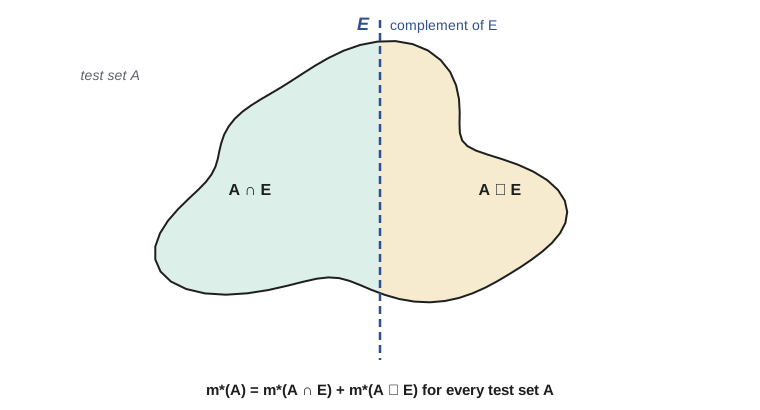
The criterion can seem mysterious at first, since it quantifies over all sets, including non-measurable ones. A useful reading is that a measurable set has a clean edge: wherever you look, through any test set, the outer measure inside \(E\) and outside \(E\) add up correctly, with no overlap of covers wasted across the boundary. Sets of outer measure zero are measurable at once, since for them \(m^*(A \cap E) \le m^*(E) = 0\) and \(m^*(A \cap E^c) \le m^*(A)\). In particular every subset of a null set is measurable, so Lebesgue measure is complete.
Theorem 3.5 (Carathéodory). Let \(m^*\) be an outer measure on a set \(X\) and let \(\mathcal{M}\) be the collection of sets satisfying the criterion. Then \(\mathcal{M}\) is a σ-algebra, and the restriction of \(m^*\) to \(\mathcal{M}\) is a complete measure.
Proof. The criterion is symmetric in \(E\) and \(E^c\), so \(\mathcal{M}\) is closed under complements, and it contains \(X\) since \(m^*(A \cap \varnothing) = 0\).
Step 1: finite unions. Let \(E, F \in \mathcal{M}\) and let \(A\) be any test set. Apply the criterion for \(E\) to \(A\), and then the criterion for \(F\) to the test set \(A \cap E^c\): \[m^*(A) = m^*(A \cap E) + m^*(A \cap E^c \cap F) + m^*(A \cap E^c \cap F^c).\] The first two sets on the right have union \(A \cap (E \cup F)\), so by subadditivity their outer measures sum to at least \(m^*(A \cap (E \cup F))\). The third set is \(A \cap (E \cup F)^c\). Hence \(m^*(A) \ge m^*(A \cap (E \cup F)) + m^*(A \cap (E \cup F)^c)\), and \(E \cup F \in \mathcal{M}\). So \(\mathcal{M}\) is an algebra.
Step 2: additivity inside a test set. Let \(E_1, \ldots, E_n \in \mathcal{M}\) be disjoint and \(B_n = E_1 \cup \cdots \cup E_n\). For any \(A\), \[m^*(A \cap B_n) = \sum_{k=1}^{n} m^*(A \cap E_k).\] For \(n = 1\) this is trivial. Assuming it for \(n - 1\), apply the criterion for \(E_n\) to the test set \(A \cap B_n\): since the sets are disjoint, \(A \cap B_n \cap E_n = A \cap E_n\) and \(A \cap B_n \cap E_n^c = A \cap B_{n-1}\), giving \(m^*(A \cap B_n) = m^*(A \cap E_n) + m^*(A \cap B_{n-1})\), and induction finishes.
Step 3: countable unions. Let \(E_1, E_2, \ldots \in \mathcal{M}\). Disjointifying as in lesson 2 uses only finite operations, which stay in the algebra \(\mathcal{M}\), so we may assume the \(E_k\) disjoint. Let \(E = \bigcup_k E_k\) and \(B_n\) as above. Since \(B_n \in \mathcal{M}\) and \(E^c \subseteq B_n^c\), \[m^*(A) = m^*(A \cap B_n) + m^*(A \cap B_n^c) \ge \sum_{k=1}^{n} m^*(A \cap E_k) + m^*(A \cap E^c).\] Let \(n \to \infty\) and use countable subadditivity: \[m^*(A) \ge \sum_{k=1}^{\infty} m^*(A \cap E_k) + m^*(A \cap E^c) \ge m^*(A \cap E) + m^*(A \cap E^c).\] So \(E \in \mathcal{M}\), and \(\mathcal{M}\) is a σ-algebra.
Step 4: countable additivity. In the last display all the inequalities must be equalities, because the right end is at least \(m^*(A)\) by subadditivity. Taking \(A = E\) gives \(m^*(E) = \sum_k m^*(E_k)\). Completeness was shown above. \(\blacksquare\)
The restriction \(m = m^*|_{\mathcal{M}}\) is Lebesgue measure. It remains to see that \(\mathcal{M}\) is large.
Borel sets are measurable
Theorem 3.6. Every Borel set is Lebesgue measurable, and \(m(I) = \ell(I)\) for every interval.
Proof. Since \(\mathcal{M}\) is a σ-algebra and the half-lines \((a, \infty)\) generate the Borel sets, it suffices to show each \((a, \infty)\) is measurable. Let \(A\) be a test set with \(m^*(A) < \infty\), let \(A_1 = A \cap (a, \infty)\) and \(A_2 = A \cap (-\infty, a]\), and fix \(\varepsilon > 0\). Choose a cover of \(A\) by open intervals \(I_k\) with \(\sum \ell(I_k) < m^*(A) + \varepsilon\). The sets \(I_k' = I_k \cap (a, \infty)\) and \(I_k'' = I_k \cap (-\infty, a]\) are intervals, with \(\ell(I_k) = \ell(I_k') + \ell(I_k'')\), and they cover \(A_1\) and \(A_2\). By Theorem 3.3 and subadditivity (outer measure of an interval is its length, whatever its type), \[m^*(A_1) + m^*(A_2) \le \sum_k \ell(I_k') + \sum_k \ell(I_k'') = \sum_k \ell(I_k) < m^*(A) + \varepsilon.\] Thus \((a, \infty)\) satisfies the criterion. The value on intervals is Theorem 3.3. \(\blacksquare\)
Worked problem
Measure of a countable union and a difference
Find the Lebesgue measure of \(E = \bigcup_{k=1}^{\infty} \big(k, k + 2^{-k}\big)\) and of \([0, 1] \setminus \mathbb{Q}\).
Show solution
- The intervals \((k, k + 2^{-k})\) are pairwise disjoint and Borel, hence measurable, with lengths \(2^{-k}\).
- By countable additivity, \(m(E) = \sum_{k=1}^{\infty} 2^{-k} = 1\), although \(E\) is unbounded.
- The set \(\mathbb{Q} \cap [0, 1]\) is countable, so it is a Borel null set, and its complement in \([0, 1]\) is measurable.
- Additivity gives \(m([0, 1] \setminus \mathbb{Q}) = m([0, 1]) - m(\mathbb{Q} \cap [0, 1]) = 1 - 0 = 1\).
Answer: \(m(E) = 1\) and \(m([0, 1] \setminus \mathbb{Q}) = 1\). Unbounded sets can have finite measure, and removing a null set does not change measure.
Regularity
Lebesgue measurable sets can be very complicated, but they are always close to simple ones. Theorem 3.7 (regularity). For \(E \subseteq \mathbb{R}\) the following are equivalent: (i) \(E\) is Lebesgue measurable; (ii) for every \(\varepsilon > 0\) there is an open set \(U \supseteq E\) with \(m^*(U \setminus E) < \varepsilon\); (iii) for every \(\varepsilon > 0\) there is a closed set \(F \subseteq E\) with \(m^*(E \setminus F) < \varepsilon\); (iv) \(E = G \setminus N\) for a \(G_\delta\) set \(G\) and a null set \(N\).
Proof sketch of (i) implies (ii). If \(m(E) < \infty\), choose a cover by open intervals with total length less than \(m(E) + \varepsilon\) and let \(U\) be their union; then \(m(U \setminus E) = m(U) - m(E) < \varepsilon\). In general apply this to \(E \cap [-n, n]\) with tolerance \(\varepsilon 2^{-n}\) and take the union. Applying (ii) to \(E^c\) and taking complements gives (iii). For (iv), take \(U_n\) from (ii) with \(\varepsilon = \frac{1}{n}\) and \(G = \bigcap U_n\); then \(G \setminus E\) has outer measure zero. Conversely, (ii) implies (iv) the same way, and (iv) implies (i) because \(G_\delta\) sets and null sets are measurable. \(\blacksquare\)
Condition (iv) shows that every Lebesgue measurable set is a Borel set up to a null set: the Lebesgue σ-algebra is the completion of the Borel σ-algebra. John Littlewood summarized regularity and its relatives in three principles: every measurable set is nearly a finite union of intervals, every measurable function is nearly continuous, and every convergent sequence of measurable functions is nearly uniformly convergent. The first is Theorem 3.7 combined with the fact that an open set of finite measure is a countable union of intervals, of which finitely many carry all but \(\varepsilon\) of its measure. The other two are Lusin's theorem and Egorov's theorem, met in lessons 5 and 9.
# Outer measure of a finite union of intervals: merge overlaps, then add lengths.
from fractions import Fraction as F

def merge(intervals):
    out = []
    for a, b in sorted(intervals):
        if out and a <= out[-1][1]:
            out[-1][1] = max(out[-1][1], b)
        else:
            out.append([a, b])
    return out

def length(intervals):
    return sum(b - a for a, b in merge(intervals))

E = [(F(0), F(1, 2)), (F(1, 3), F(2, 3)), (F(3, 4), F(1))]
print("merged E:", [(str(a), str(b)) for a, b in merge(E)], " m(E) =", length(E))

# Caratheodory splitting of test sets by the half-line (1/2, infinity)
cut = F(1, 2)
def split(A):
    inside = [(max(a, cut), b) for a, b in A if b > cut]
    outside = [(a, min(b, cut)) for a, b in A if a < cut]
    return length(inside), length(outside)

for A in ([(F(0), F(1))], E, [(F(-1), F(1, 4)), (F(3, 8), F(5, 8))]):
    i, o = split(A)
    print(f"m(A) = {length(A)}  =  {i} + {o}  ->", length(A) == i + o)

# rationals: cover the k-th rational by an interval of length eps / 2^k
eps = F(1, 1000)
print("total length of a cover of all rationals:", "at most", sum(eps / 2 ** k for k in range(1, 60)) + eps / 2 ** 59)merged E: [('0', '2/3'), ('3/4', '1')] m(E) = 11/12
m(A) = 1 = 1/2 + 1/2 -> True
m(A) = 11/12 = 5/12 + 1/2 -> True
m(A) = 3/2 = 1/8 + 11/8 -> True
total length of a cover of all rationals: at most 1/1000The code illustrates two facts in the proof. Overlapping covers waste length, so the infimum in the definition favors covers that overlap as little as possible. And intervals split additively at any point, which is exactly the computation in Theorem 3.6. What the code cannot do is test the criterion against every subset of the line; the proof does that by approximating an arbitrary test set from outside by covers.
Beyond the line
The construction works verbatim in \(\mathbb{R}^n\), with boxes \(I_1 \times \cdots \times I_n\) in place of intervals and volume in place of length, producing Lebesgue measure \(m_n\). It also works for any nondecreasing right-continuous function \(F\) on \(\mathbb{R}\): using \(\ell_F((a, b]) = F(b) - F(a)\) in place of length gives the Lebesgue–Stieltjes measure \(\mu_F\), with \(\mu_F((a, b]) = F(b) - F(a)\). Every probability distribution on the line arises this way from its distribution function, so the construction of this lesson also proves that every distribution function determines a measure. In the most general form, a countably additive premeasure on an algebra of sets always extends to a measure on the generated σ-algebra; this is the Carathéodory extension theorem, and with the uniqueness result of lesson 2, the extension is unique when the premeasure is σ-finite.
Common mistakes
MistakeUsing finite covers in the definition of outer measure.
InsteadFinite covers give Jordan content, under which the rationals in [0, 1] have content 1, not 0.
MistakeThinking outer measure is additive on all disjoint sets.
InsteadIt is only countably subadditive; additivity holds on the measurable sets selected by the criterion.
MistakeBelieving the criterion must be checked only for measurable test sets.
InsteadIt quantifies over all test sets; that is what makes the measurable sets a σ-algebra.
MistakeAssuming m*([a, b]) = b − a is obvious.
InsteadThe lower bound needs the Heine–Borel theorem, that is, the completeness of the real line.
Summary and key terms
- Lebesgue outer measure \(m^*(A)\) is the infimum of total length over countable covers of \(A\) by open intervals.
- Outer measure is monotone, countably subadditive and translation invariant, and gives every interval its length.
- A set \(E\) is measurable if \(m^*(A) = m^*(A \cap E) + m^*(A \cap E^c)\) for every test set \(A\).
- Carathéodory: the measurable sets form a σ-algebra on which outer measure is a complete measure.
- Half-lines satisfy the criterion, so every Borel set is Lebesgue measurable.
- Every measurable set is squeezed between a closed and an open set up to ε, and equals a G-delta set minus a null set.
- Outer measure
- A monotone, countably subadditive set function on all subsets with value zero on the empty set.
- Carathéodory criterion
- The requirement that a set split every test set additively.
- Lebesgue measure
- The restriction of Lebesgue outer measure to the measurable sets.
- Regularity
- Approximation of measurable sets from outside by open sets and from inside by closed sets.
- Lebesgue–Stieltjes measure
- The measure with \(\mu_F((a, b]) = F(b) - F(a)\) for a nondecreasing right-continuous \(F\).
Practice problems
Work each problem on paper first, then reveal the answer to check.
Show that \(m^*(A) = 0\) for every countable set \(A\), using only the definition.
Show answer
Cover the \(k\)th point by an open interval of length \(\varepsilon 2^{-k}\); the total is \(\varepsilon\).
Prove that if \(m^*(A) = 0\) then \(m^*(A \cup B) = m^*(B)\) for every \(B\).
Show answer
Monotonicity gives \(\ge\); subadditivity gives \(m^*(A \cup B) \le 0 + m^*(B)\).
Show that a set \(E\) is measurable if and only if \(E + t\) is measurable, and that \(m(E + t) = m(E)\).
Show answer
Translation by \(-t\) gives \(m^*(A \cap (E + t)) = m^*((A - t) \cap E)\) and \(m^*(A \cap (E + t)^c) = m^*((A - t) \cap E^c)\), so the criterion for \(E\) with test set \(A - t\) is the criterion for \(E + t\) with test set \(A\); invariance of \(m^*\) gives the equality of measures.
Find \(m\big(\bigcup_{n=1}^{\infty} [n, n + \frac{1}{n^2}]\big)\).
Show answer
The intervals are disjoint (since \(\frac{1}{n^2} < 1\)), so the measure is \(\sum \frac{1}{n^2} = \frac{\pi^2}{6}\).
If \(E\) is measurable with \(m(E) < \infty\), show there is a finite union of intervals \(V\) with \(m(E \,\triangle\, V) < \varepsilon\).
Show answer
Take open \(U \supseteq E\) with \(m(U \setminus E) < \frac{\varepsilon}{2}\), write \(U\) as a disjoint union of open intervals, and keep finitely many carrying all but \(\frac{\varepsilon}{2}\) of \(m(U)\).
Lesson quiz · 5 questions
Score 60% or more to complete this lesson.
Create a free account to save your progress, take quizzes and earn a certificate.