
MATH-441 · Lesson 11 of 12 · 23 min
Lᵖ spaces: Hölder, Minkowski and completeness
▶ Video coming soon A video version of this lesson is on the way.
The integral of \(|f - g|\) measures how far apart two functions are on average, and lesson 1 promised that, with the Lebesgue integral, this distance makes the space of integrable functions complete. This lesson delivers on that promise for a whole family of spaces. For \(1 \le p < \infty\), the space \(L^p\) consists of functions whose \(p\)th power is integrable, with norm \(\|f\|_p = \big(\int |f|^p\big)^{1/p}\); for \(p = \infty\) it consists of essentially bounded functions. We prove the inequalities of Hölder and Minkowski, which make \(\|\cdot\|_p\) a norm, and the Riesz–Fischer theorem, which says every \(L^p\) is complete. The case \(p = 2\) is a Hilbert space, the setting of Fourier analysis and quantum mechanics, and the \(L^p\) spaces are the basic objects of functional analysis in MATH-445. Throughout, \((X, \mathcal{A}, \mu)\) is a measure space.
Definitions
Definition 11.1. For \(1 \le p < \infty\) and measurable \(f\), let \[\|f\|_p = \Big( \int_X |f|^p \, d\mu \Big)^{1/p}.\] For \(p = \infty\), let \(\|f\|_\infty = \inf\{M \ge 0 : |f| \le M \text{ almost everywhere}\}\), the essential supremum of \(|f|\). The space \(L^p(\mu)\) is the set of measurable \(f\) with \(\|f\|_p < \infty\), where functions equal almost everywhere are identified.
The identification is needed because \(\|f\|_p = 0\) whenever \(f = 0\) a.e., by Corollary 6.6, and a norm must vanish only at zero. Strictly, an element of \(L^p\) is an equivalence class of functions; in practice we speak of functions and remember that values on null sets carry no meaning. In particular, it makes no sense to evaluate an element of \(L^p\) at a single point. The infimum in the definition of \(\|f\|_\infty\) is attained: \(|f| \le \|f\|_\infty\) a.e., because \(\{|f| > \|f\|_\infty\} = \bigcup_n \{|f| > \|f\|_\infty + \frac{1}{n}\}\) is a countable union of null sets.
Examples. With counting measure on \(\mathbb{N}\), \(L^p\) is the sequence space \(\ell^p\) of sequences with \(\sum |a_n|^p < \infty\), and \(\ell^\infty\) is the space of bounded sequences. On \((0, 1)\), \(x^{-a} \in L^p\) exactly when \(ap < 1\), since \(\int_0^1 x^{-ap} \, dx\) is finite exactly then. On \((1, \infty)\), \(x^{-a} \in L^p\) exactly when \(ap > 1\). So on \((0, 1)\), the singular function \(x^{-1/2}\) is in \(L^1\) but not \(L^2\), while on \((1, \infty)\) the slowly decaying function \(x^{-1}\) is in \(L^2\) but not \(L^1\). Neither of \(L^1(\mathbb{R})\) and \(L^2(\mathbb{R})\) contains the other: local singularities favor small \(p\), slow decay at infinity favors large \(p\).
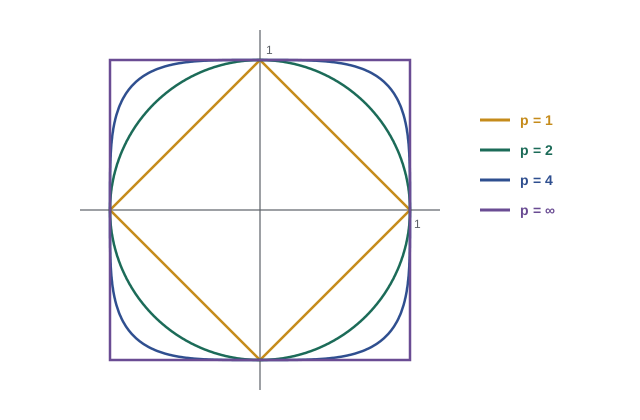
Young's and Hölder's inequalities
Two exponents \(p, q \in [1, \infty]\) are conjugate if \(\frac{1}{p} + \frac{1}{q} = 1\), with \(1\) and \(\infty\) conjugate to each other. For example, \(2\) is conjugate to itself and \(3\) to \(\frac{3}{2}\).
Lemma 11.2 (Young's inequality). For \(a, b \ge 0\) and conjugate \(1 < p, q < \infty\), \[ab \le \frac{a^p}{p} + \frac{b^q}{q},\] with equality exactly when \(a^p = b^q\). Proof: if \(a\) or \(b\) is zero the claim is trivial. Otherwise, since the logarithm is concave, \[\ln\Big(\frac{a^p}{p} + \frac{b^q}{q}\Big) \ge \frac{1}{p}\ln a^p + \frac{1}{q}\ln b^q = \ln(ab),\] with equality exactly when \(a^p = b^q\), by strict concavity. \(\blacksquare\)
Theorem 11.3 (Hölder's inequality). For conjugate \(p, q \in [1, \infty]\) and measurable \(f, g\), \[\int |fg| \, d\mu \le \|f\|_p \, \|g\|_q.\] In particular \(fg \in L^1\) when \(f \in L^p\) and \(g \in L^q\).
Proof. For \(p = 1\), \(q = \infty\): \(|fg| \le |f| \, \|g\|_\infty\) a.e., and integrate. Now let \(1 < p < \infty\). If \(\|f\|_p = 0\) then \(f = 0\) a.e. and both sides vanish; if either norm is infinite there is nothing to prove. Otherwise set \(F = \frac{|f|}{\|f\|_p}\) and \(G = \frac{|g|}{\|g\|_q}\), so \(\int F^p = \int G^q = 1\). By Young's inequality at each point, \[\int FG \le \frac{1}{p}\int F^p + \frac{1}{q}\int G^q = \frac{1}{p} + \frac{1}{q} = 1.\] Multiplying by \(\|f\|_p\|g\|_q\) gives the result. \(\blacksquare\)
Equality holds, for \(1 < p < \infty\), exactly when \(|f|^p\) and \(|g|^q\) are proportional almost everywhere. With \(p = q = 2\), Hölder's inequality is the Cauchy–Schwarz inequality \(\big|\int fg\big| \le \|f\|_2\|g\|_2\). Otto Hölder published the inequality in 1889, building on an 1888 version for sums by Leonard James Rogers.
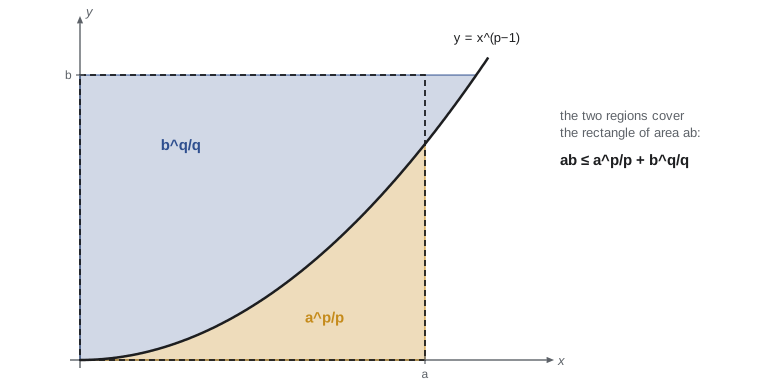
The figure gives a second proof of Young's inequality. The inverse of \(y = x^{p-1}\) is \(x = y^{q-1}\), because \((p - 1)(q - 1) = 1\) for conjugate exponents. The area under the curve from \(0\) to \(a\) is \(\frac{a^p}{p}\), the area to the left of it from \(0\) to \(b\) is \(\frac{b^q}{q}\), and together they cover the rectangle \([0, a] \times [0, b]\), with equality when the corner \((a, b)\) lies on the curve.
Minkowski's inequality
Theorem 11.4 (Minkowski's inequality). For \(1 \le p \le \infty\), \(\|f + g\|_p \le \|f\|_p + \|g\|_p\).
Proof. The cases \(p = 1\) and \(p = \infty\) follow from \(|f + g| \le |f| + |g|\). Let \(1 < p < \infty\) and assume the right side finite. Then \(f + g \in L^p\), because \(|f + g|^p \le (2\max(|f|, |g|))^p \le 2^p(|f|^p + |g|^p)\). Write \[|f + g|^p \le |f| \, |f + g|^{p-1} + |g| \, |f + g|^{p-1}.\] With \(q = \frac{p}{p-1}\), we have \(\big\| |f + g|^{p-1} \big\|_q = \big(\int |f + g|^p\big)^{1/q} = \|f + g\|_p^{p-1}\). Hölder's inequality applied to each term gives \[\|f + g\|_p^p \le \big(\|f\|_p + \|g\|_p\big) \|f + g\|_p^{p-1}.\] If \(\|f + g\|_p = 0\) the claim is trivial; otherwise divide by \(\|f + g\|_p^{p-1}\). \(\blacksquare\)
Minkowski's inequality is the triangle inequality for \(\|\cdot\|_p\). Together with \(\|cf\|_p = |c|\|f\|_p\) and \(\|f\|_p = 0\) only for \(f = 0\) a.e., it makes \(L^p\) a normed vector space. For \(0 < p < 1\) the triangle inequality fails: on \([0, 1]\) with \(f = \mathbf{1}_{[0, 1/2]}\) and \(g = \mathbf{1}_{(1/2, 1]}\), \(\|f + g\|_p = 1\) while \(\|f\|_p + \|g\|_p = 2 \cdot 2^{-1/p} < 1\). That is why the theory starts at \(p = 1\).
The Riesz–Fischer theorem
Theorem 11.5 (Riesz–Fischer, 1907). For \(1 \le p \le \infty\), \(L^p(\mu)\) is complete: every Cauchy sequence converges in \(L^p\). Moreover, every sequence converging in \(L^p\) has a subsequence converging almost everywhere.
Proof for \(1 \le p < \infty\). We use a criterion from MATH-341: a normed space is complete if every absolutely convergent series converges. Let \(\sum_k \|f_k\|_p = B < \infty\), and set \(G_n = \sum_{k=1}^{n} |f_k|\) and \(G = \sum_{k=1}^{\infty} |f_k|\). By Minkowski, \(\|G_n\|_p \le B\). Since \(G_n^p \uparrow G^p\), monotone convergence gives \(\int G^p \le B^p\), so \(G \in L^p\) and \(G < \infty\) almost everywhere. Hence \(\sum_k f_k(x)\) converges absolutely for almost every \(x\); call its sum \(F(x)\), and set \(F = 0\) on the null set where it diverges. Then \(|F - \sum_{k \le n} f_k|^p \le (2G)^p\), which is integrable, and the integrand tends to zero a.e., so by dominated convergence \(\|F - \sum_{k \le n} f_k\|_p \to 0\). The series converges in \(L^p\).
For the subsequence statement, let \(f_n\) be Cauchy in \(L^p\) and choose \(n_1 < n_2 < \cdots\) with \(\|f_{n_{k+1}} - f_{n_k}\|_p < 2^{-k}\). The telescoping series \(f_{n_1} + \sum_k (f_{n_{k+1}} - f_{n_k})\) is absolutely convergent, so by the argument above its partial sums \(f_{n_k}\) converge both almost everywhere and in \(L^p\) to some \(F\). A Cauchy sequence with a convergent subsequence converges to the same limit, so \(f_n \to F\) in \(L^p\).
Proof for \(p = \infty\). If \(f_n\) is Cauchy in \(L^\infty\), the sets \(\{|f_n - f_m| > \|f_n - f_m\|_\infty\}\) are null, and so is their countable union \(N\). Off \(N\) the sequence is uniformly Cauchy, hence uniformly convergent to a bounded function \(F\), and \(\|f_n - F\|_\infty \to 0\). \(\blacksquare\)
Frigyes Riesz and Ernst Fischer proved the theorem independently in 1907 for \(L^2\), in the form that a square-summable sequence of Fourier coefficients belongs to a square-integrable function. It was the first clear demonstration of the power of Lebesgue's integral. In MATH-341 we saw that the continuous functions on \([0, 1]\) with the \(L^1\) distance are not complete; Theorem 11.5 says that \(L^1([0, 1])\) is their completion, since continuous functions are dense in it, as we show next.
Density and inclusions
Theorem 11.6. For \(1 \le p < \infty\): (a) simple functions in \(L^p\) are dense in \(L^p(\mu)\); (b) for Lebesgue measure on \(\mathbb{R}\), step functions and continuous functions with compact support are dense in \(L^p\). Simple functions are also dense in \(L^\infty\), but continuous functions are not dense in \(L^\infty(\mathbb{R})\).
Proof. (a) For \(f \ge 0\) in \(L^p\), the simple functions \(\varphi_n \uparrow f\) of Theorem 5.6 satisfy \(|f - \varphi_n|^p \le f^p\), integrable, so \(\|f - \varphi_n\|_p \to 0\) by dominated convergence. For general \(f\) split into positive and negative parts. (b) By (a) it suffices to approximate \(\mathbf{1}_E\) for \(E\) of finite measure. By regularity (lesson 3) there is a finite union of intervals \(V\) with \(m(E \,\triangle\, V) < \varepsilon\), so \(\|\mathbf{1}_E - \mathbf{1}_V\|_p < \varepsilon^{1/p}\); and the indicator of an interval is approximated in \(L^p\) by a continuous trapezoid. For the last statement, a continuous function within \(\frac{1}{3}\) of \(\mathbf{1}_{[0, \infty)}\) in \(L^\infty\) would have to jump near \(0\), which a continuous function cannot do. \(\blacksquare\)
Proposition 11.7. If \(\mu(X) < \infty\) and \(1 \le p < q \le \infty\), then \(L^q \subseteq L^p\) with \(\|f\|_p \le \mu(X)^{\frac{1}{p} - \frac{1}{q}} \|f\|_q\). For counting measure the inclusion reverses: \(\ell^p \subseteq \ell^q\) with \(\|a\|_q \le \|a\|_p\). Proof of the first: apply Hölder to \(|f|^p \cdot 1\) with exponents \(\frac{q}{p}\) and its conjugate. For the second, normalize to \(\|a\|_p = 1\); then every \(|a_n| \le 1\), so \(|a_n|^q \le |a_n|^p\) and \(\sum |a_n|^q \le 1\). \(\blacksquare\) On a probability space, \(\|f\|_p\) is a nondecreasing function of \(p\), and \(\|f\|_p \to \|f\|_\infty\) as \(p \to \infty\).
# Norms of x^(-a) on (0, 1), a numerical check of Holder and Minkowski, and ||f||_p increasing in p.
import random, math

def norm_p(vals, p, w):
    """p-norm of a step function with values vals on cells of width w."""
    if p == math.inf:
        return max(abs(v) for v in vals)
    return (sum(abs(v) ** p for v in vals) * w) ** (1 / p)

# x^(-a) is in L^p(0, 1) exactly when a p < 1
for a in (0.25, 0.5):
    for p in (1, 2, 3, 4):
        print(f"x^-{a} in L^{p}(0, 1): {a * p < 1}", end="   ")
    print()

random.seed(441)
n = 1000; w = 1 / n
worst_holder, worst_mink = 0.0, 0.0
for trial in range(200):
    f = [random.uniform(-3, 3) for _ in range(n)]
    g = [random.expovariate(1) * random.choice((-1, 1)) for _ in range(n)]
    p = random.uniform(1.05, 6); q = p / (p - 1)
    lhs = sum(abs(x * y) for x, y in zip(f, g)) * w
    worst_holder = max(worst_holder, lhs / (norm_p(f, p, w) * norm_p(g, q, w)))
    s = [x + y for x, y in zip(f, g)]
    worst_mink = max(worst_mink, norm_p(s, p, w) / (norm_p(f, p, w) + norm_p(g, p, w)))
print(f"largest ratio in Holder over 200 trials:    {worst_holder:.4f} (must be <= 1)")
print(f"largest ratio in Minkowski over 200 trials: {worst_mink:.4f} (must be <= 1)")

f = [random.uniform(0, 2) ** 3 for _ in range(n)]       # on the probability space (0, 1)
print("||f||_p for p = 1, 2, 4, 8, 16, inf:", [round(norm_p(f, p, w), 3) for p in (1, 2, 4, 8, 16, math.inf)])x^-0.25 in L^1(0, 1): True x^-0.25 in L^2(0, 1): True x^-0.25 in L^3(0, 1): True x^-0.25 in L^4(0, 1): False x^-0.5 in L^1(0, 1): True x^-0.5 in L^2(0, 1): False x^-0.5 in L^3(0, 1): False x^-0.5 in L^4(0, 1): False largest ratio in Holder over 200 trials: 0.6870 (must be <= 1) largest ratio in Minkowski over 200 trials: 0.7475 (must be <= 1) ||f||_p for p = 1, 2, 4, 8, 16, inf: [2.072, 3.095, 4.272, 5.391, 6.292, 7.966]
What this code does
The power x to the minus a is tested for membership in each Lp space on (0, 1), which happens exactly when a times p is less than 1. Two hundred random step functions are used to check Hölder's and Minkowski's inequalities, and the ratio of the left side to the right side never goes above 1. The last line shows the p-norms of one function increasing with p toward its essential supremum, the infinity norm.
The Hilbert space L²
For \(p = 2\) the norm comes from an inner product, \(\langle f, g \rangle = \int f \overline{g} \, d\mu\), with \(\|f\|_2^2 = \langle f, f \rangle\); Cauchy–Schwarz ensures it is finite. By Riesz–Fischer, \(L^2(\mu)\) is a complete inner product space, a Hilbert space. On \([-\pi, \pi]\) the functions \(\frac{1}{\sqrt{2\pi}} e^{inx}\) form an orthonormal basis, and the map from a function to its Fourier coefficients is an isometry of \(L^2\) onto \(\ell^2(\mathbb{Z})\): this is Parseval's identity together with the Riesz–Fischer theorem in its original form. Among the \(L^p\) spaces, \(L^2\) alone has this geometry of angles and orthogonal projections, which is why least squares, Fourier series and quantum states all live there.
Duality. For \(1 \le p < \infty\) and conjugate \(q\), each \(g \in L^q\) defines a bounded linear functional \(f \mapsto \int fg \, d\mu\) on \(L^p\), of norm \(\|g\|_q\) by Hölder and its equality case. The Riesz representation theorem for \(L^p\) says that, for \(1 < p < \infty\) or for \(p = 1\) with \(\mu\) σ-finite, every bounded linear functional arises this way. The proof uses the Radon–Nikodym theorem of lesson 12, and the result is developed in MATH-445.
Worked problem
A function in exactly a range of Lᵖ spaces
For which \(p \in [1, \infty]\) is \(f(x) = \frac{1}{\sqrt{x}(1 + |\ln x|)}\) in \(L^p((0, \infty))\)?
Show solution
- Near \(0\), substitute \(x = e^{-u}\): \(\int_0^1 x^{-p/2}(1 + |\ln x|)^{-p} dx = \int_0^\infty e^{u(p/2 - 1)}(1 + u)^{-p} \, du\). This is finite for \(p < 2\), infinite for \(p > 2\), and for \(p = 2\) it is \(\int_0^\infty (1 + u)^{-2} du = 1\).
- Near infinity, substitute \(x = e^{u}\): \(\int_1^\infty x^{-p/2}(1 + \ln x)^{-p} dx = \int_0^\infty e^{u(1 - p/2)}(1 + u)^{-p} du\). This is finite for \(p > 2\), infinite for \(p < 2\), and equal to 1 for \(p = 2\).
- For \(p = \infty\), \(f\) is unbounded near 0, so it is not in \(L^\infty\).
Answer: \(f \in L^p\) only for \(p = 2\), with \(\|f\|_2^2 = 2\). The logarithmic factor is exactly enough to make both ends converge for \(p = 2\) alone.
Common mistakes
MistakeEvaluating an element of Lᵖ at a point.
InsteadElements are equivalence classes modulo null sets; point values are not defined.
MistakeAssuming L¹(ℝ) and L²(ℝ) are nested.
Instead\(x^{-1/2}\mathbf{1}_{(0,1)}\) is in \(L^1\) only, \(\frac{1}{x}\mathbf{1}_{(1,\infty)}\) in \(L^2\) only.
MistakeUsing the essential supremum and the supremum interchangeably.
InsteadChanging a function on a null set changes \(\sup |f|\) but not \(\|f\|_\infty\).
MistakeApplying the Lᵖ norm triangle inequality for p < 1.
InsteadFor 0 < p < 1 Minkowski fails; the expression is not a norm.
Summary and key terms
- \(\|f\|_p = (\int |f|^p)^{1/p}\) for \(p < \infty\), and \(\|f\|_\infty\) is the essential supremum; Lᵖ identifies functions equal a.e.
- Young: \(ab \le \frac{a^p}{p} + \frac{b^q}{q}\); Hölder: \(\int |fg| \le \|f\|_p\|g\|_q\) for conjugate exponents.
- Minkowski’s inequality is the triangle inequality, making Lᵖ a normed space for p ≥ 1.
- Riesz–Fischer: every Lᵖ is complete, and Lᵖ convergence gives an a.e. convergent subsequence.
- Simple functions, step functions and continuous functions with compact support are dense in Lᵖ(ℝ) for p < ∞.
- On finite measure spaces Lᵖ shrinks as p grows; for sequences ℓᵖ grows with p; L² is a Hilbert space.
- Conjugate exponents
- \(p, q\) with \(\frac{1}{p} + \frac{1}{q} = 1\).
- Essential supremum
- The smallest \(M\) with \(|f| \le M\) almost everywhere.
- Hölder’s inequality
- \(\int |fg| \le \|f\|_p \|g\|_q\).
- Riesz–Fischer theorem
- Completeness of the Lᵖ spaces.
- Hilbert space
- A complete inner product space, such as L².
Practice problems
Work each problem on paper first, then reveal the answer to check.
Show that \(\|f\|_2^2 \le \|f\|_1 \|f\|_\infty\).
Show answer
Hölder with \(p = 1\), \(q = \infty\) applied to \(|f| \cdot |f|\).
Prove that if \(f \in L^1 \cap L^\infty\) then \(f \in L^p\) for all \(p \in [1, \infty]\).
Show answer
\(|f|^p \le \|f\|_\infty^{p-1}|f|\) a.e., so \(\int |f|^p \le \|f\|_\infty^{p-1}\|f\|_1\).
Find \(\|f\|_p\) for \(f = \mathbf{1}_E\) and deduce \(\|f\|_p \to \|f\|_\infty\) when \(0 < \mu(E) < \infty\).
Show answer
\(\|\mathbf{1}_E\|_p = \mu(E)^{1/p} \to 1 = \|\mathbf{1}_E\|_\infty\).
Use Hölder to show \(\big(\int_0^1 |f|\big)^2 \le \int_0^1 |f|^2\).
Show answer
Cauchy–Schwarz with \(g = 1\): \(\int |f| \cdot 1 \le \|f\|_2 \|1\|_2 = \|f\|_2\).
Show that \(\ell^1 \subsetneq \ell^2\).
Show answer
The inclusion is Proposition 11.7; the sequence \(\frac{1}{n}\) is in \(\ell^2\) but not \(\ell^1\).
Lesson quiz · 5 questions
Score 60% or more to complete this lesson.
Create a free account to save your progress, take quizzes and earn a certificate.