
MATH-341 · Lesson 10 of 12 · 27 min
Differentiation in Rⁿ: the derivative as a linear map
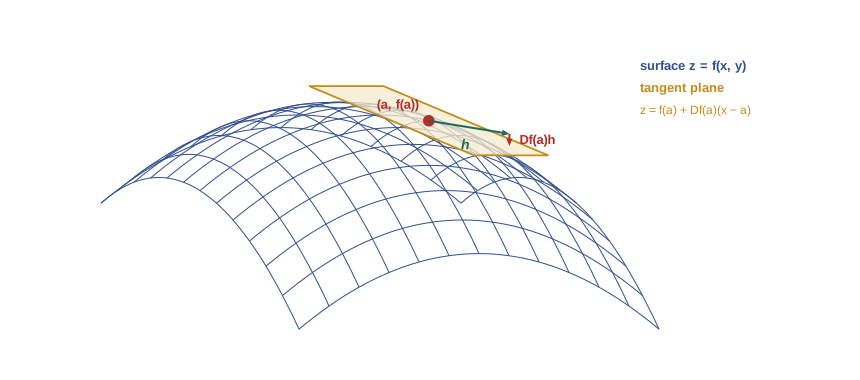
For a function of one variable the derivative \(f^\prime(a)\) is a number, and the definition \(f^\prime(a) = \lim_{h \to 0} \frac{f(a + h) - f(a)}{h}\) cannot be copied to a function \(f: \mathbb{R}^n \to \mathbb{R}^m\), since we cannot divide by a vector \(h\). The way forward is to read the one-variable definition differently. It says that \[f(a + h) = f(a) + f^\prime(a)h + r(h), \quad \text{where } \frac{r(h)}{h} \to 0,\] so the map \(h \mapsto f^\prime(a)h\), multiplication by a number, is the best linear approximation to the change \(f(a + h) - f(a)\). In several variables the derivative is defined to be that best linear approximation, which is now a linear map from \(\mathbb{R}^n\) to \(\mathbb{R}^m\).
Linear maps and their norms
We use the Euclidean norm \(|x| = \sqrt{\sum x_i^2}\) on \(\mathbb{R}^n\); by lesson 9 any other norm would give the same notions of limit and continuity. A linear map \(A: \mathbb{R}^n \to \mathbb{R}^m\) is given by an \(m \times n\) matrix, and we use the same letter for both. Its operator norm is \[\|A\| = \sup\{|Ax| : |x| \le 1\},\] the largest factor by which \(A\) stretches a vector. It is finite, since lesson 9 showed \(|Ax| \le \sqrt{\sum a_{ij}^2}\,|x|\), and it satisfies \(|Ax| \le \|A\||x|\) for all \(x\), \(\|A + B\| \le \|A\| + \|B\|\) and \(\|AB\| \le \|A\|\|B\|\). For instance, the diagonal matrix with entries 3 and \(-5\) has operator norm 5. The set of \(m \times n\) matrices with the metric \(\|A - B\|\) is just \(\mathbb{R}^{mn}\) with an unusual norm, so by lesson 9 it has the same convergent sequences as with the Euclidean norm on the entries.
The definition
Definition. Let \(U \subseteq \mathbb{R}^n\) be open and \(f: U \to \mathbb{R}^m\). Then \(f\) is differentiable at \(a \in U\) if there is a linear map \(T: \mathbb{R}^n \to \mathbb{R}^m\) such that \[\lim_{h \to 0} \frac{|f(a + h) - f(a) - Th|}{|h|} = 0.\] The map \(T\) is the derivative of \(f\) at \(a\), written \(Df(a)\) or \(f^\prime(a)\). We say \(f\) is differentiable on \(U\) if it is differentiable at every point of \(U\).
The limit is a limit in \(\mathbb{R}^n\) as \(h \to 0\) through all nonzero vectors with \(a + h \in U\), and openness of \(U\) guarantees that all small \(h\) are allowed. Writing \(r(h) = f(a + h) - f(a) - Th\), the condition is \(|r(h)| = o(|h|)\): the error of the linear approximation is small compared with \(|h|\).
Theorem 10.1. The derivative, if it exists, is unique, and a function differentiable at \(a\) is continuous at \(a\).
Proof. Suppose \(T\) and \(S\) both satisfy the definition. For a fixed unit vector \(v\) and small \(t > 0\), put \(h = tv\). Then \[|Tv - Sv| = \frac{|Th - Sh|}{t} \le \frac{|f(a + h) - f(a) - Sh|}{|h|} + \frac{|f(a + h) - f(a) - Th|}{|h|} \to 0\] as \(t \to 0\), so \(Tv = Sv\). As \(v\) was any unit vector and both maps are linear, \(T = S\). For continuity, \(|f(a + h) - f(a)| \le |Th| + |r(h)| \le \|T\||h| + |r(h)| \to 0\). \(\square\)
The idea goes back to Otto Stolz, who in 1893 defined the total differential of a function of several variables by this kind of approximation. W. H. Young's tract of 1910 on the fundamental theorems of the differential calculus made the linear approximation the central definition, and Maurice Fréchet, in papers of 1911 and 1912, stated it for maps between more general spaces, which is why the derivative of this lesson is often called the Fréchet derivative.
Partial derivatives and the Jacobian matrix
For \(f: U \to \mathbb{R}^m\) with components \(f_1, \dots, f_m\), the partial derivative \(\frac{\partial f_i}{\partial x_j}(a)\) is the ordinary derivative at 0 of \(t \mapsto f_i(a + te_j)\), where \(e_j\) is the \(j\)-th standard basis vector. More generally, the directional derivative in the direction \(v\) is \(D_vf(a) = \lim_{t \to 0} \frac{f(a + tv) - f(a)}{t}\).
Theorem 10.2. If \(f\) is differentiable at \(a\), then every directional derivative exists and \(D_vf(a) = Df(a)v\). In particular the matrix of \(Df(a)\) is the Jacobian matrix \[Df(a) = \Big(\frac{\partial f_i}{\partial x_j}(a)\Big)_{1 \le i \le m,\ 1 \le j \le n}.\]
Proof. For \(v \ne 0\) and \(h = tv\), \(\big|\frac{f(a + tv) - f(a)}{t} - Df(a)v\big| = |v|\frac{|r(tv)|}{|tv|} \to 0\) as \(t \to 0\). The \(j\)-th column of the matrix of \(Df(a)\) is \(Df(a)e_j = D_{e_j}f(a)\), whose \(i\)-th entry is \(\frac{\partial f_i}{\partial x_j}(a)\). \(\square\)
For a real-valued \(f\), the \(1 \times n\) matrix \(Df(a)\) is the row of partial derivatives, and the vector with the same entries is the gradient \(\nabla f(a)\), so \(Df(a)h = \nabla f(a) \cdot h\). By Cauchy–Schwarz, the directional derivative \(\nabla f(a) \cdot v\) over unit vectors \(v\) is largest when \(v\) points along \(\nabla f(a)\), and its largest value is \(|\nabla f(a)|\). The name Jacobian honors Carl Gustav Jacobi, whose 1841 memoir on functional determinants studied the determinant of this matrix.
The converse of theorem 10.2 is false: partial derivatives, and even all directional derivatives, can exist without the function being differentiable.
Worked problem
Directional derivatives without differentiability
Let \(f(x, y) = \frac{x^2y}{x^4 + y^2}\) for \((x, y) \ne (0, 0)\) and \(f(0, 0) = 0\). Show that every directional derivative at the origin exists but \(f\) is not differentiable there.
Show solution
- For \(v = (v_1, v_2)\) with \(v_2 \ne 0\): \(\frac{f(tv)}{t} = \frac{t^3v_1^2v_2}{t(t^4v_1^4 + t^2v_2^2)} = \frac{v_1^2v_2}{t^2v_1^4 + v_2^2} \to \frac{v_1^2}{v_2}\). For \(v_2 = 0\), \(f(tv) = 0\), so \(D_vf(0) = 0\). Every directional derivative exists.
- The map \(v \mapsto D_vf(0)\) is not linear: it is 0 on the coordinate vectors but \(D_{(1,1)}f(0) = 1\). By theorem 10.2, a derivative would force \(D_vf(0) = Df(0)v\), which is linear in \(v\). So \(f\) is not differentiable at 0.
- Worse, \(f\) is not even continuous at 0: along the parabola \(y = x^2\), \(f(x, x^2) = \frac{x^4}{2x^4} = \frac{1}{2}\).
Answer: All directional derivatives exist, yet \(f\) is discontinuous, hence not differentiable, at the origin.
What rescues the situation is continuity of the partial derivatives.
Theorem 10.3. Let \(U \subseteq \mathbb{R}^n\) be open and \(f: U \to \mathbb{R}^m\). If all partial derivatives \(\frac{\partial f_i}{\partial x_j}\) exist on \(U\) and are continuous at \(a\), then \(f\) is differentiable at \(a\).
Proof. A vector-valued map is differentiable if and only if each component is, since the Euclidean norm of a vector is at most the sum of the absolute values of its components. So assume \(m = 1\). Choose \(r > 0\) with \(B(a, r) \subseteq U\) and let \(|h| < r\), \(h = \sum_j h_je_j\). Define \(p_0 = a\) and \(p_j = a + h_1e_1 + \dots + h_je_j\), so \(p_n = a + h\). Each \(p_j\), and every point of the segment from \(p_{j-1}\) to \(p_j\), is within \(|h|\) of \(a\), so lies in the ball. Then \[f(a + h) - f(a) = \sum_{j=1}^{n} (f(p_j) - f(p_{j-1})).\] Along the segment from \(p_{j-1}\) to \(p_j\) only the \(j\)-th coordinate changes, so the one-variable mean value theorem gives a point \(q_j\) on it with \(f(p_j) - f(p_{j-1}) = h_j\frac{\partial f}{\partial x_j}(q_j)\). Hence \[\Big|f(a + h) - f(a) - \sum_j h_j\frac{\partial f}{\partial x_j}(a)\Big| \le \sum_j |h_j|\Big|\frac{\partial f}{\partial x_j}(q_j) - \frac{\partial f}{\partial x_j}(a)\Big| \le |h|\sum_j \Big|\frac{\partial f}{\partial x_j}(q_j) - \frac{\partial f}{\partial x_j}(a)\Big|.\] As \(h \to 0\), each \(q_j \to a\), and by continuity of the partials at \(a\) the last sum tends to 0. So \(f\) is differentiable at \(a\), with derivative given by the partial derivatives. \(\square\)
A map whose partial derivatives exist and are continuous on \(U\) is called continuously differentiable, or \(C^1\). By theorem 10.3 it is differentiable, and \(x \mapsto Df(x)\) is continuous from \(U\) to the space of matrices. Polynomials, exponentials, trigonometric functions and their compositions are \(C^1\) wherever they are defined, so in practice differentiability is checked by computing partial derivatives and observing that they are continuous.
The chain rule
Theorem 10.4 (chain rule). Let \(f: U \to \mathbb{R}^m\) be differentiable at \(a\), with \(U \subseteq \mathbb{R}^n\) open, and let \(g: V \to \mathbb{R}^p\) be differentiable at \(b = f(a)\), with \(V \subseteq \mathbb{R}^m\) open and \(f(U) \subseteq V\). Then \(g \circ f\) is differentiable at \(a\) and \[D(g \circ f)(a) = Dg(b)\,Df(a).\]
Proof. Let \(A = Df(a)\) and \(B = Dg(b)\). Write \(f(a + h) = b + Ah + r(h)\) with \(\frac{|r(h)|}{|h|} \to 0\), and \(g(b + k) = g(b) + Bk + s(k)\), where \(|s(k)| \le \eta(k)|k|\) with \(\eta(k) \to 0\) as \(k \to 0\) and \(\eta(0) = 0\). Put \(k = k(h) = f(a + h) - b = Ah + r(h)\). Then \[g(f(a + h)) - g(b) - BAh = Br(h) + s(k).\] The first term satisfies \(|Br(h)| \le \|B\||r(h)| = o(|h|)\). For the second, \(|k| \le \|A\||h| + |r(h)| \le (\|A\| + 1)|h|\) once \(h\) is small, and \(k \to 0\) as \(h \to 0\), so \(|s(k)| \le \eta(k)(\|A\| + 1)|h| = o(|h|)\). Hence \(g \circ f\) is differentiable at \(a\) with derivative \(BA\). \(\square\)
In matrix terms the chain rule multiplies Jacobian matrices, and written out entry by entry it is the familiar formula \(\frac{\partial (g \circ f)_i}{\partial x_j} = \sum_k \frac{\partial g_i}{\partial y_k}\frac{\partial f_k}{\partial x_j}\). The linear map point of view makes the rule almost obvious: the best linear approximation of a composition is the composition of the best linear approximations.
Worked problem
Polar coordinates
Let \(P(r, \theta) = (r\cos\theta, r\sin\theta)\). Compute \(DP\), its determinant, and the derivative of \(u(r, \theta) = g(P(r, \theta))\) for a differentiable \(g: \mathbb{R}^2 \to \mathbb{R}\).
Show solution
- The partial derivatives are continuous, so \(P\) is \(C^1\) with \(DP(r, \theta) = \begin{pmatrix} \cos\theta & -r\sin\theta \\ \sin\theta & r\cos\theta \end{pmatrix}\).
- Its determinant is \(r\cos^2\theta + r\sin^2\theta = r\), so \(DP\) is invertible exactly when \(r \ne 0\).
- By the chain rule, \(Du = Dg(P)\,DP\), that is, \(\frac{\partial u}{\partial r} = g_x\cos\theta + g_y\sin\theta\) and \(\frac{\partial u}{\partial \theta} = -g_xr\sin\theta + g_yr\cos\theta\), with \(g_x, g_y\) evaluated at \(P(r, \theta)\).
Answer: \(\det DP = r\). Lesson 11 shows that this nonvanishing determinant makes polar coordinates locally invertible away from the origin.
The mean value inequality
The mean value theorem has no exact analog for vector-valued maps. The map \(f(t) = (\cos t, \sin t)\) has \(f(2\pi) - f(0) = 0\), but \(f^\prime(t) = (-\sin t, \cos t)\) is never 0, so no \(c\) satisfies \(f(2\pi) - f(0) = 2\pi f^\prime(c)\). What survives is an inequality, and it is all we need.
Theorem 10.5 (mean value inequality). Let \(f: U \to \mathbb{R}^m\) be differentiable on an open set \(U\) containing the segment from \(a\) to \(b\), and suppose \(\|Df(x)\| \le M\) at every point \(x\) of the segment. Then \(|f(b) - f(a)| \le M|b - a|\).
Proof. Let \(v = f(b) - f(a)\); if \(v = 0\) there is nothing to prove. Define \(\phi(t) = v \cdot f(a + t(b - a))\) on an open interval containing \([0, 1]\). By the chain rule \(\phi\) is differentiable with \(\phi^\prime(t) = v \cdot Df(a + t(b - a))(b - a)\). The one-variable mean value theorem gives \(\tau \in (0, 1)\) with \[|v|^2 = \phi(1) - \phi(0) = \phi^\prime(\tau) \le |v|\,\|Df(c)\|\,|b - a| \le |v|M|b - a|,\] where \(c = a + \tau(b - a)\) and we used Cauchy–Schwarz. Dividing by \(|v|\) gives the result. \(\square\)
A set is convex if it contains the segment between any two of its points; balls are convex. On a convex open set where \(\|Df\| \le M\), the inequality makes \(f\) Lipschitz with constant \(M\). In particular, if \(Df = 0\) on a convex open set, \(f\) is constant there. Lesson 11 applies the inequality to show that a certain map is a contraction.
Computing derivatives numerically
Since \(Df(a)e_j = \lim_{t \to 0} \frac{f(a + te_j) - f(a)}{t}\), the columns of the Jacobian can be approximated by difference quotients. The forward difference \(\frac{f(a + te_j) - f(a)}{t}\) has error of order \(t\) for smooth \(f\), and the central difference \(\frac{f(a + te_j) - f(a - te_j)}{2t}\) has error of order \(t^2\), by Taylor's theorem. In floating point arithmetic, rounding errors of about \(10^{-16}\) are divided by \(t\), so making \(t\) too small makes things worse. The code compares both formulas with the exact Jacobian of \(f(x, y) = (x^2y, \ e^x\sin y, \ x + y^3)\) at \((1, 0.5)\).
import math

def f(p):
    x, y = p
    return [x * x * y, math.exp(x) * math.sin(y), x + y ** 3]

def exact_J(p):
    x, y = p
    return [[2 * x * y, x * x],
            [math.exp(x) * math.sin(y), math.exp(x) * math.cos(y)],
            [1.0, 3 * y * y]]

def jacobian(f, p, t, central=True):
    n, fp = len(p), f(p)
    cols = []
    for j in range(n):
        up = list(p); up[j] += t
        if central:
            dn = list(p); dn[j] -= t
            col = [(a - b) / (2 * t) for a, b in zip(f(up), f(dn))]
        else:
            col = [(a - b) / t for a, b in zip(f(up), fp)]
        cols.append(col)
    return [[cols[j][i] for j in range(n)] for i in range(len(fp))]   # rows = components

def max_err(A, B):
    return max(abs(a - b) for ra, rb in zip(A, B) for a, b in zip(ra, rb))

p = (1.0, 0.5)
J = exact_J(p)
print("exact Jacobian rows:", [[round(v, 6) for v in row] for row in J])
print("    t        forward error   central error")
for k in range(1, 13, 2):
    t = 10.0 ** -k
print(f"1e-{k:02d} {max_err(jacobian(f, p, t, False), J):12.3e} {max_err(jacobian(f, p, t), J):12.3e}")exact Jacobian rows: [[1.0, 1.0], [1.303214, 2.385517], [1.0, 0.75]]
t forward error central error
1e-01 1.600e-01 1.000e-02
1e-03 1.501e-03 1.000e-06
1e-05 1.500e-05 1.048e-10
1e-07 1.487e-07 1.227e-09
1e-09 8.274e-08 8.274e-08
1e-11 1.047e-05 2.722e-06The forward error falls by a factor of about 100 each time \(t\) shrinks by 100 until \(t\) is near \(10^{-7}\) or \(10^{-9}\), and the central error falls by about \(10^4\), as Taylor's theorem predicts, until \(t\) is near \(10^{-5}\). Below those values rounding error, which grows like \(\frac{10^{-16}}{t}\), dominates and the approximations get worse. Automatic differentiation, used in modern scientific computing and machine learning, avoids the dilemma by applying the chain rule exactly to the steps of a computation.
Common mistakes
MistakeConcluding differentiability from the existence of partial derivatives.
Instead\(\frac{x^2y}{x^4 + y^2}\) has all directional derivatives at 0 and is not even continuous there; continuity of the partials is what suffices.
MistakeMultiplying Jacobians in the wrong order in the chain rule.
Instead\(D(g \circ f)(a) = Dg(f(a))\,Df(a)\): the derivative of the outer map, evaluated at \(f(a)\), comes first.
MistakeUsing an equality mean value theorem for vector-valued maps.
InsteadOnly the inequality \(|f(b) - f(a)| \le M|b - a|\) holds; \((\cos t, \sin t)\) shows equality can fail.
MistakeTaking the step in a difference quotient as small as possible.
InsteadRounding error grows like \(\frac{10^{-16}}{t}\); central differences with \(t\) near \(10^{-5}\) are a good compromise.
Summary and key terms
- \(f\) is differentiable at \(a\) if \(f(a + h) = f(a) + Df(a)h + o(|h|)\) for a linear map \(Df(a)\).
- The derivative is unique, and differentiable functions are continuous.
- The matrix of the derivative is the Jacobian matrix of partial derivatives, and directional derivatives are its values on vectors.
- Existence of partial derivatives does not imply differentiability; continuity of the partials does.
- Chain rule: \(D(g \circ f)(a) = Dg(f(a))\,Df(a)\).
- Mean value inequality: \(|f(b) - f(a)| \le M|b - a|\) when \(\|Df\| \le M\) on the segment.
- Derivative (Fréchet derivative)
- The linear map \(Df(a)\) with \(|f(a + h) - f(a) - Df(a)h| = o(|h|)\).
- Jacobian matrix
- The matrix \(\big(\frac{\partial f_i}{\partial x_j}\big)\) of the derivative.
- Operator norm
- \(\|A\| = \sup_{|x| \le 1} |Ax|\).
- Directional derivative
- \(D_vf(a) = \lim_{t \to 0} \frac{f(a + tv) - f(a)}{t}\).
- Continuously differentiable
- All partial derivatives exist and are continuous; written \(C^1\).
- Gradient
- The vector \(\nabla f\) of partial derivatives of a real-valued function.
Practice problems
Work each problem on paper first, then reveal the answer to check.
Show from the definition that a linear map \(A\) is differentiable everywhere with \(DA(a) = A\).
Show answer
\(A(a + h) - A(a) - Ah = 0\), so the error is identically 0.
Compute the Jacobian of \(f(x, y, z) = (xyz, \ x^2 - z)\).
Show answer
\(\begin{pmatrix} yz & xz & xy \\ 2x & 0 & -1 \end{pmatrix}\).
Show that \(f(x, y) = \frac{xy}{\sqrt{x^2 + y^2}}\), with \(f(0, 0) = 0\), has both partial derivatives 0 at the origin but is not differentiable there.
Show answer
\(f(t, 0) = f(0, t) = 0\), so both partials vanish. If \(f\) were differentiable, \(Df(0) = 0\) and \(\frac{|f(h)|}{|h|} \to 0\), but along \(h = (t, t)\), \(\frac{|f(h)|}{|h|} = \frac{t^2/(\sqrt{2}|t|)}{\sqrt{2}|t|} = \frac{1}{2}\).
Use the chain rule to find \(\frac{d}{dt} g(t^2, \sin t)\) for differentiable \(g\).
Show answer
\(g_x(t^2, \sin t)\cdot 2t + g_y(t^2, \sin t)\cos t\).
Find the operator norm of \(A = \begin{pmatrix} 1 & 1 \\ 0 & 1 \end{pmatrix}\).
Show answer
\(\|A\|^2\) is the largest eigenvalue of \(A^TA = \begin{pmatrix} 1 & 1 \\ 1 & 2 \end{pmatrix}\), which is \(\frac{3 + \sqrt{5}}{2}\), so \(\|A\| = \frac{1 + \sqrt{5}}{2} \approx 1.618\).
Lesson quiz · 5 questions
Score 60% or more to complete this lesson.
Create a free account to save your progress, take quizzes and earn a certificate.