
MATH-323 · Lesson 12 of 12 · 24 min
Capstone: Galois theory and the insolvability of the quintic
Everyone learns the quadratic formula. Formulas for cubics and quartics were found in sixteenth-century Italy, by Scipione del Ferro, Niccolò Tartaglia, Gerolamo Cardano and Lodovico Ferrari, and published in Cardano's Ars Magna of 1545. For the next two and a half centuries the best mathematicians in Europe, Lagrange among them, sought a formula for the quintic, built from the coefficients by arithmetic and the extraction of roots. There is none. Paolo Ruffini gave a proof with gaps in 1799, Niels Henrik Abel a complete proof in 1824, and Évariste Galois, in work written before his death in a duel in 1832 at the age of twenty, explained exactly which equations can be solved by radicals and why. This capstone lesson brings together everything in the course: rings of polynomials, ideals and quotients, field extensions and degrees, splitting fields, and the group theory of MATH-322.
The Galois group
Definition. Let \(E\) be an extension of \(F\). The Galois group \(\operatorname{Gal}(E/F)\) is the group of automorphisms of \(E\) that fix every element of \(F\), under composition. The Galois group of a polynomial \(f \in F[x]\) is \(\operatorname{Gal}(E/F)\), where \(E\) is the splitting field of \(f\).
Lesson 5 contained the key observation. If \(\sigma\) fixes \(F\) and \(\alpha\) is a root of \(f \in F[x]\), then \(\sigma(\alpha)\) is also a root. So \(\sigma\) permutes the roots of \(f\), and since \(E\) is generated over \(F\) by those roots, \(\sigma\) is determined by the permutation. Thus the Galois group of a polynomial with \(n\) distinct roots is a subgroup of \(S_n\).
Examples. \(\operatorname{Gal}(\mathbb{C}/\mathbb{R}) = \{1, \text{conjugation}\} \cong \mathbb{Z}_2\). \(\operatorname{Gal}(\mathbb{Q}(\sqrt 2)/\mathbb{Q}) \cong \mathbb{Z}_2\). For \(\mathbb{Q}(\sqrt 2, \sqrt 3)\), an automorphism sends \(\sqrt 2 \mapsto \pm\sqrt 2\) and \(\sqrt 3 \mapsto \pm\sqrt 3\), independently, giving four automorphisms forming the Klein group \(\mathbb{Z}_2 \times \mathbb{Z}_2\). \(\operatorname{Gal}(\mathbb{Q}(\sqrt[3]{2})/\mathbb{Q})\) is trivial, since the field contains only one root of \(x^3 - 2\). \(\operatorname{Gal}(GF(p^n)/\mathbb{Z}_p)\) is cyclic of order \(n\), generated by Frobenius.
Galois extensions
The extensions in which the Galois group is as large as possible are the well-behaved ones. In general \(|\operatorname{Gal}(E/F)| \le [E : F]\) for a finite extension.
Definition. A finite extension \(E/F\) is Galois if \(|\operatorname{Gal}(E/F)| = [E : F]\). In characteristic 0, and over finite fields, this holds exactly when \(E\) is the splitting field of some polynomial over \(F\).
So \(\mathbb{Q}(\sqrt 2, \sqrt 3)/\mathbb{Q}\) is Galois, with 4 automorphisms and degree 4, while \(\mathbb{Q}(\sqrt[3]{2})/\mathbb{Q}\) is not, with 1 automorphism and degree 3. The splitting field \(\mathbb{Q}(\sqrt[3]{2}, \omega)\) of \(x^3 - 2\) has degree 6, and its Galois group, a subgroup of \(S_3\) of order 6, is all of \(S_3\): every permutation of the three cube roots of 2 extends to an automorphism.
The fundamental theorem
Theorem (fundamental theorem of Galois theory). Let \(E/F\) be a finite Galois extension with group \(G\). Then there is an inclusion-reversing bijection between the subgroups \(H\) of \(G\) and the intermediate fields \(F \subseteq K \subseteq E\), given by
\[H \mapsto E^H = \{a \in E : \sigma(a) = a \text{ for all } \sigma \in H\}, \qquad K \mapsto \operatorname{Gal}(E/K).\]
Moreover \([E : E^H] = |H|\) and \([E^H : F] = [G : H]\). The extension \(E^H/F\) is itself Galois exactly when \(H\) is a normal subgroup of \(G\), and then \(\operatorname{Gal}(E^H/F) \cong G/H\).
The proof uses a counting argument due to Emil Artin, from his lectures of the 1930s and his book of 1942, which gave the theorem the form taught today: if \(H\) is a finite group of automorphisms of \(E\), then \([E : E^H] = |H|\). The rest follows by combining this with the inequality \(|\operatorname{Gal}(E/K)| \le [E : K]\).
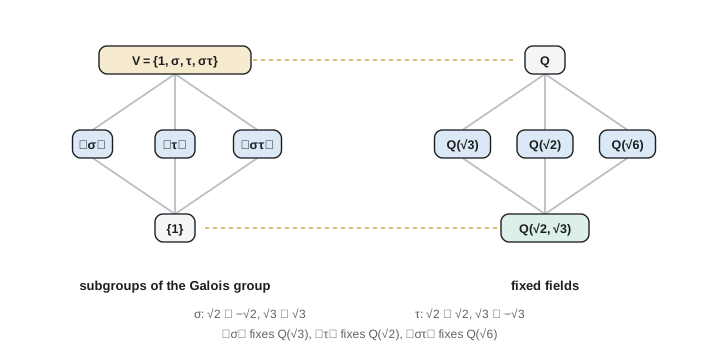
For \(E = \mathbb{Q}(\sqrt 2, \sqrt 3)\), let \(\sigma\) change the sign of \(\sqrt 2\) and fix \(\sqrt 3\), and let \(\tau\) do the opposite. The three subgroups of order 2 are \(\langle\sigma\rangle\), \(\langle\tau\rangle\) and \(\langle\sigma\tau\rangle\), with fixed fields \(\mathbb{Q}(\sqrt 3)\), \(\mathbb{Q}(\sqrt 2)\) and \(\mathbb{Q}(\sqrt 6)\), since \(\sigma\tau(\sqrt 6) = (-\sqrt 2)(-\sqrt 3) = \sqrt 6\). The correspondence proves there are no other intermediate fields: the Klein group has exactly three subgroups of order 2, so the field has exactly three quadratic subfields. This also answers a question from lesson 9: \(\sqrt 2 + \sqrt 3\) is moved by every nontrivial automorphism, so it lies in no proper subfield, and it generates \(E\).
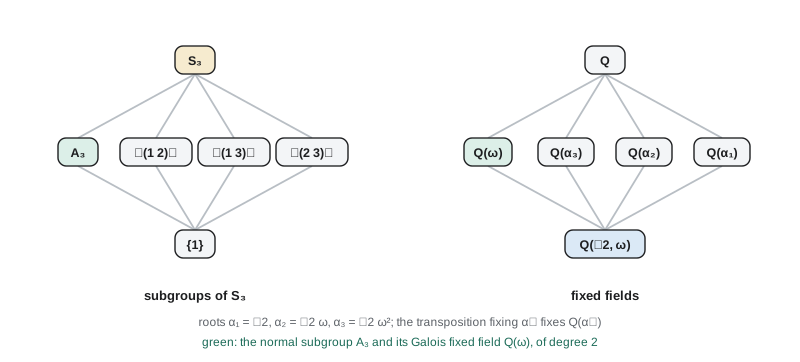
For \(x^3 - 2\), with \(G = S_3\) acting on the roots \(\alpha_k = \sqrt[3]{2}\omega^k\), the subgroups of order 2 are generated by the transpositions, each fixing one root, so their fixed fields are the three cubic fields \(\mathbb{Q}(\alpha_k)\), of index 3. The subgroup \(A_3\) of order 3, the cyclic permutations, has index 2, and its fixed field is \(\mathbb{Q}(\omega)\). \(A_3\) is normal in \(S_3\), and \(\mathbb{Q}(\omega)\), the splitting field of \(x^2 + x + 1\), is Galois over \(\mathbb{Q}\); the subgroups of order 2 are not normal, and the fields \(\mathbb{Q}(\alpha_k)\) are not Galois. The normality condition in the theorem is visible in the picture.
Solvability by radicals
A polynomial is solvable by radicals if its roots can be obtained from its coefficients by field operations and the extraction of \(n\)th roots. In field terms, the roots lie in a radical tower \(F = K_0 \subseteq K_1 \subseteq \cdots \subseteq K_r\) in which each \(K_{i+1} = K_i(\beta_i)\) with \(\beta_i^{n_i} \in K_i\).
A group \(G\) is solvable if it has a chain of subgroups \(\{1\} = G_0 \trianglelefteq G_1 \trianglelefteq \cdots \trianglelefteq G_s = G\), each normal in the next, with abelian quotients \(G_{i+1}/G_i\). Abelian groups, \(S_3\) (via \(\{1\} \trianglelefteq A_3 \trianglelefteq S_3\)) and \(S_4\) (via \(\{1\} \trianglelefteq V_4 \trianglelefteq A_4 \trianglelefteq S_4\)) are solvable. The name comes from this theorem.
Theorem (Galois). Over a field of characteristic 0, a polynomial is solvable by radicals if and only if its Galois group is solvable.
The idea of the forward direction: adjoining an \(n\)th root to a field that already contains the \(n\)th roots of unity gives a Galois extension with cyclic group, and adjoining roots of unity gives an abelian group. Through the fundamental theorem, a radical tower becomes a chain of subgroups with abelian quotients. The quadratic formula is the simplest case: \(\mathbb{Q} \subseteq \mathbb{Q}(\sqrt{b^2 - 4ac})\) corresponds to \(\mathbb{Z}_2 \trianglerighteq \{1\}\). Cardano's formula for the cubic reflects the chain \(\{1\} \trianglelefteq A_3 \trianglelefteq S_3\): a square root of the discriminant followed by a cube root.
The quintic
Theorem (Abel–Ruffini). The general polynomial of degree 5 is not solvable by radicals. Explicitly, \(x^5 - 6x + 3\) has Galois group \(S_5\) over \(\mathbb{Q}\), and \(S_5\) is not solvable.
Proof outline: \(f = x^5 - 6x + 3\) is irreducible by Eisenstein at 3. Its derivative \(5x^4 - 6\) has two real zeros, so \(f\) has at most three real roots, and since \(f(-2) = -17\), \(f(0) = 3\), \(f(1) = -2\), \(f(2) = 23\), it has exactly three. Its Galois group \(G \subseteq S_5\) has order divisible by 5, because adjoining one root gives degree 5, so by Cauchy's theorem \(G\) contains a 5-cycle. Complex conjugation restricted to the splitting field fixes the three real roots and swaps the two complex ones, so \(G\) contains a transposition. A 5-cycle and a transposition generate all of \(S_5\). Finally, \(S_5\) is not solvable: its only nontrivial proper normal subgroup is \(A_5\), and \(A_5\) is simple and nonabelian, so no chain with abelian quotients can descend through it.
The theorem does not say that no quintic can be solved: \(x^5 - 2\) is solvable, with roots \(\sqrt[5]{2}\zeta_5^k\), and its Galois group, of order 20, is solvable. It says there is no single formula in radicals that works for all quintics, and it identifies exactly which ones can be solved.
Computing Galois groups from the roots
Here is an algorithm that needs only the roots, computed numerically, and the fact that the roots are algebraic integers. Take a combination \(\theta = \sum c_i\alpha_i\) of the roots with small integer coefficients, chosen so that the values \(\theta_\pi = \sum c_i\alpha_{\pi(i)}\) for \(\pi \in S_n\) are distinct. For a subgroup \(H \subseteq S_n\), the polynomial \(\prod_{\pi \in H}(x - \theta_\pi)\) has integer coefficients exactly when \(H\) contains the Galois group \(G\). So \(G\) is the smallest subgroup for which that product is integral. The program enumerates the subgroups of \(S_n\) for \(n \le 4\), finds the Galois groups of five polynomials, and then checks by brute force that the derived series of \(S_5\) stops at \(A_5\), which is the group-theoretic heart of the insolvability of the quintic.
import cmath
from itertools import permutations

def compose(p, q):
    return tuple(p[q[i]] for i in range(len(q)))

def closure(gens, n):
    e = tuple(range(n))
    H = {e}
    frontier = [e]
    while frontier:
        new = []
        for h in frontier:
            for g in gens:
                k = compose(g, h)
                if k not in H:
                    H.add(k); new.append(k)
        frontier = new
    return frozenset(H)

def subgroups(n):
    S = list(permutations(range(n)))
    return sorted({closure([a, b], n) for a in S for b in S}, key=len)

def galois_group(roots):
    n = len(roots)
    c = [1, 3, 7, 12][:n]
    theta = lambda p: sum(c[i] * roots[p[i]] for i in range(n))
    for H in subgroups(n):
        poly = [1]
        for p in H:
            t = theta(p)
            poly = [a - t * b for a, b in zip([0] + poly, poly + [0])]
        tol = 1e-6 + 1e-12 * max(abs(a) for a in poly)
        if all(abs(a - round(a.real)) < tol for a in poly):
            return H
    return None

w = cmath.exp(2j * cmath.pi / 3)
r2, r3 = 2 ** 0.5, 3 ** 0.5
z5 = cmath.exp(2j * cmath.pi / 5)
cases = {
    "(x^2-2)(x^2-3)": [r2, -r2, r3, -r3],
    "x^3 - 2": [2 ** (1 / 3) * w ** k for k in range(3)],
    "x^3 - 3x - 1": [2 * cmath.cos(cmath.pi * a / 180) for a in (20, 140, 260)],
    "x^4 + x^3 + x^2 + x + 1": [z5 ** k for k in range(1, 5)],
    "x^4 - 2": [2 ** 0.25 * 1j ** k for k in range(4)],
}
for name, roots in cases.items():
    G = galois_group([complex(r) for r in roots])
    ab = all(compose(a, b) == compose(b, a) for a in G for b in G)
    print(f"{name:24} |G| = {len(G)}  abelian = {ab}")

def commutator_subgroup(G, n):
    inv = lambda p: tuple(sorted(range(n), key=lambda i: p[i]))
    comms = {compose(compose(a, b), compose(inv(a), inv(b))) for a in G for b in G}
    return closure(list(comms), n)

S5 = frozenset(permutations(range(5)))
series = [S5]
while True:
    D = commutator_subgroup(series[-1], 5)
    if D == series[-1]:
        break
    series.append(D)
print("derived series of S5, orders:", [len(H) for H in series], "-> stops, never reaching 1")(x^2-2)(x^2-3) |G| = 4 abelian = True x^3 - 2 |G| = 6 abelian = False x^3 - 3x - 1 |G| = 3 abelian = True x^4 + x^3 + x^2 + x + 1 |G| = 4 abelian = True x^4 - 2 |G| = 8 abelian = False derived series of S5, orders: [120, 60] -> stops, never reaching 1
The program finds a group of order 4 for \((x^2 - 2)(x^2 - 3)\), the full \(S_3\) of order 6 for \(x^3 - 2\), the cyclic group of order 3 for \(x^3 - 3x - 1\), whose roots \(2\cos 20^\circ, 2\cos 140^\circ, 2\cos 260^\circ\) are all real and are polynomial expressions in each other, a cyclic group of order 4 for the cyclotomic polynomial \(\Phi_5\), and the dihedral group of order 8 for \(x^4 - 2\), matching the degree 8 of its splitting field found in lesson 9. The derived series of \(S_5\), obtained by repeatedly taking the subgroup generated by commutators, goes from order 120 to order 60 and then stops: the commutator subgroup of \(A_5\) is \(A_5\) itself. A group is solvable exactly when this series reaches the trivial group, so \(S_5\) is not solvable.
Worked problem
A Galois correspondence by hand
Find all fields between \(\mathbb{Q}\) and \(\mathbb{Q}(\zeta_5)\), where \(\zeta_5 = e^{2\pi i/5}\).
Show solution
- \(\Phi_5\) is irreducible of degree 4, so \([\mathbb{Q}(\zeta_5) : \mathbb{Q}] = 4\). Each automorphism sends \(\zeta_5 \mapsto \zeta_5^k\), \(k \in \{1, 2, 3, 4\}\), and these compose like multiplication modulo 5. So \(G \cong U(5)\), cyclic of order 4, generated by \(\sigma : \zeta_5 \mapsto \zeta_5^2\).
- A cyclic group of order 4 has exactly one subgroup of order 2, \(\langle\sigma^2\rangle\), where \(\sigma^2 : \zeta_5 \mapsto \zeta_5^4 = \bar\zeta_5\) is complex conjugation.
- Its fixed field contains \(\zeta_5 + \bar\zeta_5 = 2\cos 72^\circ = \frac{\sqrt 5 - 1}{2}\), which generates \(\mathbb{Q}(\sqrt 5)\), of degree 2.
Answer: The only intermediate field is \(\mathbb{Q}(\sqrt 5)\). This is why the regular pentagon, whose construction needs \(\cos 72^\circ\), requires only one square root, of 5.
Afterword: where algebra went next
Galois's memoir was rejected by the Paris Academy in 1831 as insufficiently clear, and his work became widely known only when Joseph Liouville published it in 1846. Camille Jordan's treatise of 1870 made it accessible, and in the hands of Dedekind, Weber, Hilbert, Noether and Artin, groups, rings, ideals and fields became the core of modern algebra. The same ideas run through number theory, where the Galois groups of extensions of \(\mathbb{Q}\) remain a central object of research, through algebraic geometry, and through the finite fields of coding theory and cryptography.
Common mistakes
MistakeThinking every quintic is unsolvable by radicals.
Instead\(x^5 - 2\) and \(x^5 - 1\) are solvable; the theorem concerns the general quintic and those with group \(S_5\) or \(A_5\).
MistakeCounting automorphisms of a non-Galois extension as its degree.
Instead\(\mathbb{Q}(\sqrt[3]{2})\) has degree 3 but only the identity automorphism.
MistakeForgetting that the correspondence reverses inclusion.
InsteadLarger subgroups fix smaller fields; the trivial group fixes all of \(E\).
MistakeAssuming every intermediate field is Galois over the base.
InsteadOnly those fixed by normal subgroups are; \(\mathbb{Q}(\sqrt[3]{2})\) is not.
MistakeConcluding a polynomial is unsolvable because its formula is unknown.
InsteadSolvability is decided by the Galois group, not by whether a formula has been written down.
Summary and key terms
- \(\operatorname{Gal}(E/F)\) is the group of automorphisms of \(E\) fixing \(F\); for a polynomial it permutes the roots.
- \(E/F\) is Galois when \(|\operatorname{Gal}(E/F)| = [E : F]\), as for splitting fields in characteristic 0.
- Fundamental theorem: subgroups and intermediate fields correspond, reversing inclusion; normal subgroups give Galois subextensions.
- \(\mathbb{Q}(\sqrt 2, \sqrt 3)\) has group \(\mathbb{Z}_2 \times \mathbb{Z}_2\); \(x^3 - 2\) has group \(S_3\).
- A polynomial is solvable by radicals iff its Galois group is solvable.
- \(x^5 - 6x + 3\) has group \(S_5\), which is not solvable, so the general quintic has no formula in radicals.
- Galois group
- The automorphisms of an extension that fix the base field.
- fixed field
- \(E^H\), the elements fixed by every automorphism in \(H\).
- Galois extension
- A finite extension whose Galois group has order equal to its degree.
- solvable group
- A group with a subnormal series whose quotients are abelian.
- solvable by radicals
- Having roots expressible by field operations and nth roots.
- derived series
- Repeated commutator subgroups; it reaches 1 exactly for solvable groups.
- Abel–Ruffini theorem
- There is no general formula in radicals for polynomials of degree 5 or more.
Practice problems
Work each problem on paper first, then reveal the answer to check.
Find \(\operatorname{Gal}(\mathbb{Q}(\sqrt 5, i)/\mathbb{Q})\).
Show answer
Order 4, the Klein group: \(\sqrt 5 \mapsto \pm\sqrt 5\), \(i \mapsto \pm i\).
How many intermediate fields does \(\mathbb{Q}(\sqrt[3]{2}, \omega)\) have, counting the ends?
Show answer
Six, one for each subgroup of \(S_3\).
What is the fixed field of \(\langle\sigma\tau\rangle\) in \(\mathbb{Q}(\sqrt 2, \sqrt 3)\)?
Show answer
\(\mathbb{Q}(\sqrt 6)\).
Is \(S_4\) solvable? Give a chain.
Show answer
Yes: \(\{1\} \trianglelefteq V_4 \trianglelefteq A_4 \trianglelefteq S_4\), with quotients \(V_4\), \(\mathbb{Z}_3\), \(\mathbb{Z}_2\).
Why does \(x^5 - 6x + 3\) have exactly two non-real roots?
Show answer
It has three real roots by sign changes, and \(5x^4 - 6\) has only two real zeros, so it has at most three.
What is \(\operatorname{Gal}(GF(64)/GF(4))\)?
Show answer
Cyclic of order 3, generated by \(a \mapsto a^4\).
Show \(\operatorname{Gal}(\mathbb{Q}(\zeta_7)/\mathbb{Q}) \cong \mathbb{Z}_6\).
Show answer
It is \(U(7)\), cyclic of order 6, generated by \(\zeta_7 \mapsto \zeta_7^3\).
Lesson quiz · 5 questions
Score 60% or more to complete this lesson.
Create a free account to save your progress, take quizzes and earn a certificate.