
MATH-323 · Lesson 10 of 12 · 21 min
Constructibility: why you can’t trisect an angle
Greek geometers posed three construction problems that resisted every attempt for more than two thousand years: double the cube, that is, construct the side of a cube with twice the volume of a given one; trisect an arbitrary angle; and square the circle, constructing a square with the same area as a given circle. The rules allowed only an unmarked straightedge and a compass. None of the problems was solved, because none can be. The proofs did not come from geometry but from algebra, and they are among the first great triumphs of field theory. This lesson translates constructions into field extensions and shows that a constructible length always has degree a power of 2 over \(\mathbb{Q}\).
The rules of the game
Start with two points in the plane, at distance 1 apart. A straightedge may draw the line through two constructed points, and a compass may draw the circle with a constructed center through another constructed point. New points are constructed as intersections of lines and circles already drawn. A real number \(a\) is constructible if a segment of length \(|a|\) can be constructed, equivalently if the point \((a, 0)\) can be, once the two starting points are placed at \((0, 0)\) and \((1, 0)\).
Many classical constructions are allowed: perpendiculars, parallels, bisecting angles and segments, and copying lengths. From these follow the arithmetic of constructible numbers.
Theorem. The constructible numbers form a subfield of \(\mathbb{R}\), and if \(a > 0\) is constructible, so is \(\sqrt a\).
Proof sketch: sums and differences are made by laying segments end to end along a line. For products use similar triangles: on one ray from a point \(O\) mark \(OA = 1\) and \(OB = b\), on another ray mark \(OC = a\), and draw the parallel to \(AC\) through \(B\). It meets the second ray at a point \(D\) with \(OD/OC = OB/OA\), so \(OD = ab\). Quotients are similar, with the roles of 1 and \(b\) exchanged. For square roots, lay off \(AB = a\) and \(BC = 1\) along a line, draw the circle on \(AC\) as diameter, and erect the perpendicular at \(B\); it meets the circle at height \(\sqrt a\), because the two right triangles formed are similar, giving \(h^2 = a \cdot 1\).
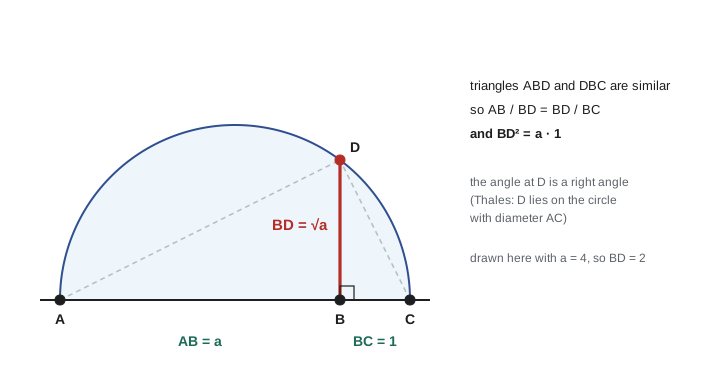
So every number obtained from rational numbers by the four operations and square roots, such as \(\sqrt{2 + \sqrt 3}\) or \(\frac{1 + \sqrt 5}{2}\), is constructible. The striking fact is the converse: nothing else is.
Constructible numbers have degree a power of 2
Theorem. If \(a\) is constructible, then \(a\) lies in a field \(K_n\) at the top of a tower \(\mathbb{Q} = K_0 \subset K_1 \subset \cdots \subset K_n\) with \([K_{i+1} : K_i] = 2\) for each \(i\). Consequently \([\mathbb{Q}(a) : \mathbb{Q}]\) is a power of 2.
Proof: suppose all points constructed so far have coordinates in a field \(K\). A line through two such points has an equation \(ux + vy = w\) with \(u, v, w \in K\), and a circle has an equation \(x^2 + y^2 + ux + vy + w = 0\) with coefficients in \(K\). Intersecting two lines means solving linear equations, which stays in \(K\). Intersecting a line with a circle means substituting the line into the circle, which gives a quadratic over \(K\); its roots lie in \(K\) or in \(K(\sqrt d)\) for some \(d \in K\). Intersecting two circles reduces to intersecting one with a line, because subtracting the two equations eliminates \(x^2 + y^2\) and leaves the line through the intersection points. So each new point has coordinates in an extension of degree 1 or 2. By induction every constructible point lies in a tower of quadratic extensions, and by the tower law \([K_n : \mathbb{Q}] = 2^n\). Since \(\mathbb{Q}(a) \subseteq K_n\), its degree divides \(2^n\).
This criterion was published by Pierre Wantzel in 1837, who used it to settle both the cube and the trisection. It is a necessary condition. The converse, that every number of degree a power of 2 is constructible, is false in general; the exact characterization, that the splitting field has degree a power of 2, needs Galois theory.
Doubling the cube
A cube of side 1 has volume 1, so doubling it requires a side of \(\sqrt[3]{2}\). Its minimal polynomial \(x^3 - 2\) is irreducible by Eisenstein, so \([\mathbb{Q}(\sqrt[3]{2}) : \mathbb{Q}] = 3\), which is not a power of 2. So \(\sqrt[3]{2}\) is not constructible and the cube cannot be doubled. The problem, also known as the Delian problem from the story of an oracle at Delos demanding an altar twice the size, was solved by the Greeks with other tools, such as Menaechmus' intersecting conic sections around 350 BCE; what is impossible is a solution with straightedge and compass alone.
Trisecting an angle
An angle \(\theta\) can be constructed exactly when \(\cos\theta\) can, by dropping a perpendicular. Some angles can be trisected: \(90^\circ\), since \(30^\circ\) is constructible (\(\cos 30^\circ = \frac{\sqrt 3}{2}\)). To show that a general angle cannot be, it is enough to find one that cannot, and \(60^\circ\) is such an angle, even though \(60^\circ\) itself is constructible.
The triple-angle formula \(\cos 3\theta = 4\cos^3\theta - 3\cos\theta\) with \(\theta = 20^\circ\) and \(\cos 60^\circ = \frac12\) gives \(4c^3 - 3c = \frac12\) for \(c = \cos 20^\circ\), that is, \(8c^3 - 6c - 1 = 0\). With \(u = 2c\), this becomes \(u^3 - 3u - 1 = 0\), the cubic shown irreducible in lesson 7 by the rational root test. So \(2\cos 20^\circ\) has degree 3 over \(\mathbb{Q}\), \(\cos 20^\circ\) is not constructible, and the angle of \(60^\circ\) cannot be trisected.
Trisection with a marked straightedge, the neusis construction known to Archimedes, is possible. Many amateur 'trisections' succeed only by slipping in such a step or by giving an approximation. The algebra says precisely that no finite sequence of honest straightedge and compass steps lands exactly on \(\cos 20^\circ\).
Squaring the circle
A circle of radius 1 has area \(\pi\), so a square of equal area has side \(\sqrt\pi\). If \(\sqrt\pi\) were constructible, \(\pi\) would be too, and it would be algebraic. Lindemann's theorem of 1882 that \(\pi\) is transcendental ends the matter. This is the deepest of the three, since it needs analysis rather than just the tower law.
Regular polygons
The regular \(n\)-gon is constructible exactly when \(\cos\frac{2\pi}{n}\) is. Euclid constructed the triangle, square, pentagon and fifteen-gon, and bisection doubles the number of sides. On 30 March 1796, at eighteen, Gauss discovered that the regular 17-gon is constructible, the first new constructible polygon in two thousand years. He showed that \(\cos\frac{2\pi}{17}\) can be written using only square roots, for instance
\[16\cos\frac{2\pi}{17} = -1 + \sqrt{17} + \sqrt{34 - 2\sqrt{17}} + 2\sqrt{17 + 3\sqrt{17} - \sqrt{34 - 2\sqrt{17}} - 2\sqrt{34 + 2\sqrt{17}}}.\]
The reason is that \([\mathbb{Q}(\zeta_{17}) : \mathbb{Q}] = 16 = 2^4\), and the Galois group, cyclic of order 16, has a chain of subgroups of index 2. Gauss stated in the Disquisitiones of 1801 that the regular \(n\)-gon is constructible when \(n\) is a power of 2 times a product of distinct Fermat primes \(2^{2^k} + 1\), and Wantzel proved in 1837 that these are the only ones. The known Fermat primes are 3, 5, 17, 257 and 65537. So the regular 7-gon and 9-gon are not constructible: \(\cos\frac{2\pi}{7}\) has degree 3 over \(\mathbb{Q}\), and the 9-gon would trisect \(120^\circ\), giving \(\cos 40^\circ\), also of degree 3.
The pentagon shows the algebra at work. With \(\zeta = e^{2\pi i/5}\), the number \(c = 2\cos 72^\circ = \zeta + \zeta^{-1}\) satisfies \(c^2 + c - 1 = 0\), because \(\zeta^2 + \zeta + 1 + \zeta^{-1} + \zeta^{-2} = 0\) can be rewritten as \((\zeta + \zeta^{-1})^2 + (\zeta + \zeta^{-1}) - 1 = 0\). So \(c = \frac{\sqrt 5 - 1}{2}\), a single square root, and \(\mathbb{Q} \subset \mathbb{Q}(\sqrt 5)\) is the whole tower. Euclid's construction in Book IV of the Elements, through the golden triangle, is a geometric way of extracting that square root.
Other tools
The impossibility results depend on the tools. If the straightedge may be marked, or if paper folding is allowed, the permitted operations include solving cubic equations, and both the cube and the trisection become possible. The axioms of origami formulated by Humiaki Huzita in the 1980s allow a fold that places two points onto two lines at once, which amounts to solving a cubic; the numbers constructible by origami are those reachable by towers of extensions of degrees 2 and 3. The algebraic method adapts in each case: identify the degree of the extensions each step can create, and apply the tower law. What remains impossible with any of these tools is squaring the circle, because no finite tower of algebraic extensions contains \(\pi\).
Checking constructibility by computer
The program computes \(2\cos\frac{2\pi}{n}\) numerically and identifies its minimal polynomial over \(\mathbb{Q}\) from the exact theory: for \(n \ge 3\) its degree is \(\varphi(n)/2\). It flags \(n\) as constructible when that degree is a power of 2 and \(n\) has the Gauss–Wantzel form, checks the 17-gon formula, and verifies numerically that \(u = 2\cos 20^\circ\) is a root of \(u^3 - 3u - 1\), which has no rational roots.
import cmath, math
from math import gcd
from fractions import Fraction as Fr

def phi(n):
    return sum(1 for k in range(1, n + 1) if gcd(k, n) == 1)

fermat = [3, 5, 17, 257, 65537]
def gauss_wantzel(n):
    while n % 2 == 0:
        n //= 2
    for p in fermat:
        if n % p == 0:
            n //= p
            if n % p == 0:
                return False
    return n == 1

def pow2(k):
    return k & (k - 1) == 0

ok = [n for n in range(3, 41) if gauss_wantzel(n)]
print("constructible n-gons, 3 <= n <= 40:", ok)
print("degree of cos(2 pi/n) is phi(n)/2 a power of 2 exactly for these:",
      ok == [n for n in range(3, 41) if pow2(phi(n) // 2)])
for n in (7, 9, 17):
    print(f"  n = {n}: [Q(cos 2pi/n) : Q] = {phi(n) // 2}")

s = math.sqrt(17)
rhs = -1 + s + math.sqrt(34 - 2*s) + 2*math.sqrt(17 + 3*s - math.sqrt(34 - 2*s) - 2*math.sqrt(34 + 2*s))
print("Gauss 17-gon formula:", round(rhs / 16, 12), "vs", round(math.cos(2 * math.pi / 17), 12))

u = 2 * math.cos(math.radians(20))
print("u = 2cos20:", round(u, 9), " u^3 - 3u - 1 =", round(u**3 - 3*u - 1, 12))
print("rational roots of u^3 - 3u - 1:", [r for r in (Fr(1), Fr(-1)) if r**3 - 3*r - 1 == 0])
z = cmath.exp(2j * cmath.pi / 9)
print("2cos40 is a root of u^3 - 3u + 1:", abs((z + 1/z)**3 - 3*(z + 1/z) + 1) < 1e-12)constructible n-gons, 3 <= n <= 40: [3, 4, 5, 6, 8, 10, 12, 15, 16, 17, 20, 24, 30, 32, 34, 40] degree of cos(2 pi/n) is phi(n)/2 a power of 2 exactly for these: True n = 7: [Q(cos 2pi/n) : Q] = 3 n = 9: [Q(cos 2pi/n) : Q] = 3 n = 17: [Q(cos 2pi/n) : Q] = 8 Gauss 17-gon formula: 0.932472229404 vs 0.932472229404 u = 2cos20: 1.879385242 u^3 - 3u - 1 = 0.0 rational roots of u^3 - 3u - 1: [] 2cos40 is a root of u^3 - 3u + 1: True
The list of constructible polygons up to 40 sides begins 3, 4, 5, 6, 8, 10, 12, 15, 16, 17, and for these values \(\varphi(n)\) is a power of 2. The numerical check of Gauss's formula agrees to twelve decimal places. The cubic \(u^3 - 3u - 1\) has the root \(2\cos 20^\circ \approx 1.879\) and no rational roots, which is the whole proof that \(60^\circ\) cannot be trisected.
Worked problem
Is this length constructible?
Decide whether \(\sqrt[4]{5}\), \(\sqrt[6]{5}\) and \(\sqrt{3 + \sqrt 7}\) are constructible.
Show solution
- \(\sqrt[4]{5} = \sqrt{\sqrt 5}\) is obtained by two square roots, so it is constructible, with degree 4.
- \(\sqrt[6]{5}\) is a root of \(x^6 - 5\), irreducible by Eisenstein at 5, so it has degree 6, not a power of 2. Not constructible.
- \(\sqrt{3 + \sqrt 7}\) is a square root of a constructible number, hence constructible.
Answer: \(\sqrt[4]{5}\) and \(\sqrt{3 + \sqrt 7}\) are constructible; \(\sqrt[6]{5}\) is not, since its degree is 6.
Common mistakes
MistakeConcluding that no angle can be trisected.
InsteadMany can, such as \(90^\circ\) and \(180^\circ\). The theorem is that some angles, such as \(60^\circ\), cannot.
MistakeThinking degree a power of 2 implies constructible.
InsteadIt is necessary only; the exact condition involves the Galois group.
MistakeUsing a marked ruler and calling it a straightedge construction.
InsteadNeusis constructions go beyond the rules.
MistakeBelieving the impossibility is just a lack of cleverness.
InsteadIt is a theorem: \(\cos 20^\circ\) has degree 3.
MistakeThinking the circle cannot be squared because \(\pi\) is irrational.
Instead\(\sqrt 2\) is irrational but constructible; the reason is that \(\pi\) is transcendental.
Summary and key terms
- Constructible numbers form a field closed under square roots.
- Each construction step is an extension of degree 1 or 2, so a constructible number has degree \(2^k\) over \(\mathbb{Q}\) (Wantzel, 1837).
- Doubling the cube needs \(\sqrt[3]{2}\), of degree 3: impossible.
- Trisecting \(60^\circ\) needs \(\cos 20^\circ\), a root of the irreducible \(8x^3 - 6x - 1\): impossible.
- Squaring the circle needs \(\sqrt\pi\), transcendental by Lindemann (1882): impossible.
- The regular \(n\)-gon is constructible iff \(n\) is \(2^k\) times distinct Fermat primes; Gauss found the 17-gon in 1796.
- constructible number
- A length obtainable from 1 by straightedge and compass.
- quadratic extension
- An extension of degree 2, generated by a square root.
- Wantzel’s theorem
- Constructible numbers have degree a power of 2 over \(\mathbb{Q}\).
- Fermat prime
- A prime of the form \(2^{2^k} + 1\).
- neusis
- Construction with a marked straightedge, beyond the classical rules.
- Delian problem
- Doubling the cube.
Practice problems
Work each problem on paper first, then reveal the answer to check.
Is \(\cos 15^\circ\) constructible?
Show answer
Yes: \(\cos 15^\circ = \frac{\sqrt 6 + \sqrt 2}{4}\).
Can a regular 51-gon be constructed?
Show answer
Yes: \(51 = 3 \cdot 17\), a product of distinct Fermat primes.
Can a regular 25-gon be constructed?
Show answer
No: 5 appears twice.
Show that a cube cannot be tripled.
Show answer
\(\sqrt[3]{3}\) has degree 3, by Eisenstein at 3.
Is \(\sqrt[8]{2}\) constructible?
Show answer
Yes: three successive square roots of 2.
Which angle can be trisected: \(45^\circ\) or \(30^\circ\)?
Show answer
\(45^\circ\), since \(15^\circ\) is constructible. For \(30^\circ\), \(\cos 10^\circ\) has degree \(\varphi(36)/2 = 6\) over \(\mathbb{Q}\).
Why is the regular 7-gon not constructible?
Show answer
\(2\cos\frac{2\pi}{7}\) is a root of the irreducible cubic \(x^3 + x^2 - 2x - 1\).
Lesson quiz · 5 questions
Score 60% or more to complete this lesson.
Create a free account to save your progress, take quizzes and earn a certificate.