
MATH-323 · Lesson 1 of 12 · 24 min
From groups to rings
Abstract Algebra I studied sets with one operation. A group captures the arithmetic of symmetry: you can compose two symmetries, undo any symmetry, and composing in stages does not depend on how you bracket the stages. But most of the number systems you have used since primary school carry two operations, addition and multiplication, tied together by the distributive law. The integers, the rationals, polynomials, matrices, the integers modulo \(n\): in every one of these you can add, subtract and multiply, and in some of them you can also divide. A ring is the abstract structure that captures exactly this kind of two-operation arithmetic, and a field is a ring in which division by nonzero elements is always possible.
This course, MATH-323 Abstract Algebra II, is the sequel to MATH-322. It assumes the group theory of that course: subgroups, cosets and Lagrange's theorem, homomorphisms and kernels, normal subgroups and quotients, the isomorphism theorems, and group actions. It follows the same plan, carried over to rings. We define rings and their substructures, find the ring analog of a normal subgroup (an ideal), build quotient rings and prove the isomorphism theorems. Then we turn to polynomials: division with remainder, irreducibility and unique factorization. The last third of the course studies fields and their extensions, which settles three problems that stood open for two thousand years, the ruler-and-compass constructions of ancient Greece, and ends with Galois theory and the reason there is no formula for the roots of a general quintic.
Two operations and one law linking them
Look at the integers \(\mathbb{Z}\). Under addition they form an abelian group: addition is associative and commutative, 0 is an identity, and every integer \(a\) has an additive inverse \(-a\). Multiplication is also associative and commutative and has an identity, 1, but most integers have no multiplicative inverse in \(\mathbb{Z}\): there is no integer \(x\) with \(2x = 1\). So under multiplication \(\mathbb{Z}\) is not a group, only something weaker. What links the two operations is the distributive law,
\[ a(b + c) = ab + ac \quad\text{and}\quad (a + b)c = ac + bc. \]
Without that law the two operations would be unrelated and we would just have two separate structures on the same set. With it, a great deal follows. For example, \(0 \cdot a = 0\) for every \(a\) is not an axiom about integers; it is a consequence of the distributive law. Since \(0 + 0 = 0\), we get \(0 \cdot a = (0 + 0)a = 0 \cdot a + 0 \cdot a\), and canceling \(0 \cdot a\) in the additive group leaves \(0 = 0 \cdot a\). Similarly the rule that a negative times a negative is positive, which puzzles many students when they first meet it, is forced by the distributive law, as we prove in lesson 2.
The definition of a ring
Definition. A ring is a set \(R\) with two binary operations, written \(+\) and \(\cdot\) (or just juxtaposition), such that:
- \((R, +)\) is an abelian group, whose identity is written 0 and in which the inverse of \(a\) is written \(-a\);
- multiplication is associative: \((ab)c = a(bc)\) for all \(a, b, c\);
- both distributive laws hold: \(a(b + c) = ab + ac\) and \((a + b)c = ac + bc\) for all \(a, b, c\).
A ring is commutative if \(ab = ba\) for all \(a, b\). It has a unity (or identity, or one) if there is an element \(1\) with \(1 \cdot a = a \cdot 1 = a\) for all \(a\). Authors disagree about whether a ring must have a unity. Many modern texts require it; older and more general texts do not, so that the even integers \(2\mathbb{Z}\), which have no 1, still count as a ring. In this course a ring need not have a unity unless we say so, but almost every ring we study does. The phrase commutative ring with unity will appear often.
Two distributive laws are needed because multiplication need not be commutative. In a matrix ring, \(A(B + C) = AB + AC\) and \((A + B)C = AC + BC\) are genuinely different statements.
A first gallery
- The number systems \(\mathbb{Z}\), \(\mathbb{Q}\), \(\mathbb{R}\) and \(\mathbb{C}\) are commutative rings with unity. In the last three every nonzero element has a multiplicative inverse, so they are fields.
- The integers modulo \(n\), \(\mathbb{Z}_n = \{0, 1, \dots, n - 1\}\), with addition and multiplication modulo \(n\), form a commutative ring with unity. Here something new happens: in \(\mathbb{Z}_6\) we have \(2 \cdot 3 = 0\) although neither factor is 0. Such elements are called zero divisors, and lesson 3 studies them.
- The even integers \(2\mathbb{Z}\) form a commutative ring with no unity: there is no even integer \(e\) with \(e \cdot 2 = 2\).
- The \(n \times n\) matrices over \(\mathbb{R}\), written \(M_n(\mathbb{R})\), form a ring with unity \(I\) that is not commutative when \(n \ge 2\).
- The polynomials \(\mathbb{Z}[x]\), \(\mathbb{Q}[x]\) and \(\mathbb{R}[x]\) with the usual addition and multiplication form commutative rings with unity. Polynomial rings are the subject of lessons 6 to 8.
- The real-valued functions on \(\mathbb{R}\), with \((f + g)(x) = f(x) + g(x)\) and \((fg)(x) = f(x)g(x)\), form a commutative ring with unity, the constant function 1.
- The Gaussian integers \(\mathbb{Z}[i] = \{a + bi : a, b \in \mathbb{Z}\}\) are a commutative ring with unity sitting inside \(\mathbb{C}\). Gauss used them in 1832 to study which primes are sums of two squares, and we meet them again in lesson 8.
- The quaternions \(\mathbb{H}\), discovered by Hamilton in 1843, form a ring in which every nonzero element has an inverse but \(ij = k = -ji\). A ring in which every nonzero element is invertible but multiplication need not commute is called a division ring.
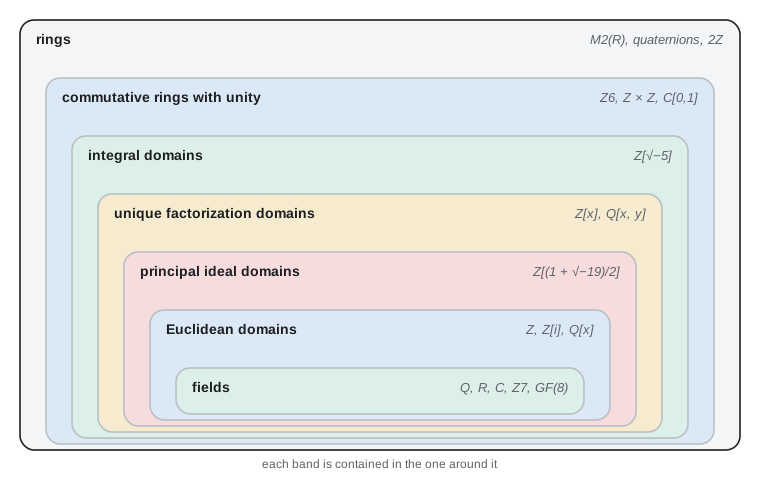
The figure shows the classes of rings this course studies. Each class is a special case of the one around it, and each step inward adds a condition that makes arithmetic behave more like arithmetic in \(\mathbb{Z}\). By lesson 8 every band will have been defined and every inclusion proved, and you will have examples showing that each inclusion is strict.
Comparing rings with groups
Much of MATH-322 transfers to rings with only small changes, and part of the skill this course develops is recognizing which group-theory argument to reuse. Here is a dictionary.
The parallel is not perfect. A ring has more structure, so there are more conditions to check and more ways for things to go wrong. Every ring is an abelian group under addition, so every additive subgroup is automatically normal; the extra condition an ideal must satisfy concerns multiplication. And some ring properties have no group analog at all: zero divisors, units, primes and irreducibles, unique factorization.
Where rings came from
Rings were not invented in one stroke. The ingredients came from number theory in the nineteenth century. Fermat had claimed that \(x^n + y^n = z^n\) has no solutions in positive integers for \(n \ge 3\). Lamé announced a proof in 1847 that factored \(x^n + y^n\) over the ring \(\mathbb{Z}[\zeta]\), where \(\zeta\) is a complex \(n\)th root of unity, and assumed that factorization into primes in that ring is unique. Liouville pointed out at once that the assumption needed proof, and Kummer had already found that it fails for some \(n\), the first being 23. Kummer rescued as much of the argument as he could by inventing ideal numbers, phantom factors that restore unique factorization. Dedekind turned Kummer's ideal numbers into sets of actual numbers in 1871, and called them ideals; lesson 4 uses exactly his definition.
The word ring (Zahlring, number ring) is due to Hilbert in 1897. The abstract axioms were given by Fraenkel in 1914, and the modern subject took shape in the 1920s in the work of Emmy Noether, whose papers of 1921 on ideal theory in rings are the source of much of lessons 4 and 5. Fields have a parallel history: the arithmetic of roots of polynomials studied by Lagrange, Gauss, Abel and Galois became the theory of field extensions in the hands of Dedekind, Weber, Steinitz (1910) and Artin, whose 1940s lectures fixed the form of Galois theory taught in lesson 12.
Checking the axioms by computer
For a finite ring the axioms can be checked by brute force. The code below builds the addition and multiplication tables of \(\mathbb{Z}_n\), checks every ring axiom on every triple of elements, and then does the same for a set that looks like a ring but is not: \(\mathbb{Z}_6\) with ordinary addition modulo 6 but with a modified multiplication \(a * b = a + b \bmod 6\). That second operation fails distributivity, and the program finds a counterexample.
from itertools import product

def check_ring(elems, add, mul, zero):
    E = list(elems)
    fails = []
    for a, b in product(E, E):
        if add(a, b) != add(b, a): fails.append(("add comm", a, b)); break
    if any(add(zero, a) != a for a in E): fails.append(("zero", zero))
    if any(all(add(a, b) != zero for b in E) for a in E): fails.append(("negatives",))
    for a, b, c in product(E, E, E):
        if add(add(a, b), c) != add(a, add(b, c)): fails.append(("add assoc", a, b, c)); break
    for a, b, c in product(E, E, E):
        if mul(mul(a, b), c) != mul(a, mul(b, c)): fails.append(("mul assoc", a, b, c)); break
    for a, b, c in product(E, E, E):
        if mul(a, add(b, c)) != add(mul(a, b), mul(a, c)): fails.append(("left distrib", a, b, c)); break
    for a, b, c in product(E, E, E):
        if mul(add(a, b), c) != add(mul(a, c), mul(b, c)): fails.append(("right distrib", a, b, c)); break
    return fails

for n in (2, 5, 6, 12):
    f = check_ring(range(n), lambda a, b: (a + b) % n, lambda a, b: (a * b) % n, 0)
    print(f"Z_{n}: ring axioms", "all hold" if not f else f)

bad = check_ring(range(6), lambda a, b: (a + b) % 6, lambda a, b: (a + b) % 6, 0)
print("Z_6 with a*b = a+b:", bad)
a, b, c = bad[0][1:]
print(f" a*(b+c) = {(a + (b + c) % 6) % 6}, but a*b + a*c = {((a + b) + (a + c)) % 6}")Z_2: ring axioms all hold
Z_5: ring axioms all hold
Z_6: ring axioms all hold
Z_12: ring axioms all hold
Z_6 with a*b = a+b: [('left distrib', 1, 0, 0), ('right distrib', 0, 0, 1)]
a*(b+c) = 1, but a*b + a*c = 2For \(\mathbb{Z}_n\) every axiom holds, as it must, because addition and multiplication modulo \(n\) inherit the laws of integer arithmetic. The second structure passes every test except distributivity. Its multiplication is associative, because it is just addition again, but \(a * (b + c) = a + b + c\) while \(a * b + a * c = 2a + b + c\), and these differ whenever \(a \ne 0\). The program reports the first such triple, \(a = 1\), \(b = c = 0\), where the two sides are 1 and 2. Always state the counterexample explicitly when you claim an axiom fails.
Worked problem
Is this a ring?
Let \(R = \mathbb{Z} \times \mathbb{Z}\) with componentwise addition and the product \((a, b)(c, d) = (ac, bd)\). Is \(R\) a ring? Commutative? Does it have a unity? Does it have zero divisors?
Show solution
- Under componentwise addition \(R\) is the direct product of two copies of the abelian group \(\mathbb{Z}\), so it is an abelian group with zero \((0, 0)\).
- Associativity: \(((a, b)(c, d))(e, f) = (ace, bdf) = (a, b)((c, d)(e, f))\), because integer multiplication is associative in each slot.
- Distributivity: \((a, b)((c, d) + (e, f)) = (a(c + e), b(d + f)) = (ac + ae, bd + bf) = (a, b)(c, d) + (a, b)(e, f)\), and the other side is the same computation.
- Commutativity holds slot by slot, and \((1, 1)\) is a unity.
- But \((1, 0)(0, 1) = (0, 0)\) although neither factor is zero.
Answer: Yes: \(R\) is a commutative ring with unity \((1, 1)\), and it has zero divisors such as \((1, 0)\) and \((0, 1)\). It is the direct product \(\mathbb{Z} \times \mathbb{Z}\).
The direct product of rings \(R \times S\), with both operations taken componentwise, is always a ring, and it always has zero divisors when both factors are nonzero. This is one reason lesson 3 singles out rings without zero divisors: they behave like the integers, and products do not.
How this course is organized
Lessons 2 to 5 build the general theory: elementary consequences of the axioms, subrings, units and zero divisors, integral domains and fields, characteristic, ideals and quotient rings, homomorphisms and the isomorphism theorems, prime and maximal ideals. Lessons 6 to 8 study polynomial rings: the division algorithm, roots, irreducibility tests, and the hierarchy of Euclidean domains, principal ideal domains and unique factorization domains. Lessons 9 to 12 study fields: extensions and their degrees, ruler-and-compass constructions, splitting fields and finite fields, and finally Galois theory. Every lesson has standard-library Python that you can run, because many claims in ring theory can be tested on small examples before they are proved.
Common mistakes
MistakeAssuming every ring has a unity.
Instead\(2\mathbb{Z}\) is a ring with no 1. Say "ring with unity" when you need one.
MistakeAssuming multiplication in a ring is commutative.
InsteadMatrix rings and the quaternions are not commutative; that is why two distributive laws are needed.
MistakeAssuming \(ab = 0\) forces \(a = 0\) or \(b = 0\).
InsteadIn \(\mathbb{Z}_6\), \(2 \cdot 3 = 0\). This cancellation property holds only in special rings.
MistakeListing \(0 \cdot a = 0\) as an axiom.
InsteadIt is a theorem, proved from distributivity and additive cancellation.
MistakeThinking the nonzero elements of a ring form a group under multiplication.
InsteadThat happens only in division rings; in \(\mathbb{Z}\), 2 has no inverse.
Summary and key terms
- A ring is an abelian group under \(+\) with an associative multiplication that distributes over addition on both sides.
- Commutativity of multiplication and a unity are extra conditions, not part of the definition.
- Key examples: \(\mathbb{Z}\), \(\mathbb{Q}\), \(\mathbb{R}\), \(\mathbb{C}\), \(\mathbb{Z}_n\), \(2\mathbb{Z}\), matrix rings, polynomial rings, function rings, \(\mathbb{Z}[i]\), the quaternions.
- Fields are commutative rings with unity in which every nonzero element is invertible.
- Ring theory parallels group theory: subrings, ideals (like normal subgroups), quotient rings and homomorphisms.
- Rings and ideals came out of nineteenth-century number theory and attempts on Fermat’s last theorem.
- ring
- An abelian group \((R, +)\) with an associative, distributive multiplication.
- commutative ring
- A ring with \(ab = ba\) for all \(a, b\).
- unity
- An element 1 with \(1a = a1 = a\) for all \(a\).
- field
- A commutative ring with unity \(1 \ne 0\) in which every nonzero element has a multiplicative inverse.
- division ring
- A ring with unity in which every nonzero element has an inverse, commutative or not.
- zero divisor
- A nonzero \(a\) with \(ab = 0\) or \(ba = 0\) for some nonzero \(b\).
- direct product
- \(R \times S\) with componentwise operations.
- Gaussian integers
- \(\mathbb{Z}[i] = \{a + bi : a, b \in \mathbb{Z}\}\).
Practice problems
Work each problem on paper first, then reveal the answer to check.
Show that \(3\mathbb{Z}\) is a ring. Does it have a unity?
Show answer
It is closed under addition, negation and multiplication, and inherits associativity and distributivity from \(\mathbb{Z}\). It has no unity: \(3e = 3\) forces \(e = 1 \notin 3\mathbb{Z}\).
Find all zero divisors of \(\mathbb{Z}_8\).
Show answer
2, 4 and 6: for example \(2 \cdot 4 = 0\) and \(6 \cdot 4 = 0\). The odd classes are invertible.
Is the set of \(2 \times 2\) real matrices with determinant 1 a ring under matrix addition and multiplication?
Show answer
No: it is not closed under addition, since \(I + I = 2I\) has determinant 4, and it does not contain the zero matrix.
Give two matrices \(A, B\) in \(M_2(\mathbb{R})\) with \(AB \ne BA\).
Show answer
\(A = \begin{pmatrix}1 & 1\\ 0 & 1\end{pmatrix}\), \(B = \begin{pmatrix}1 & 0\\ 1 & 1\end{pmatrix}\): \(AB = \begin{pmatrix}2 & 1\\ 1 & 1\end{pmatrix}\) and \(BA = \begin{pmatrix}1 & 1\\ 1 & 2\end{pmatrix}\).
In \(\mathbb{Z} \times \mathbb{Z}\), which elements have multiplicative inverses?
Show answer
Exactly \((\pm 1, \pm 1)\), the four pairs whose entries are units of \(\mathbb{Z}\).
Prove that \(0 \cdot a = 0\) in any ring.
Show answer
\(0 \cdot a = (0 + 0) \cdot a = 0 \cdot a + 0 \cdot a\); adding \(-(0 \cdot a)\) to both sides gives \(0 = 0 \cdot a\).
Why is \(\mathbb{Z}[i]\) closed under multiplication?
Show answer
\((a + bi)(c + di) = (ac - bd) + (ad + bc)i\), and \(ac - bd\) and \(ad + bc\) are integers.
Lesson quiz · 5 questions
Score 60% or more to complete this lesson.
Create a free account to save your progress, take quizzes and earn a certificate.