
MATH-100 · Lesson 5 of 12 · 42 min
Inverse functions, logarithmic differentiation and rates of change
Lesson 4 gave you the rules for differentiating powers, products, quotients, compositions, exponentials, logarithms and trigonometric functions. This lesson completes the toolkit and then turns to what derivatives mean in practice. First, it shows how to differentiate an inverse function from the function itself, which yields the derivatives of the inverse trigonometric functions met in Lesson 2. Second, it introduces logarithmic differentiation, a technique that tames products, quotients and variable exponents. Third, and most importantly, it surveys how derivatives appear as rates of change throughout science and engineering: velocity and acceleration, current, power, reaction rates, stiffness, marginal cost, and the relative rates that express sensitivity. By the end you should be able to read a derivative in any of these settings and interpret its sign, size and units.
The derivative of an inverse function
If \(f\) is one-to-one and differentiable, its inverse \(f^{-1}\) is differentiable wherever \(f'\) is not zero, and the slopes are reciprocals. Geometrically, the graph of \(f^{-1}\) is the reflection of the graph of \(f\) in the line \(y = x\), and reflection swaps rise and run, so a tangent of slope \(m\) on \(f\) becomes a tangent of slope \(1/m\) on \(f^{-1}\). Algebraically, differentiating \(f(f^{-1}(x)) = x\) with the chain rule gives \(f'(f^{-1}(x)) \cdot (f^{-1})'(x) = 1\), so:
The formula says: to find the slope of the inverse at a point, find the corresponding input of the original function, evaluate its slope there, and take the reciprocal.
Worked problem
Slope of an inverse without a formula
Let \(f(x) = x^3 + 2x + 1\), which is increasing and therefore one-to-one. Find \((f^{-1})'(4)\).
Show solution
- Find the input with \(f(x) = 4\): \(x^3 + 2x + 1 = 4\) gives \(x = 1\) (check: \(1 + 2 + 1 = 4\)).
- Slope of \(f\) there: \(f'(x) = 3x^2 + 2\), so \(f'(1) = 5\).
- Reciprocal: \((f^{-1})'(4) = 1/5\).
Answer: The inverse has slope 1/5 at x = 4, found without ever writing a formula for f⁻¹, which would require solving a cubic.
Applied to \(y = e^x\), whose inverse is \(\ln x\), the formula gives \((\ln x)' = 1/e^{\ln x} = 1/x\), confirming the result stated in Lesson 4.
Derivatives of the inverse trigonometric functions
Let \(y = \arcsin x\), so \(\sin y = x\) with \(-\pi/2 \le y \le \pi/2\). Differentiating implicitly gives \(\cos y \, y' = 1\), so \(y' = 1/\cos y\). On this interval \(\cos y \ge 0\), and \(\cos y = \sqrt{1 - \sin^2 y} = \sqrt{1 - x^2}\). The same method gives the others:
The first two hold for \(-1 < x < 1\); the arctangent formula holds for all \(x\). Notice that these derivatives are algebraic functions, not trigonometric ones: differentiating the inverse trigonometric functions removes the trigonometry. This is why integrals such as \(\int \frac{dx}{1 + x^2}\) produce arctangents, as you will see in MATH-101.
Worked problem
Rate of change of a viewing angle
A camera on the ground 50 m from the base of a launch tower tracks a rocket rising vertically. When the rocket is at height \(h\), the camera's elevation angle is \(\theta = \arctan(h/50)\). How fast is the angle changing, per meter of altitude, when \(h = 50\) m and when \(h = 500\) m?
Show solution
- Chain rule: \(\dfrac{d\theta}{dh} = \dfrac{1}{1 + (h/50)^2} \cdot \dfrac{1}{50}\).
- At \(h = 50\): \(\dfrac{1}{2} \cdot \dfrac{1}{50} = 0.01\) rad/m.
- At \(h = 500\): \(\dfrac{1}{101} \cdot \dfrac{1}{50} = 1.98 \times 10^{-4}\) rad/m.
Answer: About 0.01 rad per meter at 50 m, falling to 0.0002 rad per meter at 500 m. Combined with the rocket's speed, this gives the rate at which the camera must turn, a related-rates problem of the kind developed in Lesson 7.
Logarithmic differentiation
Some functions are easier to differentiate after taking logarithms. The method is: take the natural logarithm of both sides, simplify with the laws of logarithms, differentiate implicitly, and solve for \(y'\). It is especially useful in two situations.
Variable exponents
The power rule handles \(x^n\) with a constant exponent, and the exponential rule handles \(a^x\) with a constant base. Neither handles a function such as \(x^x\), where both base and exponent vary.
Worked problem
A variable base and exponent
Differentiate \(y = x^x\) for \(x > 0\).
Show solution
- Take logarithms: \(\ln y = x \ln x\).
- Differentiate both sides: \(\dfrac{y'}{y} = \ln x + x \cdot \dfrac{1}{x} = \ln x + 1\).
- Solve: \(y' = x^x(\ln x + 1)\).
Answer: y′ = xˣ(ln x + 1). The slope is zero at x = 1/e, where xˣ reaches its minimum value of about 0.692.
The same idea gives the derivatives of exponentials and logarithms to any base. Since \(a^x = e^{x \ln a}\), the chain rule gives \(\dfrac{d}{dx} a^x = a^x \ln a\); and since \(\log_a x = \ln x / \ln a\), \(\dfrac{d}{dx}\log_a x = \dfrac{1}{x \ln a}\).
Products and quotients of many factors
For a function built from many multiplied and divided factors, logarithms turn the product into a sum, which is much easier to differentiate.
Worked problem
A messy quotient
Differentiate \(y = \dfrac{x^2 \sqrt{3x + 1}}{(x - 2)^4}\).
Show solution
- Take logarithms: \(\ln y = 2 \ln x + \tfrac{1}{2}\ln(3x + 1) - 4 \ln(x - 2)\).
- Differentiate: \(\dfrac{y'}{y} = \dfrac{2}{x} + \dfrac{3}{2(3x + 1)} - \dfrac{4}{x - 2}\).
- Multiply by \(y\): \(y' = \dfrac{x^2 \sqrt{3x + 1}}{(x - 2)^4}\left(\dfrac{2}{x} + \dfrac{3}{2(3x + 1)} - \dfrac{4}{x - 2}\right)\).
Answer: The result follows in three short steps, whereas the quotient and product rules together would produce a page of algebra.
Rates of change in science and engineering
A derivative \(dy/dx\) measures how fast \(y\) changes as \(x\) changes, in units of \(y\) per unit of \(x\). Many quantities that engineers measure are derivatives of others:
| Field | Quantity | Derivative of |
|---|---|---|
| Mechanics | Velocity \(v = ds/dt\) | Position with respect to time |
| Mechanics | Acceleration \(a = dv/dt\) | Velocity with respect to time |
| Electricity | Current \(i = dq/dt\) | Charge with respect to time |
| Energy | Power \(P = dE/dt\) | Energy with respect to time |
| Materials | Stiffness \(k = dF/dx\) | Force with respect to displacement |
| Chemistry | Reaction rate \(-d[A]/dt\) | Concentration with respect to time |
| Fluids | Flow rate \(Q = dV/dt\) | Volume with respect to time |
| Economics | Marginal cost \(dC/dq\) | Total cost with respect to quantity |
Motion along a line
For an object moving along a straight line with position \(s(t)\), the velocity \(v = s'(t)\) gives speed and direction (its sign), and the acceleration \(a = v'(t) = s''(t)\) gives the rate of change of velocity. The object is at rest when \(v = 0\), moves in the positive direction when \(v > 0\), and is speeding up when \(v\) and \(a\) have the same sign and slowing down when they have opposite signs. The rate of change of acceleration, \(j = a'(t)\), called jerk, matters in elevator and vehicle design, because passengers feel sudden changes in acceleration as discomfort.
Worked problem
Analyzing a motion
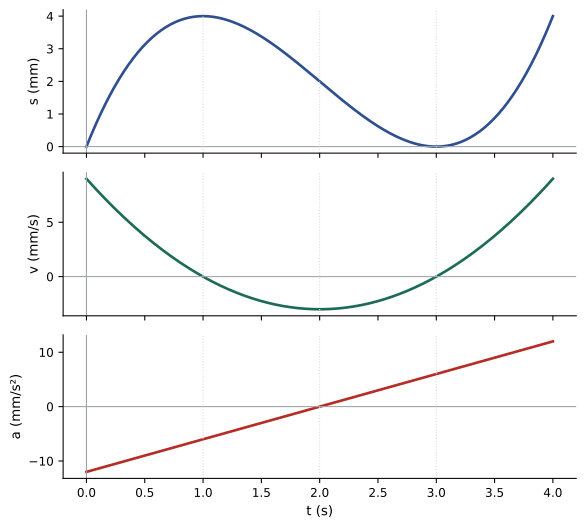
A machine slide moves with position \(s(t) = t^3 - 6t^2 + 9t\) mm for \(0 \le t \le 4\) s. When is it at rest? When does it move backward? When is it speeding up? What total distance does it travel?
Show solution
- Velocity: \(v = 3t^2 - 12t + 9 = 3(t - 1)(t - 3)\). At rest at \(t = 1\) and \(t = 3\) s.
- Sign of \(v\): positive on \([0, 1)\), negative on \((1, 3)\), positive on \((3, 4]\). It moves backward between 1 and 3 s.
- Acceleration: \(a = 6t - 12\), negative before 2 s and positive after.
- Speeding up where \(v\) and \(a\) share a sign: on \((1, 2)\) (both negative) and \((3, 4]\) (both positive).
- Positions: \(s(0) = 0\), \(s(1) = 4\), \(s(3) = 0\), \(s(4) = 4\). Distance: \(4 + 4 + 4 = 12\) mm.
Answer: At rest at 1 s and 3 s, moving backward between them, speeding up on (1, 2) and (3, 4], and traveling 12 mm in total although it ends only 4 mm from its start. Distance and displacement differ whenever the velocity changes sign.
Current, power and energy
Electrical current is the rate at which charge passes a point, \(i = dq/dt\). If the charge on a capacitor is \(q = CV\) and the voltage changes with time, the current is \(i = C \, dV/dt\), the defining relationship of a capacitor. Power is the rate of energy transfer, \(P = dE/dt\), and for a component with voltage \(v\) and current \(i\), \(P = vi\).
Worked problem
Current in a capacitor
The voltage across a 10 µF capacitor is \(V(t) = 170 \sin(120\pi t)\) V, a 60 Hz supply. Find the current and its maximum value.
Show solution
- \(i = C \dfrac{dV}{dt} = 10 \times 10^{-6} \times 170 \times 120\pi \cos(120\pi t)\).
- Amplitude: \(10^{-5} \times 170 \times 377 = 0.641\) A.
Answer: i(t) = 0.641 cos(120πt) A. The current peaks when the voltage is changing fastest, at the zero crossings, a quarter-cycle ahead of the voltage, which is why current leads voltage in a capacitor.
Stiffness and the slope of a test curve
In a tensile or spring test, the slope of the force-displacement curve is the stiffness \(k = dF/dx\). For a linear spring the slope is constant; for real materials and structures it changes. A rubber mount may stiffen as it is compressed, and a steel bar loses stiffness as it begins to yield. Engineers read the tangent stiffness from the slope of the curve at the operating point, exactly the derivative of Lesson 3.
Worked problem
Tangent stiffness of a mount
A rubber mount follows \(F(x) = 20x + 0.8x^3\) N, with \(x\) in mm. Find its stiffness at \(x = 2\) mm and at \(x = 5\) mm.
Show solution
- \(k(x) = F'(x) = 20 + 2.4x^2\) N/mm.
- At 2 mm: \(20 + 9.6 = 29.6\) N/mm. At 5 mm: \(20 + 60 = 80\) N/mm.
Answer: The mount is 29.6 N/mm stiff at 2 mm and 80 N/mm at 5 mm. Such hardening springs are used to isolate vibration at light load while limiting deflection under heavy load.
Marginal quantities in economics
In economics, the derivative of total cost \(C(q)\) with respect to quantity \(q\) is the marginal cost, approximately the cost of producing one more unit. Engineers use marginal analysis when deciding how far to push an expensive improvement: if the marginal cost of a further gain in efficiency exceeds the marginal value of the energy saved, the improvement is not worth it.
Worked problem
Marginal cost
The daily cost of producing \(q\) castings is \(C(q) = 2000 + 45q + 0.02q^2\) dollars. Find the marginal cost at \(q = 500\), and compare with the actual cost of the 501st casting.
Show solution
- \(C'(q) = 45 + 0.04q\), so \(C'(500) = 65\) dollars per casting.
- Actual: \(C(501) - C(500) = (45 \times 501 + 0.02 \times 501^2) - (45 \times 500 + 0.02 \times 500^2) = 45 + 0.02 \times 1001 = 65.02\) dollars.
Answer: The marginal cost of $65 closely matches the actual extra cost of $65.02, illustrating the linear approximation of Lesson 3.
Relative rates and sensitivity
Often the useful question is not how much a quantity changes but by what percentage. The relative rate of change of \(y\) is \(y'/y\), which equals the derivative of \(\ln y\). For small changes, the fractional change in \(y\) is approximately \((y'/y)\,\Delta x\). Taking logarithms of a formula built from powers gives a quick way to find how percentage errors combine: if \(y = k \, x_1^a x_2^b\), then \(\ln y = \ln k + a \ln x_1 + b \ln x_2\), and small fractional changes satisfy:
Worked problem
Sensitivity of wire resistance
The resistance of a round wire is \(R = \dfrac{4 \rho L}{\pi D^2}\). If the diameter is 1 percent smaller than specified and the length 0.5 percent longer, by what percentage does the resistance change?
Show solution
- Logarithms: \(\ln R = \ln(4\rho/\pi) + \ln L - 2 \ln D\).
- Fractional change: \(\Delta R / R \approx 0.005 - 2(-0.01) = 0.025\).
Answer: About 2.5 percent higher resistance. Diameter enters squared, so its error counts double; this is why wire is specified by cross-sectional area or gauge with tight diameter tolerances.
This technique, sometimes called logarithmic error propagation, is the basis of the uncertainty calculations used in laboratory reports and of sensitivity studies in design. It also explains exponential growth from a new angle: a quantity with a constant relative growth rate \(y'/y = k\) satisfies \(y' = ky\), whose solution, as Lesson 8 shows, is \(y = y_0 e^{kt}\).
Common mistakes
MistakeWriting (f⁻¹)′(x) = 1/f′(x).
InsteadEvaluate f′ at f⁻¹(x): (f⁻¹)′(x) = 1/f′(f⁻¹(x)).
MistakeUsing the power rule on xˣ.
InsteadUse logarithmic differentiation for variable base and exponent.
MistakeTreating displacement as distance traveled.
InsteadSplit the motion where velocity changes sign and add the pieces.
MistakeDeciding an object is speeding up because acceleration is positive.
InsteadIt speeds up when velocity and acceleration have the same sign.
MistakeForgetting units when interpreting a derivative.
InsteadA derivative has units of output per unit of input.
Summary and key terms
- The slope of an inverse is the reciprocal of the original slope at the corresponding point.
- d/dx arcsin x = 1/√(1−x²), d/dx arccos x = −1/√(1−x²), d/dx arctan x = 1/(1+x²).
- Logarithmic differentiation handles variable exponents and long products and quotients.
- d/dx aˣ = aˣ ln a and d/dx logₐ x = 1/(x ln a).
- Velocity, acceleration, current, power, stiffness, reaction rate and marginal cost are derivatives.
- An object speeds up when velocity and acceleration share a sign; distance and displacement differ when velocity changes sign.
- Relative rates y′/y give percentage sensitivities; powers in a formula multiply fractional errors.
- Inverse function derivative
- The reciprocal of the original derivative at the matching point.
- Logarithmic differentiation
- Differentiating the logarithm of a function to simplify the calculation.
- Velocity
- The rate of change of position with respect to time.
- Acceleration
- The rate of change of velocity with respect to time.
- Jerk
- The rate of change of acceleration with respect to time.
- Displacement
- The net change in position.
- Tangent stiffness
- The slope of a force-displacement curve at a point.
- Marginal cost
- The derivative of total cost with respect to quantity.
- Relative rate of change
- The derivative divided by the function value, y′/y.
- Sensitivity
- How strongly an output responds to a change in an input.
Practice problems
Work each problem on paper first, then reveal the answer to check.
\(f(x) = x^5 + x\). Find \((f^{-1})'(2)\).
Show answer
f(1) = 2 and f′(1) = 6, so 1/6.
Differentiate \(\arctan(3x)\).
Show answer
3/(1 + 9x²).
Differentiate \(\arcsin(x^2)\).
Show answer
2x/√(1 − x⁴).
Differentiate \(y = 10^x\).
Show answer
10ˣ ln 10.
Differentiate \(y = x^{\sin x}\) for \(x > 0\).
Show answer
xˢⁱⁿ ˣ (cos x ln x + sin x / x).
\(s(t) = t^2 - 4t\). When is the object at rest, and what distance does it travel from 0 to 5 s?
Show answer
At rest at t = 2; distance 4 + 9 = 13.
Charge \(q(t) = 0.002 e^{-50t}\) C. Find the current at \(t = 0\).
Show answer
−0.1 A.
\(F = 50x + 2x^2\) N with x in mm. Tangent stiffness at 10 mm?
Show answer
90 N/mm.
A sphere's volume is \(\tfrac{4}{3}\pi r^3\). A 2% error in r gives what error in V?
Show answer
About 6%.
What does a relative growth rate of 0.05 per year mean?
Show answer
The quantity grows by about 5% of its size per year.
Lesson quiz · 5 questions
Score 60% or more to complete this lesson.
Create a free account to save your progress, take quizzes and earn a certificate.