
MATH-100 · Lesson 2 of 12 · 43 min
Exponential, logarithmic and inverse functions
Polynomials and rational functions describe many engineering quantities, but some of the most important processes in nature and technology follow a different pattern: a quantity changes at a rate proportional to its current size. A charged capacitor discharges this way, a radioactive sample decays this way, a hot casting cools roughly this way, and money grows this way under compound interest. These processes are described by exponential functions, and undoing them, finding how long it takes to reach a given value, requires their inverses, the logarithms. This lesson develops the idea of an inverse function, then studies exponential and logarithmic functions, the inverse trigonometric functions that turn ratios back into angles, and the limits of these functions that you will need when you differentiate them in Lessons 4 and 5. It also shows how to recognize exponential behavior in measured data.
One-to-one functions and inverses
A function \(f\) takes each input \(x\) to one output \(f(x)\). An inverse function \(f^{-1}\) runs the process backward, taking each output back to the input that produced it:
An inverse exists only if no two inputs give the same output, that is, if \(f\) is one-to-one. Graphically, a function is one-to-one if every horizontal line crosses its graph at most once (the horizontal line test). The function \(f(x) = x^3\) passes: each output comes from exactly one input. The function \(f(x) = x^2\) fails, because \(f(2) = f(-2) = 4\), so the question "which input gave 4?" has two answers. We can still define an inverse by restricting the domain: on \(x \ge 0\), \(x^2\) is one-to-one and its inverse is \(\sqrt{x}\).
To find an inverse algebraically, write \(y = f(x)\), solve for \(x\) in terms of \(y\), then rename the variables if you want the inverse as a function of \(x\). The composition of a function and its inverse gives back the original input: \(f^{-1}(f(x)) = x\) for every \(x\) in the domain of \(f\), and \(f(f^{-1}(y)) = y\) for every \(y\) in its range. The domain of \(f^{-1}\) is the range of \(f\), and vice versa.
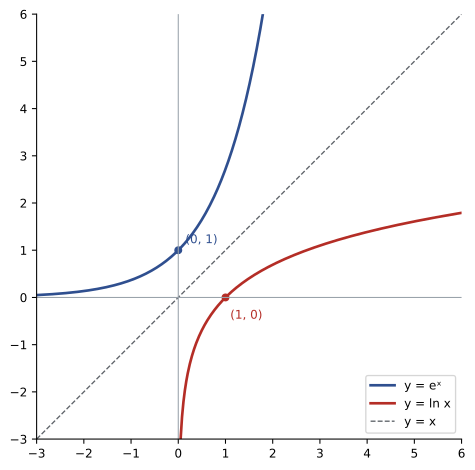
Because the inverse swaps the roles of input and output, the graph of \(f^{-1}\) is the mirror image of the graph of \(f\) in the line \(y = x\).
Worked problem
Finding an inverse
A temperature sensor's output voltage is \(V = 0.5 + 0.01T\), where \(T\) is the temperature in °C. Find the function that converts a voltage reading back to temperature, and the temperature when \(V = 0.82\) V.
Show solution
- Solve for \(T\): \(V - 0.5 = 0.01T\), so \(T = 100(V - 0.5)\).
- At \(V = 0.82\): \(T = 100 \times 0.32 = 32\) °C.
- Check: \(0.5 + 0.01 \times 32 = 0.82\).
Answer: The inverse is T = 100(V − 0.5), giving 32 °C. Instrument calibration is a constant use of inverse functions: the sensor maps temperature to voltage, and the software must map voltage back.
Worked problem
Restricting the domain
Find the inverse of \(f(x) = (x - 2)^2 + 1\) on the domain \(x \ge 2\), and state its domain and range.
Show solution
- Write \(y = (x - 2)^2 + 1\), so \((x - 2)^2 = y - 1\).
- Since \(x \ge 2\), take the positive root: \(x - 2 = \sqrt{y - 1}\), so \(x = 2 + \sqrt{y - 1}\).
- The range of \(f\) on \(x \ge 2\) is \(y \ge 1\), which becomes the domain of the inverse.
Answer: f⁻¹(x) = 2 + √(x − 1), with domain x ≥ 1 and range y ≥ 2.
Exponential functions
An exponential function has the variable in the exponent:
For \(a > 1\) it increases, slowly at first and then ever faster; for \(0 < a < 1\) it decreases toward zero. Every exponential function passes through \((0, 1)\), is always positive, and has the horizontal asymptote \(y = 0\) on one side. The familiar laws of exponents apply: \(a^{x+y} = a^x a^y\), \(a^{x-y} = a^x / a^y\), \((a^x)^y = a^{xy}\) and \(a^{-x} = 1/a^x\).
The key property of exponential growth is that equal steps in \(x\) multiply the output by equal factors. Increasing \(x\) by 1 multiplies \(2^x\) by 2, whatever the starting point. This is why exponential quantities have a fixed doubling time or half-life.
The number e
One base is special. Consider an account paying 100 percent interest per year, compounded \(n\) times a year. After one year, one dollar becomes \((1 + 1/n)^n\) dollars. Compounding more often gives more, but the amount approaches a limit:
The function \(e^x\), often written \(\exp(x)\), is called the natural exponential function. Lesson 4 will show why it is natural: it is the only exponential function whose slope at every point equals its own value, which makes it the function that describes any process whose rate of change is proportional to its size. Every exponential can be written with base \(e\), since \(a^x = e^{x \ln a}\).
Exponential models
A quantity that grows or decays at a rate proportional to its size follows:
where \(Q_0\) is the initial value and \(k\) the growth rate (positive for growth, negative for decay). Decay problems are often written with a time constant \(\tau = -1/k\), so that \(Q = Q_0 e^{-t/\tau}\): after one time constant, the quantity has fallen to \(1/e \approx 36.8\) percent of its starting value.
Worked problem
Capacitor discharge
A 100 µF capacitor charged to 400 V in a power supply discharges through a 47 kΩ bleeder resistor, so that \(V(t) = 400 e^{-t/RC}\). What is the voltage after 10 seconds, and after how many time constants is it below 50 V, a common safety threshold?
Show solution
- Time constant: \(RC = 47{,}000 \times 100 \times 10^{-6} = 4.7\) s.
- At 10 s: \(V = 400 e^{-10/4.7} = 400 e^{-2.13} = 400 \times 0.119 = 47.6\) V.
- Below 50 V requires \(e^{-t/RC} < 0.125\), which, as the logarithm section will show, means \(t > RC \ln 8 = 2.08\,RC\).
Answer: About 48 V after 10 s, a little over two time constants. Safety standards for power electronics require bleeder resistors sized so that stored voltage falls to a safe level within a specified time after power is removed.
Logarithms
Because \(a^x\) is one-to-one, it has an inverse, the logarithm to base \(a\):
In words, \(\log_a y\) is the exponent to which \(a\) must be raised to give \(y\). Logarithms are defined only for positive \(y\), because \(a^x\) is always positive. The logarithm to base \(e\) is the natural logarithm, written \(\ln\), and the logarithm to base 10 is the common logarithm, often written \(\log\). As inverse functions, \(\ln(e^x) = x\) for all \(x\) and \(e^{\ln y} = y\) for \(y > 0\). The graph of \(\ln x\) is the reflection of \(e^x\) in the line \(y = x\): it passes through \((1, 0)\), increases without bound but very slowly, and plunges toward \(-\infty\) as \(x \to 0^+\).
The laws of logarithms follow from the laws of exponents. For positive \(x\) and \(y\):
A logarithm to any base can be computed from natural logarithms with the change-of-base formula, \(\log_a x = \ln x / \ln a\).
Solving exponential equations
Logarithms bring exponents down to where they can be solved for. To solve \(Q_0 e^{kt} = Q\), divide by \(Q_0\) and take the natural logarithm of both sides: \(kt = \ln(Q/Q_0)\), so \(t = \ln(Q/Q_0)/k\). Two useful special cases are the doubling time of growth, \(t_2 = \ln 2 / k \approx 0.693/k\), and the half-life of decay, \(t_{1/2} = \ln 2 / |k|\).
Worked problem
Radiocarbon dating
Carbon-14 has a half-life of about 5,730 years. A wooden beam from an archaeological site contains 62 percent of the carbon-14 found in living wood. Estimate its age.
Show solution
- Decay constant: \(k = -\ln 2 / 5730 = -1.21 \times 10^{-4}\) per year.
- Solve \(e^{kt} = 0.62\): \(t = \ln 0.62 / k = -0.478 / (-1.21 \times 10^{-4}) \approx 3{,}950\) years.
Answer: About 3,950 years. In practice, radiocarbon ages are calibrated against tree-ring records, because the atmosphere's carbon-14 level has varied over time.
Worked problem
How long to cool?
A steel casting at 900 °C cools in a room at 20 °C. Its temperature difference from the room decays exponentially, \(T - 20 = 880 e^{-t/45}\), with \(t\) in minutes. When does it reach 60 °C, safe to handle with gloves?
Show solution
- Set \(880 e^{-t/45} = 40\), so \(e^{-t/45} = 40/880 = 0.0455\).
- Take logarithms: \(-t/45 = \ln 0.0455 = -3.09\), so \(t = 139\) minutes.
Answer: About 139 minutes, a little over two hours. This model, Newton's law of cooling, is derived from a differential equation in Lesson 8.
Logarithmic scales
Quantities that span many orders of magnitude are often measured on logarithmic scales. Sound pressure level in decibels is \(L = 20 \log_{10}(p/p_0)\), where \(p_0 = 20\) µPa, so every factor of 10 in sound pressure adds 20 dB (and every factor of 10 in sound power adds 10 dB). The pH of a solution is \(-\log_{10}[\text{H}^+]\). Earthquake magnitudes, signal gains in electronics, and star brightnesses are all logarithmic. On such scales, equal steps represent equal ratios, not equal differences.
Worked problem
Adding noise sources
One machine produces 85 dB at a work station. What is the level when a second, identical machine is switched on, if the sound powers add?
Show solution
- Doubling the sound power adds \(10 \log_{10} 2 = 3.0\) dB.
- Level: \(85 + 3 = 88\) dB.
Answer: About 88 dB, not 170 dB. Because decibels are logarithmic, doubling the number of equal sources adds only 3 dB, while occupational noise limits in many jurisdictions halve the permitted exposure time for each 3 dB increase.
Inverse trigonometric functions
The sine function is not one-to-one, because it repeats every \(2\pi\). To define an inverse, we restrict its domain to \([-\pi/2, \pi/2]\), where it increases through every value from −1 to 1 exactly once. The inverse sine, \(\arcsin x\) or \(\sin^{-1} x\), is the angle in \([-\pi/2, \pi/2]\) whose sine is \(x\). Similarly, \(\arccos x\) is the angle in \([0, \pi]\) whose cosine is \(x\), and \(\arctan x\) is the angle in \((-\pi/2, \pi/2)\) whose tangent is \(x\); \(\arctan x\) is defined for all real \(x\) and approaches \(\pm\pi/2\) as \(x \to \pm\infty\).
Note that \(\sin^{-1} x\) means the inverse function, not \(1/\sin x\), which is \(\csc x\). Calculators return values only in the restricted ranges, so the engineer must decide which angle a problem actually needs. To find the direction of a vector \((x, y)\) in any quadrant, programming languages provide a two-argument function, usually called atan2, that uses the signs of both components.
Worked problem
Angle of a ramp
An accessible ramp must rise 0.75 m over a horizontal run of 9.0 m. What angle does it make with the horizontal, and what is its length?
Show solution
- Angle: \(\theta = \arctan(0.75 / 9.0) = \arctan(0.0833) = 0.0831\) rad \(= 4.76°\).
- Length: \(\sqrt{9.0^2 + 0.75^2} = 9.03\) m.
Answer: About 4.8°, a slope of 1 in 12, the usual maximum for accessible ramps in building codes, and a length of about 9.03 m.
Limits of exponential and logarithmic functions
The limits of these functions at infinity, and their comparison with powers, appear constantly in engineering analysis:
- \(\lim_{x \to \infty} e^x = \infty\) and \(\lim_{x \to -\infty} e^x = 0\), so \(e^{-t/\tau} \to 0\) as \(t \to \infty\): every exponential decay dies out.
- \(\lim_{x \to \infty} \ln x = \infty\) and \(\lim_{x \to 0^+} \ln x = -\infty\).
- Exponentials beat powers: for any power \(n\), \(\lim_{x \to \infty} x^n / e^x = 0\). However large \(n\) is, \(e^x\) eventually grows faster.
- Powers beat logarithms: for any \(p > 0\), \(\lim_{x \to \infty} \ln x / x^p = 0\).
These comparisons can be checked numerically now and will be proved with L'Hôpital's rule in Lesson 7. They explain, for instance, why an algorithm whose running time grows exponentially with the size of its input soon becomes impractical, while one that grows like a power can scale, and one that grows like a logarithm barely notices larger inputs.
Worked problem
Exponential versus power growth
Compare \(x^{10}\) and \(e^x\) at \(x = 10\), \(30\) and \(50\).
Show solution
- At 10: \(10^{10} = 1.0 \times 10^{10}\) and \(e^{10} = 2.2 \times 10^4\); the power is far larger.
- At 30: \(30^{10} = 5.9 \times 10^{14}\) and \(e^{30} = 1.1 \times 10^{13}\); the power is still larger.
- At 50: \(50^{10} = 9.8 \times 10^{16}\) and \(e^{50} = 5.2 \times 10^{21}\); the exponential has overtaken it by a factor of about 50,000.
Answer: The exponential overtakes x¹⁰ between 30 and 50 (at about x ≈ 35.8) and then leaves it far behind. Limits describe eventual behavior, which can differ greatly from behavior at moderate values.
Recognizing exponential behavior in data
If \(y = A e^{kt}\), then taking logarithms gives \(\ln y = \ln A + kt\): a straight line when \(\ln y\) is plotted against \(t\). Plotting measured data on a semi-logarithmic graph (logarithmic vertical axis, linear horizontal axis) is therefore a quick test for exponential behavior, and the slope gives the rate \(k\). Similarly, a power law \(y = A x^n\) becomes \(\ln y = \ln A + n \ln x\), a straight line on a log-log graph with slope \(n\). These transformations are widely used in engineering to fit models to test data.
Worked problem
Fitting a decay from two readings
The activity of a medical radioisotope source is 800 MBq on Monday at 9:00 and 200 MBq on Wednesday at 9:00. Assuming exponential decay, find its half-life and predict the activity on Thursday at 9:00.
Show solution
- Activity fell by a factor of 4 in 48 hours, which is two halvings, so the half-life is 24 hours.
- Formally: \(k = \ln(200/800)/48 = -1.386/48 = -0.0289\) per hour; \(t_{1/2} = \ln 2 / 0.0289 = 24\) h.
- Thursday is 24 hours later: \(200 \times 0.5 = 100\) MBq.
Answer: A half-life of 24 hours and an activity of 100 MBq on Thursday. With more than two readings, a straight-line fit to ln(activity) versus time gives the best estimate of k.
Common mistakes
MistakeAssuming every function has an inverse.
InsteadOnly one-to-one functions do; restrict the domain if necessary.
MistakeWriting ln(x + y) = ln x + ln y.
Insteadln(xy) = ln x + ln y; there is no rule for the logarithm of a sum.
MistakeReading sin⁻¹ x as 1/sin x.
Insteadsin⁻¹ x is the inverse sine (arcsin); 1/sin x is csc x.
MistakeAdding decibel levels directly.
InsteadConvert to powers, add, and convert back; two equal sources add 3 dB.
MistakeTaking the logarithm of zero or a negative number.
InsteadLogarithms are defined only for positive arguments.
Summary and key terms
- A one-to-one function has an inverse whose graph is the reflection of the original in y = x.
- Exponential functions aˣ multiply by a fixed factor for each unit step, giving constant doubling times or half-lives.
- The number e ≈ 2.718 arises from continuous compounding; Q = Q₀eᵏᵗ models proportional growth and decay.
- Logarithms are inverses of exponentials and turn products into sums and powers into multiples.
- Doubling time is ln 2/k; time constants describe decay to 1/e.
- Inverse trigonometric functions return angles in restricted ranges.
- Exponentials outgrow every power, powers outgrow logarithms, and semi-log plots reveal exponential data.
- One-to-one function
- A function in which different inputs always give different outputs.
- Inverse function
- A function that reverses another, mapping each output back to its input.
- Horizontal line test
- A graph is one-to-one if every horizontal line meets it at most once.
- Exponential function
- A function of the form aˣ with constant base a.
- Natural exponential
- The function eˣ.
- Time constant
- The time for an exponential decay to fall to 1/e of its value.
- Half-life
- The time for a decaying quantity to halve.
- Natural logarithm
- The logarithm to base e, written ln.
- Logarithmic scale
- A scale on which equal steps represent equal ratios.
- Inverse sine
- The angle in [−π/2, π/2] whose sine is a given number.
Practice problems
Work each problem on paper first, then reveal the answer to check.
Find the inverse of \(f(x) = 3x - 7\).
Show answer
f⁻¹(x) = (x + 7)/3.
Does \(f(x) = x^4\) have an inverse on all real numbers? On \(x \ge 0\)?
Show answer
No (it fails the horizontal line test); yes, the fourth root.
Simplify \(\ln(e^5) + e^{\ln 3}\).
Show answer
5 + 3 = 8.
Solve \(2^x = 50\).
Show answer
x = ln 50 / ln 2 ≈ 5.64.
A population grows at 3% per year continuously. Doubling time?
Show answer
ln 2 / 0.03 ≈ 23.1 years.
A source has a half-life of 8 days. What fraction remains after 24 days?
Show answer
1/8.
An RC circuit has τ = 2 ms. How long until it falls to 1% of its initial voltage?
Show answer
τ ln 100 = 2 × 4.605 ≈ 9.2 ms.
Two sources produce 90 dB and 90 dB. Combined level?
Show answer
93 dB.
Evaluate \(\arcsin(0.5)\) and \(\arctan(1)\) in radians.
Show answer
π/6 and π/4.
Data fall on a straight line when ln y is plotted against t with slope −0.2. What model fits?
Show answer
y = Ae^(−0.2t), exponential decay.
Lesson quiz · 5 questions
Score 60% or more to complete this lesson.
Create a free account to save your progress, take quizzes and earn a certificate.