
LVT-110 · Lesson 8 of 12 · 19 min
Ladders, lifts, ceilings and confined spaces
Most of a low-voltage technician's working hours are spent above the floor. Cable is pulled through ceilings, devices are mounted on walls and ceilings, access points hang from gymnasium trusses and warehouse roof structures, and cameras sit on parking lot poles. Falls are the leading cause of serious injury in the trade, and many of them are falls from a stepladder of only a few steps. This lesson covers the equipment used to work at height, how to choose and use it, the particular hazards of ceiling spaces, and the confined spaces such as maintenance holes and utility vaults that some low-voltage work enters.
Why falls happen
Falls in this trade rarely happen because of a dramatic failure. They happen when a technician stands on the top step of a stepladder to reach a little farther, leans out to one side instead of moving the ladder, climbs with a box of hardware in one hand, sets a ladder on a cable or a patch of wet floor, or uses a stepladder folded and leaned against a wall. A fall of 2 m onto a concrete floor can cause a fractured skull, wrist or spine. The controls are well known and simple, and the challenge is using them every time, especially at the end of a long day when only one more device remains.
OSHA's construction rules set out requirements for ladders in 29 CFR 1926 Subpart X, for scaffolds and aerial lifts in Subpart L, and for fall protection in Subpart M, which generally requires fall protection at 6 ft and above in construction work; employers must train workers who use ladders and fall protection.
Choosing a ladder
Ladders are rated by duty: the maximum load they are designed to carry, including the worker, clothing, tools and materials. ANSI A14 rates portable ladders by duty type; Type I and Type IA ladders, rated 250 and 300 lb, are the usual choice on construction sites. A technician carrying a cable spool, a drill and a pouch of hardware weighs a good deal more than she does in the parking lot, and the rating must cover the total.
Material matters too. Aluminum ladders conduct electricity, so they are never used near exposed power conductors or overhead lines; fiberglass ladders are standard in the trade for that reason. Wooden ladders are rarely seen now.
- Stepladders are self-supporting and suit most interior work below about 3 m. They must be fully opened with the spreaders locked, set on firm level ground, and the top cap and the step below it must not be stood on. A technician who needs to stand higher needs a taller ladder.
- Extension and straight ladders lean against a support and suit reaching ceilings above the stepladder's range, roofs and exterior walls.
- Platform ladders provide a standing platform with a guard rail at the top, and are often a better choice than a stepladder for extended overhead work such as terminating at a ceiling-mounted access point.
Every ladder is inspected before use: rails and steps for cracks, bends or damage; feet and their pads; spreaders and locks; rungs for oil or mud; and labels. A damaged ladder is tagged out of service and removed from the site, never left leaning against a wall for someone else to use.
Setting up and using an extension ladder
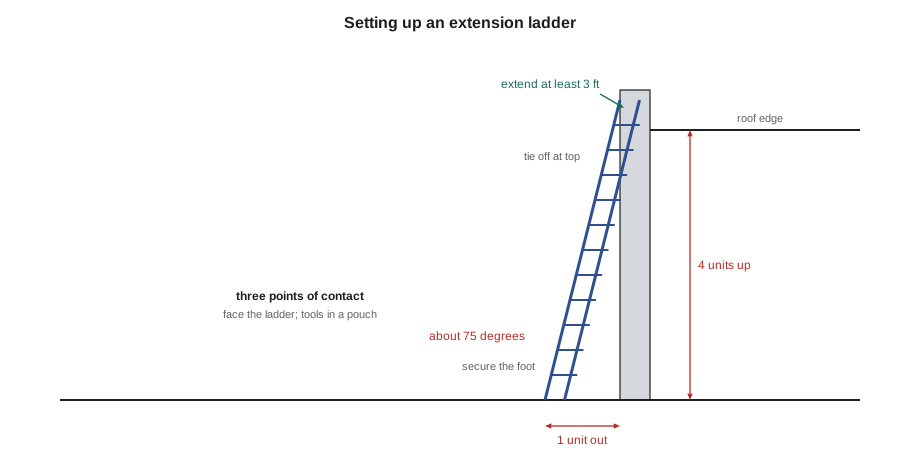
An extension ladder must lean at the correct angle. The rule is four to one: for every four units of height to the point where the ladder rests, the foot is set one unit out from the wall, which gives an angle of about 75 degrees. A ladder set too steeply can tip backward when the climber leans back; one set too shallow can slide out at the foot. When the ladder is used to reach a roof or platform, its side rails must extend at least 3 ft above the landing so the climber has something to hold while stepping off, and it must be tied off or otherwise secured at the top and footed or secured at the bottom.
# Four-to-one ladder setup check
import math
def check(height, base):
    angle = math.degrees(math.atan2(height, base))
    ratio = height / base
    ok = 73.0 <= angle <= 78.0
    return angle, ratio, ok
for height, base in ((20.0, 5.0), (20.0, 3.0), (16.0, 6.5)):
    a, r, ok = check(height, base)
    tip = "" if ok else ("  too steep: move the foot out" if a > 78 else "  too shallow: move the foot in")
    print(f"height {height} ft, foot {base} ft out: {r:.1f} to 1, {a:.1f} degrees{tip}")
print(f"ideal foot distance for a {20.0} ft support: {20.0 / 4:.2f} ft")height 20.0 ft, foot 5.0 ft out: 4.0 to 1, 76.0 degrees height 20.0 ft, foot 3.0 ft out: 6.7 to 1, 81.5 degrees too steep: move the foot out height 16.0 ft, foot 6.5 ft out: 2.5 to 1, 67.9 degrees too shallow: move the foot in ideal foot distance for a 20.0 ft support: 5.00 ft
Climbing follows three-point contact: two hands and a foot, or two feet and a hand, are on the ladder at all times, and the climber faces the ladder. Tools and materials go up in a pouch or on a hand line, not in a hand. The climber keeps her belt buckle between the rails; if she has to lean so that her body is outside the rails, the ladder needs to be moved. Only one person is on a ladder at a time unless it is designed for more.
Mobile elevating work platforms
At Riverside's gymnasium and the Hartwell distribution warehouse, the access points and cameras hang 25 to 40 ft above the floor, far beyond any ladder. Cobalt Line uses mobile elevating work platforms: scissor lifts, which raise a platform straight up, and boom lifts, which reach up and out on an articulating or telescoping arm. Operators must be trained and familiarized on the specific model, and lifts are inspected before each shift: controls, emergency lowering, guardrails, tires, hydraulic leaks and the platform gate.
The guardrails of a scissor lift are the fall protection, and the operator stays on the platform floor inside them; climbing the guardrails or standing on a bucket to gain height defeats them. On boom lifts, a full-body harness with a short lanyard attached to the platform's anchor point is required, because a boom can catapult a worker out of the basket if it is struck or if a wheel drops into a hole. Before raising a lift, the operator checks the floor for slopes, holes, drains and soft spots, the overhead area for structure, sprinkler pipes and power lines, and the travel path for people. When traveling, the platform is lowered as far as the work allows. At Hartwell, the general contractor issues a lift permit for each zone, and forklift traffic is stopped in the zone while Cobalt Line's lifts are working.
Working in ceiling spaces
A suspended ceiling hides a crowded space: ductwork, sprinkler pipes, electrical conduit, light fixtures and their power whips, other trades' cable trays, and the hanger wires that hold up the grid. Hazards include sharp edges on ducts and metal studs, hot pipes, live lighting circuits, dust and debris that falls into the eyes, and, in older buildings, asbestos in pipe insulation, fireproofing or ceiling tiles. A ceiling tile or grid will never support a person, and a technician never climbs into or walks on a suspended ceiling; work is done from below, from ladders or platforms.
Before opening ceilings in an existing building, Cobalt Line checks the owner's designated substances or asbestos survey, and work stops if suspect material is found. In hospitals, opening ceilings also requires an infection control permit. At St. Brendan's, every ceiling opening above a patient area is done inside a portable containment cart with a HEPA-filtered fan, the tile is replaced the same day, and the cart is wiped down before it moves. Lesson 12 returns to the permit process.
Ceiling work also brings eye and head hazards. Safety glasses are worn whenever a tile is lifted, because the dust and debris above a tile fall straight down into the face. A bump cap or hard hat protects against duct corners and hanger rods in low spaces. And a technician pulling cable through a ceiling must watch where her hands go: reaching blindly into a ceiling to grab a cable can put a hand on a hot pipe, a sharp duct edge or a light fixture's power connection.
Confined spaces
Some low-voltage work enters confined spaces: maintenance holes and vaults for underground fiber and copper, crawl spaces under buildings, and occasionally tanks or equipment enclosures. A confined space is one that is not designed for continuous occupancy, has restricted entry or exit, and may contain or develop a hazardous atmosphere or other serious hazard. Underground vaults can collect gases such as hydrogen sulfide or methane, can lack oxygen, or can contain carbon monoxide from nearby vehicle exhaust. Their atmosphere can be dangerous even when it smells of nothing.
OSHA's construction confined space rule, 29 CFR 1926 Subpart AA, sets the requirements: identification of permit-required spaces, atmospheric testing before and during entry, ventilation, an attendant, an entry permit and a rescue plan that is in place before anyone enters. Maya will not enter a confined space until she has been trained for it, and she never enters one, even briefly, to rescue a coworker who has collapsed inside; most confined space deaths are would-be rescuers who entered without protection.
Worked problem
Choosing access for a gymnasium access point
At Riverside, an access point must be mounted on a beam 25 ft above the gymnasium floor. The crew has a 10 ft stepladder, a 24 ft extension ladder and a scissor lift rated for 26 ft platform height. What should be used?
Show solution
- The stepladder is far too short.
- The extension ladder, set at four to one, reaches only about 23 ft up a wall, and the beam is in the middle of the room with no wall to lean against; overhead work at the top of a ladder with an access point and drill is unsafe anyway.
- The scissor lift, with a 26 ft platform height and the technician's working reach of about 6 ft above it, comfortably reaches the beam.
- Before raising it, Maya checks the gym floor for the protective covering, the floor load, and overhead obstructions such as basketball backboards, and the gym is closed to other trades below the lift.
Answer: The scissor lift; neither ladder is suitable for overhead work at that height in the middle of a room.
Housekeeping and the work area
Many falls happen on the floor, not from a height. A job site where low-voltage crews are working is full of trip hazards: cable laid across corridors, empty boxes and reels, offcuts of tray and strut, ladders lying flat, and dust that makes polished floors slippery. Cobalt Line's crews pull cable along walls rather than across walkways, coil and tie off cable ends when they leave an area, remove waste to the bins at least at every break, and keep fire exits, stairways and electrical rooms clear at all times. A clean work area is also safer for the other trades who walk through it and for the occupants of buildings that are in use.
Barricades complete the picture. When work is overhead, the area below is barricaded with tape or cones so that a dropped tool or tile cannot hit someone walking underneath, and tools used at height are tethered where practical. In occupied buildings such as St. Brendan's, Cobalt Line uses portable barriers and signs that explain the work, because hospital staff and visitors may not recognize construction hazards that a tradesperson takes for granted.
At the end of every shift the crew walks the area once more before leaving: ladders folded and stored, lifts lowered and their keys removed, tiles closed, cords coiled and offcuts in the bin. Greta audits sites unannounced, and the housekeeping walk is the first thing she checks, because it predicts how carefully everything else is done.
Common mistakes
MistakeStanding on the top cap or top step of a stepladder.
InsteadUse a taller ladder or a platform ladder.
MistakeLeaning an aluminum ladder near power conductors.
InsteadUse fiberglass ladders, and keep clear of power.
MistakeSetting an extension ladder too steep or too flat.
InsteadUse the four-to-one rule, about 75 degrees.
MistakeClimbing the guardrails of a scissor lift for extra reach.
InsteadLower the lift, reposition, or use the right equipment.
MistakeEntering a confined space to help a collapsed coworker.
InsteadCall for the planned rescue; never enter without the plan and protection.
Summary and key terms
- Falls from ladders and lifts are the leading cause of serious injury in the trade.
- Choose ladders by duty rating and material; fiberglass near electrical equipment; inspect before use.
- Set extension ladders at four to one, extend them above landings, secure them and keep three-point contact.
- Lift operators are trained, inspect the lift and the area, stay inside the guardrails, and wear a harness on boom lifts.
- Ceilings hide sharp, hot and live hazards and sometimes asbestos; confined spaces need assessment, testing, an attendant and a rescue plan.
- Duty rating
- The maximum total load a ladder is designed to carry.
- Four-to-one rule
- Set the foot of a leaning ladder one unit out for every four units of height, about 75 degrees.
- Three-point contact
- Keeping two hands and one foot, or two feet and one hand, on the ladder while climbing.
- Mobile elevating work platform
- A scissor lift, boom lift or similar machine that raises workers on a platform.
- Confined space
- A space not designed for continuous occupancy, with restricted entry or exit and possible hazardous atmosphere.
- Attendant
- A person stationed outside a confined space who monitors the entrants and starts the rescue plan.
Practice problems
Work each problem on paper first, then reveal the answer to check.
An extension ladder will rest against a wall 21 ft up. How far out should its foot be?
Show answer
21 / 4 = 5.25 ft, about 5 ft 3 in.
Why are fiberglass ladders standard in the trade?
Show answer
They do not conduct electricity like aluminum.
What is the fall protection on a scissor lift?
Show answer
Its guardrails, with the gate closed.
Name three gases that can make an underground vault dangerous.
Show answer
Any three of hydrogen sulfide, methane, carbon monoxide, or a lack of oxygen.
Lesson quiz · 5 questions
Score 60% or more to complete this lesson.
Create a free account to save your progress, take quizzes and earn a certificate.