
LVT-110 · Lesson 5 of 12 · 18 min
AC, DC and power supplies
Nearly every device Maya installs runs on low-voltage DC, but the building delivers 120 V AC. Between the two sits a power supply: a wall transformer, a rack-mounted supply, an access control power supply in a locked enclosure, or a network switch that sends power down the data cable. This lesson explains alternating current, how power supplies convert it to the DC the devices need, how to read a supply's ratings and how to load it sensibly, and how Power over Ethernet budgets work.
Alternating current
In an AC circuit the voltage rises from zero to a positive peak, falls through zero to a negative peak and returns, 60 times every second in North America. One complete repetition is a cycle, and the number of cycles per second is the frequency in hertz, Hz. The voltage that a meter shows, such as 120 V, is the RMS or effective value: the DC voltage that would heat a resistor equally. The actual peak of a 120 V sine wave is about 170 V, the RMS value multiplied by the square root of two.
AC is used for power distribution because transformers can raise and lower it efficiently. A transformer is two coils wound on an iron core. AC in the primary coil creates a changing magnetic field in the core, which induces a voltage in the secondary coil in proportion to the ratio of the turns. A transformer with ten times as many turns on its primary as on its secondary turns 120 V into 12 V. Transformers work only on AC, because only a changing current produces a changing field. The small 24 V AC transformers that power some cameras and door hardware are exactly this.
Commercial buildings in the United States use more than one AC voltage. Receptacles and small loads run at 120 V, single phase. Larger loads and the building's main distribution use three-phase systems, typically 120/208 V for receptacles and small equipment and 277/480 V for lighting and motors. A low-voltage technician never works on these circuits, but she must recognize their panels, their labels and their voltages, because she will often work beside them and must never mistake one for a Class 2 circuit.
From AC to DC
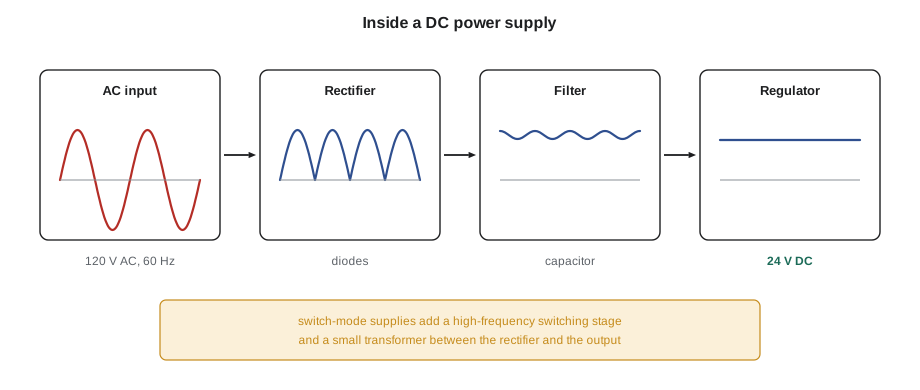
A DC power supply converts AC into a steady DC voltage in three stages. A rectifier, built from diodes, lets current flow in only one direction and turns the alternating wave into pulses that are all positive. A filter, mainly a large capacitor, charges to the peak of those pulses and smooths them into a nearly steady voltage. A regulator then holds the output at its rated value as the load and the input vary. Older linear supplies used a transformer first to reduce the voltage and a regulator that burned off the excess as heat. Almost all modern supplies are switch-mode: they rectify the incoming AC directly, chop the resulting high DC voltage at tens or hundreds of kilohertz, pass it through a small high-frequency transformer and rectify again. Switch-mode supplies are smaller, lighter and much more efficient, which is why a 24 V, 4 A supply now fits in a box the size of a book.
The filter capacitors inside a supply store energy and can hold a charge after the supply is unplugged. Small access control supplies hold only a little, but larger supplies and amplifiers can hold enough to give a painful shock from the primary side. Maya does not open the primary side of any supply; if a supply fails, it is replaced, not repaired in the field.
Reading a power supply
The label of a power supply carries the information an installer needs. Its input rating gives the AC voltage and current it draws, which the electrician uses to size the branch circuit that feeds it. Its output rating gives the DC voltage and the maximum current, sometimes per output and sometimes as a total. A Class 2 marking, described in Lesson 2, shows that each output is power-limited. Many access control supplies also have a battery charging output, a fire alarm interface input that releases the locks when the fire alarm operates, and supervisory contacts that report AC failure, low battery and a blown output fuse to the access control panel.
A supply should not be loaded to its maximum rating continuously. Its life depends mainly on the temperature of its capacitors, which rises with the load, and manufacturers' ratings often assume a cool, ventilated location. Sanjay's design rule for Cobalt Line is to load supplies to no more than about 80 percent of their rated output in continuous use, and to keep the battery charging current inside the remaining capacity. A supply loaded to 80 percent also has headroom for the inrush current of locks and cameras when they first power up.
# Loading check for an access control power supply (illustrative ratings)
RATED_A = 5.0          # total output, 24 V DC
CHARGE_A = 0.7         # battery charging current, taken from the same output capacity
loads = {"maglocks (4 x 0.50 A)": 2.00, "strikes (2 x 0.30 A, energized together)": 0.60,
         "readers (6 x 0.12 A)": 0.72, "request-to-exit sensors (6 x 0.03 A)": 0.18}
load = sum(loads.values())
for k, v in loads.items():
    print(f"{k:<42} {v:5.2f} A")
print(f"device load {load:.2f} A + charging {CHARGE_A:.2f} A = {load + CHARGE_A:.2f} A of {RATED_A:.1f} A")
use = (load + CHARGE_A) / RATED_A
print(f"supply loading {use:.0%}:", "within the 80 % design rule" if use <= 0.80 else "over the 80 % rule: use a larger supply or split the doors")maglocks (4 x 0.50 A) 2.00 A strikes (2 x 0.30 A, energized together) 0.60 A readers (6 x 0.12 A) 0.72 A request-to-exit sensors (6 x 0.03 A) 0.18 A device load 3.50 A + charging 0.70 A = 4.20 A of 5.0 A supply loading 84%: over the 80 % rule: use a larger supply or split the doors
The calculation shows a loading of 84 percent, too high under the design rule, so Sanjay moves two of the doors to a second supply. Lesson 6 explains how the battery current is set and how long the battery will carry the load if the AC fails.
Power over Ethernet
Power over Ethernet, PoE, sends DC power to a device on the same twisted-pair cable that carries its data. The power source equipment, PSE, is usually a network switch, sometimes a separate injector; the powered device, PD, is the camera, access point, phone or reader at the other end. PoE has made installation simpler, because a device needs only one cable and no local power outlet, and it lets the network team restart a device remotely by switching its port off and on.
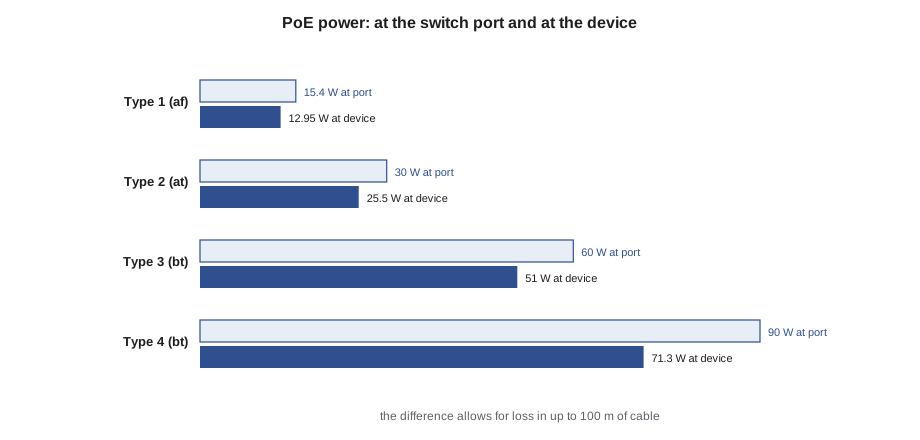
PoE uses about 50 to 57 V DC, applied between pairs of the cable. Before applying power, the PSE detects whether a PoE device is connected by measuring a signature resistance, and it then classifies the device to learn how much power it needs, so a laptop plugged into a PoE port is not harmed. The IEEE 802.3 standards define the power levels in types. The PSE delivers more power than the PD receives, because some is lost in the cable's resistance; the standards assume up to 100 m of cable.
| Standard and type | Power at the switch port | Power at the device | Pairs used | Typical devices |
|---|---|---|---|---|
| 802.3af, Type 1 | 15.4 W | 12.95 W | 2 | Phones, fixed cameras, readers |
| 802.3at, Type 2 | 30 W | 25.5 W | 2 | Access points, PTZ cameras |
| 802.3bt, Type 3 | 60 W | 51 W | 4 | Multi-radio access points, displays |
| 802.3bt, Type 4 | 90 W | 71.3 W | 4 | Large displays, heated cameras, lighting |
A switch also has a total PoE budget, which is usually less than the sum of its ports' maximums. A 48-port switch might support Type 2 on every port but have a total budget of 740 W. When Sanjay plans a closet at Riverside, he adds up the power each device will actually draw, allows for growth, and checks it against the switch's budget. The network team configures the switch, but the installer must understand the budget, because a new camera that does not power up on a busy switch may simply be the one that exceeded it.
# PoE budget for one 48-port switch at Riverside (power each device class is allocated)
BUDGET_W = 740.0
devices = {"Wi-Fi 7 access points (802.3bt Type 3)": (14, 51.0),
           "fixed cameras (Type 1)": (18, 12.95),
           "PTZ cameras (Type 2)": (4, 25.5),
           "IP phones (Type 1)": (8, 6.5)}
total = 0.0
for name, (n, w) in devices.items():
    print(f"{name:<40} {n:3d} x {w:6.2f} W = {n * w:6.1f} W")
    total += n * w
ports = sum(n for n, _ in devices.values())
print(f"{ports} ports, {total:.0f} W of {BUDGET_W:.0f} W budget ({total / BUDGET_W:.0%})")
if total > BUDGET_W:
print("over budget: move some access points to a second switch or add a power supply module")Wi-Fi 7 access points (802.3bt Type 3) 14 x 51.00 W = 714.0 W fixed cameras (Type 1) 18 x 12.95 W = 233.1 W PTZ cameras (Type 2) 4 x 25.50 W = 102.0 W IP phones (Type 1) 8 x 6.50 W = 52.0 W 44 ports, 1101 W of 740 W budget (149%) over budget: move some access points to a second switch or add a power supply module
The plan exceeds the switch's budget by a large margin, mostly because of the high-power access points, and Sanjay splits them between two switches. Note that the calculation uses the power at the device, as the switch usually allocates; some switches allocate by class at the port instead, which is more conservative.
Polarity, grounding and the order of connection
DC circuits have polarity, and many devices are damaged if it is reversed. Low-voltage cable for power is usually red and black, or a marked pair, and Cobalt Line's standard is red for positive and black for negative throughout. Dev's procedure is to connect and check the load side first, with the supply's output switched off or its fuse removed, then confirm polarity with a meter at the device before energizing. The negative side of a DC supply is often connected to ground at one point; connecting it to ground at a second point can create ground loops that cause interference in video and audio systems. LVT-330 covers bonding and grounding.
Worked problem
Choosing a supply for four corridor cameras
Four 24 V DC cameras with infrared illuminators each draw 0.35 A by day and 0.62 A at night with the illuminators on. They will run from one supply. What supply rating is needed under the 80 percent rule?
Show solution
- Design for the worst case, night: 4 × 0.62 = 2.48 A.
- Under the 80 percent rule, the supply must be rated at least 2.48 / 0.80 = 3.1 A.
- Sanjay chooses a 24 V DC, 4 A Class 2 supply with four separately fused outputs, one per camera, which also keeps each output well below its own limit.
- If battery backup is wanted, the charging current must also fit within the rating, which Lesson 6 covers.
Answer: A 24 V DC supply of at least 3.1 A; a 4 A supply with four fused outputs is the practical choice.
One practical note on PoE: a camera or access point that reboots at random is often a PoE problem rather than a device fault. The cause may be a switch near its budget, a cable with a poor termination that raises its resistance, or a passive injector that does not match the device's standard. Checking the switch's per-port power reading and the link's test results usually separates the possibilities quickly.
Common mistakes
MistakeSizing a supply for daytime camera current.
InsteadUse the highest current, usually at night with infrared illuminators on.
MistakeLoading a supply to its full rating continuously.
InsteadKeep to about 80 percent to protect its life and leave room for inrush.
MistakeAdding the PoE port maximums to check a switch.
InsteadCompare the devices' actual power with the switch's total PoE budget.
MistakeConnecting a 24 V AC transformer to a 24 V DC device.
InsteadMatch AC or DC as well as voltage.
MistakeOpening a supply to repair it in the field.
InsteadReplace failed supplies; the primary side is power wiring and the capacitors hold charge.
Summary and key terms
- AC reverses 60 times a second; meters show RMS values, and the peak is about 1.414 times higher.
- Transformers change AC voltage by their turns ratio; they do not work on DC.
- DC supplies rectify, filter and regulate; switch-mode supplies are small and efficient.
- Read the input, output and Class 2 markings; load supplies to about 80 percent.
- PoE types deliver from 12.95 W to 71.3 W at the device; a switch's total budget limits how many high-power devices it can feed.
- RMS value
- The effective value of an AC voltage or current, equal in heating effect to the same DC value.
- Rectifier
- A circuit of diodes that lets current flow in one direction only.
- Switch-mode supply
- A power supply that converts power by switching at high frequency through a small transformer.
- PSE
- Power sourcing equipment, the switch or injector that supplies PoE.
- PD
- Powered device, the equipment that receives PoE.
- PoE budget
- The total power a switch can deliver to all its PoE ports together.
Practice problems
Work each problem on paper first, then reveal the answer to check.
What is the peak voltage of a 24 V AC transformer output?
Show answer
24 × 1.414 = about 34 V.
A transformer has a 5:1 turns ratio and 120 V on its primary. What is the secondary voltage?
Show answer
120 / 5 = 24 V.
A supply rated 24 V, 5 A feeds 3.2 A of locks and a 0.5 A battery charger. What is its loading?
Show answer
3.7 / 5 = 74 %, within the 80 % rule.
A switch has a 370 W budget. How many 25.5 W access points can it power?
Show answer
370 / 25.5 = 14.5, so 14.
Lesson quiz · 5 questions
Score 60% or more to complete this lesson.
Create a free account to save your progress, take quizzes and earn a certificate.