
LVT-110 · Lesson 2 of 12 · 19 min
What counts as low voltage: Class 2, Class 3 and limited-energy circuits
On her second week at Riverside, Maya hears three people use the words low voltage in one morning and mean three different things. The electrical foreman calls the building's 120/208 V panels low voltage, because his utility calls anything above 750 V high voltage. A camera supplier's representative calls his 12 V power supply low voltage. And Dev calls Cobalt Line a low-voltage contractor. Dev uses the morning to explain the terms the electrical code actually uses, because those terms, not the trade slang, decide how Maya's circuits are installed and who is allowed to install them.
Voltage bands in the electrical code
The electrical codes on both sides of the border classify circuits in several overlapping ways. One classification is by voltage alone. The National Electrical Code mostly uses voltage thresholds inside individual rules rather than named bands, and in everyday use electricians call systems up to 600 V, or 1,000 V in newer rules, low voltage and anything above it medium or high voltage. By that classification, nearly everything in a commercial building, including the receptacles and the lighting, is low voltage.
A second classification is by the energy a circuit's source can deliver. This is the one that matters to the low-voltage trade. A circuit whose power source is designed so that, even under a fault, it cannot deliver more than a limited voltage, current and power is called power-limited or limited-energy. Because the energy is limited, the circuit presents little risk of fire and, at the lower voltages, little risk of shock, so the code relaxes the wiring methods: such circuits can use lighter cable, need not be enclosed in conduit and may be installed by people who are not licensed electricians, subject to the rules in each state.
Class 1, Class 2 and Class 3
Remote control, signaling and power-limited circuits fall into classes. In the 2023 National Electrical Code, Article 724 covers Class 1 circuits and Article 725 covers Class 2 and Class 3 power-limited circuits, with the cable requirements for all of them gathered in Article 722.
- Class 1 circuits are remote control and signaling circuits supplied from ordinary power sources or from power-limited sources with higher limits. They are wired much like power circuits, with building wire in raceways, and in most jurisdictions they are electricians' work. A 120 V coil circuit that switches a contactor is a typical example.
- Class 2 circuits are supplied by sources that limit their output to about 100 VA, and to voltages that present little shock risk: in dry locations up to 30 V AC or 60 V DC for most sources. Thermostat wiring, door contact and card reader circuits, and the 24 V supplies for electric locks are Class 2.
- Class 3 circuits are also limited to about 100 VA but may operate at higher voltages, up to 150 V. Because the voltage is higher, Class 3 wiring has stricter protection requirements than Class 2. Some paging amplifiers with 70 V and 100 V speaker outputs are listed as Class 2 at their rated output, and others as Class 3; the marking on the amplifier decides.
Communication circuits, such as telephone, data and cable television circuits, have their own sections or articles (Article 800 and the articles that follow it in the National Electrical Code). Fire alarm circuits have theirs too. Power over Ethernet sits at an interesting boundary: the cabling is a communication circuit, but because it carries power, the codes now include rules about bundle sizes and conductor heating, which LVT-220 covers.
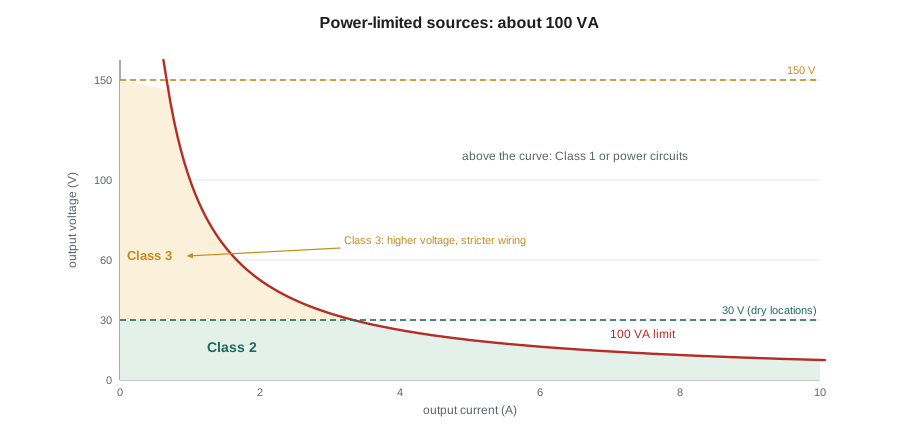
Why the source matters, not the load
The most important principle in this lesson is that the class of a circuit is decided by its power source. A 24 V circuit fed from a listed Class 2 transformer is Class 2. The same 24 V load fed from a 24 V tap on a large unlimited control transformer is not Class 2, even though the voltage is the same, because a fault on the circuit could draw hundreds of amperes from that transformer and start a fire. Class 2 sources achieve their limit in one of two ways. Some are inherently limited: a small transformer whose windings are designed so that its current falls off under overload, so it cannot deliver more than its rated power even with its output shorted. Others are not inherently limited and use overcurrent protection, a fuse or electronic current limit, to hold the output within the limits.
A listed Class 2 source is marked. Transformers and power supplies carry a label reading Class 2 or Class 2 power source, often with the certification mark of a testing laboratory, and the marking may give separate limits for each output on a multi-output supply. When Maya installs an access control power supply at Juniper Point, the condominium tower Cobalt Line is wiring, she checks three things on its label before she connects anything to it: that each output is marked Class 2, the voltage and current rating of each output, and the total rating of the supply.
# Is a 24 V DC lock supply output within Class 2 limits? (illustrative check)
outputs = [
    ("door 1 maglock", 24.0, 0.50),
    ("door 2 maglock", 24.0, 0.50),
    ("door 3 strike", 24.0, 0.45),
    ("readers and request-to-exit", 24.0, 0.60),
]
LIMIT_VA = 100.0
for name, volts, amps in outputs:
    va = volts * amps
    print(f"{name:<28} {volts:4.0f} V x {amps:4.2f} A = {va:5.1f} VA")
total_a = sum(a for _, _, a in outputs)
print(f"total on one output: {total_a:.2f} A = {24.0 * total_a:.0f} VA")
print("within the 100 VA per-output limit" if 24.0 * total_a <= LIMIT_VA else "too much for one Class 2 output: split the loads")
print("supply has 4 outputs of 2.5 A max:", "ok" if max(a for _, _, a in outputs) <= 2.5 else "check")door 1 maglock 24 V x 0.50 A = 12.0 VA door 2 maglock 24 V x 0.50 A = 12.0 VA door 3 strike 24 V x 0.45 A = 10.8 VA readers and request-to-exit 24 V x 0.60 A = 14.4 VA total on one output: 2.05 A = 49 VA within the 100 VA per-output limit supply has 4 outputs of 2.5 A max: ok
The calculation shows why multi-output supplies exist. The four loads together draw 2.05 A at 24 V, or about 49 VA, comfortably within the limit, but on a larger floor with ten doors the total would pass 100 VA and the loads would have to be divided among separately limited outputs.
What the codes require of limited-energy wiring
Because Class 2 and communication circuits are limited in energy, the codes require less of them than of power wiring, but they do not require nothing. Five requirements appear in some form in both countries' codes, and Lesson 4 and LVT-330 return to them in detail.
- Cable ratings. Limited-energy and communication cables must be listed and marked for the space they pass through. Air-handling spaces need the most fire-resistant cables, vertical risers need riser-rated cable, and general spaces can use general-purpose cable. The markings on the jacket, such as CMP, CMR and CM for communication cable, show the rating.
- Separation from power. Limited-energy conductors must be kept apart from power and lighting conductors, by distance, by a barrier or by separate raceways, so that a fault in the power wiring cannot energize the limited circuit and so that power insulation failure cannot reach the technician handling the limited cable.
- Support. Cables must be supported by the building structure or by supports intended for them, not by ceiling grid wires, pipes or other trades' equipment.
- Fire stopping. Where cables pass through fire-rated walls and floors, the openings must be sealed with a listed firestop system so that the rating of the assembly is kept.
- Abandoned cable. Cable that is no longer used and is not tagged for future use must, in many cases, be removed, because large quantities of abandoned cable add to the fuel load in ceilings.
These requirements apply whether or not anyone is watching. In most jurisdictions limited-energy work does not need an electrical permit or inspection for each job, so the installer's knowledge and integrity are the main safeguard.
Where the boundary can be crossed
Low-voltage technicians run into power circuits more often than they expect. A card reader controller may sit in an enclosure that also contains a 120 V transformer; a camera may be powered by a 24 V AC transformer that plugs into a receptacle; a paging amplifier is fed from a 120 V circuit; a motorized projection screen has both a 120 V motor and a low-voltage control input. Dev's rule is that a technician must always know where the power-limited side ends and the power side begins. The primary side of a Class 2 transformer, the receptacle it plugs into and any line-voltage terminals inside an enclosure are power wiring. On many devices the two sides are separated inside the enclosure by a barrier, and the field wiring must stay on the correct side of it.
A second boundary is the reclassification of a circuit. If a Class 2 circuit is wired with power conductors in the same raceway, or with the wiring methods of a Class 1 circuit, the code may then treat it as Class 1 throughout. That can be done deliberately, but it then becomes electricians' work. Maya will not make that choice; she only needs to know that it exists so that she recognizes a reclassified circuit when she meets one.
Worked problem
Classifying four circuits at Juniper Point
Sanjay's drawings for a floor of Juniper Point show four circuits near the elevator lobby: (a) a magnetic lock fed from a 24 V DC output of a listed Class 2 access control supply; (b) the 120 V circuit that feeds that supply; (c) a 24 V AC camera fed from a large 24 V control transformer in the mechanical room that is not marked Class 2; (d) Category 6 data cable to the lobby intercom. Which are limited-energy circuits?
Show solution
- (a) is Class 2: its source is listed and marked Class 2.
- (b) is a power circuit, installed by the electrical contractor.
- (c) is not Class 2, because its source is not a listed limited source. It must be treated as a Class 1 or power circuit until a listed Class 2 transformer replaces the unmarked one.
- (d) is a communication circuit.
Answer: Only (a) and (d) are limited-energy or communication circuits; (c) shows that a 24 V circuit is not automatically Class 2.
Limited energy in the field: three quick checks
Dev gives Maya three questions to ask at every limited-energy connection, and they turn the rules of this lesson into a habit. First, what is the source? She reads the label on the supply, amplifier or controller output and confirms that it is marked Class 2, Class 3 or as a communication or PoE source. Second, what else shares the space? She looks into the box, enclosure or raceway for any power conductors, and if she finds them she stops, because a limited-energy cable must not share that space unless a barrier or a code rule allows it. Third, what is the cable marked? She reads the jacket for the rating the space requires, plenum, riser or general purpose, and for the type, so that the cable matches both the circuit and the space.
The checks take less than a minute. They catch the mistakes that cause the most trouble later: an unmarked 24 V transformer feeding a camera, a data cable pushed into a junction box beside a lighting splice, or a general-purpose cable run through a return air plenum. Each of those mistakes is invisible once the ceiling closes, and each can fail an inspection, void a warranty or, in the worst case, contribute to a fire.
Common mistakes
MistakeCalling any circuit under 50 V Class 2.
InsteadOnly a circuit supplied by a listed Class 2 source is Class 2.
MistakeAdding loads to a Class 2 output until the supply's total rating is reached.
InsteadCheck each output's limit as well as the total; split loads among outputs.
MistakeRunning Class 2 cable in the same box or raceway as power conductors.
InsteadKeep separation by distance, barrier or separate raceway unless a code rule allows otherwise.
MistakeChoosing a cable rating by price.
InsteadChoose the rating the space requires, such as plenum or riser.
MistakeLeaving abandoned cable in the ceiling.
InsteadRemove it or tag it for future use as the code requires.
Summary and key terms
- Low voltage means different things in different contexts; the codes classify limited-energy circuits by their power sources.
- Class 2 sources are limited to about 100 VA and to voltages that present little shock risk; Class 3 sources allow higher voltage with stricter wiring rules.
- Communication and fire alarm circuits have their own code sections.
- A circuit's class is set by its listed source, not by its voltage or its load.
- Limited-energy wiring still has rules for cable ratings, separation, support, firestopping and abandoned cable.
- Extra-low voltage
- A term from the Canadian and international codes for voltages up to about 30 V; the NEC instead sets limits within each rule.
- Class 2 circuit
- A circuit supplied by a listed source that limits its output to about 100 VA at voltages with little shock risk.
- Class 3 circuit
- A power-limited circuit allowed to operate at higher voltages, up to about 150 V, with stricter wiring requirements.
- Inherently limited source
- A power source whose design alone limits its output, even under a short circuit.
- Power-limited
- Describes a circuit whose source limits the energy it can deliver under fault conditions.
Practice problems
Work each problem on paper first, then reveal the answer to check.
A 24 V DC supply output is marked Class 2, 2.5 A. What is the most power it can deliver?
Show answer
24 × 2.5 = 60 VA, within the 100 VA limit.
Why can a 24 V circuit from an unmarked control transformer not be treated as Class 2?
Show answer
The transformer is not a listed limited source, so a fault could draw enough current to cause a fire.
Name three requirements that still apply to Class 2 wiring.
Show answer
Any three of: listed cable for the space, separation from power, support from the structure, firestopping, removal of abandoned cable.
Where on a Class 2 transformer does the power wiring end?
Show answer
At the transformer's primary terminals; the primary side and its supply circuit are power wiring.
Lesson quiz · 5 questions
Score 60% or more to complete this lesson.
Create a free account to save your progress, take quizzes and earn a certificate.