
LVT-110 · Lesson 11 of 12 · 20 min
State licensing for low-voltage work
Maya's apprenticeship agreement, the electrical contractor's license on the Riverside site sign and the alarm company's registration on its van door all reflect one fact: in the United States, the right to do electrical and low-voltage work is regulated by each state, and sometimes by cities and counties, and the rules differ widely. A low-voltage technician must know what she is allowed to do where she works, what credentials she can earn, and where her work ends and a licensed electrician's begins. This lesson describes the general structure, the rules in Texas where Cobalt Line works, and how other states differ.
Three layers of regulation
Low-voltage work in the United States is governed by three layers. The first is the electrical code: most states adopt the National Electrical Code, often with amendments, and a state agency or local building department enforces it and issues permits. The second is licensing: states license electrical contractors and electricians, and many have separate low-voltage, limited-energy or systems licenses, while others exempt low-voltage work from licensing altogether. The third covers particular systems: fire alarm and security alarm work often have their own licenses, registrations and background checks, sometimes from a different agency.
The layers interact. A job can be exempt from one layer and still fall under another; a technician may need no electrician's license for a Class 2 circuit, yet the company may still need an alarm registration for the same work, and the work must still meet the code. The safe assumption is that every job is regulated somehow, and the question is only how.
Texas
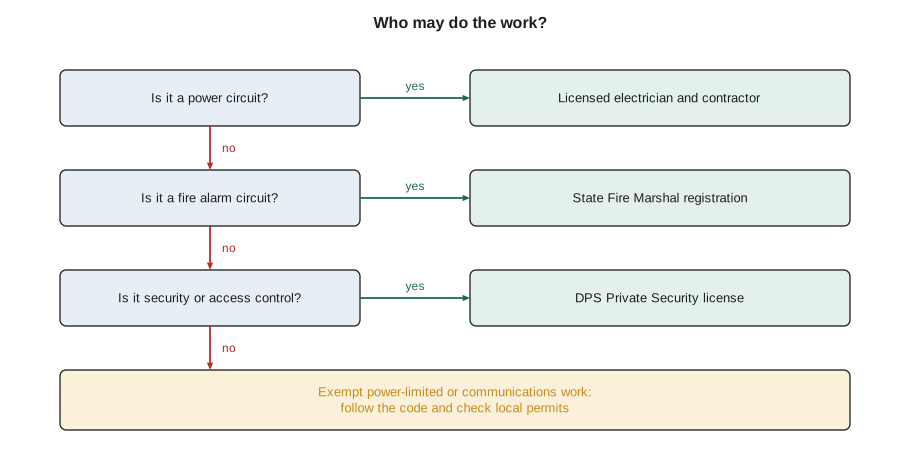
In Texas, the Texas Department of Licensing and Regulation, TDLR, licenses electricians and electrical contractors. The Texas Electrical Safety and Licensing Act exempts specified work from electrician licensing, including Class 1, Class 2 and Class 3 remote control, signaling and power-limited circuits, fire alarm circuits, optical fiber cables and communications circuits. That exemption does not remove other obligations. Alarm systems and electronic access control are licensed by the Department of Public Safety's Private Security Program, which requires company licenses, a qualified manager and registration and background checks for individual installers. Fire alarm companies are registered and their technicians licensed by the State Fire Marshal's Office. And cities such as Austin may require permits for some low-voltage work under their adopted codes.
Texas has no statewide low-voltage contractor license, so a low-voltage technician working only on exempt power-limited and communications circuits needs no electrician's license. Cobalt Line holds a Private Security company license for its access control and alarm work, and every technician who installs or services those systems, including Maya, holds a DPS registration, which requires fingerprinting and a background check, before working on them. For cabling, Cobalt Line relies on industry certifications such as BICSI's Installer credentials and manufacturers' certifications, which owners often require in their specifications.
Workplace safety law adds its own requirements. OSHA's construction and general industry standards require employers to train workers for the hazards of their work and to protect them, and many owners and general contractors also require OSHA 10-hour or 30-hour construction training on their sites.
Other states
Other states draw the lines very differently. Some, like Texas, exempt power-limited work from electrician licensing. Others require a specific license for it: Arizona's Registrar of Contractors licenses low-voltage communication systems contractors under its C-67, R-67 and CR-67 classifications, with an experience requirement and trade and business law exams; Washington issues limited energy specialty electrician certificates; and several states license alarm or low-voltage contractors through their electrical boards. Some cities and counties add their own licenses or registrations. Industry associations such as NSCA publish guides to state licensing because the rules change frequently. A technician who moves between states, or a company that bids work in another state, checks the rules there before starting.
# Which credentials does each task at Juniper Point need? (Texas, simplified)
RULES = {"data cabling and terminations": "exempt from electrician licensing; BICSI certification preferred",
         "access control readers and locks": "DPS Private Security company license and registered installer",
         "120 V feed to the lock power supply": "TDLR-licensed electrician and electrical contractor",
         "fire alarm interface to the lock power supply": "SFMO-registered fire alarm company and licensed technician",
         "IP camera installation": "DPS-registered installer when part of a security system"}
tasks = ["data cabling and terminations", "access control readers and locks", "120 V feed to the lock power supply",
         "fire alarm interface to the lock power supply", "IP camera installation"]
for t in tasks:
print(f"{t:<46} -> {RULES[t]}")data cabling and terminations -> exempt from electrician licensing; BICSI certification preferred access control readers and locks -> DPS Private Security company license and registered installer 120 V feed to the lock power supply -> TDLR-licensed electrician and electrical contractor fire alarm interface to the lock power supply -> SFMO-registered fire alarm company and licensed technician IP camera installation -> DPS-registered installer when part of a security system
Industry certifications
Beyond the legal requirements, the trade has a set of industry certifications that employers, owners and designers recognize. BICSI, an international association for information and communications technology, offers Installer 1, Installer 2 Copper and Installer 2 Optical Fiber, and Technician credentials, as well as the RCDD design credential that Sanjay holds. Manufacturers of cabling systems certify installers to offer extended system warranties, often twenty-five years, which owners such as school boards specify. Security and access control manufacturers certify technicians on their products. The Fiber Optic Association offers fiber credentials, and audio-visual technicians may pursue AVIXA's CTS credentials. LVT-340 prepares for several of these.
Working within the scope
Knowing the rules matters most when the job pushes against them. A building manager asks Maya to add a receptacle beside a new camera power supply because the nearest one is across the room. A general contractor wants the access control crew to connect the lock power supply to the fire alarm relay because the fire alarm technician is late. A customer asks a technician to extend a 120 V circuit to a new display. Each request crosses a line, and the answer is the same: the work belongs to the trade that is licensed or certified for it, and Cobalt Line will arrange it. Doing it anyway can void insurance, breach the contract, expose the company to fines and, most of all, put people at risk.
The reverse is also true. Electricians who install low-voltage systems must meet the same codes and specifications, and in some jurisdictions they are the only ones allowed to do so. Mutual respect between the electrical and low-voltage trades is part of a well-run project.
Worked problem
A request from the property manager
At Juniper Point after handover, the property manager asks Maya, who is there to add a reader, to also move a 120 V receptacle so the lobby display can sit lower on the wall. She has the tools and it would take ten minutes. What should she do?
Show solution
- The receptacle is part of a power circuit. Moving it is electrical work that requires a licensed electrician and electrical contractor, and possibly a city permit.
- Maya does not do it, explains why, and tells the manager that Cobalt Line will arrange it with its electrical partner.
- She reports the request to Dev and Colette, who send a quotation that includes the electrical work.
- She completes the reader work, which is within her scope, and records both on the service report.
Answer: She declines the receptacle work and arranges for a licensed electrical contractor to do it; the reader work proceeds.
Permits and inspections for low-voltage work
Whether a low-voltage job needs a permit and an inspection depends on the state, the city and the system. In Austin, the city's adopted electrical code and its permit rules decide which low-voltage installations need a permit, and the power side of every system, the circuits that feed supplies, amplifiers and racks, is permitted and inspected through the licensed electrical contractor who installs it. Fire alarm work is permitted and inspected under the fire code. For the limited-energy side, the contractor follows the city's current rules and keeps its own records of testing and inspection. On institutional projects such as Riverside and St. Brendan's, the owner's consultants also review the work, and their acceptance is part of the contract.
Whether or not an inspector looks at the work, the installation must meet the code. Inspectors and owners' consultants commonly find the same faults in low-voltage work: cables supported from ceiling wires or pipes, missing or improper firestops, general-purpose cable in plenum spaces, power and limited-energy conductors sharing a box, abandoned cable left in ceilings and unlabeled cables. Each of those is a code or specification issue that the technician controls.
Apprenticeship and the path to certification
An apprentice in Texas may train through a registered apprenticeship program, an employer's training program or a union or association program. Hours on the job are logged, the employer signs off skills as they are demonstrated, and classroom training is taken in blocks or evenings. Because Texas has no statewide low-voltage license, the credentials that matter most are the DPS registration for security work and industry certifications such as BICSI Installer 1 and Installer 2, which require documented experience and examinations. Maya's training plan lists the skills she must demonstrate: planning and preparing installations, installing pathways and cable, terminating and splicing copper and fiber, testing and documenting, installing network devices and troubleshooting. Many of those are taught in the later courses of this program.
The apprenticeship is also where professional habits are formed. An apprentice works under the direction of a journeyperson or lead technician, does not take on work outside her training and supervision, and asks before acting when unsure. Dev's view is that the best apprentices are not the fastest but the ones who ask the right questions before they cut, drill or connect anything.
Liability and insurance
Contractors carry liability insurance and, for many institutional owners, must show proof of it before starting work. That insurance assumes the contractor works within its licenses and registrations. Work done outside them can leave the contractor uninsured for any damage or injury that follows, and can expose the individual technician to discipline by the licensing body. A technician protects herself, her employer and the customer by knowing her scope and staying inside it.
Keeping credentials current
Credentials expire, and keeping them current is the technician's own responsibility. Working at heights training, lift operator training, first aid, Hazard Communication and confined space training all have renewal periods; security registrations and industry certifications must be renewed, often with continuing education credits; and manufacturer certifications lapse if the technician does not complete updated training when products change. Cobalt Line's safety coordinator, Greta, keeps a training matrix for every employee and reminds them two months before anything expires, but Dev tells Maya to keep her own list too, with copies of every card and certificate on her phone, because a site gate may refuse entry to anyone who cannot show them.
Codes change as well. The National Electrical Code is revised on a three-year cycle, and states adopt new editions on their own schedules, sometimes years later and with amendments; Texas adopts editions through TDLR. Cabling and security standards are revised too. A technician who learned the rules ten years ago and has not looked since is working to an outdated rulebook, and the courses, bulletins and supplier seminars that the trade offers are how a careful technician keeps up.
Ethics and trust
Low-voltage technicians work inside the most sensitive parts of buildings: telecommunications rooms with the network that carries every email, security systems that control who enters, cameras that watch staff and visitors, and hospital wings where patient privacy is protected by law. Owners trust contractors with keys, access cards, passwords and drawings of their security systems. That trust is part of why security work is licensed and installers are screened in many jurisdictions. Cobalt Line's technicians keep customer passwords and system details confidential, never photograph a customer's security layout except for the job record, return keys and cards at the end of each day and report any lost card at once. A technician's reputation for discretion is worth as much as her skill with a punch-down tool.
Common mistakes
MistakeAssuming low-voltage work is unregulated.
InsteadEvery job is regulated somehow; find out which rules apply.
MistakeMoving or adding a receptacle because it is quick.
InsteadPower work belongs to licensed electricians.
MistakeConnecting to the fire alarm system without the fire alarm technician.
InsteadFire alarm interfaces are made and tested under fire alarm rules.
MistakeAssuming the rules in Texas apply in another state.
InsteadCheck the rules wherever the work is done.
MistakeTreating industry certifications as optional extras.
InsteadOwners often require them in specifications and warranties.
Summary and key terms
- Low-voltage work is regulated by the electrical code, licensing and system-specific rules, set by each state and sometimes by cities.
- In Texas, TDLR exempts power-limited and communications circuits from electrician licensing, but DPS and the State Fire Marshal license alarm and fire alarm work.
- Other states, such as Arizona and Washington, require specific low-voltage licenses or certificates.
- Industry certifications such as BICSI's and manufacturers' are widely required by owners.
- Requests outside the technician's scope are declined and referred to the licensed trade.
- Compulsory trade
- A trade that requires a license or certificate to practice.
- Voluntary trade
- A trade or credential that is available but not legally required.
- Authority having jurisdiction
- The agency or official that enforces the code and approves installations.
- BICSI
- An international association for information and communications technology that certifies installers and designers.
- RCDD
- Registered Communications Distribution Designer, BICSI's design credential.
Practice problems
Work each problem on paper first, then reveal the answer to check.
Who must install the 120 V circuit that feeds a lock power supply in Texas?
Show answer
A TDLR-licensed electrician working for a licensed electrical contractor.
Does Texas require an electrician's license for Class 2 access control wiring?
Show answer
No, it is exempt from electrician licensing, but the work needs a DPS Private Security license and installer registration.
Name two industry certifications for cabling installers.
Show answer
Any two of: BICSI Installer 1, Installer 2 Copper, Installer 2 Optical Fiber, Technician; manufacturer installer certifications; FOA credentials.
A customer asks you to extend a 120 V circuit. What do you say?
Show answer
That it is electrical work for a licensed electrician, and that your company will arrange it.
Lesson quiz · 5 questions
Score 60% or more to complete this lesson.
Create a free account to save your progress, take quizzes and earn a certificate.