
LSAT-111 · Lesson 2 of 12 · 21 min
Common flaws
▶ Video coming soon A video version of this lesson is on the way.
For the second half of the October 13 workshop, Harriet handed out what she called the map: a single page listing the flaws that turn up again and again in Logical Reasoning. 'You will not memorize this tonight,' she said. 'You will meet each family properly over the next four lessons. Tonight I want you to see the whole territory, so that when you meet a flawed argument you have somewhere to put it.'
Marcus, who had taken the LSAT once before, said he remembered the flaw questions as the ones where the answer choices all sounded like philosophy textbooks. Harriet laughed. 'That is exactly why the map helps. The choices are abstract because the same handful of flaws can appear in an argument about cheese, cancer research or zoning law. If you know the handful, the abstract wording starts to sound familiar.'
This lesson is that map. It introduces about a dozen common flaws, each with a short example and the kind of wording that describes it in answer choices. Lessons 3 to 6 then take the families one at a time and go deeper.
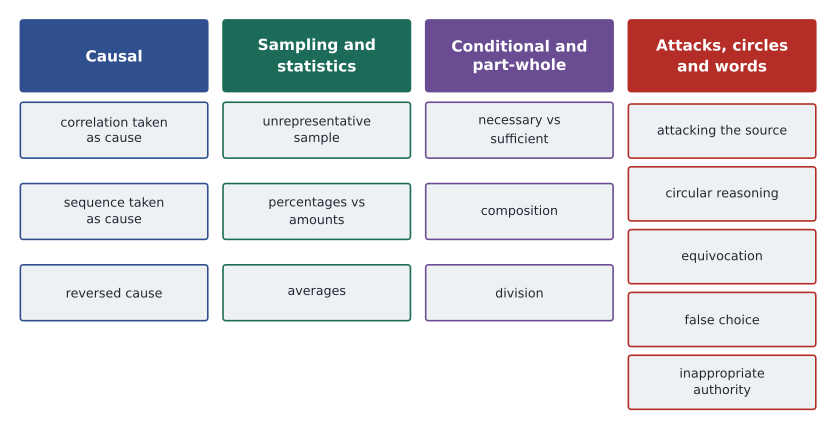
Family 1: Causal flaws
Causal arguments conclude that one thing causes another. They are the single most common kind of argument in Logical Reasoning, and they go wrong in a few standard ways.
- Correlation taken as causation. Two things occur together, so the author concludes one causes the other. "Cities with more libraries have lower crime rates, so libraries reduce crime." Perhaps wealthier cities have both.
- Sequence taken as causation. One thing happened after another, so the first caused the second. "After the coach changed the team's diet, it won six straight games, so the diet improved performance." Perhaps the team also got healthier players back.
- Reversed causation. The author assumes A causes B when B might cause A. "People who exercise are happier, so exercise makes people happy." Perhaps happier people are more inclined to exercise.
Typical answer wording: "infers a causal relationship from a mere correlation," "fails to consider that some other factor could account for both," "mistakes a cause for an effect."
Family 2: Sampling and statistical flaws
Many arguments rely on numbers. Numbers feel precise, which makes these flaws easy to miss.
- Unrepresentative sample. A conclusion about a large group rests on a part of the group that differs from the whole. "Of the readers who answered our online poll, most favor a shorter work week, so most workers favor a shorter work week." Online poll respondents choose themselves and may not resemble workers in general.
- Percentages versus amounts. A change in a proportion is treated as a change in a number, or the reverse. "The share of the budget spent on parks fell, so the city spent less on parks." If the whole budget grew, park spending may have risen.
- Averages. What is true of the average is assumed true of each member. "The average income in the district rose, so every family is better off." A few large gains can lift the average while most families lose ground.
Typical answer wording: "draws a conclusion about a population from a sample that may be unrepresentative," "confuses a proportion with an absolute number," "presumes that what is true of a group on average is true of each member."
Family 3: Conditional and part-whole flaws
These flaws involve the logical structure you studied in LSAT-110.
- Treating a sufficient condition as necessary. "Anyone who finishes the training is certified. Rosa did not finish the training, so she is not certified." Finishing the training is one way to be certified; there may be others.
- Treating a necessary condition as sufficient. "Only residents may use the pool. Kofi is a resident, so he may use the pool." Being a resident is required, but other conditions (a membership fee, a swim test) might also apply.
- Composition. Assuming that what is true of each part is true of the whole. "Every player on the team is excellent, so the team is excellent." Excellent players may not play well together.
- Division. Assuming that what is true of the whole is true of each part. "The committee is biased, so each member is biased." A committee's overall lean can come from a majority.
Typical answer wording: "takes a condition that is sufficient to be a condition that is required," "presumes that what is true of each part is true of the whole," "infers that a property of a group belongs to each of its members."
Family 4: Attacks, circles and shifting words
The last family is a mixed group, held together by the fact that each one substitutes something else for genuine support.
- Attacking the source (ad hominem). Rejecting a claim because of who made it. "The inspector says the bridge is unsafe, but she is paid by a rival construction company." Her motive does not show the bridge is safe.
- Circular reasoning. The conclusion is assumed in the premises. "This textbook is reliable because everything in it is accurate." Reliable and accurate mean nearly the same thing.
- Equivocation. A key word changes meaning between premise and conclusion. "The law says all people are equal. But people are clearly unequal in height. So the law is mistaken." Equal before the law is not equal in height.
- False choice. Presenting two options as the only ones. "Either we close the museum or we raise ticket prices. Closing is unthinkable, so we must raise prices." There may be other options, such as grants or donations.
- Inappropriate appeal to authority or popularity. Treating a claim as true because an expert outside their field, or many people, accept it. "A famous actor recommends this vitamin, so it must be effective."
Typical answer wording: "attacks the source of a claim rather than the claim itself," "assumes what it sets out to prove," "relies on a term used in two different senses," "presents two options as the only ones available," "relies on the views of someone who is not shown to have relevant expertise."
| Flaw | Short pattern | Answer-choice wording |
|---|---|---|
| Correlation as cause | A and B occur together, so A causes B | "infers causation from correlation" |
| Unrepresentative sample | Some members have X, so all members have X | "relies on a sample that may not be representative" |
| Sufficient as necessary | If A then B; not A, so not B | "treats a sufficient condition as a required one" |
| Necessary as sufficient | B only if A; A, so B | "treats a required condition as sufficient" |
| Composition | Each part has X, so the whole has X | "assumes the whole has a property of its parts" |
| Ad hominem | The source is suspect, so the claim is false | "attacks the source rather than the argument" |
| Circular | The conclusion appears among the premises | "presupposes what it seeks to establish" |
| Equivocation | A key word shifts meaning | "uses a key term in two different senses" |
| False choice | Either A or B; not A, so B | "overlooks other alternatives" |
Two flaws that cut across families
Two broader patterns appear inside many of the families above.
The first is absence of evidence treated as evidence of absence. "No study has shown the additive is harmful, so it is safe." The lack of proof that something is harmful is not proof that it is safe; perhaps nobody has looked. The mirror image appears too: "The experiment failed to prove the drug works, so the drug does not work."
The second is overreaching from limited evidence: concluding that something is certain, universal or impossible when the evidence supports only that it is possible, common or unlikely. Harriet called this "the strength mismatch." It often travels with sampling flaws but can appear anywhere. The fix is always to compare the strength of the conclusion with the strength of the support.
Why recognize families instead of memorizing names?
Thomas asked whether he should make flashcards of the flaw names. Harriet's answer was cautious. 'Flashcards of names will help less than you think. The test never asks you to name a flaw; it asks you to recognize a description of it. What helps is seeing the pattern in an argument and then matching it to the description in a choice.'
She suggested a different flashcard: on one side, a short flawed argument the student had written; on the other, a plain-English description of what was wrong. Writing your own flawed arguments, she said, is one of the fastest ways to learn to spot them. Dani took this to heart and filled a notebook page that night with flawed arguments drawn from her firm's client intake forms (names removed). Ji-won wrote hers about software releases. Élodie wrote two in French first, then translated them, which she said made her notice the shifting words.
Worked problem
Placing a flaw on the map
Stimulus: "A survey of the hospital's cardiology patients found that most drink coffee daily. Coffee, therefore, is a significant contributor to heart disease." Which family does the flaw belong to, and what exactly is wrong?
Show solution
- Conclusion: coffee contributes significantly to heart disease (a causal claim).
- Evidence: most cardiology patients drink coffee daily.
- Causal family: the argument infers causation from a correlation. It does not rule out that coffee drinking is simply common among adults generally, or that some third factor (such as stress or age) is linked to both.
- There is also a sampling issue: without knowing how common daily coffee drinking is among people without heart disease, the survey of cardiology patients alone shows nothing.
Answer: Mainly a causal flaw (correlation taken as cause), supported by a missing comparison group. A strong answer choice would say the argument "fails to establish that daily coffee drinking is more common among heart patients than among people in general."
The missing comparison
The coffee example shows a pattern worth naming on its own: the missing comparison. Many arguments present a number about one group and draw a conclusion that only makes sense if you know the number for another group. "Eighty percent of people who won the lottery bought a ticket at a convenience store" means nothing until you know what share of all lottery tickets are sold at convenience stores. If it is ninety percent, convenience-store buyers are actually under-represented among winners.
When you see a striking statistic about one group, ask: compared with what? If the stimulus gives no comparison, the argument probably has a gap there.
Using the map in practice
Harriet closed with a three-step routine for any flawed argument.
- Step 1: Find the conclusion and classify it. Is it causal, a generalization, a conditional inference, a recommendation, or a claim about a person's view?
- Step 2: Ask which family that kind of conclusion usually falls into. Causal conclusions invite causal flaws; generalizations invite sampling flaws; conditional inferences invite necessary-sufficient flaws.
- Step 3: Confirm the specific gap in this argument before moving to the choices.
The classification in step 1 is the shortcut. Experienced test takers do not search the whole map every time; the kind of conclusion points them to the right corner of it.
Practice: place each flaw on the map
Worked problem
Sample question (written for this course)
Stimulus: "Our town's two largest employers both moved their offices downtown last year, and downtown restaurants reported record sales. Clearly, the new offices are the reason restaurant sales rose, so the council should encourage more employers to move downtown." Stem: "Which one of the following most accurately describes a flaw in the argument?" (A) It presents two options as the only ones available. (B) It relies on the views of an unqualified authority. (C) It uses the term "sales" in two different senses. (D) It takes for granted that an increase following an event was caused by that event. (E) It concludes that each restaurant had record sales because the downtown area did.
Show solution
- Classify the conclusion: causal (the offices caused the sales rise), followed by a recommendation. Family: causal.
- (A) No either-or appears. (B) No authority is cited; the restaurants reported their own sales. (C) "Sales" means the same thing throughout.
- (E) describes division; the argument says restaurants reported record sales, not that each did because the area did, so this is not what the argument does.
- (D) The argument infers that the office moves caused the sales increase simply because the increase followed them. That is sequence taken as cause.
Answer: (D). Classifying the conclusion as causal pointed straight to the right family, and only one choice describes a causal flaw.
Harriet asked each student to explain why the division choice was tempting. Ji-won said it was the only choice that mentioned restaurants, which made it feel specific. 'Specific is not the same as accurate,' Harriet said. 'Ask whether the argument actually does what the choice says.'
Common mistakes
MistakeMemorizing flaw names without practicing recognition.
InsteadLearn the patterns by writing and spotting flawed arguments, then match patterns to descriptions.
MistakeTreating every statistic as strong evidence.
InsteadAsk whether the sample is representative and what the comparison group is.
MistakeSearching the whole list of flaws on every question.
InsteadClassify the conclusion first; its type points to the likely family.
MistakeAssuming absence of evidence shows something is false.
InsteadA lack of proof that something is true does not prove it false.
Summary and key terms
- Common flaws fall into four families: causal; sampling and statistical; conditional and part-whole; attacks, circles and shifting words.
- Causal flaws infer causation from correlation or sequence, or reverse cause and effect.
- Statistical flaws include unrepresentative samples, percentages confused with amounts, and averages applied to individuals.
- Conditional flaws confuse necessary and sufficient conditions; part-whole flaws move properties between parts and wholes.
- Other flaws substitute an attack on the source, a circle, a shifting word, a false choice or an inappropriate authority for real support.
- Ask "compared with what?" when a statistic about one group is used to support a conclusion.
- Correlation
- A pattern in which two things tend to occur together.
- Ad hominem
- Rejecting a claim by attacking the person who made it.
- Circular reasoning
- Reasoning in which the conclusion is assumed in the premises.
- Equivocation
- Using a key word in two different senses in the same argument.
- False choice
- Presenting two options as the only possibilities when others exist.
- Composition
- Assuming that what is true of each part is true of the whole.
- Division
- Assuming that what is true of the whole is true of each part.
Practice problems
Work each problem on paper first, then reveal the answer to check.
Name the family: "Ticket sales rose in every month the band played the anthem, so playing the anthem boosts sales."
Show answer
Causal (correlation or sequence taken as causation).
Name the flaw: "Every ingredient in this cake is low in calories, so the cake is low in calories."
Show answer
Composition: assuming the whole has the property of its parts. Many low-calorie ingredients can add up to a high-calorie cake.
What comparison is missing? "Seventy percent of the accidents at the plant happened on the night shift."
Show answer
What share of work hours, or of workers, is on the night shift. If the night shift covers most of the plant's hours, seventy percent may be low.
Lesson quiz · 5 questions
Score 60% or more to complete this lesson.
Create a free account to save your progress, take quizzes and earn a certificate.