
LSAT-111 · Lesson 10 of 12 · 24 min
Evaluate questions
▶ Video coming soon A video version of this lesson is on the way.
The November 17 workshop opened with Marcus. He had tested the previous Thursday at a Prometric center in Columbus and reported that the Logical Reasoning sections had felt, in his words, "like a Tuesday night." His score would not be released until December 2, and under his own rule he would decide then whether to keep it. Harriet congratulated him on finishing and asked him to stay for the session anyway. 'Evaluate questions are rare,' she said, 'which is exactly why people lose points on them. You have only seen a few.'
This lesson covers evaluate questions, sometimes called evaluate-the-argument questions. They are less common than strengthen and weaken questions, but they use the same thinking in a distinctive way.
What an evaluate question asks
Evaluate stems ask which piece of information would be most useful, or most relevant, in judging the argument.
- "Which one of the following would it be most useful to know in order to evaluate the argument?"
- "The answer to which one of the following questions would most help in evaluating the argument?"
- "Which one of the following is most relevant to evaluating the argument?"
The answer choices are usually questions ("Whether…", "How many…", "Did…?") or descriptions of information. The correct choice identifies something whose answer would make a real difference to how strong the argument is.
The key idea: answers that cut both ways
The best way to understand evaluate questions is to imagine the two possible answers to each choice. If one answer would strengthen the argument and the other would weaken it, the choice is relevant: knowing the answer would help you evaluate the argument. If neither answer would make a difference, the choice is irrelevant.
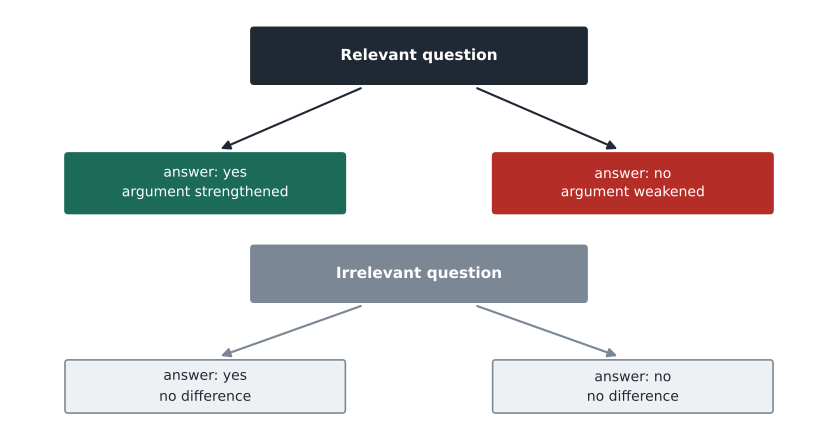
Harriet called this the variance test, a name many prep books use. Try both answers. If they push the argument in opposite directions, you have found the credited response.
Worked problem
Applying the variance test
Argument: "Since the city started offering free transit passes to students, student enrollment at the downtown college has risen. The passes must have encouraged more students to enrol." Evaluate this choice: "Whether enrollment also rose at colleges in cities without free transit passes."
Show solution
- If enrollment did not rise elsewhere: the downtown increase is more likely due to the passes. The argument is strengthened.
- If enrollment rose just as much elsewhere: a general trend explains the increase. The argument is weakened.
- The two answers cut in opposite directions, so the question is relevant.
Answer: This choice would be useful for evaluating the argument; it is the kind of choice that is credited.
Compare an irrelevant choice: "Whether the transit passes were funded by the province." Yes or no, the funding source tells you nothing about whether the passes encouraged enrollment. Neither answer changes the argument's strength.
The connection to strengthen and weaken
Every correct evaluate answer is really a strengthener and a weakener folded into one question. That gives you a second way to find it: predict the gap, then look for a choice that asks about the gap. In the transit example, the gap is whether something other than the passes explains the rise. The correct choice asks about exactly that.
This means your preparation for strengthen and weaken questions transfers directly. If you know how to weaken a causal argument (alternative cause, effect without cause), you know what an evaluate answer for a causal argument will ask about.
| Argument type | What the evaluate answer usually asks about | Example |
|---|---|---|
| Causal | An alternative cause, or whether the effect occurred without the cause | "Whether enrollment also rose elsewhere" |
| Sampling | Whether the sample is representative | "How the survey respondents were selected" |
| Analogy | Whether the compared things are alike in the relevant way | "Whether the two cities have similar populations" |
| Plan | Whether the plan will achieve its goal or has a major drawback | "Whether the new bins will be placed where most litter occurs" |
| Statistical | The total, the base rate or the comparison group | "What share of all tickets were sold at convenience stores" |
The method
- Step 1: Find the conclusion and evidence; classify the conclusion.
- Step 2: Identify the gap.
- Step 3: Predict what you would want to know to judge the gap.
- Step 4: For any promising choice, apply the variance test: imagine both answers. Pick the choice where the answers cut in opposite directions.
Common wrong answers
- Interesting but irrelevant. A choice raises a question you might be curious about but that does not bear on the reasoning. "How long the transit passes have been offered in other cities." Curiosity is not relevance.
- Only one direction. A choice where one answer would matter but the other would not. Sometimes test writers include a choice that could weaken but not strengthen. These are weaker than choices that work in both directions.
- About a premise. A choice that asks whether a premise is true. Since premises are accepted, knowing more about them usually does not help evaluate the reasoning.
- Too general. "Whether college enrollment is important." Broad questions rarely bear on the specific link the argument depends on.
Worked problem
Sample question (written for this course)
Stimulus: "The Ardley Hotel replaced the carpets in its lobby with tile floors last spring. Since then, guest complaints about lobby noise have doubled. The hotel should therefore return to carpeting to reduce noise complaints." Stem: "Which one of the following would it be most useful to know in order to evaluate the argument?" (A) How much the new tile floors cost. (B) Whether the hotel's staff prefer tile floors. (C) Whether carpets are harder to clean than tile. (D) How many hotels in the region have tile lobbies. (E) Whether the number of guests passing through the lobby also increased since last spring.
Show solution
- Conclusion: return to carpets to reduce complaints. Evidence: complaints doubled after the switch to tile.
- Gap: something else might explain the rise, such as more guests or a change in nearby noise.
- (E) variance test: if traffic doubled, complaints per guest may be unchanged, weakening the argument; if traffic stayed the same, the tile is a more likely cause, strengthening it. Relevant.
- (A) cost does not bear on whether carpets would reduce complaints. (B) staff preference is irrelevant to guest complaints. (C) cleaning matters to a decision but not to whether carpets reduce noise complaints. (D) other hotels' floors are irrelevant.
Answer: (E). Its answer would either support the tile explanation or undermine it.
A subtle case: the "plan" evaluate question
When the conclusion is a recommendation, an evaluate answer may ask about a drawback. In the hotel example, one choice asks about cleaning. Is it relevant? The argument concludes that the hotel should return to carpets "to reduce noise complaints." A cleaning drawback does not affect whether carpets reduce complaints, which is the reasoning the argument offers. Some stems, however, ask about evaluating a decision more broadly. Read the conclusion carefully: if it is about achieving a specific goal, focus on whether the plan achieves it.
Élodie found this distinction important. She had chosen cleaning-type answers on two practice questions because, as she put it, a real hotel manager would care about cleaning. Harriet agreed a real manager would, but reminded her that the LSAT asks what would help evaluate this argument, not what would help make the best decision overall.
Why evaluate questions feel hard
Evaluate questions combine two moves: imagining hypothetical answers, and judging their effect. Under time pressure, students skip the first move and simply look for a choice that sounds relevant. The variance test slows you down by a few seconds and prevents most errors.
Ji-won said she liked evaluate questions for that reason; they were mechanical once she applied the test. Thomas found them harder, because he tended to decide a choice was relevant before trying both answers. On the six-question evaluate set that closed the session (eight and a half minutes; Ji-won about thirteen), Thomas scored 4 and Ji-won 6. Élodie, Dani and Marcus each scored 5. In blind review, Thomas got the other two right after forcing himself to write "yes:" and "no:" next to each choice.
Practice: two evaluate questions
Worked problem
Sample question (written for this course)
Stimulus: "A survey of Tillman University graduates found that those who had studied abroad earned higher salaries five years after graduation. The university concludes that studying abroad helps students build careers." Stem: "Which one of the following would it be most useful to know in order to evaluate the university's conclusion?" (A) Which countries students studied in. (B) Whether students who studied abroad came from families with higher incomes than students who did not. (C) How many graduates responded to the survey last year. (D) Whether studying abroad is popular. (E) Whether the university plans to expand its programs.
Show solution
- Causal conclusion from an observational comparison. Gap: the groups may differ in other ways.
- Variance test on (B): if study-abroad students were wealthier, family advantages could explain the salaries (weakens); if not, studying abroad is a stronger candidate (strengthens). Relevant.
- (A) Destination might matter in some way, but neither answer clearly helps or hurts the general claim. (C) Last year's response count is irrelevant to this survey. (D) Popularity does not bear on the effect. (E) Plans are irrelevant.
Answer: (B).
Worked problem
Sample question (written for this course)
Stimulus: "The Westbrook Library plans to extend its weekday hours until 10 p.m. to attract more young adult patrons, since young adults often work during the day." Stem: "The answer to which one of the following questions would most help in evaluating the plan?" (A) Whether the library's building is accessible. (B) How many books the library owns. (C) Whether young adults in Westbrook who work during the day would be able and willing to visit the library in the evening. (D) Whether other libraries close earlier. (E) Whether the library's staff prefer daytime shifts.
Show solution
- Plan: extend hours to attract young adults. Gap: whether those young adults would actually come in the evening.
- Variance test on (C): if yes, the plan is promising; if no, it fails. Relevant.
- (A), (B), (D) and (E) do not bear on whether the extended hours would attract young adults.
Answer: (C). For plans, the most useful question is usually whether the people the plan targets will respond as expected.
A quick self-check
Ji-won suggested a two-line check for every evaluate choice, which Harriet adopted for the group: "If yes, then… If no, then…". If both lines end in "no change," cross the choice out. If both end in the same direction, the choice is a strengthener or weakener, not an evaluate answer. Only a choice whose lines end in opposite directions survives.
Evaluate questions and the error log
Because evaluate questions are uncommon, Harriet recommended tracking them separately in the error log. A student who sees only one or two per section may not notice a pattern of misses for weeks. She asked each student to tag every evaluate question in practice with "EV" and to review all tagged questions together once a week. Dani found that three of her four misses over the month came from choices that were interesting but failed the variance test, the same pattern the group saw in the November 17 set.
She also suggested writing the gap at the top of the scratch paper before reading the choices, as with weaken questions. An evaluate choice that does not mention anything related to the gap is rarely correct.
Marcus suggested one refinement: when two choices both seem to pass the variance test, pick the one closer to the central gap. Harriet agreed, adding that this is the same tie-breaker the group used for strengthen and weaken questions: the credited answer usually concerns the assumption the whole argument rests on, not a side issue.
Common mistakes
MistakeChoosing a choice because it sounds interesting or related.
InsteadApply the variance test: does one answer strengthen and the other weaken?
MistakePicking a choice whose answer could only weaken the argument.
InsteadThe best evaluate choices cut in both directions.
MistakeChoosing a question about whether a premise is true.
InsteadPremises are accepted; ask about the gap, not the evidence.
MistakeEvaluating a plan as a whole decision when the conclusion is about one goal.
InsteadFocus on whether the plan achieves the stated goal.
Summary and key terms
- Evaluate questions ask what information would most help judge the argument.
- The variance test: imagine both answers to a choice; if one strengthens and the other weakens, the choice is relevant.
- Correct evaluate answers ask about the argument's gap, combining a strengthener and a weakener in one question.
- Strengthen and weaken skills transfer directly: the argument type tells you what the answer will ask about.
- Wrong answers are interesting but irrelevant, work in only one direction, ask about a premise or are too general.
- For plans, check whether the choice bears on the specific goal the conclusion names.
- Evaluate question
- A question asking which information would most help judge an argument's strength.
- Variance test
- Imagining both possible answers to a choice to see whether they push the argument in opposite directions.
- Relevant
- Bearing on the strength of the link between the evidence and the conclusion.
Practice problems
Work each problem on paper first, then reveal the answer to check.
Apply the variance test: Argument: "Since the bakery started using organic flour, sales rose, so customers prefer organic bread." Choice: "Whether the bakery advertised its organic flour."
Show answer
If customers did not know the flour was organic, the preference explanation is weakened; if it was advertised, the explanation is more plausible. Relevant.
Is this choice relevant? Same argument. Choice: "Whether organic flour is more expensive."
Show answer
Not to whether customers prefer organic bread. Neither answer changes the argument's strength.
Write an evaluate choice for: "A survey of members of the cycling club found most want more bike lanes, so most residents want more bike lanes."
Show answer
Example: "Whether the cycling club's members hold views about bike lanes that differ from those of other residents."
Lesson quiz · 5 questions
Score 60% or more to complete this lesson.
Create a free account to save your progress, take quizzes and earn a certificate.