
LSAT-111 · Lesson 11 of 12 · 25 min
Principles, EXCEPT questions and harder variations
▶ Video coming soon A video version of this lesson is on the way.
The second half of November 17 was, in Harriet's words, "the advanced class." She had saved three variations for the end of the series: questions that use principles, questions with EXCEPT in the stem, and strengthen or weaken questions built around complicated arguments. 'None of these needs a new skill,' she said. 'They need you to apply the old skills carefully when the question is trying to rush you.'
This lesson covers those variations, plus a few stems that look different from standard strengthen and weaken questions but work the same way.
Principle-justify questions
A principle is a general rule. Principle-justify questions ask which principle, if valid, would most help justify an argument's conclusion or reasoning. They are strengthen questions in which every choice is a rule.
- "Which one of the following principles, if valid, most helps to justify the reasoning above?"
- "The argument conforms most closely to which one of the following principles?"
The first stem asks you to strengthen; the second asks which principle the argument already follows. Both reward the same method: find the specific facts and the specific conclusion, then find the rule whose conditions match the facts and whose result matches the conclusion.
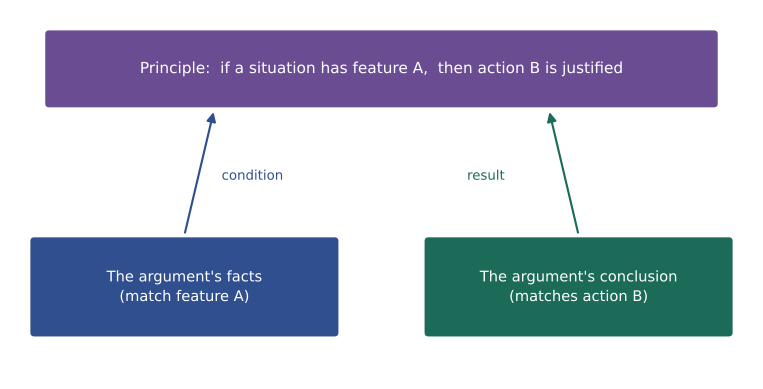
How to match a principle
Treat the correct principle like a sufficient assumption written in general terms. If the argument says, "This product contains a known allergen and its label does not mention it, so the company acted wrongly," the justifying principle will say something like: "A company acts wrongly if it sells a product containing a known allergen without disclosing it on the label." Its condition (allergen, no disclosure) matches the facts; its result (acted wrongly) matches the conclusion.
Wrong choices fail the match in predictable ways.
- The condition is too narrow. "A company acts wrongly if it sells a product containing peanuts without disclosure" does not apply if the allergen is something else.
- The result is different. "Companies should test every product for allergens" leads to a different conclusion.
- The principle is reversed. "If a company acts wrongly, it has failed to disclose an allergen" confuses necessary and sufficient conditions.
- The principle is too weak. "Disclosure of allergens is generally desirable" does not get you to "acted wrongly."
Dani found principle questions satisfying because they resemble the legal tests she saw at work. 'It is just a rule and a set of facts,' she said. Harriet agreed: law school would ask her to do this daily.
EXCEPT questions
An EXCEPT stem turns a question inside out. "Each of the following, if true, strengthens the argument EXCEPT:" means four choices strengthen and one does not. The correct answer is the one that does not strengthen. It may weaken, or it may be irrelevant.
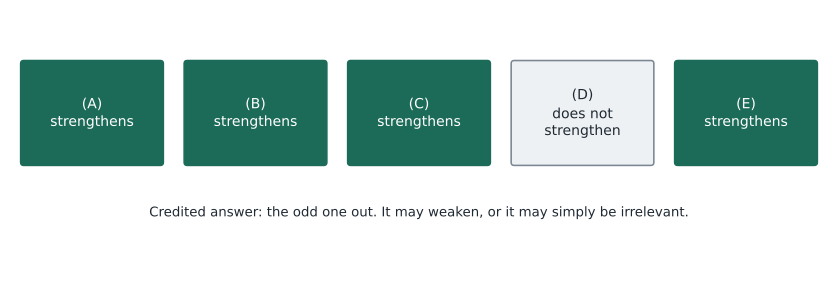
The trap is to look for the opposite: on a strengthen EXCEPT question, students hunt for a weakener, and if the odd one out is merely irrelevant, they cannot find their target. Instead, sort each choice into "does it" or "does not," and pick the one that does not.
Harriet's routine for EXCEPT questions:
- Circle EXCEPT in the stem and rewrite the task in your own words: "Four strengthen. Find the one that doesn't."
- Mark each choice: S for strengthens, and X for anything else.
- Choose the single X.
Because you must evaluate all five choices, EXCEPT questions take longer. Budget for that, and avoid second-guessing a clear X.
Most strongly supported and resolving paradoxes, briefly
Two other question families are close relatives of strengthen and weaken questions but are covered in LSAT-112. Most-strongly-supported questions reverse the direction: the stimulus supports one of the answer choices, rather than a choice supporting the stimulus. Resolve-the-paradox questions present two facts that seem to conflict and ask which choice, if true, explains how both can be true. Both share the "if true" habit you have built here. Harriet mentioned them so that the group would not confuse the stem forms under time pressure.
Strengthen and weaken with complex arguments
Harder strengthen and weaken questions tend to come with longer stimuli: an argument that answers an objection, an argument with an intermediate conclusion, or a dialogue. The same method works, but finding the target takes more care.
- With intermediate conclusions, identify the main conclusion. A choice that strengthens the step to the intermediate conclusion may help, but a choice that strengthens the step from the intermediate to the main conclusion often helps more.
- With opposing views, make sure you strengthen the author's conclusion, not the view the author rejects. This is the most common trap on hard questions.
- With dialogues, check which speaker's argument the stem asks about.
Worked problem
Sample question (written for this course)
Stimulus: "Some council members argue that the city should build a new library branch in Northgate because the neighborhood is growing quickly. But Northgate's growth comes mostly from families with young children, and the existing Central branch, a short bus ride away, has the city's largest children's section. So the money would be better spent expanding Central's children's section." Stem: "Which one of the following, if true, most strengthens the argument?" (A) Families in Northgate already use the Central branch frequently and report that the bus route is convenient. (B) Northgate's population has grown faster than any other neighborhood's. (C) New library branches attract visitors from across the city. (D) The cost of building a new branch is lower than expected. (E) Children's sections are popular in libraries generally.
Show solution
- Main conclusion: the money is better spent expanding Central. The council members' view (build in Northgate) is the opposing view.
- Gap: the argument assumes Northgate families can and will use Central.
- (B) supports the opposing view. (C) supports a new branch. (D) makes the new branch more attractive, weakening the author.
- (E) is too general to help either side.
- (A) confirms that Northgate families already use Central conveniently, closing the gap.
Answer: (A). (B) is the classic trap: it strengthens the view the author rejects.
Other stem forms that work the same way
You may meet strengthen and weaken questions phrased differently. All of these use the same method.
- "Which one of the following, if true, would provide the most support for the scientists' hypothesis?" (strengthen a hypothesis or explanation)
- "Which one of the following, if true, most undermines the critic's objection?" (weaken an objection, which may strengthen the main argument)
- "The argument would be most strengthened if it were established that…" (strengthen)
- "Which one of the following, if true, most supports the proposal?" (strengthen a plan)
Read the stem carefully to identify whose position you are helping or hurting. A stem that asks you to weaken an objection to the argument is, in effect, asking you to strengthen the argument.
| Stem says | What you are doing | Watch out for |
|---|---|---|
| "Principle… most helps to justify" | Strengthen with a general rule | Rules that are too narrow, reversed or too weak |
| "Each of the following strengthens… EXCEPT" | Find the one that does not strengthen | Hunting only for a weakener |
| "Each of the following weakens… EXCEPT" | Find the one that does not weaken | Hunting only for a strengthener |
| "Most undermines the objection" | Weaken the objection (helps the author) | Weakening the author instead |
| "Support for the hypothesis" | Strengthen an explanation | Supporting a rival explanation |
The group's mixed set
The session closed with a mixed set of ten questions in fourteen minutes (Ji-won twenty-one): three principle questions, three EXCEPT questions, and four strengthen or weaken questions with complex stimuli. Élodie scored 9, Ji-won 9, Marcus 8, Dani 8 and Thomas 7. Thomas lost both his points to an opposing-view trap and an EXCEPT question where he hunted for a weakener. 'That is the whole lesson in two mistakes,' Harriet told him, kindly. He wrote both into his error log with the fixes next to them.
Harriet then announced the capstone: a Saturday drill on November 21, fifteen questions drawn from the whole series, under timed conditions, followed by blind review.
Practice: a principle question and an EXCEPT question
Worked problem
Sample question (written for this course)
Stimulus: "Jae borrowed his neighbor's ladder without asking, intending to return it within an hour, and returned it undamaged. Even so, Jae acted wrongly." Stem: "Which one of the following principles, if valid, most helps to justify the conclusion?" (A) It is wrong to damage property one has borrowed. (B) Neighbors should lend each other tools. (C) One should return borrowed property promptly. (D) It is wrong to use another person's property without permission, even briefly and without causing harm. (E) Using another person's property is acceptable if it is returned undamaged.
Show solution
- Facts: used without permission, briefly, no damage. Conclusion: acted wrongly.
- (A) The ladder was not damaged, so this principle does not apply. (B) Concerns lending, not taking. (C) Jae returned it promptly; this would not make him wrong. (E) Supports the opposite conclusion.
- (D) Its condition (use without permission, even briefly and harmlessly) matches the facts, and its result (wrong) matches the conclusion.
Answer: (D).
Worked problem
Sample question (written for this course)
Stimulus: "Since the Pinecrest school district began serving breakfast to all students free of charge, attendance has risen. The free breakfasts, therefore, improved attendance." Stem: "Each of the following, if true, weakens the argument EXCEPT:" (A) The district also hired attendance counselors that year. (B) Attendance rose by the same amount in neighboring districts without free breakfasts. (C) That year, the district changed how it counts students who arrive late, recording many of them as present. (D) A flu outbreak had lowered attendance sharply the year before. (E) Attendance rose most at the schools where the largest share of students ate the free breakfast.
Show solution
- Four choices weaken; find the one that does not.
- (A) an alternative cause, weakens. (B) effect without cause, weakens. (C) a change in measurement, weakens. (D) an unusually low baseline, weakens.
- (E) shows a dose-response pattern, which strengthens. It is the odd one out.
Answer: (E). Mark each choice "W" or "X" and pick the single X.
When the stem changes the target
Élodie pointed out that a stem like "most undermines the critic's objection" sends you through two layers: first find the objection, then weaken it. Harriet agreed and suggested writing the target at the top of the scratch paper before reading the choices, for example "TARGET: the objection that costs will rise." That one line prevents the most common error on these questions, which is attacking the author's argument instead of the objection.
Principles in other question types
Principles appear in more than one kind of question. Some stems ask you to justify an argument with a principle (a strengthen task). Others ask which principle an argument conforms to (a description task), and still others give a principle in the stimulus and ask which situation applies it correctly (an inference task covered in LSAT-112). The core skill is the same in all three: match the principle's condition to the facts and its result to the conclusion, and watch for reversed or overly narrow rules.
Marcus said the principle questions reminded him of building codes: a rule, a set of facts, and a judgment about whether the facts trigger the rule. Harriet said that comparison would serve him well in law school, whatever his December score turned out to be.
Practice: weakening an objection
Worked problem
Sample question (written for this course)
Stimulus: "The city should convert two downtown traffic lanes into a protected bike lane. Critics object that this will hurt downtown businesses because fewer drivers will be able to reach them." Stem: "Which one of the following, if true, most undermines the critics' objection?" (A) Bike lanes are expensive to build. (B) In comparable cities, downtown businesses near new protected bike lanes saw customer numbers hold steady or rise, as more people arrived by bike and on foot. (C) Many drivers dislike cycling. (D) The city's downtown has several parking garages. (E) Some business owners support the bike lane.
Show solution
- Target: the objection that businesses will lose customers because fewer drivers can reach them.
- (A) Cost is not the objection. (C) Drivers' dislike of cycling, if anything, supports the critics. (D) Parking garages might help drivers, but the objection is about lane capacity; this helps only a little. (E) Some owners' support says nothing about whether business will suffer.
- (B) shows that in similar cases business did not suffer, directly undermining the objection.
Answer: (B). Undermining the objection supports the author's recommendation.
Common mistakes
MistakeChoosing a principle that matches the topic but not the facts and conclusion.
InsteadThe principle's condition must match the facts and its result must match the conclusion.
MistakeOn a strengthen EXCEPT question, looking only for a weakener.
InsteadThe credited answer is any choice that does not strengthen, including irrelevant ones.
MistakeStrengthening the view the author rejects.
InsteadIdentify the main conclusion before testing choices.
MistakeMisreading whose position the stem asks about.
InsteadWeakening an objection to an argument strengthens the argument.
Summary and key terms
- Principle-justify questions are strengthen questions with general rules as choices.
- A justifying principle's condition matches the facts and its result matches the conclusion.
- EXCEPT questions ask for the one choice that lacks the property the other four share; it may be irrelevant rather than opposite.
- In complex arguments, strengthen or weaken the main conclusion, not an opposing view or an intermediate step alone.
- Read unusual stems carefully to see whose position you are supporting or attacking.
- Principle
- A general rule that applies to many situations.
- Principle-justify question
- A question asking which principle would most support an argument's reasoning.
- EXCEPT question
- A question in which four choices share a property and the credited answer is the one that does not.
- Opposing view
- A position in the stimulus that the author argues against.
Practice problems
Work each problem on paper first, then reveal the answer to check.
Write a justifying principle: "The tenant reported the leak promptly and the landlord ignored it for a month, so the landlord should pay for the water damage."
Show answer
Example: "A landlord who ignores a promptly reported leak should pay for the resulting damage."
On a "weakens… EXCEPT" question, a choice is irrelevant. Could it be the credited answer?
Show answer
Yes. Any choice that does not weaken, whether it strengthens or is irrelevant, can be the credited answer.
A stem asks which choice "most undermines the critic's objection." Whose argument does the correct answer help?
Show answer
The author's, because weakening the objection removes a challenge to the author's argument.
Lesson quiz · 5 questions
Score 60% or more to complete this lesson.
Create a free account to save your progress, take quizzes and earn a certificate.