
LSAT-111 · Lesson 12 of 12 · 52 min
Capstone: a timed flaw, strengthen and weaken drill
▶ Video coming soon A video version of this lesson is on the way.
On Saturday morning, November 21, 2026, the Thursday Circle met for the capstone of the Tuesday series. Harriet had written fifteen questions for the occasion: five flaw questions, four strengthen, four weaken and two evaluate, mixed in random order as they would be on the test. The time limit was twenty-one minutes, the same pace as a real section (about 84 seconds a question). Ji-won had thirty-one and a half minutes under her accommodation. Marcus, whose score was still unreleased, took the drill anyway, as he put it, "for the sake of finishing what I started."
This lesson contains the full drill, with an explanation for every answer choice, followed by the group's results and Harriet's debrief. You will get the most from it by taking the drill yourself first, timed, before reading the explanations.
How to take the drill
- Set a timer for 21 minutes (or your own accommodated time).
- Work through the fifteen questions in order, marking an answer for every one. There is no penalty for wrong answers on the LSAT, so never leave a question blank.
- Flag any question you are unsure about.
- When time is up, stop. Then do blind review: revisit every flagged question without looking at the answers, and decide on your final choice with as much time as you need.
- Only then read the explanations. Record your timed score and your blind review score separately.
The drill
Worked problem
Drill question 1 (flaw)
Stimulus: "Every member of the Ashby Rowing Club who trained with the new coach last season improved her race times. Therefore, the new coach is the reason the club's rowers improved." Stem: "The reasoning in the argument is flawed because the argument" (A) relies on the testimony of an interested party. (B) treats a necessary condition as a sufficient one. (C) fails to consider that rowers who chose to train with the new coach may have been more motivated to improve. (D) draws a conclusion about one club from evidence about many clubs. (E) presupposes that race times are an accurate measure of skill.
Show solution
- Conclusion: the coach caused the improvement. Evidence: those who trained with the coach improved.
- (A) No testimony is cited. (C) Correct: the rowers who chose the coach may differ from others, an alternative explanation the argument ignores. (B) No conditional structure is involved. (D) The evidence is about one club. (E) Using race times as a measure is reasonable and not the gap.
Answer: (C).
Worked problem
Drill question 2 (weaken)
Stimulus: "The town of Corrin introduced a curbside composting program in January. By December, the amount of garbage sent to the landfill had fallen by twenty percent. The composting program, therefore, reduced the town's landfill garbage." Stem: "Which one of the following, if true, most seriously weakens the argument?" (A) Some residents did not participate in the composting program. (B) Composting programs have reduced landfill garbage in other towns. (C) The composting program was more expensive than expected. (D) In February, the town's largest employer, which had produced much of its garbage, closed its factory. (E) Most residents said they liked the composting program.
Show solution
- Causal argument from a sequence. Predict an alternative cause.
- (A) Partial participation does not show the program had no effect. (D) Correct: the factory closure is an alternative explanation for the drop. (B) Strengthens slightly by showing such programs can work. (C) Cost is irrelevant to whether garbage fell because of the program. (E) Opinions do not bear on the cause.
Answer: (D).
Worked problem
Drill question 3 (strengthen)
Stimulus: "A survey of 1,500 adults selected at random from the province's voter list found that sixty percent support extending store hours on Sundays. So most adults in the province support extending Sunday store hours." Stem: "Which one of the following, if true, most strengthens the argument?" (A) Nearly all adults in the province are on the voter list. (B) The survey was conducted by a reputable polling firm. (C) Many stores already open on Sundays. (D) Support for Sunday hours has risen over the past decade. (E) Sixty percent is a large majority.
Show solution
- Sampling argument: the sample is random from the voter list; the conclusion is about all adults.
- Gap: voters may differ from all adults.
- (B) Helps a little, but does not address who was sampled. (A) Correct: if nearly all adults are on the list, the sample represents adults generally. (C) Irrelevant to support. (D) A trend says nothing about the current majority. (E) Repeats the premise.
Answer: (A).
Worked problem
Drill question 4 (flaw)
Stimulus: "Only employees who complete the safety course may operate the forklift. Raj completed the safety course last month. So Raj may operate the forklift." Stem: "Which one of the following most accurately describes a flaw in the argument?" (A) It confuses a correlation with a cause. (B) It relies on a sample that is too small. (C) It attacks Raj rather than the policy. (D) It assumes what it sets out to prove. (E) It presumes that completing the course is all that is required to operate the forklift.
Show solution
- Translate: Operate → Course. The argument reasons Course, so Operate: necessary treated as sufficient.
- (E) Correct: it treats a requirement as a guarantee. (A), (B), (C) and (D) describe flaws absent from this argument.
Answer: (E).
Worked problem
Drill question 5 (evaluate)
Stimulus: "After the Fenwick Art Gallery began offering free admission on Thursday evenings, its total monthly attendance rose by a third. The free evenings, then, attracted many new visitors." Stem: "Which one of the following would it be most useful to know in order to evaluate the argument?" (A) Whether the gallery has a café (B) Whether the gallery's paid attendance on other days fell after the free evenings began (C) How many paintings the gallery owns (D) Whether other galleries charge admission (E) How long the gallery has been open
Show solution
- Variance test on (B): if paid attendance fell, existing visitors may simply have shifted to free evenings, weakening the "new visitors" claim; if it held steady, the rise more likely reflects new visitors, strengthening it.
- (A), (C), (D) and (E): neither answer would affect whether the free evenings brought in new visitors.
Answer: (B).
Worked problem
Drill question 6 (weaken)
Stimulus: "Patients at Linwood Clinic who use its new appointment-reminder text messages miss far fewer appointments than patients who do not. The clinic should therefore require all patients to receive the reminders." Stem: "Which one of the following, if true, most seriously weakens the argument?" (A) Text messages are inexpensive to send. (B) Missed appointments cost the clinic money. (C) Some patients prefer phone calls to text messages. (D) Patients who signed up for the reminders were already among the clinic's most reliable patients. (E) The reminders are sent two days before each appointment.
Show solution
- Observational comparison: users versus non-users. Predict a pre-existing difference.
- (A) Supports the plan slightly. (D) Correct: reliable patients chose the reminders, so the difference may reflect who signed up rather than the reminders. (B) Explains why the goal matters. (C) Too weak; a preference does not show reminders fail. (E) A detail with no effect.
Answer: (D).
Worked problem
Drill question 7 (flaw)
Stimulus: "Critics claim that the proposed tax on sugary drinks will harm small businesses. But the critics include several soft drink manufacturers, who obviously stand to lose money from the tax. So the tax will not harm small businesses." Stem: "The argument is most vulnerable to criticism on the grounds that it" (A) rejects a claim on the basis of the interests of some of those who make it. (B) presents two options as the only ones possible. (C) uses the term "harm" in two different senses. (D) relies on an unrepresentative sample of businesses. (E) confuses a cause with its effect.
Show solution
- The author dismisses the critics' claim because of who some critics are, and then concludes the opposite.
- (B), (C), (D) and (E) do not occur. (A) Correct: an attack on the source.
Answer: (A).
Worked problem
Drill question 8 (strengthen)
Stimulus: "Researchers found that birds in cities sing at higher pitches than birds of the same species in the countryside. They concluded that city birds raise their pitch so that their songs can be heard over low-pitched traffic noise." Stem: "Which one of the following, if true, most strengthens the researchers' conclusion?" (A) City birds are generally smaller than country birds. (B) Some country birds also sing at high pitches. (C) Within the same city, birds sing at higher pitches near busy roads than in quiet parks. (D) Traffic noise has increased in many cities. (E) Birdsong serves several purposes, including attracting mates.
Show solution
- Causal explanation: traffic noise causes higher pitch.
- (A) Suggests an alternative cause (size affects pitch), weakening. (C) Correct: a dose-response pattern within the same city, with the noise varying and other city conditions held roughly constant. (B) Too weak to matter. (D) Does not link noise to pitch. (E) Irrelevant to why pitch differs.
Answer: (C).
Worked problem
Drill question 9 (weaken)
Stimulus: "The proportion of Weston's workforce employed in manufacturing fell from 30 percent to 20 percent over the past decade. Clearly, the number of manufacturing jobs in Weston has declined." Stem: "Which one of the following, if true, most seriously weakens the argument?" (A) Manufacturing wages in Weston have risen. (B) Several factories in nearby towns closed. (C) Many manufacturing workers are near retirement. (D) Weston's service sector employs more people than its manufacturing sector. (E) Weston's total workforce more than doubled over the decade.
Show solution
- Percentage-to-amount argument. Predict: the total changed.
- (E) Correct: if the workforce more than doubled, 20 percent of the new total exceeds 30 percent of the old, so manufacturing jobs rose. (A), (B), (C) are irrelevant to the count. (D) is consistent with the premises and does not weaken.
Answer: (E).
Worked problem
Drill question 10 (flaw)
Stimulus: "The new regulation is certainly fair, since every provision in it treats all citizens justly." Stem: "The reasoning in the argument is flawed because the argument" (A) relies on an authority outside his or her field. (B) presupposes the truth of what it seeks to establish. (C) treats a sufficient condition as a necessary one. (D) infers a cause from a correlation. (E) generalizes from a small sample.
Show solution
- "Fair" and "treats all citizens justly" amount to the same claim; the premise restates the conclusion.
- (B) Correct: circular reasoning. The other choices describe flaws absent from the argument. (One might suspect composition, from provisions to the whole regulation, but that is not offered.)
Answer: (B).
Worked problem
Drill question 11 (strengthen)
Stimulus: "Cooking classes for children at the Maple Hill Community Center should be expanded. The classes teach healthy eating habits, and children who take them eat more vegetables at home afterwards, according to their parents." Stem: "Which one of the following, if true, most strengthens the argument?" (A) The community center also offers swimming lessons. (B) Parents enjoy cooking with their children. (C) Cooking classes are popular in many community centers. (D) Children who took the classes and those who did not had similar diets before the classes began. (E) Some children found the classes difficult.
Show solution
- The argument relies on a before-and-after effect reported by parents. Gap: children who took the classes might already have eaten more vegetables.
- (D) Correct: it rules out a pre-existing difference. (A), (B), (C) are irrelevant to the classes' effect. (E) slightly weakens.
Answer: (D).
Worked problem
Drill question 12 (evaluate)
Stimulus: "To reduce the number of cars on its campus, Kestrel Ridge College plans to raise parking fees by fifty percent. Since most students and staff are cost-conscious, the plan should work." Stem: "The answer to which one of the following questions would most help in evaluating the argument?" (A) Whether the college's parking lots are paved (B) How much the college earns from parking fees today (C) Whether practical alternatives to driving, such as frequent bus service, are available to most people who now drive to campus (D) Whether faculty members prefer to drive (E) How many students attend Kestrel Ridge College
Show solution
- Plan argument. Variance test on (C): if alternatives exist, higher fees can push drivers to switch, strengthening the plan; if not, people may simply pay more, weakening it.
- (A) Irrelevant. (B) Revenue is not the goal. (D) Preference alone does not decide whether people will stop driving if costs rise. (E) Size of the student body does not bear on whether the plan reduces cars.
Answer: (C).
Worked problem
Drill question 13 (weaken)
Stimulus: "The Brennan Museum surveyed visitors leaving its new dinosaur exhibit, and ninety percent rated it excellent. So the exhibit will substantially increase attendance at the museum next year." Stem: "Which one of the following, if true, most seriously weakens the argument?" (A) Most visitors to the exhibit were annual members who visit the museum regularly regardless of new exhibits. (B) The survey was conducted on weekends. (C) Dinosaur exhibits are popular with children. (D) The museum spent a great deal on the exhibit. (E) Ten percent of visitors did not rate the exhibit excellent.
Show solution
- Prediction from a satisfaction survey: the gap is whether liking the exhibit will bring additional visitors.
- (A) Correct: if most viewers were regulars who come anyway, high ratings do not indicate new attendance. (B) Weekends alone do not show bias in ratings. (C) Mildly supports. (D) Irrelevant. (E) Restates the premise.
Answer: (A).
Worked problem
Drill question 14 (flaw)
Stimulus: "Every song on the band's new album is under four minutes long. So the album as a whole is short." Stem: "The flawed reasoning in the argument is most similar to which one of the following errors?" (A) Concluding that each part has a property because the whole has it (B) Treating a correlation as a cause (C) Rejecting a claim because of its source (D) Using a key word in two senses (E) Concluding that a whole has a property because each of its parts has it
Show solution
- An album of many short songs can be long. The argument moves a property from the parts to the whole.
- (E) Correct: composition. (A) is division, the reverse. (B), (C) and (D) do not apply.
Answer: (E).
Worked problem
Drill question 15 (strengthen)
Stimulus: "Sales of the Harlow Bakery's sourdough bread rose sharply after the bakery began displaying it in its front window. The window display, therefore, increased sourdough sales." Stem: "Which one of the following, if true, most strengthens the argument?" (A) The bakery also sells rye bread. (B) Sales of the bakery's other breads, which were not displayed in the window, did not change over the same period. (C) Sourdough bread is more expensive than white bread. (D) The bakery's owner designed the window display herself. (E) Window displays are common in bakeries.
Show solution
- Causal argument. Predict: rule out a general rise in sales.
- (B) Correct: other breads stayed flat, so a bakery-wide cause (more customers, a holiday) is less likely. (A), (C), (D), (E) are irrelevant to the cause of the rise.
Answer: (B).
Answer key
| Question | Type | Answer | Flaw or move tested |
|---|---|---|---|
| 1 | Flaw | C | Self-selection / alternative explanation |
| 2 | Weaken | D | Alternative cause |
| 3 | Strengthen | A | Representative sample |
| 4 | Flaw | E | Necessary treated as sufficient |
| 5 | Evaluate | B | Shift versus new visitors |
| 6 | Weaken | D | Pre-existing difference |
| 7 | Flaw | A | Attacking the source |
| 8 | Strengthen | C | Dose-response |
| 9 | Weaken | E | Percentage versus amount |
| 10 | Flaw | B | Circular reasoning |
| 11 | Strengthen | D | Rule out pre-existing difference |
| 12 | Evaluate | C | Plan feasibility |
| 13 | Weaken | A | Unrepresentative respondents |
| 14 | Flaw | E | Composition |
| 15 | Strengthen | B | Effect absent without cause |
The group's results
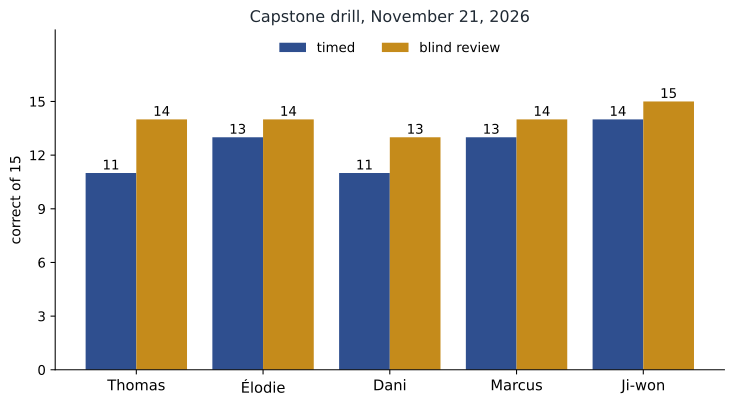
Timed and blind review scores out of fifteen: Thomas 11 and 14; Élodie 13 and 14; Dani 11 and 13; Marcus 13 and 14; Ji-won 14 and 15. Harriet compared them with the Thursday group's November 5 argument drill and with the November 19 mini diagnostic. Everyone's timed accuracy had held steady or improved even though the questions were harder.
Thomas's gap of three points between timed and blind review was the largest. In debrief, he found that two of his timed errors were on questions he simply rushed: a weaken question where he picked a disguised strengthener, which he caught in blind review, and question 9, where he forgot to ask whether the total changed. Harriet told him his understanding was now solid and his next task was pacing, which LSAT-140 would address. His target for April remained 162.
Dani's two blind review misses were both evaluate questions. She had chosen choices that were interesting but failed the variance test. She resolved to write "yes / no" beside each evaluate choice until it became automatic.
Élodie missed question 13 in both timed and blind review. She had chosen (B), reasoning that weekend visitors might be families who liked dinosaurs more. Harriet acknowledged the instinct but pointed out that (A) attacks the central gap, the move from ratings to new attendance, whereas (B) raises only a possible bias in ratings.
Marcus missed question 5 in both timed and blind review, choosing (D). He laughed and said that was what happened when you took a drill while waiting for a real score.
Ji-won got every question right in blind review. Her one timed miss was question 12, where she ran short of time at the end and guessed. Harriet suggested she move faster through early flaw questions, which she now answered almost instantly, to bank time for evaluate and plan questions.
Harriet's debrief
Harriet closed the series with four points.
- The gap is everything. Every question on the drill turned on the same gap you found before reading the choices. When you missed one, the cause was almost always a missing or vague prediction.
- Direction matters. On strengthen and weaken questions, the most common error is choosing a relevant answer that pushes the wrong way. Check direction every time.
- Premises are true. No credited answer on any of these question types attacks a premise.
- Keep the error log honest. Record not just the question type you missed but the move you missed: "forgot to check the total," "fell for the opposing view," "skipped the variance test." Moves repeat across topics; question numbers do not.
She reminded the group of what came next: LSAT-112 for inference, principle and parallel questions, and the reading comprehension courses. For Dani, Élodie and Ji-won, the January test was less than two months away. For Marcus, December 2 would bring his score and a decision. For Thomas, the plan was steady work toward April.
Common mistakes
MistakeReading the explanations before attempting the drill.
InsteadTake the drill timed first, then do blind review, then read explanations.
MistakeTreating a missed question as bad luck.
InsteadRecord the specific move you missed so you can fix it.
MistakeSpending equal time on every question.
InsteadMove quickly through questions you predict confidently and bank time for harder ones.
Summary and key terms
- The capstone mixes flaw, strengthen, weaken and evaluate questions as they appear on the test.
- Take it timed, then do blind review, and compare the two scores.
- A large gap between timed and blind review scores points to pacing; a small gap points to understanding.
- Most errors trace back to a missing prediction, a choice that pushes the wrong direction, or skipping the variance test.
- An error log that records moves, not just question types, makes practice more efficient.
- Blind review
- Revisiting questions after a timed set, without seeing the answers, to decide on final choices with unlimited time.
- Error log
- A record of missed questions noting the type, the move missed and the fix.
- Pacing
- Managing time so that easier questions are answered quickly and harder ones get more time.
Practice problems
Work each problem on paper first, then reveal the answer to check.
Your timed score is 9 of 15 and your blind review score is 14. What should you work on?
Show answer
Pacing and test-taking under time pressure; your understanding is largely sound.
Your timed score is 10 and your blind review score is 10. What does this suggest?
Show answer
Your errors come from understanding, not time; review the concepts and moves behind each miss.
Write an error log entry for missing question 9.
Show answer
Example: "Weaken, percentage-to-amount. Missed move: did not ask whether the total changed. Fix: circle every percentage and write 'of what?'"
Lesson quiz · 5 questions
Score 60% or more to complete this lesson.
Create a free account to save your progress, take quizzes and earn a certificate.