
LES-204 · Lesson 7 of 12 · 19 min
Defensive tactics principles: stance, distance, balance and control
▶ Video coming soon A video version of this lesson is on the way.
Haddad has taught defensive tactics on the mat for eleven years, but she does not bring a mat into this classroom. 'You will spend dozens of hours on the mat in recruit training, and then every year after that for as long as you carry a badge,' she tells the class. 'What you learn here is what the mat is for. If you understand the principles, the techniques make sense, you will pick them up faster, and you will be able to explain afterward why you did what you did. If you only learn techniques, you will use them in the wrong places.'
What defensive tactics are for
Defensive tactics, sometimes called control tactics or arrest and control, are the physical skills officers use to protect themselves and others and to bring a resisting person under control with the least injury to everyone. The name is deliberate. The skills are defensive in purpose even when they involve the officer acting first, because their goal is to stop a threat or overcome resistance to a lawful action, not to win a fight or punish anyone.
Every defensive tactics program has three goals, and they are in priority order. The first is safety: the officer, the person and bystanders should all come through the encounter with as little injury as possible. The second is control: the person should end up in a position where they can no longer resist or hurt anyone, usually handcuffed. The third is lawfulness and accountability: every action should be one the officer can justify and explain. A technique that achieves control but injures the person unnecessarily, or that the officer cannot explain, has failed.
Distance and the reactionary gap
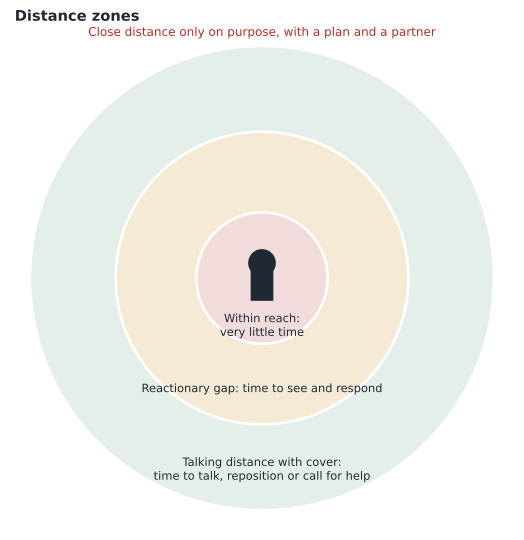
Lessons 3 and 4 showed that distance buys time. Defensive tactics training builds on the same idea with the concept of the reactionary gap: the distance an officer needs between themselves and a person to have time to see a threatening movement and respond to it. Because action is faster than reaction, an officer who is very close to a person can be struck before they can respond, however skilled they are. Training teaches officers to manage distance throughout an encounter: to stay outside arm's reach when talking with someone who might become violent, to close distance only on purpose and with a plan, and to create distance again if the situation changes.
At Tidewater Park, the officers kept a large gap while Pelley held the bottle, and the gap closed only at the curb, when the alternative was letting him walk into traffic. 'That was the right decision,' Haddad says, 'but notice it was not a planned decision. Dev and Sofia closed from about 16 feet at a run. Nobody had said who would take which arm or what we would do if he fought.' Planning to close distance is one of the main lessons of the review.
Stance and position
How an officer stands affects both safety and communication. Training generally teaches a balanced, relaxed stance in which the officer stands at a slight angle to the person rather than square on, with weight evenly spread and knees slightly bent, and with hands up and open in front of the body, often in a non-threatening position such as loosely clasped or gesturing as the officer talks. The angle protects the officer's equipment side and makes them a smaller target; the balance lets them move in any direction; and the open hands are ready to protect without looking aggressive. To a person in crisis, a well-trained interview stance looks like someone listening.
Position also matters relative to the environment and to other officers. Officers are taught to keep an escape route for themselves and, where possible, for the person, because a person who feels trapped is more likely to fight. They avoid standing in each other's line of fire, avoid backing into traffic or off stairs, and use objects such as cars and walls as cover. At Tidewater Park, Reyes's position about 13 feet to Malhotra's left, at an angle, let her see Pelley's hands and kept her out of Malhotra's way.
Balance and base
Much of defensive tactics is about balance: keeping your own and controlling the other person's. A person who is off balance cannot strike or pull away effectively, and a person who is on balance can. Officers learn to keep a stable base, with feet apart and weight low, so that a sudden pull or push does not take them off their feet. Falls are one of the most common causes of injury in police struggles, for officers and subjects alike, and an uncontrolled fall onto concrete or into traffic can cause serious head injuries.
At Tidewater Park, Pelley, Malhotra, Reyes and Brody all went to the ground together in an unplanned fall onto the grass beside the sidewalk. 'We were lucky it was grass,' Haddad says. 'Ten feet to the left and it was the sidewalk, or the road.' Training teaches officers that if a person is to be brought to the ground, it should be a controlled movement onto a safe surface, ideally with several officers working together, rather than a tumble.
Categories of control
Defensive tactics programs organize physical techniques into categories. This course describes the categories and the legal and medical issues each raises. It does not teach the techniques themselves, which are taught only by certified instructors on the mat.
| Category | Purpose | Main risks and limits |
|---|---|---|
| Escort and guiding touch | Direct a cooperative or mildly resistant person | Low risk; can escalate if the person feels grabbed without warning |
| Joint control and pressure points | Gain compliance through controlled discomfort | Must stop when the person complies; risk of joint injury if forced |
| Grounding | Bring a resisting person to the ground to control them | Falls, head injuries; surface and environment matter; leads to prone position |
| Strikes | Stop an assault or create an opening for control | Higher injury risk; head strikes can cause serious harm; must be justified each time |
| Handcuffing | Restrain the hands for safety and custody | Wrist and shoulder injuries; positional asphyxia if prone too long |
| Neck restraints | Restricted or banned in many services | Can cause death or serious injury; often limited to situations where lethal force is justified |
Two principles run through every category. First, pain compliance techniques are meant to produce compliance, not punishment: as soon as the person stops resisting, the pressure stops. Officers are trained to pair any such technique with clear directions so the person knows what will make it stop. Second, each use of a higher-risk technique, such as a strike, must be justified on its own. A person who was assaultive a few seconds ago may now be trying to get away or may have given up, and the response must change accordingly.
Teamwork in control
One officer trying to control a strong, resisting person is in a dangerous position for both of them, because the officer may have to use more force to make up for having no help. Two or three officers working together can often control the same person with less force and less injury, because each can control part of the person's movement without having to hurt them. That is why training increasingly emphasizes team control: officers waiting, when possible, until enough officers are present, agreeing on roles before going hands on, and having one officer take charge of the person's head and breathing during any ground control. Lesson 9 shows why that last role matters.
Team control also means that one officer, usually the one who was talking, keeps talking. At Tidewater Park, nobody spoke to Pelley for about fifteen seconds after the group went down, apart from shouts of 'Stop resisting'. The review recommended that the contact officer keep giving short, clear directions during any struggle, and that someone tell the person what is happening as soon as the handcuffs are on.
Protecting the officer's equipment
Every officer on patrol carries weapons, and in any struggle there is a risk that the person will try to take one. Training therefore treats weapon retention as a principle that shapes everything else: officers stand with their equipment side angled away, avoid letting a resisting person get behind them or onto their belt, and work in teams so that one officer can protect equipment while others control the person. Holster design, which the firearms course covers, adds mechanical security. A grab for an officer's firearm changes the legal situation completely, because it can create a risk of death or grievous bodily harm, and officers must be able to recognize and describe that change.
What injury data show
Studies of use-of-force incidents in North America consistently find that most injuries to both officers and subjects are minor, such as abrasions, bruises and sprains, and that the risk of injury rises with the level of physical struggle and with going to the ground. Several large studies have found that the use of conducted energy weapons and OC spray is associated with fewer injuries than prolonged physical struggles, while baton strikes and ground fighting are associated with more. The less-lethal weapons course examines that research. For this course, the lesson is that the length and intensity of a physical struggle are themselves a risk factor, so strategies that shorten a struggle, such as having enough officers and a plan, also reduce injuries.
Explaining control in a report
Because every physical action must be justifiable, officers need to be able to describe what they did in plain words. A report that says 'the subject was taken to the ground using an approved technique' tells a reviewer nothing. A report that says what the person was doing, what the officer did, why, and what happened next lets a reviewer, a court and the person judge whether it was reasonable. Lesson 11 covers report writing in detail.
Size, strength and fitness
Officers come in every size, and so do the people they meet. Defensive tactics programs are designed so that technique, leverage and teamwork can make up for differences in size and strength, but they cannot make up for everything. An officer who is much smaller than a resisting person may reasonably need more help, more distance or a different option. Courts and reviewers take the relative size, strength and number of officers and subjects into account in judging whether force was reasonable. Fitness also matters: a struggle of even thirty seconds is exhausting, and a tired officer makes worse decisions and is more likely to use higher levels of force.
Skills fade
Physical skills that are not practiced fade quickly, often within months. Under stress, officers fall back on what they have practiced most, which may not be what they learned most recently. That is why services require annual requalification, why the best programs build skills through frequent short practice sessions rather than occasional long ones, and why scenario training combines communication, decision-making and physical skills in realistic settings. Officers who train regularly tend to use less force, because they are more confident and less likely to panic, and they are less likely to be injured.
Worked problem
How much training time is enough?
Port Ardent requires 16 hours of defensive tactics training a year. A research summary suggests that skills hold better with practice at least once a month. If the 16 hours were spread over monthly sessions, how long would each session be, and how many more hours a year would be needed to make each monthly session 2 hours long?
Show solution
- Monthly sessions from 16 hours:
- \[16 \div 12 \approx 1.33 \text{ hours}\]
- That is about 1 hour 20 minutes a month.
- Hours needed for 2 hours a month:
- \[2 \times 12 = 24 \text{ hours}\]
- \[24 - 16 = 8 \text{ more hours}\]
Answer: About 1 hour 20 minutes a month, or 8 more hours a year for 2-hour monthly sessions. Many services choose fewer, longer sessions because of scheduling, even though spaced practice works better.
Common mistakes
MistakeDefensive tactics are about winning a fight.
InsteadThey are about safety and control with the least injury, and every action must be justifiable.
MistakeClosing distance quickly shows confidence and control.
InsteadClosing distance gives up reaction time; it should be done on purpose, with a plan and enough officers.
MistakePain compliance can continue until the person apologizes or stops arguing.
InsteadIt must stop as soon as the person stops resisting.
MistakeOnce trained, an officer keeps their skills.
InsteadPhysical skills fade quickly without regular practice.
Summary and key terms
- Defensive tactics aim for safety, then control, then lawful and explainable action.
- The reactionary gap is the distance needed to see and respond to a sudden movement; officers close it only on purpose.
- A balanced, angled stance with open hands supports both safety and communication.
- Balance and controlled movement prevent falls, a major cause of injury.
- Control categories range from escorts to strikes and neck restraints, with rising risk and stricter justification.
- Team control, continued communication, fitness and regular practice reduce force and injuries.
- Defensive tactics
- Physical skills used to protect people and control resistance with the least injury.
- Reactionary gap
- The distance an officer needs to have time to see and respond to a threatening movement.
- Interview stance
- A balanced, angled, open-handed stance used while talking with someone who might become violent.
- Pain compliance
- Controlled discomfort used to gain compliance, which must stop when compliance is achieved.
- Team control
- Several officers working together, with assigned roles, to control a person with less force.
Practice problems
Work each problem on paper first, then reveal the answer to check.
What are the three goals of defensive tactics, in order?
Show answer
Safety, control, and lawful and explainable action.
Why is closing distance at a run risky?
Show answer
It removes reaction time, often happens without a plan and can lead to uncontrolled falls.
Why do teams often use less force than single officers?
Show answer
Each officer controls part of the person's movement, so nobody has to hurt the person to make up for having no help.
What should happen to pain compliance when the person stops resisting?
Show answer
It should stop immediately.
Lesson quiz · 5 questions
Score 60% or more to complete this lesson.
Create a free account to save your progress, take quizzes and earn a certificate.