
LES-204 · Lesson 10 of 12 · 21 min
The duty to intervene and peer intervention
▶ Video coming soon A video version of this lesson is on the way.
Sofia Reyes was eleven months out of the academy on the night of Tidewater Park. Ken Brody had eight years of service and had trained her for part of her coach period. When she heard Pelley say he could not breathe the second time, and saw that Brody's knee had not moved, she said, loudly and in a flat voice, 'Ken. Off his back. Roll him.' Brody moved within two seconds. In her interview, Reyes said she had hesitated for a few seconds before speaking. 'I thought, he's senior, he knows what he's doing, maybe I'm wrong,' she said. 'Then I thought about the training video we watched. And I just said it.'
Haddad pauses on that sentence. 'That hesitation,' she says, 'is the most normal thing in the world, and it is why we train this. Sofia did exactly the right thing, and she did it even though every instinct she had about rank and loyalty was telling her not to. Our job is to make that easier for every one of you.'
What the duty to intervene is
The duty to intervene is an officer's obligation to act when they see another officer using force that is clearly beyond what is objectively reasonable, or otherwise acting unlawfully, and they have a realistic chance to stop it. Intervention can be verbal, such as telling the officer to stop, or physical, such as pulling them away, and it usually also includes reporting what happened to a supervisor. A related duty is the duty to render or summon medical aid, discussed in lesson 9. The two often go together, because the officer who sees excessive force is often also the one best placed to see that the person needs help.
In the United States, the duty to intervene has both legal and policy sources. Federal courts have long held that an officer who has a realistic opportunity to stop another officer's excessive force, and fails to do so, can be held liable under 42 U.S.C. section 1983; one of the earliest cases was Byrd v. Brishke, decided by the Seventh Circuit in 1972. Failing to intervene can also be a federal crime under 18 U.S.C. section 242. After 2020, many states passed laws requiring officers to intervene and report, and a 2022 executive order required federal law enforcement agencies to adopt duty-to-intervene policies. Most large agencies now include the duty in their use-of-force policies.
Why it matters: incidents that changed policing
Several incidents have shown what happens when officers do not intervene. The death of George Floyd in Minneapolis in May 2020 is the best-known example: while one officer knelt on Floyd's neck for more than nine minutes, three other officers held him or kept bystanders back. All three were later convicted in federal court of violating his rights, including by failing to provide medical aid, and two were also convicted of failing to intervene. Earlier, the beating of Rodney King by Los Angeles officers in 1991, while other officers watched, had raised the same questions. These cases led agencies across the country to strengthen intervention policies and training.
Why intervening is hard
Intervening against a fellow officer is one of the hardest things an officer may ever be asked to do. Research on bystanders, including the work of the psychologist Ervin Staub, whose studies of why people do or do not intervene underpin modern peer intervention programs, identifies several barriers. People in a group assume someone else will act, a pattern sometimes called diffusion of responsibility. People doubt their own reading of the situation, especially if others seem unconcerned. They worry about being wrong, about damaging a relationship or about being punished. And in policing, the culture of loyalty to partners and respect for rank and experience can make speaking up feel like betrayal.
| Barrier | What it sounds like | What helps |
|---|---|---|
| Diffusion of responsibility | "Someone else will say something." | Training that makes intervention every officer's personal job |
| Self-doubt | "Maybe I'm reading this wrong." | Clear, simple triggers, such as "I can't breathe" or force after handcuffing |
| Rank and seniority | "He's been on the job much longer than me." | Policy and leaders that say rank does not matter for intervention |
| Loyalty | "I don't want to get my partner in trouble." | Framing intervention as protecting the partner from a career-ending mistake |
| Fear of retaliation | "I'll be the one who gets frozen out." | Protection from retaliation in policy and in practice |
Peer intervention training
Modern peer intervention programs try to lower these barriers. One of the first was EPIC (Ethical Policing Is Courageous), developed by the New Orleans Police Department in 2016. Building on EPIC and on Staub's research, Georgetown University Law Center launched the ABLE program (Active Bystandership for Law Enforcement) in 2020. ABLE has since been adopted by hundreds of agencies in the United States, and some Canadian services have introduced similar peer intervention training. These programs share several features.
First, they teach intervention as a skill, with practice. Officers rehearse short, clear phrases they can use in the moment, such as 'Stop', 'Off his neck', 'Roll him', 'Let me take over' or 'Step back, I've got this', and they practice saying them to more senior officers in scenarios. Second, they treat intervention as protecting the officer being stopped as well as the person on the ground. Third, they include agency commitments: leaders state publicly that intervention is expected, that officers who intervene will be supported, and that retaliation will be punished. And fourth, they apply the same skills to other kinds of misconduct and mistakes, not only force, so that speaking up becomes normal.
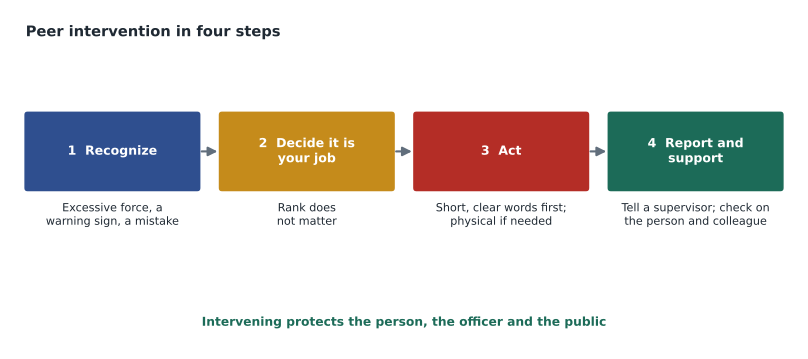
What intervention looks like
Intervention is usually verbal, short and specific. The most effective phrases tell the officer what to do rather than what they are doing wrong, because a person under stress can follow a simple instruction more easily than they can process criticism. Reyes's words at Tidewater Park are a model: she used Brody's name to get his attention through his tunnel vision, then gave two short instructions. If words do not work, intervention may become physical, such as placing a hand on the officer's shoulder, pulling them back or physically taking over their position. Physical intervention against a fellow officer is a last resort, but it is sometimes necessary when a person's life is at risk.
Intervention also includes what happens after. The intervening officer should report what they saw to a supervisor, should check on the person who was subjected to the force, and, where appropriate, should check on the colleague they stopped. Haddad says Brody came to find Reyes after the call. 'He thanked her,' Haddad says. 'Not right away. He was upset and defensive for about an hour. But before the end of the shift he found her and said thank you. That is what good intervention culture looks like.'
When to intervene
Officers are not expected to second-guess every decision a colleague makes, and intervention is not the same as disagreeing about tactics. Most policies require intervention when force is clearly beyond what is objectively reasonable or when an officer sees a clear warning sign, such as a person saying they cannot breathe, force being used on a person who is already handcuffed and not resisting, force used to punish or retaliate, or an officer who has lost control of their emotions. When an officer is unsure, the safest course is usually to say something short and neutral, such as 'Check his breathing' or 'He's cuffed', which gives the other officer information without accusing them of anything.
Intervention beyond force
The same skills apply to problems other than force. Officers may see a colleague about to search a car without grounds, write something in a report that did not happen, speak to a person with racist or demeaning language, drive dangerously or come to work impaired. Each of these can harm the public and end the colleague's career, and each is easier to stop early, with a quiet word, than to fix later. Peer intervention programs deliberately practice these everyday situations, because officers who are used to speaking up about small things find it much easier to speak up when a life is at stake.
Some situations require a formal report whether or not the officer intervened in the moment. Most policies require officers to report misconduct they witness to a supervisor, and failing to report can itself be a disciplinary offense. Policies and, in many places, laws protect officers who report in good faith from retaliation. In practice, that protection depends on leaders: officers watch closely how colleagues who speak up are treated, and draw their own conclusions.
Desjardins adds that intervention also protects the officer who intervenes. An officer who stands by while a colleague uses clearly excessive force may later face the same investigation, the same discipline and, in serious cases, the same criminal or civil liability as the officer who used it. Being present and doing nothing is not a neutral position.
The role of supervisors and leaders
Supervisors set the tone for intervention more than any policy. A sergeant who praises an officer for intervening, in front of the platoon, sends a stronger message than any training video. A sergeant who rolls their eyes or quietly moves the officer to a different shift sends the opposite message, and everyone notices. Supervisors also need to accept intervention themselves. Haddad tells the class that the most important thing she does as a sergeant is tell every new officer, in their first week, that she expects them to stop her if they see her about to make a mistake, and to mean it.
After the Tidewater Park review, the service's chief formally recognized Reyes's intervention, and the platoon used her words in its next requalification. Brody completed additional training on restraint and medical risk. 'Nobody wanted Ken's career to end over forty seconds,' Haddad says. 'It didn't, because Sofia spoke up when she did. That is the argument I make to every officer who thinks intervention is disloyal. The most loyal thing she could have done was exactly what she did.'
Worked problem
How fast did the intervention work?
Pelley first said he could not breathe at 19:49:50. Reyes intervened at 19:50:16, and Brody's knee came off at 19:50:18. How long did Reyes take to speak after the first warning, and how long did it take for the intervention to work once she spoke? If she had spoken within 5 seconds of the first warning and Brody had reacted just as fast, when would the knee have come off?
Show solution
- From first warning to intervention: 19:50:16 minus 19:49:50 is 26 seconds.
- From intervention to knee off: 2 seconds.
- If she had spoken 5 seconds after the first warning, at 19:49:55, and the knee came off 2 seconds later:
- the knee would have come off at 19:49:57.
- That is 21 seconds earlier than 19:50:18.
Answer: Reyes took 26 seconds to speak, and her words worked in 2 seconds. Speaking at the first warning would have ended the weight on Pelley's back about 21 seconds sooner. Training aims to shrink that hesitation.
Haddad does not present those numbers as a criticism of Reyes. 'Twenty-six seconds is faster than most officers manage the first time,' she says. 'The point of the math is to show what training buys. If speaking up is a reflex, not a decision, those seconds disappear.'
Common mistakes
MistakeOnly a supervisor can tell an officer to stop.
InsteadEvery officer, regardless of rank or seniority, has a duty to intervene in clearly excessive force.
MistakeIntervening means criticizing a colleague in front of the public.
InsteadEffective intervention uses short, specific instructions such as "Off his back, roll him".
MistakeIntervention is complete once the force stops.
InsteadIt also includes reporting, checking on the person and supporting the colleague.
MistakeIntervention is disloyal.
InsteadIt protects the person, the public and the colleague from a career-ending mistake.
Summary and key terms
- The duty to intervene requires officers to act when they see clearly excessive force and have a realistic chance to stop it.
- In the United States, the duty comes from section 1983 case law, 18 U.S.C. section 242, state law, a 2022 executive order and agency policy.
- Diffusion of responsibility, self-doubt, rank, loyalty and fear of retaliation make intervention hard.
- Peer intervention programs such as EPIC and ABLE teach intervention as a practiced skill backed by agency commitments.
- Effective intervention is short and specific, using the officer's name and a clear instruction.
- Intervention includes reporting, checking on the person and supporting the colleague.
- Duty to intervene
- An officer's obligation to act to stop clearly excessive force or other unlawful conduct by another officer.
- Diffusion of responsibility
- The tendency of people in groups to assume someone else will act.
- Active bystandership
- Taking action when witnessing harm, rather than staying passive.
- ABLE
- Active Bystandership for Law Enforcement, a peer intervention program launched in 2020.
- EPIC
- Ethical Policing Is Courageous, a peer intervention program developed in New Orleans in 2016.
Practice problems
Work each problem on paper first, then reveal the answer to check.
What exactly did Reyes say, and why did it work?
Show answer
"Ken. Off his back. Roll him." Using his name broke through his tunnel vision, and the short instructions were easy to follow.
Name three barriers to intervention.
Show answer
Any three of: diffusion of responsibility, self-doubt, rank, loyalty, fear of retaliation.
Give two warning signs that should trigger intervention.
Show answer
Any two of: a person saying they cannot breathe, force on a handcuffed non-resisting person, force used to punish, an officer who has lost control.
Why is standing by not a neutral position?
Show answer
An officer who watches clearly excessive force and does nothing can face investigation, discipline and liability as well.
Give two examples of intervention outside force situations.
Show answer
Any two of: an unlawful search, a false report, demeaning language, dangerous driving, a colleague at work impaired.
What should an officer do after intervening?
Show answer
Report to a supervisor, check on the person and, where appropriate, check on the colleague.
Lesson quiz · 5 questions
Score 60% or more to complete this lesson.
Create a free account to save your progress, take quizzes and earn a certificate.