
LES-204 · Lesson 5 of 12 · 19 min
The law of force
▶ Video coming soon A video version of this lesson is on the way.
At the curb on Harbor Street, Malhotra caught Pelley's right arm and Reyes his left, about a step before he reached the road. Pelley pulled hard, twisted and kicked at Reyes. Brody ran in from the bus shelter. In the struggle, all four went down onto the grass beside the sidewalk, with Pelley face down. Malhotra and Reyes controlled his arms, Brody put his knee across Pelley's upper back, and after about twenty seconds Pelley was handcuffed. Desjardins writes three questions on the board. 'Were they allowed to grab him at all? Was taking him to the ground lawful? And was the knee on his back lawful, and for how long?' He turns to the class. 'Today we answer the first two. The third needs lesson 9 as well.'
Where the authority comes from
In the United States, the starting point is the Fourth Amendment, which protects people against unreasonable seizures. When an officer uses force to arrest, detain or otherwise seize a person, the force is part of the seizure, and it must be objectively reasonable. The power to make the seizure comes from somewhere else, such as state arrest law, a warrant, or an emergency hold under state mental health law such as Ohio Revised Code section 5122.10. The Constitution then asks whether the way the seizure was carried out, including the force, was reasonable.
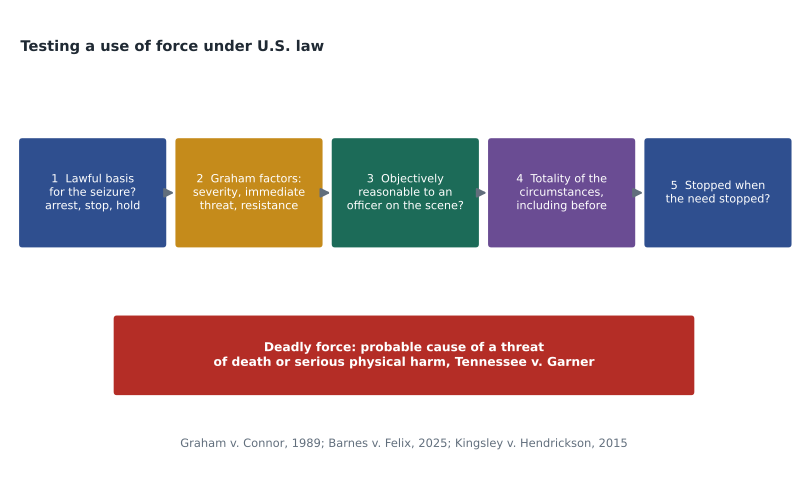
Three conditions follow. First, the officer must have a lawful basis for the seizure. Force used for a purpose the law does not authorize, such as punishing someone or making them show respect, is unreasonable by definition. Second, the officer's assessment of the situation is judged by what a reasonable officer would have believed from the facts known at the time. Third, the amount and type of force must be reasonable in light of the need for it.
Necessity and proportionality
The Supreme Court explained the test in Graham v. Connor in 1989. Dethorne Graham, a diabetic man, asked a friend to drive him to a store for orange juice to counter an insulin reaction, then left the store quickly because the line was too long. An officer who thought this was suspicious stopped the car, and Graham was handcuffed, thrown against the car and injured before officers learned that nothing had happened in the store. The Court held that force during a seizure must be judged under the Fourth Amendment's objective reasonableness standard, from the perspective of a reasonable officer on the scene rather than with the 20/20 vision of hindsight, and with allowance for the fact that officers often make split-second judgments in tense, uncertain and rapidly evolving circumstances. It listed three factors that courts commonly weigh: the severity of the crime at issue, whether the person poses an immediate threat to the safety of the officers or others, and whether the person is actively resisting arrest or attempting to evade arrest by flight.
In practice, courts balance the nature and quality of the intrusion on the person against the government interests at stake. Force that might be reasonable against a person who is attacking an officer may be unreasonable against a person who is passively refusing to move. The facts are judged as a reasonable officer would have perceived them at the time, not as they turn out to be later, but the officer's perception must itself be reasonable.
Looking at the whole situation
Until 2025, some federal appeals courts applied a moment-of-threat doctrine, judging only the instant when the officer used force and ignoring how the situation developed. In Barnes v. Felix in 2025, the Supreme Court unanimously rejected that approach. A Texas officer had jumped onto the door sill of a car that began to drive away during a traffic stop and shot the driver, Ashtian Barnes, within about two seconds. The Court held that courts must consider the totality of the circumstances, including events leading up to the use of force. The Court did not decide whether the officer's own conduct made the force unreasonable, leaving that for the lower courts, but the case means that an officer's earlier choices are part of the analysis.
Force that may cause death or grievous harm
Deadly force has its own, higher threshold. In Tennessee v. Garner in 1985, a Memphis officer shot and killed Edward Garner, an unarmed fifteen-year-old who was fleeing a burglary. The Supreme Court held that deadly force may not be used to prevent the escape of a fleeing suspect unless the officer has probable cause to believe that the suspect poses a significant threat of death or serious physical injury to the officer or others, and that a warning should be given where feasible. The firearms course (LES-207) covers deadly force in detail.
Some force that is not usually thought of as lethal can still cause death or grievous harm, depending on how it is used. Neck restraints, strikes to the head, and weight on the back or neck of a person who is lying face down all carry this risk. That is one reason the knee on Pelley's back is a harder legal question than the grab at the curb, and lesson 9 covers the medical reasons.
Excessive force and other provisions
Force that is reasonable at the start of an encounter can become unreasonable if it continues after the need has passed, for example once a person is handcuffed and no longer resisting. In Lombardo v. City of St. Louis in 2021, the Supreme Court sent back a case in which officers held a handcuffed and shackled man face down for about fifteen minutes until he stopped breathing, saying that the lower court had to consider facts such as the duration of the restraint, the fact that he was already handcuffed and the well-known risks of prone restraint. For people already in custody before trial, Kingsley v. Hendrickson in 2015 held that force is unconstitutional if it is objectively unreasonable, without any need to prove the officer's state of mind. Convicted prisoners are protected by the Eighth Amendment.
| Source | What it does |
|---|---|
| Fourth Amendment | Force during arrest or seizure must be objectively reasonable |
| Graham v. Connor (1989) | Reasonable officer on the scene; severity, immediate threat, resistance or flight |
| Tennessee v. Garner (1985) | Deadly force against a fleeing person only for a significant threat of death or serious injury |
| Barnes v. Felix (2025) | Courts must consider the totality of the circumstances, not only the final moment |
| Lombardo v. St. Louis (2021) | Duration of prone restraint and the person's restrained condition matter |
| Kingsley v. Hendrickson (2015) | Objective standard for force against pretrial detainees |
| State law and agency policy | Criminal law, training standards and often stricter limits, such as chokehold bans and duty to intervene |
Honest mistakes
Officers often act on incomplete information, and sometimes they are wrong. The law allows for reasonable mistakes. If an officer reasonably believed that a person was reaching for a weapon, the force is judged on that belief, even if it later turns out the person was reaching for a phone. But the belief must be reasonable, not just honestly held. A belief based on assumptions about a person's race, appearance or neighborhood, or on a failure to look at what was plainly visible, is not reasonable. And the officer's training counts: what is reasonable for a trained officer is judged against what that training should have taught them to notice.
Three kinds of accountability
A single use of force can lead to three separate processes, each with its own standard. A state criminal prosecution for assault or homicide, or a federal prosecution under 18 U.S.C. section 242 for wilfully depriving a person of constitutional rights, requires proof beyond a reasonable doubt. A civil lawsuit under 42 U.S.C. section 1983 requires proof on a preponderance of the evidence that the force was objectively unreasonable, although officers can raise qualified immunity, which protects them unless the force violated clearly established law. Discipline under agency policy asks whether the officer broke the rules, which are often stricter than the Constitution, and can lead to penalties up to termination and, in many states, loss of certification. An officer can be cleared in one process and found responsible in another.
Limits set by policy and statute on specific techniques
Beyond the constitutional rules, states and agencies set limits on particular techniques and weapons. After 2020, many states passed laws banning or restricting chokeholds and neck restraints, often allowing them only where deadly force would be justified, and a 2022 executive order did the same for federal law enforcement agencies. Many states and agencies also restrict shooting at moving vehicles and require warnings before force where feasible. These rules do not change the Fourth Amendment, but an officer who breaks them faces discipline or prosecution under state law, and a court may treat the policy as evidence of what a reasonable officer would have done.
Applying the law at the curb
At the curb, the officers had a lawful basis for an emergency hold under Ohio Revised Code section 5122.10, as lesson 4 explained, and the risk of Pelley walking into traffic was immediate. Applying the Graham factors, no serious crime was at issue, which weighs against heavy force; but he posed an immediate threat to his own safety and, once he kicked, to the officers, and he was actively resisting. A verbal warning had been given and ignored. Taking hold of his arms was the least force that could work, and controlling him on the ground when he pulled away and kicked was likely reasonable, because the alternative was to let go next to moving traffic.
The analysis changes once Pelley was handcuffed. After that, he could no longer reach the road, he was not striking anyone, and the purpose of the force had largely been achieved. Any force after that point had to be justified by a new need, such as keeping him from kicking while the officers stood him up. Brody's knee stayed on Pelley's upper back for about forty seconds after the handcuffs were on, while Pelley said twice that he could not breathe. That is the part of the call the review focused on, and it is why the law cannot be separated from the medical risks in lesson 9 and the duty to intervene in lesson 10.
Desjardins tells the class that the law is applied the same way in the officer's report. A good report does not say 'reasonable force was used to effect the apprehension'. It says what the authority was, what the person did, what each officer did in response, why lesser options would not have worked at that moment and when each kind of force stopped. Lesson 11 covers report writing; the habit of thinking in phases starts here.
Worked problem
Breaking a use of force into phases
Body-worn camera time stamps show: grab at the curb at 19:49:12; on the ground at 19:49:18; handcuffs on at 19:49:38; knee removed at 19:50:18; Pelley rolled onto his side at 19:50:24. How long did each phase last, and how much of the time on the ground came after the handcuffs were on?
Show solution
- Grab to ground: 19:49:18 minus 19:49:12 is 6 seconds.
- Ground to handcuffs: 19:49:38 minus 19:49:18 is 20 seconds.
- Handcuffs to knee removed: 19:50:18 minus 19:49:38 is 40 seconds.
- Knee removed to side: 6 seconds.
- Time on the ground until he was on his side: 20 + 40 + 6 = 66 seconds.
- After handcuffing: 40 + 6 = 46 seconds.
- \[46 \div 66 \approx 0.70\]
Answer: About 70 in every 100 seconds that Pelley spent face down came after he was handcuffed. Each phase must be justified on its own; lawful force in one phase does not justify force in the next.
Common mistakes
MistakeThe Fourth Amendment gives police the power to arrest.
InsteadThe power to seize comes from other law; the Fourth Amendment limits how it is carried out.
MistakeIf force was lawful at the start, it stays lawful until the incident ends.
InsteadEach phase must be justified; force that continues after the need has passed can be excessive.
MistakeCourts expect officers to use exactly the right amount of force.
InsteadGraham allows for split-second judgments, but force must still be objectively reasonable.
MistakeOnly firearms count as potentially lethal force.
InsteadNeck restraints, head strikes and weight on a prone person can also cause death or grievous harm.
Summary and key terms
- The Fourth Amendment requires force during a seizure to be objectively reasonable.
- Graham v. Connor judges force from a reasonable officer's perspective, weighing severity, threat and resistance or flight.
- Tennessee v. Garner limits deadly force; Lombardo and Kingsley address force after a person is restrained or detained.
- Barnes v. Felix requires courts to consider the totality of the circumstances, including events before the force.
- Force must be justified phase by phase, and it must stop when the need stops.
- Seizure
- A government restraint of a person's freedom to walk away, including an arrest or detention.
- Objective reasonableness
- Judging force by what a reasonable officer would do with the same facts, regardless of intent.
- Deadly force
- Force likely to cause death or serious physical injury.
- Excessive force
- Force that is objectively unreasonable in the circumstances.
Practice problems
Work each problem on paper first, then reveal the answer to check.
What three Graham factors do courts commonly weigh?
Show answer
The severity of the crime, whether the person poses an immediate threat, and whether they are actively resisting or fleeing.
Why was grabbing Pelley at the curb likely lawful?
Show answer
There was authority to apprehend him, a warning was ignored, and he was about to walk into traffic; holding his arms was the least force that could work.
Why does the analysis change after handcuffing?
Show answer
The purpose of the force was largely achieved, so further force needs a new justification.
What did Lombardo v. St. Louis emphasize?
Show answer
The duration of prone restraint, the person's restrained condition and the known risks of prone restraint must be considered.
Lesson quiz · 5 questions
Score 60% or more to complete this lesson.
Create a free account to save your progress, take quizzes and earn a certificate.