
LES-204 · Lesson 12 of 12 · 20 min
Capstone: reviewing the Tidewater Park call
▶ Video coming soon A video version of this lesson is on the way.
For the final class, Desjardins arranges the room as the Port Ardent use-of-force review committee would: a long table, the three body-worn camera videos queued on a screen, the reports, the medical record summary and Haddad's supervisor review in a binder at each seat. The students sit as the committee. Haddad, Ivey and, by video link, Kerr, the crisis worker, take questions. 'You have everything the real committee had,' Desjardins says. 'Your job is not to decide whether these officers are good or bad people. Your job is to understand what happened, judge each part against the law and policy, and decide what should change so the next call goes better.'
The method
The committee uses a structured after-action review built around four questions, adapted from the method the United States Army developed in the 1970s and now used widely in policing, health care and firefighting. What was supposed to happen? What actually happened? Why was there a difference? What will we sustain and what will we change? The review looks at the whole call, from the 911 call to the meeting with Pelley a week later, not only at the moments of force. It separates findings about individual officers from findings about training, policy and equipment, because most problems in a call have causes at more than one level.
Desjardins sets three ground rules. First, judge decisions by what the officers knew and could reasonably have known at the time, not by what the video later showed. Second, give credit where it is due as carefully as you identify problems, because what went well is just as important to repeat. Third, every recommendation needs an owner and a date, or it is not a recommendation.
The timeline
| Time | Event |
|---|---|
| 19:20 | 911 call from a transit supervisor: man shouting at passengers, holding a broken bottle |
| 19:24 | Malhotra and Reyes arrive; Malhotra begins talking with Pelley from behind the planter wall |
| 19:25 | Malhotra requests the mobile crisis team; Reyes takes the cover role |
| 19:27 | Brody arrives; asks transit to hold buses and moves passengers back |
| 19:28 | Pelley takes two quick steps toward Malhotra, who steps back and keeps talking; Pelley stops |
| 19:30 | Haddad on the radio: "Take all the time you need." |
| 19:33 | Pelley puts the bottle on the planter wall and sits on the bench |
| 19:41 | Kerr, the crisis worker, arrives and talks with Pelley |
| 19:48:50 | Kerr raises going to the hospital; Pelley stands up |
| 19:49:05 | Pelley walks quickly toward Harbor Street; Malhotra shouts a warning |
| 19:49:12 | Malhotra and Reyes take hold of his arms at the curb |
| 19:49:18 | All go to the ground on the grass; Brody joins |
| 19:49:38 | Handcuffs on |
| 19:49:50 | Pelley: "I can't breathe." |
| 19:50:10 | Pelley, more quietly: "I can't breathe." |
| 19:50:16 | Reyes: "Ken. Off his back. Roll him." |
| 19:50:18 | Brody's knee off Pelley's back |
| 19:50:24 | Pelley on his side; sitting up at 19:50:45 |
| 19:50:30 | Malhotra requests paramedics |
| 19:54:10 | Paramedics arrive; Ivey measures oxygen saturation of 91, rising to 97 with oxygen |
| 20:20 | Pelley transported to Port Ardent General, accompanied by Malhotra |
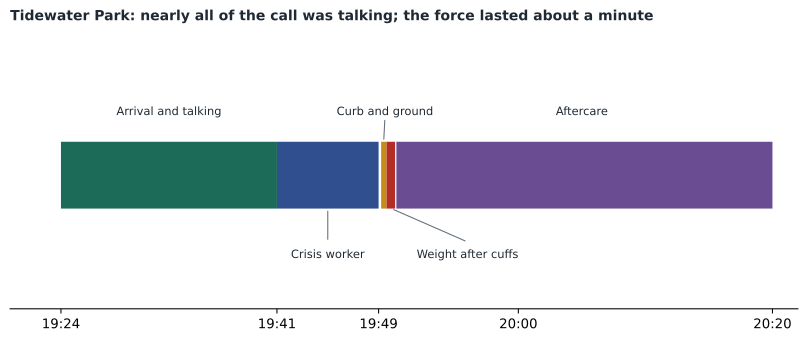
Phase one: arrival and communication
What was supposed to happen: policy called for officers to use time, distance and communication with a person in crisis, to request a crisis team where available and to keep the public safe. What happened: the officers did all of this, and did it well. Malhotra introduced himself, listened, named emotions and offered choices, as lesson 2 described. Reyes took cover without being asked. Brody managed bystanders and transit without adding a voice. Haddad supported the slow approach on the radio. The bottle came down after nine minutes without force.
The committee found that this phase should be sustained in full and used as a training example. Students point out that it is the part of the call most likely to be forgotten, because nothing dramatic happened. 'That's exactly why we have to put it in front of every recruit,' Haddad says. 'If all anyone remembers from Tidewater Park is the knee, we will have learned the wrong lesson.'
Phase two: the handover
What was supposed to happen: a calm handover to the crisis worker, with a plan for transport to hospital. What happened: Kerr arrived, the conversation went well, and then the hospital was raised without the officers having agreed with her where they would stand or what they would do if Pelley tried to leave. Nobody was between Pelley and the road. Why the difference: the handover felt like the end of the call, so the officers relaxed, and the platoon had no habit of a short planning huddle with crisis workers. Kerr told the committee she would have welcomed one.
The committee found that this was a system gap rather than an individual failing. It recommended that the service and the crisis program agree on a short handover checklist, as lesson 4 described, and train on it jointly.
Phase three: the curb and the ground
What was supposed to happen: if Pelley tried to leave and posed a risk to himself, officers could lawfully apprehend him and use the force reasonably necessary to do so. What happened: the officers stopped him at the curb with the least force that could work, and when he pulled and kicked, they brought him to the ground and handcuffed him in twenty seconds. The committee found the apprehension and the grounding lawful and within policy, as lesson 5 explained. It noted that closing the distance at a run, with no roles agreed, led to an uncontrolled fall that could easily have been onto the sidewalk or the road, and that nobody spoke to Pelley for the first fifteen seconds on the ground except to shout 'Stop resisting.'
Phase four: after the handcuffs
What was supposed to happen: policy required that a person handcuffed in a prone position be moved onto their side or sitting up as soon as practicable, with someone monitoring breathing. What happened: Brody's knee stayed on Pelley's upper back for about 40 seconds after handcuffing, while Pelley said twice that he could not breathe. Reyes intervened after 26 seconds of the first warning, and Pelley was on his side 46 seconds after the handcuffs went on. Why the difference: as lesson 8 explained, Brody arrived into the struggle at peak arousal, experienced auditory exclusion and task fixation, and nobody announced that the handcuffs were on.
The committee found that the weight after handcuffing was outside policy, created real medical risk and was the most serious issue in the call. It also found that the main causes were ones training could address, that Brody's corrected report was honest and that his response to the review was constructive. It found Reyes's intervention exemplary. It did not find that Brody had intended to harm Pelley, and it agreed with Haddad's decision to deal with the matter through additional training rather than discipline.
Phase five: aftercare, reporting and follow-up
Medical care, once paramedics were called, was good, and Malhotra stayed with Pelley at the hospital. The committee noted that paramedics were requested 52 seconds after handcuffing, which it considered reasonable, but recommended that paramedics be requested before going hands on with a person in crisis whenever possible. Explanation to Pelley at the scene was minimal. Reports were completed on time, but one was incomplete. Haddad's meeting with Pelley a week later, though not required, was found to be good practice.
| Area | Score | Note |
|---|---|---|
| Communication and tactical communication | 2 | Model example |
| Time, distance and cover | 2 | Kept throughout while the bottle was held |
| Crisis response and resources | 2 | Crisis team requested in the first minute |
| Handover planning | 0 | No plan before the hospital was raised |
| Lawful authority and decision to use force | 2 | Apprehension and grounding justified |
| Planned, controlled physical control | 1 | Lawful but unplanned; uncontrolled fall |
| Force stopped when the need stopped | 0 | About 40 seconds of weight after handcuffing |
| Duty to intervene | 2 | Clear, prompt verbal intervention |
| Medical care and monitoring | 1 | Good once started; delayed by the weight |
| Explanation, reporting and follow-up | 1 | Little explanation at scene; one report returned; good follow-up |
Worked problem
Scoring the call
Using the scorecard, what is the total score out of 20, and what share of the available points did the call earn? How many areas scored full marks?
Show solution
- Add the scores: 2 + 2 + 2 + 0 + 2 + 1 + 0 + 2 + 1 + 1.
- \[2 \times 5 + 1 \times 3 + 0 \times 2 = 13\]
- Share of available points:
- \[13 \div 20 = 0.65\]
- Five areas scored 2.
Answer: The call scored 13 out of 20, or 65 in every 100 available points, with full marks in five of ten areas. The score is a discussion tool, not a grade: two zeros in critical areas matter more than the total.
Recommendations
| Recommendation | Owner | Due |
|---|---|---|
| Joint handover checklist with the mobile crisis program | Inspector, community response, with crisis program manager | December 31, 2025 |
| Train officers to announce "cuffs on" and assign one officer to breathing and the head in every ground control | Training sergeant | Next requalification cycle, from January 2026 |
| Add the Tidewater Park scenario, with a role player who says "I can't breathe", to requalification | Use-of-force instructors | January 2026 |
| Request paramedics before going hands on with a person in crisis whenever possible | Patrol operations, with paramedic service | Policy update by November 30, 2025 |
| Reminder and short training on explaining to the person after force | Platoon sergeants | Next briefing cycle |
| Publish a summary of the review and changes | Professional standards | Within 60 days |
Students debate whether the recommendations go far enough. Marco DiSanto argues that Brody should have been disciplined. Jesse Morningstar argues that discipline would have taught every officer to write shorter reports and stay quiet. Desjardins lets the debate run, then points out that both concerns are legitimate and that accountability can take different forms. 'What matters is that the outcome is fair, that it is explained, and that the same thing is less likely to happen again,' he says. 'That last test is the hardest one, and it is the one the public cares about most.'
What the people involved said
Malhotra told the committee that the nine minutes of conversation were the most satisfying part of his career so far, and the curb the most frightening. Reyes said she would remember the four words she said to Brody for the rest of her career, and that she wished she had said them twenty seconds sooner. Brody said he had watched the video more times than he could count, and that what bothered him most was not that he had been told to move but that he had not heard Pelley. Kerr said she now huddles with officers before every handover. Ivey said the call was a reminder that the line between a routine apprehension and a death in custody can be a matter of seconds.
Pelley, through his sister, gave permission for the call to be used in training. His sister said he was doing better, back on his medication and living with her. She asked that the course include one thing: that the officers who talked to him at the start were kind, and that he remembers that part too.
Taking it forward
Desjardins ends the course where it began, with the still image of two officers standing well back from a man holding a bottle. 'Everything in this course is in that picture,' he says. 'The talking, the distance, the patience, the crisis worker on the way. And everything after it, the curb, the ground, the knee, the words that stopped it, the care, the report, the review, is what happens when even a well-handled call reaches the point where force is needed. You will all be in that picture one day. When you are, talk first, wait if you can, get help if you can, use the least force that will work, stop the moment it is no longer needed, look after the person afterward, and speak up when a colleague needs you to.'
The next courses in the program build on this one. The arrest and control course covers handcuffing, escorts and searching people after arrest in practical detail. The firearms course covers deadly force and judgment under stress. In the spring term, the less-lethal weapons course covers conducted energy weapons, OC spray and batons, and the high-risk calls course covers felony stops, building searches and active threats.
Common mistakes
MistakeAn after-action review is about finding who to blame.
InsteadIt is about understanding what happened, judging it fairly and changing what needs to change.
MistakeOnly the moments of force need to be reviewed.
InsteadThe whole call, from the 911 call to follow-up, shapes the outcome.
MistakeA good total score means the call was handled well.
InsteadZeros in critical areas, such as force continuing after the need stopped, matter more than the total.
MistakeA recommendation is complete once it is written down.
InsteadEvery recommendation needs an owner and a date.
Summary and key terms
- After-action reviews ask what was supposed to happen, what happened, why there was a difference and what to sustain or change.
- Judge decisions by what officers knew at the time, and give credit as carefully as you find problems.
- Tidewater Park showed excellent communication and de-escalation, lawful apprehension, an unplanned closing of distance and about 40 seconds of weight after handcuffing.
- Reyes's intervention and good medical care limited the harm.
- Recommendations covered handover planning, "cuffs on" announcements, scenario training, early paramedic requests, explanation after force and publication.
- The course's working rule: talk, wait, get help, use the least force, stop when the need stops, provide care and speak up.
- After-action review
- A structured review of an incident that compares what was planned with what happened and identifies what to sustain and change.
- System gap
- A problem caused by training, policy, equipment or procedures rather than by an individual alone.
- Owner
- The person responsible for carrying out a recommendation.
- Scorecard
- A simple rating of each area of a call, used to focus discussion.
Practice problems
Work each problem on paper first, then reveal the answer to check.
What are the four questions of an after-action review?
Show answer
What was supposed to happen, what actually happened, why there was a difference, and what to sustain and change.
Which phase of the call did the committee most want to sustain?
Show answer
Arrival and communication: the nine minutes of de-escalation before any force.
Why did the committee treat the handover as a system gap?
Show answer
There was no habit or checklist for planning with crisis workers; the problem was not one person's choice.
A scorecard has scores of 2, 2, 1, 1, 0, 2, 2, 1, 2 and 2. What is the total out of 20?
Show answer
15 out of 20.
Lesson quiz · 5 questions
Score 60% or more to complete this lesson.
Create a free account to save your progress, take quizzes and earn a certificate.