
LES-201 · Lesson 8 of 12 · 20 min
Interviewing suspects: Miranda, voluntariness and PEACE
▶ Video coming soon A video version of this lesson is on the way.
Cody Marsh was arrested at his apartment on Elm Street at 2:10 p.m. on February 20, thirteen days after the robbery. Detective Whitlock told him he was under arrest for the robbery of Northgate Convenience, and, in the car, read him the Miranda warnings from a card: that he had the right to remain silent, that anything he said could be used against him in court, that he had the right to talk to a lawyer before and during questioning, and that if he could not afford one, a lawyer would be appointed. He said he understood. Whitlock asked no questions. Desjardins tells the class that by the time Ferreira sat down with Marsh in the interview room, the most important decisions about whether his statement would ever be heard in court had already been made. This lesson covers the law that governs suspect interviews, the risk of false confessions, and the PEACE model of investigative interviewing.
Why suspect interviews matter, and why they go wrong
A suspect's own account can be powerful evidence. It can explain innocent facts that look suspicious, identify other witnesses or evidence, lead to the recovery of property, or contain admissions that corroborate other evidence. But confessions are also a leading cause of wrongful convictions. Studies of exonerations have found that a substantial share involved false confessions or admissions, often from young people, people with intellectual disabilities or mental illness, and people interviewed for many hours, told false things about the evidence, or offered inducements. Innocent people confess for reasons that make sense in the moment: to end an exhausting interview, because they believe the evidence against them is overwhelming and they will be treated more leniently, or because they come to doubt their own memory. A false confession is also dangerous because juries find confessions very persuasive, and once police have one, they often stop looking for the real offender.
For these reasons, the law surrounds suspect interviews with protections, and modern interview training emphasizes gathering information rather than obtaining a confession. Desjardins writes the aim on the board: 'The purpose of a suspect interview is to obtain accurate and reliable information, not to get a confession.'
Miranda and the Fifth Amendment
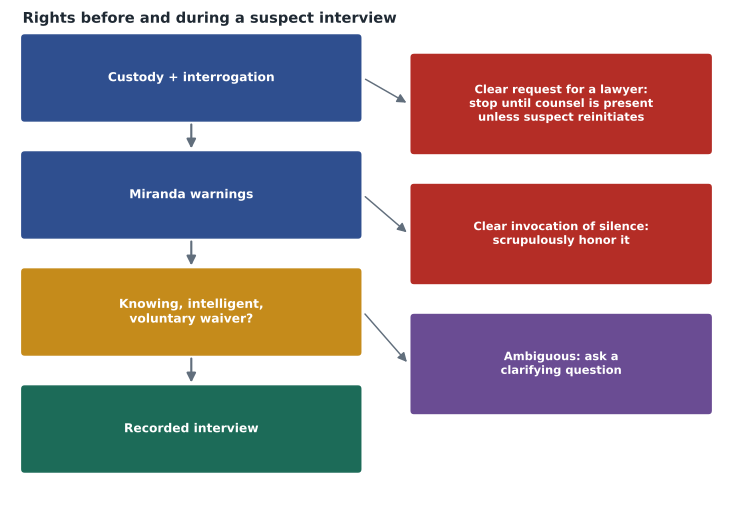
The Fifth Amendment protects people from being compelled to be witnesses against themselves. Miranda v. Arizona (1966) requires police to give the warnings before custodial interrogation, meaning questioning or its functional equivalent of a person in custody. A suspect may waive the rights if the waiver is knowing, intelligent and voluntary; Berghuis v. Thompkins (2010) held that a suspect who understands the warnings and then answers questions has impliedly waived the right to silence. Statements obtained in violation of Miranda are generally inadmissible in the prosecution's main case, and Missouri v. Seibert (2004) held that police cannot deliberately question first, obtain a confession, and then give warnings and repeat the questions.
At the station, Ferreira began the interview at 3:40 p.m., in a recorded interview room. She repeated the Miranda warnings on video using the department's written form, asked Marsh to read each line aloud, asked whether he understood each right, and asked whether, having those rights in mind, he was willing to talk to her. He said 'Yeah, I'll talk, I didn't do anything,' and signed the form. Ferreira recorded the time of each step.
Invoking the rights
If a suspect clearly asks for a lawyer, Edwards v. Arizona (1981) requires all questioning to stop until a lawyer is present, unless the suspect starts a new conversation about the case. If the request is ambiguous, Davis v. United States (1994) held that police are not required to stop, although many departments train officers to ask a clarifying question. If a suspect clearly says they want to remain silent, Michigan v. Mosley (1975) requires police to scrupulously honor that choice. Under Ohio Revised Code 2933.81, a statement made during an electronically recorded custodial interrogation in a place of detention is presumed voluntary for certain serious offenses, such as homicide and rape; Port Ardent policy records every custodial interview regardless of the offense.
Voluntariness and the confessions rule
Apart from Miranda, the due process clause requires that any confession be voluntary in the totality of the circumstances. Courts consider the suspect's age, education, intelligence, mental state and experience with police; the length of the interview; whether food, rest and breaks were provided; threats, promises and physical pressure; and the use of deception. Colorado v. Connelly (1986) held that some coercive police conduct is required for a confession to be involuntary. Frazier v. Cupp (1969) allowed police to lie about evidence, but research shows that false evidence claims increase the risk of false confessions, and a growing number of states have banned deception when interviewing juveniles. Desjardins tells the class that Port Ardent does not allow officers to lie about evidence, threaten consequences, or suggest leniency in exchange for a statement, whatever the courts might allow, because those tactics produce unreliable statements.
Accusatory interviewing and the PEACE model
For decades, many North American officers were trained in accusatory methods, the best known being the Reid technique, which moves from a non-accusatory interview to an interrogation in which the officer confronts the suspect with an assertion of guilt, discourages denials, and develops themes that minimize the moral seriousness of the offense or maximize the consequences of not confessing. Critics argue that these methods increase the risk of false confessions, and in 2017 one of the largest training firms in the United States announced it would stop teaching the Reid method. Some American departments have adopted the PEACE model or similar information-gathering approaches.
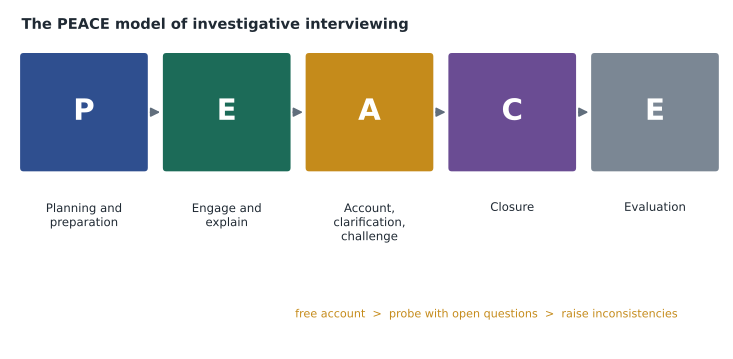
PEACE was developed in England and Wales in the early 1990s after several wrongful convictions based on false confessions. The letters stand for the stages of the interview. Planning and preparation: the interviewer reviews the evidence, identifies what is known and what needs to be explained, decides what to disclose and when, and plans the topics. Engage and explain: the interviewer introduces everyone, explains the purpose and the suspect's rights, and builds rapport. Account, clarification and challenge: the suspect gives their account in their own words, the interviewer probes each part of it with open questions, and then, where the account conflicts with the evidence, raises the inconsistencies and asks the suspect to explain them, without accusing or pressuring. Closure: the interviewer summarizes, allows the suspect to add or correct anything, and explains what happens next. Evaluation: after the interview, the investigator assesses the information obtained against the other evidence and reviews their own performance.
The Marsh interview
Ferreira had planned the interview carefully. She listed what Marsh would need to explain: his DNA on the inside cuff of a glove found on the robber's escape route, the gray hatchback registered to him with a dented rear bumper, and the online listings for cigarettes of the same brand posted from an account linked to his phone number two days after the robbery. She decided to ask for his account of the evening of February 7 before disclosing any of it, so that his account would not be shaped by what he knew the police had.
Marsh said he had been at home all evening playing video games. Ferreira asked open questions about the evening: what he ate, who he spoke to, when he went to bed. Then she asked about his car, and he said he had lent it to a friend that week but would not give the friend's name. When she showed him a photograph of the glove, he said he had lost a pair of black gloves 'a few weeks ago, maybe at the bus stop'. Ferreira did not suggest he was lying. She asked when and where he had last had the gloves, and recorded the answer. When she asked about the cigarette listings, Marsh said, 'Should I be getting a lawyer for this?' Ferreira treated it as a possible request for counsel and asked him directly whether he wanted a lawyer before answering more questions. He said, 'Yeah, I think so.' She stopped the interview at 4:31 p.m. and did not ask anything further.
# Interview timeline from the recording log: check total time and the
# longest stretch of questioning without a break.
log = [
    ("15:40", "start: rights confirmed, caution"),
    ("16:05", "break: water, washroom"),
    ("16:12", "resume: account of the evening"),
    ("16:31", "end: suspect asked for a lawyer"),
]
def m(t):
    h, mi = map(int, t.split(":")); return h * 60 + mi
start, end = m(log[0][0]), m(log[-1][0])
questioning = [(m(log[0][0]), m(log[1][0])), (m(log[2][0]), m(log[3][0]))]
print("total elapsed:", end - start, "minutes")
print("questioning blocks:", [b - a for a, b in questioning], "minutes")
print("longest block:", max(b - a for a, b in questioning), "minutes")total elapsed: 51 minutes questioning blocks: [25, 19] minutes longest block: 25 minutes
The recorded interview lasted 51 minutes, with a seven-minute break, before Marsh asked for a lawyer; the longest continuous block of questioning was 25 minutes. Desjardins notes that interview length alone does not make a statement involuntary, but the recording, the breaks, and the offers of food and water all help prove that the statement was given freely. Marsh's statement contained no confession, but it was still useful: his explanations about the car and the gloves could be checked, and each one later proved false. The friend he would not name did not exist in his phone contacts, and his own phone placed him near Harbor Road at 9:40 p.m. on February 7, as lesson 10 explains.
Vulnerable suspects, interpreters and recording
Some suspects need additional care. Young people, people with intellectual disabilities or mental illness, people under the influence of alcohol or drugs, and people who are exhausted or in pain are more likely to misunderstand their rights, to agree with suggestions, and to give unreliable answers. Interviewers should check understanding by asking the person to explain their rights in their own words, use plain language, keep questions short, take regular breaks, and consider delaying the interview until an intoxicated person is sober. If a person's first language is not English, or they are Deaf or hard of hearing, a qualified interpreter should be used for the rights and the interview, not a family member or a bilingual officer from the case, because a misunderstanding of the rights can make the whole statement inadmissible.
Recording the whole custodial interview, from the moment the person enters the room until they leave, protects everyone. It shows exactly how the rights were given and understood, what was said and how, and how the person was treated. It also protects officers against false allegations. Recordings should capture the faces of both the interviewer and the suspect, and the room should have a clock visible or a time stamp on the recording. Any conversation about the case outside the recording, such as in the car or the cells, should be avoided, and if the person starts talking about the case outside the recording, the officer should write down what was said, word for word, and offer to continue on video.
Worked problem
Recognizing problem tactics
During an interview about a break-in, an officer says to a 19-year-old suspect: 'Your prints are on the window. That's a fact.' (In fact, no prints were found.) Later he says, 'If you tell me what happened, I'll make sure the judge knows you cooperated and you'll probably just get probation. If you keep lying, I'll charge you with everything I can.' The interview has lasted five hours, and the suspect has asked twice to go home. What are the problems?
Show solution
- The false claim about fingerprints is deception about evidence, which increases the risk of a false confession and is prohibited by many services' policies.
- The promise of probation is an inducement of leniency in exchange for a statement, a classic threat to voluntariness.
- The threat to charge 'everything I can' is a threat that can make a statement involuntary.
- Five hours of questioning of a young suspect who has asked to leave raises concerns about oppression; the suspect's age increases the risk.
- If the suspect is in custody, his requests to go home may need to be assessed as attempts to invoke his rights.
- Any statement from this interview is at serious risk of exclusion and, more importantly, may be unreliable.
Answer: False evidence, promises, threats and an oppressive length all undermine voluntariness and reliability.
Common mistakes
MistakeThe aim of a suspect interview is a confession.
InsteadThe aim is accurate, reliable information; a confession is useful only if it is reliable and lawfully obtained.
MistakeAnswering questions after Miranda warnings always requires a signed waiver.
InsteadThompkins holds that a waiver can be implied when a suspect who understands the warnings answers questions; a signed form is still good practice.
MistakeInnocent people never confess.
InsteadFalse confessions are a recognized cause of wrongful convictions, especially with vulnerable suspects and coercive tactics.
MistakeA statement with no admissions is worthless.
InsteadExplanations can be checked, and false explanations can be strong evidence.
Summary and key terms
- Miranda warnings are required before custodial interrogation, and a waiver must be knowing, intelligent and voluntary.
- A clear request for counsel stops questioning under Edwards; a clear invocation of silence must be honored.
- Confessions must also be voluntary under the due process totality of circumstances test.
- False confessions are a leading cause of wrongful convictions, and vulnerable suspects are at higher risk.
- PEACE structures interviews as planning, engagement, account, closure and evaluation, and focuses on information rather than confession.
- Recording, breaks and careful notes help prove a statement was voluntary.
- Caution
- A warning that the person need not say anything and that anything said may be used as evidence.
- Voluntariness
- The requirement that a statement be given freely, without threats, promises, oppression or improper trickery.
- Operating mind
- Enough awareness to understand what one is saying and that it may be used against oneself.
- False confession
- An admission of guilt by a person who did not commit the crime.
- PEACE
- An interview model: planning, engage and explain, account, closure, evaluation.
- Strategic disclosure
- Planning when to reveal evidence to a suspect so their account is given before it can be shaped by that evidence.
Practice problems
Work each problem on paper first, then reveal the answer to check.
Why did Ferreira ask for Marsh's account before showing him the evidence?
Show answer
So his account would not be shaped by knowing what the police had.
In the code example, how long was the longest block of questioning?
Show answer
25 minutes, from 15:40 to 16:05.
Name three groups at higher risk of false confession.
Show answer
Young people, people with intellectual disabilities, people with mental illness.
What does the C in PEACE stand for?
Show answer
Closure.
Lesson quiz · 5 questions
Score 60% or more to complete this lesson.
Create a free account to save your progress, take quizzes and earn a certificate.