
LES-201 · Lesson 6 of 12 · 20 min
Interviewing witnesses and victims
▶ Video coming soon A video version of this lesson is on the way.
At ten o'clock on the morning after the robbery, Sunita Rao sat in a soft interview room at the Port Ardent police station, a room with a couch, a small table and a camera in the corner. Detective Ferreira had offered to meet her at home, but Rao said she would rather come in; she did not want to talk about it in her living room. Ferreira began by thanking her, explaining what would happen, how long it might take, that it would be video recorded and why, that she could take breaks, and that a victim services worker was available. Then she asked Rao to tell her everything she remembered, in her own words, from the moment she came on shift. She did not interrupt for eleven minutes.
Desjardins plays the first few minutes of a reconstruction of that interview, with an actor playing Rao. 'Most new officers would have interrupted her within thirty seconds,' he says, 'usually to ask for a description. Ferreira already had the description from the night before. What she wanted now was everything Rao knew that nobody had asked her about yet, and the only way to get that is to let her talk.' This lesson is about how memory works, why witnesses make mistakes, and how to interview witnesses and victims in a way that gets the most accurate information while treating them with respect.
How memory works
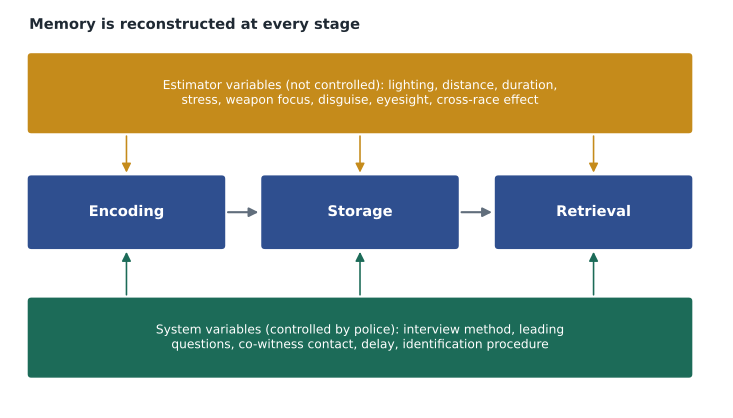
Memory is not a recording. It is a reconstruction. Psychologists describe three stages. At encoding, a person takes in information through the senses, but only part of what happens is noticed, and attention is limited and selective. During storage, memories fade over time and can be changed by later information. At retrieval, the person rebuilds the memory from fragments, filling gaps with expectations and with information learned since. Each stage can introduce errors, and the witness is usually unaware of them. A confident, detailed account can still be wrong, and an honest witness can be mistaken.
Researchers divide the factors that affect accuracy into two groups. Estimator variables are features of the event and the witness that the justice system cannot control: lighting, distance, the length of time the witness had to see the offender, stress, the presence of a weapon, disguise, the witness's eyesight, and whether the witness and offender are of different races, since people are generally less accurate at recognizing faces of a different race than their own. System variables are features of the investigation that police can control: how and when the witness is interviewed, what questions are asked, whether witnesses talk to each other, and how identification procedures are run. Police cannot change what the witness saw, but they can avoid damaging the memory and can collect it accurately.
Several estimator variables applied to Rao. The robber displayed a knife, and research on weapon focus shows that a weapon draws a witness's attention, so they remember less about the person's face. The robber's face was mostly covered. The event was short and frightening. On the other hand, the store was brightly lit, Rao was close to him across the counter, and she had a clear view of his hands, his clothing and his eyes. Ferreira's notes before the interview listed these factors, because they would affect how much weight to give different parts of the account.
Stress and the perception of time
Stress affects memory in complex ways. Moderate arousal can sharpen attention on central details, but high stress, especially when a person feels their life is at risk, tends to narrow attention, reduce memory for peripheral details and distort the sense of time. Witnesses commonly overestimate how long a frightening event lasted. Rao told Malhotra the robber was in the store 'for about five minutes'. The store video, once its clock was corrected, showed he was inside for 74 seconds.
# Witness estimates compared with times verified from corrected video
events = [
    # (what, witness estimate in seconds, verified seconds)
    ("robber inside the store",        300, 74),
    ("time knife was displayed",        60, 21),
    ("car leaving the lot after exit",  30, 38),
]
for what, est, real in events:
    ratio = est / real
print(f"{what:32} estimate {est:4} s actual {real:3} s ratio {ratio:.1f}")robber inside the store estimate 300 s actual 74 s ratio 4.1 time knife was displayed estimate 60 s actual 21 s ratio 2.9 car leaving the lot after exit estimate 30 s actual 38 s ratio 0.8
Rao overestimated the time inside the store and the time the knife was shown by a factor of three or four, which is typical for the victim of a frightening event. Beaulieu, who was not threatened and saw only the car, slightly underestimated the gap between the robber leaving and the car pulling out. Desjardins tells the class that these errors are not signs of dishonesty. Investigators should never challenge a victim's account because the times are wrong, and they should rely on video, phone records and other objective sources for timing whenever possible.
The cognitive interview
The cognitive interview was developed by psychologists Ronald Fisher and Edward Geiselman in the 1980s and has been refined since; it is now taught in police training in many countries and is a core part of the PEACE framework discussed in lesson 8. Research has found that it produces substantially more correct information than a standard police interview, without a large increase in errors. It combines techniques drawn from memory research with techniques for building rapport and managing the conversation.
The interview usually follows these phases. First, rapport and explanation: the interviewer introduces themselves, explains the purpose and process, and transfers control to the witness, making clear that the witness has the information and should do most of the talking. Second, the instruction to report everything, even details that seem trivial or that the witness is unsure of, while saying so when they are unsure and that 'I don't know' is an acceptable answer. Third, mental reinstatement of context: the interviewer asks the witness to think back to the event, picture where they were, what they could see, hear and smell, and how they felt, which helps retrieval. Fourth, free recall: the witness gives an uninterrupted account. Fifth, questioning: the interviewer follows up on each topic the witness raised, in the witness's order, with open questions first and closed questions only to clarify. Sixth, varied retrieval: the witness may be asked to recall in a different order, such as backwards from the end, or to focus on a particular sense. Finally, closure: the interviewer summarizes, asks the witness to correct anything, explains what happens next and how to make contact if more comes to mind.
| Question type | Example | Use |
|---|---|---|
| Open | Tell me about the man who came to the counter. | Main tool; invites a free account |
| Probing | You said his voice was calm. What else do you remember about how he spoke? | Follows up a topic the witness raised |
| Closed | Was he wearing gloves on both hands? | Clarifies a specific detail, used sparingly |
| Leading | He was tall, wasn't he? | Avoid: suggests the answer and can change the memory |
| Multiple | Was he white or Black, and how old? | Avoid: confusing, and the witness may answer only part |
| Forced choice | Was the car gray or silver? | Avoid unless an open question has failed; offer an other option |
What Rao remembered
During her free recall, Rao described details nobody had asked about the night before. The robber had said 'Just the bills, then the smokes,' in a calm, young voice with no accent she could identify. He wore a black knit glove on his right hand. When he reached for the cigarettes, his left hand was bare, and she saw a dark mark on the back of it near the thumb, which she thought might be a small tattoo. She thought he was about five foot ten, but when Ferreira asked her to compare him with the height markers on the door frame she had seen him pass, she said she was not sure. He had pushed the door open with his left shoulder on the way out. She had heard what she thought was a car door in the lot within a minute. Each of these details became a lead.
Ferreira did not suggest anything. When Rao said 'a dark mark', Ferreira asked, 'Tell me more about the mark,' not 'Was it a tattoo?' When Rao said she thought he was white, Ferreira asked what she had been able to see that told her that, and Rao described his eyes, the skin around them and his bare hand. When Rao asked whether the police had caught anyone, Ferreira told her truthfully that the investigation was continuing and that she would keep her informed. She did not mention any suspect, because Rao might later be asked to view a lineup, and information about a suspect could contaminate her memory.
Recording and preserving statements
Witness interviews should be recorded whenever possible, preferably on video. A recording preserves the witness's exact words, the questions asked and the way they were asked, which protects the witness, the interviewer and the accused. In the United States, a witness's prior statements can be used at trial to refresh memory or to impeach the witness if their testimony differs, and under Ohio Evidence Rule 801(D)(1) some prior statements are not hearsay when the witness testifies and is subject to cross-examination. Statements to police that are testimonial generally cannot be used against the accused unless the witness testifies, under the Sixth Amendment's Confrontation Clause as interpreted in Crawford v. Washington (2004). Video recording, and a signed written statement reviewed by the witness, make the statement easier to prove and harder to dispute.
After the recorded interview, Ferreira asked Rao to review a written summary and sign it, and noted the time. Beaulieu was interviewed the same afternoon in his apartment, with an audio recording; the customer from the laundromat gave a brief recorded phone statement. Ferreira asked each witness not to discuss what they remembered with anyone else involved, explaining that it was to protect the accuracy of their memories, not because anyone was under suspicion.
Interviewing victims with care
A victim is not just a source of information. Ohio's Marsy's Law amendment to the state constitution, adopted in 2017, gives victims rights to be treated with fairness and respect, to be informed and present at proceedings, to be heard, to protection, and to restitution, and police must provide victims with information about those rights. A trauma-informed approach recognizes that a frightened or traumatized person may give an account that is fragmented, out of order or inconsistent, and that this is how trauma affects memory, not a sign of lying. Interviewers should offer choices where possible, explain each step, allow breaks, avoid blame, and connect the victim with support services. Many robbery victims experience anxiety, sleeplessness and fear at work for weeks; Rao was referred to victim services, and her employer arranged for a second staff member on evening shifts for a month.
Desjardins adds that some witnesses are reluctant: they fear retaliation, distrust police, have their own legal problems, or do not want to be involved. Officers should listen to the reason, explain honestly what involvement would mean, describe the protections available, and never threaten or mislead a witness to get a statement. A statement given under pressure is less reliable and can damage both the case and the community's trust.
Worked problem
Planning a witness interview
A teenager saw a man smash a car window and take a laptop bag from the back seat outside a gym, then run toward a bus stop. She called the police and waited. She is 16 and nervous, and her mother has arrived. Plan the main steps of the interview.
Show solution
- Arrange a quiet place, and explain the process to the teenager and her mother, including that it will be recorded and that her mother may be present if the teenager wishes and the service's policy allows.
- Build rapport and transfer control: she was there and knows what happened, and she should say 'I don't know' if she doesn't.
- Ask her to picture the scene: where she was standing, the light, the sounds, what she was doing.
- Invite free recall without interruption, then ask open follow-up questions on each topic she raised, in her order.
- Use closed questions only to clarify specific points, avoid leading questions, and never mention any suspect.
- Close by summarizing, asking her to correct anything, explaining what happens next, and giving her a way to add information later.
Answer: Rapport and explanation, context reinstatement, free recall, open then closed questions, and a careful close, all recorded.
Common mistakes
MistakeA confident witness is an accurate witness.
InsteadConfidence and accuracy are only weakly related, especially after a delay; memories can be wrong without the witness knowing.
MistakeInterrupt early to get the description.
InsteadLet the witness give a free account first; interruptions reduce the amount of information recalled.
MistakeLeading questions save time.
InsteadLeading questions can plant details that become part of the witness's memory.
MistakeInconsistent times show a victim is lying.
InsteadStress commonly distorts the perception of time; use video and records for timing.
Summary and key terms
- Memory is reconstructed at encoding, storage and retrieval, and errors can occur at each stage.
- Estimator variables, such as stress and weapon focus, cannot be controlled; system variables, such as interview methods, can.
- Stressed witnesses often overestimate durations; objective sources should be used for timing.
- The cognitive interview combines rapport, reporting everything, context reinstatement, free recall, open questions and varied retrieval.
- Statements should be recorded and reviewed by the witness; the Confrontation Clause limits their use if the witness does not testify.
- Victims have legal rights to information and support, and trauma-informed interviewing improves both care and accuracy.
- Encoding
- Taking information into memory at the time of the event.
- Estimator variable
- A factor affecting accuracy that police cannot control, such as lighting or stress.
- System variable
- A factor affecting accuracy that police can control, such as interview method.
- Weapon focus
- The tendency of a witness to look at a weapon and remember less about the person holding it.
- Cognitive interview
- A research-based interview method that improves witness recall.
- Free recall
- An uninterrupted account given by the witness in their own words.
Practice problems
Work each problem on paper first, then reveal the answer to check.
Why did Ferreira not tell Rao about any suspect?
Show answer
Rao might view a lineup, and information about a suspect could contaminate her memory.
In the code example, by what factor did Rao overestimate the time inside the store?
Show answer
300 divided by 74, about 4.1.
Give an open question about the robber's hands.
Show answer
For example: 'Tell me about his hands.'
Name two parts of a trauma-informed approach.
Show answer
Any two of: explaining each step, offering choices, allowing breaks, avoiding blame, connecting to support.
Lesson quiz · 5 questions
Score 60% or more to complete this lesson.
Create a free account to save your progress, take quizzes and earn a certificate.