
LES-201 · Lesson 12 of 12 · 19 min
Capstone: a case review of the Northgate robbery investigation
▶ Video coming soon A video version of this lesson is on the way.
Three weeks after Marsh pleaded guilty, Professor Desjardins hands each student a binder. Inside is a training copy of the Northgate file, with names of real people changed and private information removed, and a case review form used by Port Ardent's major crime unit. 'Every serious case in this department gets a review after it closes,' he says, 'whether it ended in a conviction, an acquittal or no charge at all. The review is not about blame. It asks two questions: what did we do well that we should keep doing, and what could have gone wrong that we should fix?' The students' task for the final lesson is to complete the review, using everything they have learned in the course. This lesson walks through the review that the class completed together, and the habits of a good investigation it reveals.
The review framework
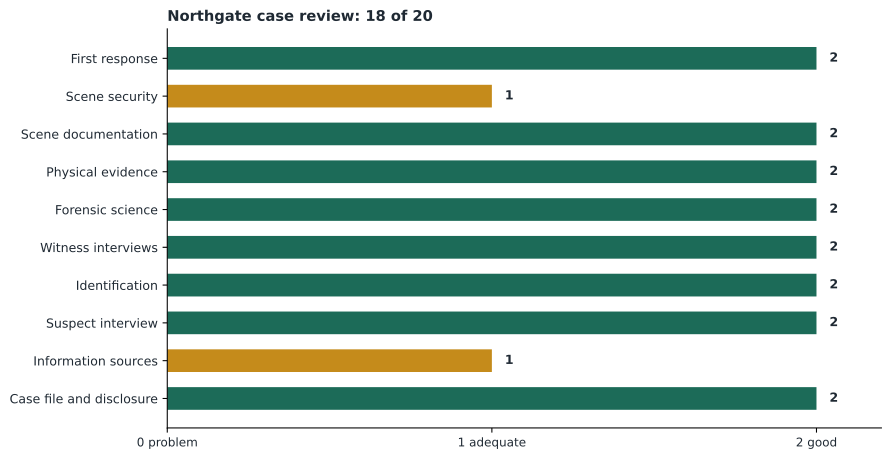
Port Ardent's review form scores ten areas of the investigation from 0 to 2: 0 means a significant problem, 1 means adequate with room for improvement, and 2 means good practice. For each area, the reviewer writes what was done, what the evidence in the file shows, and any recommendation. The reviewer must cite the document in the file that supports each finding. The ten areas follow the course: first response, scene security, scene documentation, physical evidence and chain of custody, use of forensic science, witness interviews, identification procedures, the suspect interview, information sources such as canvasses, video, tips and open sources, and records, case file and disclosure.
First response and scene security
The class scored first response 2. Malhotra arrived within three minutes, confirmed safety, broadcast a structured description that separated what was seen from what was assumed, updated it with the car within two minutes, set perimeters that included the escape route, and asked the customer and Rao to stay. His body-worn camera footage supports every step. The second officer's handling of the footwear impressions and the glove, protecting and photographing them without touching them, is singled out as model practice. Without the glove, the case might never have been solved.
Scene security scored 1. The scene log is complete except for the missing exit time for Sergeant Haddad when the log keeper changed at 23:30. The gap was explained by supplementary notes from both officers, and nothing suggests anything was disturbed, but the defense asked about it in a disclosure request, and the explanation took time. The class's recommendation is that a log handover should include reading back the names of everyone still inside the perimeter, so that the incoming officer knows whose exit to record. Desjardins adds that Haddad, a sergeant, being the person with the missing exit makes the point well: rank does not exempt anyone from the log.
Documentation, physical evidence and forensic science
Scene documentation scored 2. Liu's notes, photo log and sketch agree with each other, the triangulation measurements are reproducible, the photographs follow the overall, mid-range and close-up sequence with and without scales, and she corrected a duplicated exhibit number at the scene with a recorded explanation. Physical evidence and chain of custody scored 2. Each exhibit was photographed in place, packaged in suitable material, sealed and labeled, and its custody record shows each transfer with no gaps; Liu's notes explain the three hours the glove spent with her before it went into the locker. Elimination samples from the clerk and owner were taken with written consent.
Use of forensic science scored 2. The laboratory submission for the glove asked clear questions and did not reveal any suspect. When the databank hit arrived, Ferreira treated it as a lead, obtained a search warrant for a reference sample, and waited for the direct comparison before describing it as a match. The file quotes the laboratory's conclusions exactly, including 'cannot be excluded' for the shoes and 'insufficient for comparison' for the rack rail print. The class notes one point for discussion rather than criticism: the shoe report took almost three weeks longer than the DNA, which delayed full disclosure; the laboratory's turnaround times are outside the investigator's control, but the file records that Ferreira followed up twice.
Witnesses and identification
Witness interviews scored 2. Rao's interview, conducted the morning after with a cognitive interview approach, produced several details that became leads, including the bare left hand with a dark mark that later matched a small tattoo on the back of Marsh's left hand. Ferreira used open questions, avoided leading questions, did not mention any suspect, and referred Rao to victim services. Beaulieu and the laundromat customer were interviewed separately and recorded. The canvass found the dog walker, whose account corroborated the direction of the car.
Identification procedures scored 2, and the class spends the most time on this area. The decision not to show Mehta a single photograph of Pelletier, as Whitlock had suggested, was the most important decision in the investigation from the point of view of preventing a wrongful conviction. Pelletier had a robbery record, drove a gray hatchback, lived nearby and had been named by a tipster. Had Mehta been shown his photo alone and said 'that could be him', the pressure to build a case against Pelletier would have been strong, and the later evidence pointing to Marsh might have been explained away. Instead, both lineups were double-blind, used fillers matching the description, gave unbiased instructions, recorded confidence statements in Mehta's own words, and were video recorded. Mehta's non-identification of Pelletier was recorded and disclosed. Whitlock's suggestion is recorded in Ferreira's notes, and the review recommends refresher training, without discipline, because he raised it rather than acted on it.
The suspect interview
The suspect interview scored 2. The Miranda warnings were given on arrest and again on video before questioning, with a signed waiver. Ferreira planned the interview, obtained Marsh's account before disclosing evidence, used open questions, did not lie about evidence or offer inducements, and when Marsh asked whether he should get a lawyer, she treated it as a possible request, asked him directly, and stopped when he said yes. The interview produced no admission, but Marsh's explanations about the friend who borrowed his car and the gloves he lost were both checked and found false, and that evidence was strong.
Information sources
Information sources scored 1. The canvass and video canvass were prompt and thorough, the clock offsets were recorded for every system, and the partial plate search was carried out systematically, with every candidate vehicle checked and recorded. The open-source capture of the cigarette listing followed policy. The tip about Pelletier was assessed and checked properly. The deduction was for one problem: the store's own footage was first exported by the owner, at an officer's request, to a common video format on a memory stick, which removed the on-screen time stamps. Liu returned the next day to copy the recorder's native files and measure the clock offset, and the original export was kept and disclosed, but if the recorder had overwritten its footage in the meantime, the precise timing would have been lost. The class recommends that patrol officers be trained not to accept owner exports for serious cases, but to preserve the system and call for a trained copier.
# Northgate case review scores (0 = significant problem, 1 = adequate, 2 = good practice)
scores = {
    "first response": 2, "scene security": 1, "scene documentation": 2,
    "physical evidence": 2, "forensic science": 2, "witness interviews": 2,
    "identification": 2, "suspect interview": 2, "information sources": 1,
    "case file and disclosure": 2,
}
total = sum(scores.values())
print("total:", total, "of", 2 * len(scores))
print("areas for improvement:", [k for k, v in scores.items() if v < 2])
# A second reviewer scored independently; compare
second = dict(scores, **{"scene security": 2, "information sources": 1, "suspect interview": 1})
diff = {k: (scores[k], second[k]) for k in scores if scores[k] != second[k]}
print("disagreements:", diff)total: 18 of 20
areas for improvement: ['scene security', 'information sources']
disagreements: {'scene security': (1, 2), 'suspect interview': (2, 1)}The class total is 18 out of 20, with scene security and information sources as the areas for improvement. Desjardins then shows the scores from a second reviewer who worked independently. She agreed on 8 of the 10 areas but scored scene security 2, judging the log gap minor and well explained, and the suspect interview 1, because she thought Ferreira should have asked a clarifying question earlier, when Marsh first hesitated about whether to talk at all. Desjardins tells the class that disagreement between reviewers is normal and useful. The point of independent review is to bring a second set of eyes, the same safeguard against tunnel vision that lesson 1 recommended for investigations themselves.
Case file and disclosure
The case file and disclosure scored 2. The synopsis was accurate and noted weaknesses, including the height discrepancy and the fact that no video showed the driver. Every item that pointed away from Marsh, including the Pelletier tip and alibi, the first non-identification, the height estimate, the insufficient print and the neighbor's statement about the car, was in the file and disclosed. The phone extraction was vetted with reasons, the late shoe report was disclosed within two days of arrival, and the disclosure index was updated each time. The lead list closed with all 47 leads accounted for.
What the review teaches
Desjardins asks each student to name one habit from the review they will take into their careers. Amara Okafor chooses writing down alternative hypotheses on the first day, as Ferreira did, because it forced the investigation to check Pelletier fairly and to keep looking. Jesse Morningstar chooses treating every tip as a lead to be corroborated, because his community has seen people suffer because of rumors. Priya Sandhu chooses quoting the laboratory's words exactly, because one paraphrase can turn 'cannot be excluded' into 'matches'. Linh Tran chooses measuring clock offsets, because without them the video would have told the wrong story. Marco DiSanto chooses the scene log, because the only real gap in the file was one missing time.
Desjardins ends the course where he began: lawful, thorough, fair. The Northgate investigation, he says, was not brilliant. It was careful. It found the robber because ordinary steps were done properly: a broadcast updated, a glove protected, a recorder's clock checked, a tip tested, a lineup run blind, an interview planned, a file assembled honestly. And it avoided charging an innocent man for the same reasons. The next course, LES-202, takes the file into the courtroom, where the rules of evidence decide what a judge or jury will hear, and where every one of the officers in this case may be asked to testify about what they did and why.
Worked problem
Writing a review finding
In another case, a reviewer finds that an officer took a witness's statement in the witness's car without recording it, wrote a two-line summary in his notebook an hour later, and asked the witness, 'The guy was wearing a red jacket, right?' after another witness had mentioned a red jacket. Write the review finding, score and recommendation for witness interviews.
Show solution
- What was done: the witness was interviewed informally without a recording, and the account was summarized briefly an hour later.
- What the file shows: the officer's notebook entry and the second witness's statement mentioning the red jacket, cited by page.
- Problem: the question about the red jacket was leading and introduced information from another witness, which may have contaminated this witness's memory.
- Score: 0 for witness interviews, because the leading question could affect the reliability of identification evidence.
- Recommendation: refresher training on the cognitive interview and on recording witness statements; disclosure of the leading question and its circumstances to the prosecutor.
- Note that the finding is about practice, not blame, and that the problem must still be disclosed.
Answer: Describe what was done, cite the file, explain the problem, score it, recommend training and ensure disclosure.
Common mistakes
MistakeA case review is only needed when a case fails.
InsteadEvery serious case is reviewed, including convictions, because what nearly went wrong matters as much as what went wrong.
MistakeA conviction proves the investigation was sound.
InsteadA conviction can follow a flawed investigation; the review examines the process, not just the outcome.
MistakeReviewers should agree on every score.
InsteadIndependent reviewers often disagree, and the discussion improves the review.
MistakeThe only safeguard against wrongful conviction is the court.
InsteadInvestigators provide the first safeguards: alternative hypotheses, fair identification, lawful interviews and full disclosure.
Summary and key terms
- Case reviews score each area of an investigation and cite the file for every finding.
- The Northgate investigation scored 18 out of 20, with improvements needed in scene log handovers and video preservation.
- Refusing a single-photo showing and running blind lineups protected an innocent man.
- Quoting laboratory conclusions exactly, checking every tip and recording every lead kept the file honest.
- Independent reviewers may disagree, which is part of the safeguard.
- Good investigation is careful rather than brilliant: lawful, thorough and fair.
- Case review
- A structured assessment of an investigation after it closes.
- Good practice
- A step done in a way that should be repeated in other cases.
- Independent review
- Assessment by someone not involved in the original work.
- Lead list
- The numbered record of every investigative task and its result.
- Wrongful conviction
- The conviction of a person for a crime they did not commit.
- Safeguard
- A practice that reduces the risk of error or injustice.
Practice problems
Work each problem on paper first, then reveal the answer to check.
Why was the decision not to show Mehta Pelletier's photo alone so important?
Show answer
A single-photo showing could have produced a false identification of a man who fit the profile, leading to tunnel vision and a wrongful charge.
In the code example, on how many areas did the two reviewers agree?
Show answer
Eight of ten; they disagreed on scene security and the suspect interview.
What was the problem with the owner's export of the store video?
Show answer
It removed the time stamps, so a native copy and clock offset were needed; if the recorder had overwritten, precise timing would have been lost.
What course follows LES-201, and what does it cover?
Show answer
LES-202, evidence and courtroom procedure, including testifying.
Lesson quiz · 5 questions
Score 60% or more to complete this lesson.
Create a free account to save your progress, take quizzes and earn a certificate.