
LES-201 · Lesson 1 of 12 · 21 min
The investigative process and the investigative mindset
▶ Video coming soon A video version of this lesson is on the way.
Professor Desjardins begins the course with a photograph projected on the screen: the front counter of a small convenience store, a till drawer hanging open, a rack of cigarettes half empty. 'At 9:48 on a Saturday night in February,' he says, 'a man in a dark hoodie and a face covering walked into Northgate Convenience on Harbor Road, showed the clerk what looked like a knife, and left with about 640 dollars and six cartons of cigarettes. Nobody was physically hurt. The clerk, Sunita Rao, has worked that counter for eleven years. By the end of this course you will know how the Port Ardent police department investigated that robbery, what it did well, where it nearly went wrong, and why.' The class has spent two courses learning the rights that limit police and the powers that let them act. This course is about what officers do with those powers when a crime has already happened and the question is who did it and how it can be proved.
Desjardins tells the students that criminal investigation is not the dramatic deduction they see on television. It is a disciplined process of gathering information, testing explanations against it, and recording every step so that someone else, a supervisor, a prosecutor, a defense lawyer or a judge, can follow the same path and reach the same conclusion. The investigator's job is not to build a case against a person. It is to find out what happened. A good investigation is as willing to clear an innocent suspect as to identify a guilty one, and the record should show both.
What an investigation is for
An investigation has several goals that sit together. The first is to establish whether a crime was committed at all; some reports turn out to be accidents, misunderstandings or false complaints. The second is to identify the person responsible, and to rule out people who are not. The third is to gather evidence that is lawfully obtained, reliable and admissible, so that a court can decide guilt fairly. The fourth is to recover property and protect victims and witnesses. The fifth, which students often forget, is to support the victim through a process that can be frightening and slow. Sunita Rao, Desjardins notes, slept badly for weeks after the robbery, and the way officers treated her affected whether she was willing to keep helping.
Investigators must also work within the law at every step. The Constitution, the Ohio Revised Code, the Ohio Criminal Rules and the rules of evidence set limits on how evidence is gathered, and the previous course showed what happens when those limits are crossed: evidence may be excluded and a guilty person may go free, or worse, an innocent person may be convicted on evidence that should never have been trusted. Desjardins writes three words on the board: lawful, thorough, fair. 'Everything in this course hangs on those three,' he says.
The stages of the investigative process
Most investigations follow a recognizable sequence, although in practice the stages overlap and loop back on each other. The process begins with the initial report, usually a call for service. The first officers on scene carry out the preliminary investigation: they preserve life, secure the scene, identify and separate witnesses, broadcast suspect information, and record what they see. If the case is not solved on the spot, it moves to the follow-up investigation, where detectives or the original officer gather further evidence, interview people in depth, send items to the laboratory, and develop and test explanations. When the evidence is strong enough, the case moves to an arrest and charge decision. After the charge, the investigation continues: disclosure, further analysis, preparing witnesses and testifying in court. Some cases end without a charge and remain open until new information arrives.
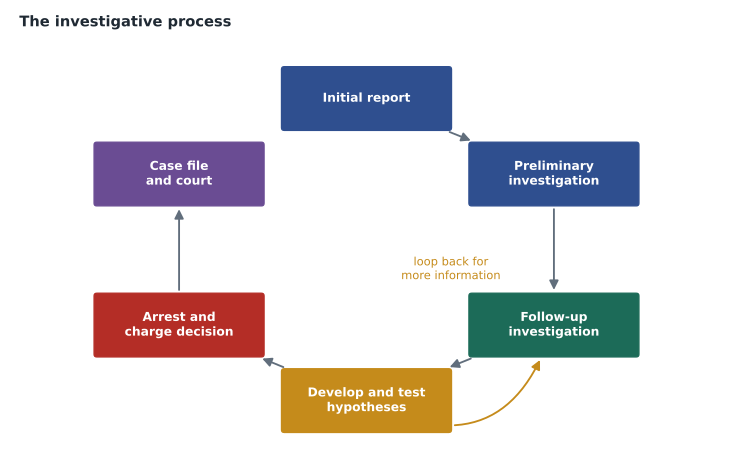
Desjardins stresses that the preliminary investigation is where most cases are won or lost. Studies of how crimes are solved, beginning with the RAND Corporation's study of detectives in the 1970s and repeated in later research, found that the information gathered by the first officers, especially the name or description of a suspect from a victim or witness, was the strongest predictor of whether a case would be cleared. Detectives add value, particularly in serious cases and with forensic and digital evidence, but they cannot recover information that was never collected or was lost at the scene.
Solvability and case screening
Police services receive far more reports than they can investigate fully, so they screen cases for solvability. A solvability factor is a piece of information that makes it more likely that a case can be solved: a named or described suspect, a witness, a vehicle license plate, usable video, physical evidence such as fingerprints or DNA, traceable property, or a distinctive method that links the crime to others. Cases with several factors are assigned for follow-up; cases with none may be filed pending new information, and the victim is told so honestly. Screening is not giving up. It is deciding where limited investigative hours will do the most good, and it is supposed to be reviewed when new information arrives.
Serious crimes against persons, such as robberies, sexual assaults and homicides, are usually investigated regardless of their solvability score, because of the harm involved and the risk that the offender will strike again. The Northgate robbery was assigned to Detective Ana Ferreira of the major crime unit the next morning because a weapon was displayed and because two other stores in the north end had reported similar robberies in the previous month.
# Port Ardent property crime screening: one month of reports
# each case lists which solvability factors were present
cases = {
    "B-101": ["witness", "video"],
    "B-102": [],
    "B-103": ["plate", "video", "property"],
    "B-104": ["witness"],
    "B-105": ["prints"],
    "B-106": [],
    "B-107": ["suspect named", "witness", "property"],
    "B-108": ["video"],
}
threshold = 2
assigned = [c for c, f in cases.items() if len(f) >= threshold]
filed = [c for c, f in cases.items() if len(f) == 0]
review = [c for c, f in cases.items() if 0 < len(f) < threshold]
print("assign for follow-up:", assigned)
print("supervisor review:", review)
print("file pending new information:", filed)assign for follow-up: ['B-101', 'B-103', 'B-107'] supervisor review: ['B-104', 'B-105', 'B-108'] file pending new information: ['B-102', 'B-106']
The code applies a simple rule: two or more factors means follow-up, none means the file is held pending new information, and one factor goes to a supervisor to decide. Real screening models weight the factors, because a named suspect is worth more than a partial description, and they let the supervisor override the score for reasons such as a vulnerable victim or a pattern of offenses. Desjardins warns the class that any scoring system can hide bias: if officers in one neighborhood routinely record fewer factors, that neighborhood's victims will get less investigation. Supervisors should check the outcomes, not just the scores.
Thinking like an investigator: hypotheses
At the heart of investigation is a way of thinking. An investigator gathers information, forms possible explanations of what happened, called hypotheses, and then tests each one against the evidence. A good hypothesis is specific enough to be tested: 'the robber arrived and left by car' can be checked against video and witness accounts in a way that 'someone did it' cannot. The investigator should keep several hypotheses open at once, including the possibility that the obvious explanation is wrong, and should actively look for evidence that would disprove each one. A hypothesis that survives a genuine attempt to disprove it is stronger than one that has only been supported.
In the Northgate case, Ferreira wrote four hypotheses in her notes on the first morning: the robber was the same person responsible for the two earlier north-end robberies; the robber was a local person known to the store; the robbery was a one-off by someone passing through; and the clerk's account was inaccurate in some important way, which she listed not because she doubted Rao but because every account must be tested. For each one she wrote what evidence would support it and what would undermine it. That page, Desjardins says, is one of the most important documents in the file.
Tunnel vision and how investigations go wrong
Studies of wrongful convictions, including the work of the National Registry of Exonerations and research on cases later overturned by DNA evidence, have identified tunnel vision as a leading cause. Researchers describe it as a narrow focus on one suspect that leads investigators to select and interpret evidence in a way that builds a case against that person while ignoring or explaining away evidence that points elsewhere. Tunnel vision is not usually deliberate. It grows out of ordinary features of human thinking, especially confirmation bias, the tendency to seek and favor information that supports what we already believe.
Several pressures make tunnel vision more likely: a serious crime that has frightened the public, a suspect with a criminal record who seems to fit, a confident early identification, and a supervisor or media demand for quick results. Once an investigator has decided who is responsible, an alibi can start to look like a lie, an inconsistent witness can look unreliable only when they help the suspect, and laboratory results that do not match can be explained away. Desjardins tells the class that the cure is not to stop forming opinions but to build habits that test them: write down alternative hypotheses, ask a colleague to argue the other side, record evidence that does not fit as carefully as evidence that does, and treat a lack of corroboration as a warning.
| Habit | What it looks like in practice |
|---|---|
| Keep alternatives open | List at least two other explanations and what would support each |
| Seek disconfirming evidence | Ask what evidence would prove the main theory wrong, and look for it |
| Record everything | Note information that does not fit, with the same care as information that does |
| Use a second set of eyes | Have a supervisor or colleague review the theory and the file |
| Separate fact from inference | Mark what was observed, what was reported and what was concluded |
| Be wary of a single source | Treat an uncorroborated tip or identification as a lead, not proof |
Major case management
Large investigations in the United States have no single national system, but many departments use a structured case management approach built on the same lessons: one lead investigator accountable for the case, a supervisor who reviews progress, a case coordinator or records specialist who manages documents and evidence, and software that tracks every lead and task. Reviews of serial offender cases have repeatedly found that information held by different agencies was never connected. The ideas apply to smaller cases too: someone must own the investigation, every lead must be recorded and tracked to a result, and information must be shared with the people who need it.
In the Northgate case Ferreira was the lead investigator, Sergeant Lisa Haddad reviewed the file at set points, and a civilian case coordinator kept the lead list. Each lead received a number, a person responsible, a due date and a result. By the time the file closed there were 47 leads, from 'canvass the laundromat next door' to 'check online listings for the brand of cigarettes stolen'. Fourteen produced useful information. The rest were closed with a short note on what was done and why it led nowhere. Desjardins says those 33 dead ends matter: they show the court and the defense that alternatives were considered and checked.
Worked problem
Writing hypotheses for a new case
On a Tuesday afternoon, a pharmacy reports that a staff member found the back door forced and a cabinet of prescription medications missing when she opened in the morning. The alarm did not sound. The owner says a former employee was dismissed three weeks ago after an argument. Write three hypotheses and, for each, one piece of evidence that would support it and one that would undermine it.
Show solution
- Hypothesis 1: the former employee committed the break-in. Supporting evidence: knowledge of the alarm code or its weakness, or video of a person matching their build. Undermining evidence: a verified alibi or an alarm log showing a method the employee would not know.
- Hypothesis 2: an unknown offender targeted the pharmacy for drugs, possibly as part of a pattern. Supporting evidence: similar break-ins at other pharmacies with the same method. Undermining evidence: no other incidents and signs the offender knew the layout.
- Hypothesis 3: a current employee staged or assisted the break-in. Supporting evidence: tool marks inconsistent with forced entry, or an alarm disarmed with a valid code. Undermining evidence: clear signs of forced entry and alarm records showing a fault.
- Note why each matters: the dismissal is a lead, not proof, and the alarm failure must be explained whichever hypothesis is right.
- Record all three in the notes before interviewing anyone, so the interviews are planned to test them.
Answer: Three testable hypotheses, each with evidence for and against, recorded before interviews begin.
Common mistakes
MistakeThe investigator's job is to build the case against the suspect.
InsteadThe investigator's job is to find out what happened, which includes clearing people who are not responsible.
MistakeDetectives solve most cases through clever deduction.
InsteadMost cases are solved by information gathered early, especially from victims, witnesses and the first officers.
MistakeOnce a suspect fits, other explanations can be dropped.
InsteadAlternative hypotheses should be kept open and tested until the evidence rules them out.
MistakeDead-end leads do not need to be recorded.
InsteadEvery lead and its result belongs in the file, because it shows alternatives were checked.
Summary and key terms
- An investigation aims to establish what happened, identify and rule out suspects, gather lawful and reliable evidence, recover property and support victims.
- The process runs from initial report and preliminary investigation through follow-up, charge and court, with frequent loops back.
- Solvability factors help services decide where to spend investigative hours; serious crimes against persons are usually investigated regardless.
- Good investigators write testable hypotheses and look for evidence that would disprove them.
- Tunnel vision, driven by confirmation bias and pressure, is a leading cause of wrongful convictions.
- Structured case management assigns ownership, tracks every lead and shares information.
- Preliminary investigation
- The work of the first officers at the scene: preserving life, securing the scene, identifying witnesses and recording observations.
- Follow-up investigation
- Further work after the initial response to gather evidence, interview people and test explanations.
- Solvability factor
- Information that makes it more likely a case can be solved, such as a witness, video or physical evidence.
- Hypothesis
- A specific, testable explanation of what happened.
- Confirmation bias
- The tendency to seek and favor information that supports an existing belief.
- Tunnel vision
- A narrow focus on one theory or suspect that distorts how evidence is gathered and assessed.
Practice problems
Work each problem on paper first, then reveal the answer to check.
Name three solvability factors.
Show answer
Any three of: a named or described suspect, a witness, a license plate, usable video, physical evidence, traceable property, a distinctive method.
In the code example, which cases go to supervisor review?
Show answer
B-101 has two factors, so it is assigned; B-104, B-105 and B-108 have one factor each and go to review.
Why did Ferreira include the hypothesis that the clerk's account was inaccurate?
Show answer
Every account must be tested, and listing it guards against relying on any single source without checking.
What is the main cure for tunnel vision?
Show answer
Habits that test the main theory: alternative hypotheses, seeking disconfirming evidence, recording what does not fit and independent review.
Lesson quiz · 5 questions
Score 60% or more to complete this lesson.
Create a free account to save your progress, take quizzes and earn a certificate.